Page 121 of 371
If the Light Is On Steady
You may be able to correct the emission system
malfunction by considering the following:
Did you recently put fuel into your vehicle?
If so, reinstall the fuel cap, making sure to fully install
the cap. The diagnostic system can determine
if the fuel
cap has been left off or improperly installed.
A loose or
missing fuel cap will allow fuel to evaporate into the
atmosphere.
A few driving trips with the cap properly
installed should turn the light off.
Did you just drive through a deep puddle of water?
If
so, your electrical system may be wet. The condition
will usually be corrected when the electrical system
dries out.
A few driving trips should turn the light off. Have
you recently changed brands of fuel?
If
so, be sure to fuel your vehicle with quality fuel (see
“Fuel” in the Index). Poor fuel quality will cause your
engine not to run as efficiently as designed. You may
notice this as stalling after start-up, stalling when you
put the vehicle into gear, misfiring, hesitation on
acceleration or stumbling on acceleration. (These
conditions may go away once the engine is warmed up.)
This will be detected by the system and cause the light
to
turn on.
If you experience one or more of these conditions,
change the fuel brand you use. It will require at least one
full tank of the proper fuel to turn the light off.
If none of the above steps have made the light turn off,
have your dealer or qualified service center check the
vehicle. Your dealer has the proper test equipment and
diagnostic tools to fix any mechanical or electrical
problems that may have developed.
2-66
Page 124 of 371
Up Shift Light (Manual Transaxle)
SHIFT
Fuel Gage
W
This light comes on when
you need to shift to the next
higher gear. See “Manual
Transaxle” in the Index.
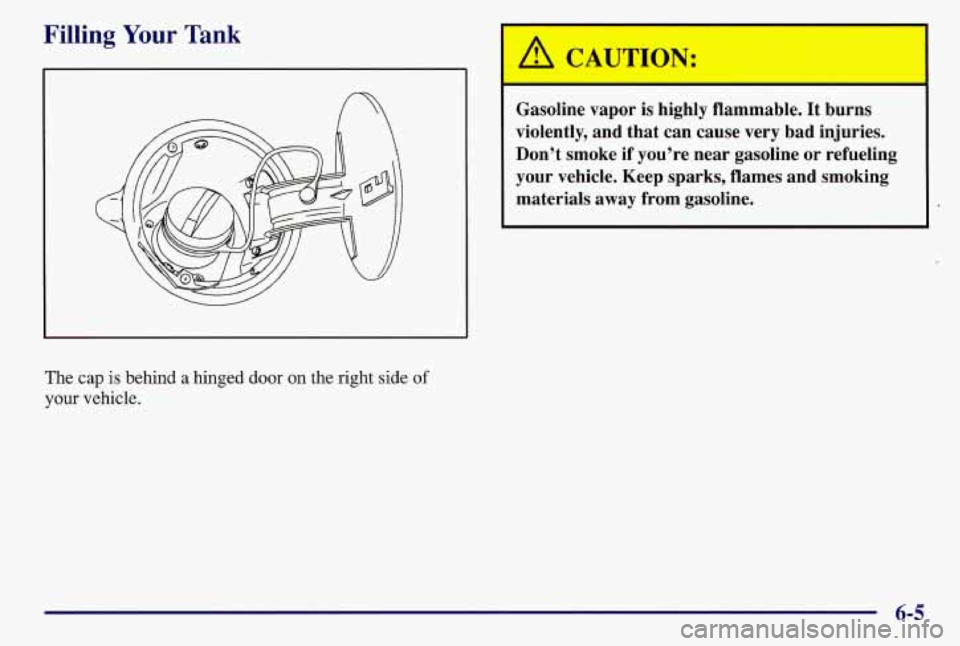
Your fuel gage tells
you
about how much fuel you
have left, when the ignition
is
on. When the indicator nears
EMPTY (E), you still have a
little fuel left, but you should get more soon.
An amber
light
will come on below the
gage when the fuel
tank is
near EMPTY (E).
Here are four things that some owners ask about. None
of these show a problem with your fuel gage:
0
0
0
At the service station, the gas pump shuts off before
the gage reads
FULL (F).
It takes a little more or less fuel to fill up than the
gage indicated. For example, the gage may have
indicated the tank was half full, but
it actually took a
little more or less than half the tank’s capacity to fill
the tank.
The gage moves a little when you turn a corner or
speed up.
The gage doesn’t go back to EMPTY
(E) when you
turn
off the ignition.
Page 130 of 371
Air Conditioning Heating
Turning
the right control knob to HEATER and the
center control knob clockwise sends some heated air
through the heater ducts toward your feet, and some
through the defroster vents.
On very
hot days, open the windows long enough to let
hot, inside air escape. This reduces the time
it takes for
your vehicle to cool down, which should help fuel
economy.
For quick cool-down on very hot days, use MAX with
the temperature knob all the way in the blue area.
If the
setting is used for long periods of time, the air in your
vehicle may become too dry.
For normal cooling on hot days, use
NC with the
temperature knob in the blue area. The system will bring
in outside air and cool it.
On cool but sunny days, the sun may warm your upper
body, but your lower body may not be warm enough. You
can use
BI-LEVEL with the temperature knob in the
middle. The system will bring in outside air and direct
it
to your upper body, while sending slightly warmed air to
your lower body. You may notice this temperature
difference more at some times than at others. VENT
and HEATER are economical positions because
the air conditioner compressor doesn’t run in these
two settings. This reduces engine load, resulting in
improved fuel economy.
If either setting fails to keep
you comfortable, or causes your windows to fog up, turn
the right control knob to one of the air conditioning
positions, or to DEFROST.
If you have the optional engine coolant heater
(engine block heater) and use
it during cold weather,
0 “F (- 18 O C) or lower, your heating system will more
quickly provide heat because the engine coolant is
already warmed. See “Engine Coolant Heater” in
the Index.
3-5
Page 184 of 371
Loading Your Vehicle
TIRE-LOADING INFORMATION VEHICLE CAP. WT.
FRT, CTR.
RR. TOTAL LBS.
MAX. LOADING & GVWR SAME AS VEHICLE
CAPACITY WEIGHT
XXX COLD TIRE
TIRE SIZE SPEED PRESSURE
RTG PSliKPa
FRT.
RR.
SPA. IF TIRES ARE
HOT, ADD 4PS1/28KPa
SEE OWNER‘S MANUAL FOR ADDITIONAL
INFORMATION
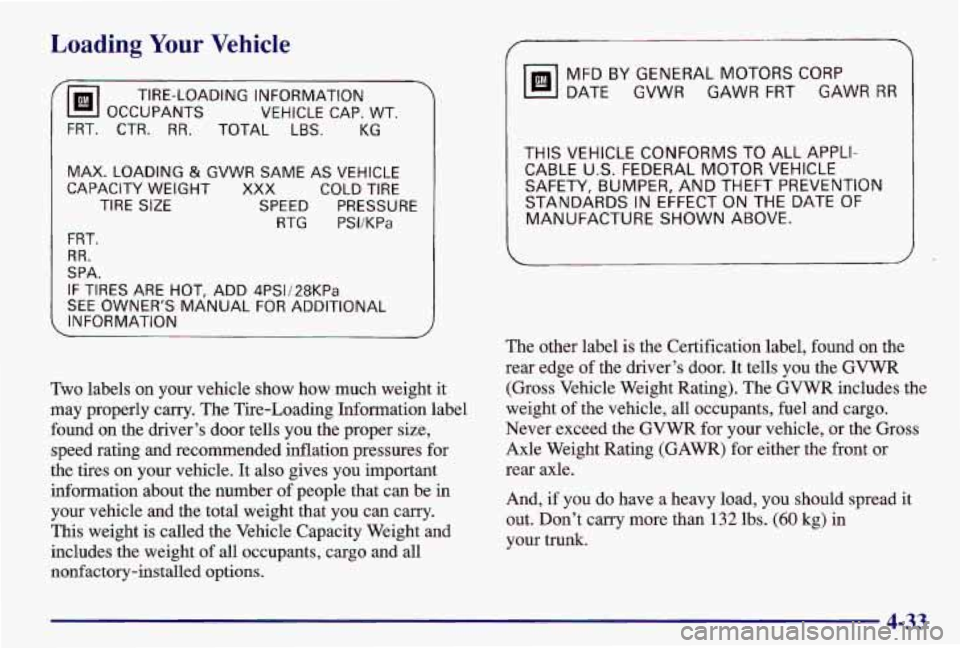
Two labels on your vehicle show how much weight it
may properly carry. The Tire-Loading Information label
found on the driver’s door tells you the proper size,
speed rating and recommended inflation pressures for
the tires on your vehicle. It also gives you important
information about the number
of people that can be in
your vehicle and the total weight that you can carry.
This weight is called the Vehicle Capacity Weight and
includes the weight of all occupants, cargo and all
nonfactory-installed options.
f
MFD BY GENERAL MOTORS CORP
DATE GVWR
GAWR FRT GAWR RR
THIS VEHICLE CONFORMS TO ALL APPLI-
CABLE U.S. FEDERAL MOTOR VEHICLE
SAFETY, BUMPER, AND THEFT PREVENTION
STANDARDS
IN EFFECT ON THE DATE OF
MANUFACTURE SHOWN ABOVE.
The other label is the Certification label, found on the
rear edge of the driver’s door. It tells
you the GVWR
(Gross Vehicle Weight Rating). The GVWR includes the
weight of the vehicle, all occupants, fuel and cargo.
Never exceed the GVWR for your vehicle,
or the Gross
Axle Weight Rating (GAWR) for either the front or
rear axle.
And,
if you do have a heavy load, you should spread it
out. Don’t carry more than
132 lbs. (60 kg) in
your
trunk.
4-33
Page 186 of 371
Towing a Trailer
If you don’t use the correct equipment and drive
properly, you can lose control when you pull
a
trailer. For example, if the trailer is too heavy, the
brakes may not work well
-- or even at all. You
and your passengers could be seriously injured.
Pull
a trailer only if you have followed all the
steps in this section. Ask your Pontiac dealer for
advice and information about towing
a trailer
with your vehicle.
NOTICE:
Pulling a trailer improperly can damage your
vehicle and result in costly repairs not covered by
your warranty.
To pull a trailer correctly, follow
the advice in
this part, and see your Pontiac
dealer for important information about towing
a
trailer with your vehicle.
Do not tow a trailer if your vehicle is equipped with a
2.4L (Code T) engine.
Your vehicle can tow a trailer if
it is equipped with a
3 100 (Code M) engine and proper trailer towing
equipment.
To identify what the vehicle trailering
capacity
is for your vehicle, you should read the
information in “Weight
of the Trailer’’ that appears later
in this section. But trailering is different than just
driving your vehicle
by itself. Trailering means changes
in handling, durability and fuel economy. Successful,
safe trailering takes correct equipment, and it has to be
used properly.
4-35
Page 228 of 371

Section 6 Service and Appearance Care
Here you will find information about the care of your Pontiac. This section begins with service and fuel information,
and then it shows how to check important fluid and lubricant levels. There is also technical information about your
vehicle, and a part devoted to its appearance care.
6-2
6-3
6-4
6-5
6-8
6- 12
6-18
6- 19
6-2 1
6-23
6-24
6-28
6-28
6-28
6-29
6-30
6-34 Service
Fuel
Fuels in Foreign Countries
Filling Your Tank
Checking Things Under the Hood
Engine Oil
Air Cleaner
Automatic Transaxle Fluid
Manual Transaxle Fluid
Hydraulic Clutch
Engine Coolant
Surge Tank Pressure Cap
Thermostat
Power Steering Fluid
Windshield Washer Fluid
Brakes
Battery Bulb
Replacement
Halogen Bulbs
Appearance Care
Cleaning the Inside of Your Pontiac
Cleaning the Outside of Your Pontiac
Aluminum Wheels
(If Equipped)
Cleaning Tires
Sheet Metal Damage
Finish Damage
Appearance Care Materials Chart
Vehicle Identification Number (VIN)
Electrical System
Replacement Bulbs
Capacities and Specifications
Air Conditioning Refrigerants
Normal Maintenance Replacement Parts
Dimensions
6-35
6-35
6-49
6-50
6-54 6-55
6-55
6-55
6-56
6-57
6-5
8
6-5 8
6-63
6-64
6-65
6-65
6-65
6-1
Page 232 of 371
Filling Your Tank
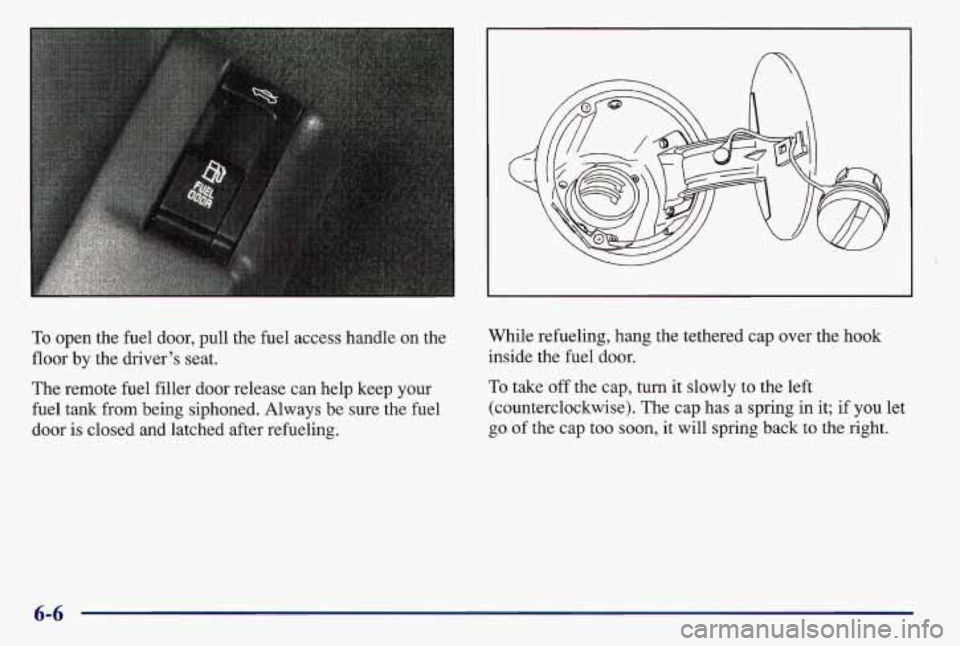
The cap is behind a hinged door on the right side of
your vehicle.
6h, CAUTION:
Gasoline vapor is highly flammable. It burns
violently, and that can cause very bad injuries.
Don’t smoke if you’re near gasoline or refueling
your vehicle. Keep sparks, flames and smoking
materials away from gasoline.
6-5
Page 233 of 371
A
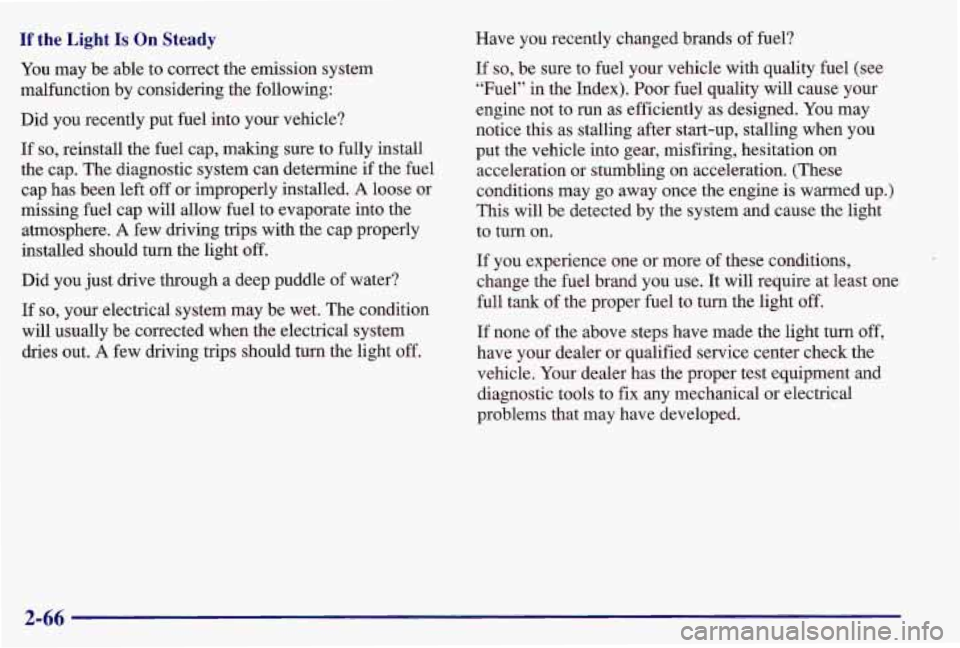
To open the fuel door, pull the fuel access handle on the
floor by the driver’s seat.
The remote fuel filler door release can help keep your
fuel
tank from being siphoned. Always be sure the fuel
door is closed and latched after refueling. While refueling, hang the tethered cap over
the hook
inside the fuel door.
To take off the cap, turn it slowly to the left
(counterclockwise). The cap has a spring in it; if you let
go of the cap too soon, it will spring back to the right.