1997 PONTIAC GRAND AM service
[x] Cancel search: servicePage 78 of 371

AUTOMATIC OVERDRIVE (D): This position is for
normal driving with the four-speed automatic transaxle.
If you need more power for passing, and you’re:
0 Going less than about 35 mph (55 km/h), push your
Going about 35 mph (55 km/h) or more, push the
The transaxle will automatically shift down
to the next
gear
and provide more power.
accelerator pedal about halfway down.
accelerator all
the way down. THIRD
(3): This position
is also used for normal
driving, however, it offers more power and lower fuel
economy than AUTOMATIC OVERDRIVE (D). Here are some times you might choose THIRD
(3) instead of
AUTOMATIC OVERDRIVE (D):
0 When driving on hilly, winding roads.
When towing a trailer, so there is less shifting
When going down a steep hill.
between gears.
I NOTICE:
This NOTICE applies
only if you have an
automatic overdrive transaxle.
If your vehicle is
so equipped and if it seems to start up rather
slowly, or if it seems not to shift gears
as you go
faster, something may be wrong with a transaxle
system sensor.
If you drive very far that way,
your vehicle can be damaged.
So, if this happens,
have your vehicle serviced right away. Until then,
you can use SECOND
(2) when you are driving
less than
35 mph (56 km/h) and AUTOMATIC
OVERDRIVE
(@) for higher speeds.
2-23
Page 91 of 371

Turn and Lane Change Signals
The turn signal has two upward (for right) and two
downward (for left) positions. These positions allow you
to signal a turn or a lane change.
To signal a turn, move the lever all the way up or down.
When the turn is finished, the lever will return
automatically.
An arrow on the instrument
panel will flash in the
direction of the turn or
lane change.
To signal a lane change, just raise or lower the lever
until the arrow starts to flash. Hold it there until you
complete your lane change. The lever will return by
itself when you release it.
A warning chime signal will come on
if you have left
your turn signal on for more than
3/4 mile (1 km).
As you signal a turn or a lane change, if the arrows flash
rapidly, a signal bulb may be burned out and other
drivers won’t see your turn signal.
If a bulb is burned out, replace it to help avoid an
accident. If the arrows don’t go on at all when you
signal a turn, check the fuse (see “Fuses and Circuit
Breakers” in the Index). If the arrows still do not flash,
have your Pontiac Dealer service department check the
bulb in the instrument panel.
Headlamp High/Low Beam
To change the headlamps
from low beam to high or
high to low, pull the turn
signal lever all the way
toward you. Then release it.
When the high beams are
on, a light on the instrument
panel
also will be on.
The headlamp high/low beam indicator may flash
if the
Daytime Running Lamps (DRL) system is experiencing
a problem
or if a headlamp is malfunctioning.
2-36
Page 114 of 371

Safety Belt Reminder Light
When the key is turned to RUN or START, a chime will
come on for about eight seconds to remind people to
fasten their safety belts, unless the driver’s safety belt is
already buckled,
The safety belt light will also come on and stay
on for about
20 seconds,
then it will flash for about
55 seconds. If the driver’s
belt is already buckled,
neither the chime nor the
light will come on.
Air Bag Readiness Light
There is an air bag readiness light on the instrument
panel, which shows AIR BAG. The system checks the
air bag’s electrical system for malfunctions. The light
tells you
if there is an electrical problem. The system
check includes the air bag sensor, the air bag modules,
the wiring and the crash sensing and diagnostic module.
For more information on the air bag system, see “Air
Bag”
in the Index.
AIR
BAG
This light will come on
when you start your engine,
and it will flash for a few
seconds. Then the light
should go out. This means
the system is ready.
If the air bag readiness light stays on after you start the -
engine or comes on when you are driving, your air bag
system may not work properly. Have your vehicle
serviced right away.
The
air bag readiness light should flash for a few
seconds when you turn the ignition key to RUN.
If the
light doesn’t come on then, have it fixed
so it will be
ready to warn you
if there is a problem.
2-59
Page 116 of 371
If the light comes on while you are driving, pull off the
road and stop carefully. You may notice that the pedal is
harder to push. Or, the pedal may go closer to the floor.
It may take longer to stop.
If the light is still on, have the
vehicle towed for service. (See “Towing Your Vehicle”
in the Index.)
A CAUTION:
Your brake system may not be working properly
if the brake system warning light is
on. Driving
with the brake system warning light on can lead
to an accident. If the light is still on after you’ve
pulled off the road and stopped carefully, have
the vehicle towed for service.
When the ignition is on, the brake system warning light
will also come on when you set your parking brake. The
light will stay on
if your parking brake doesn’t release
fully. If it stays on after your parking brake is fully
released, it means you have a brake problem.
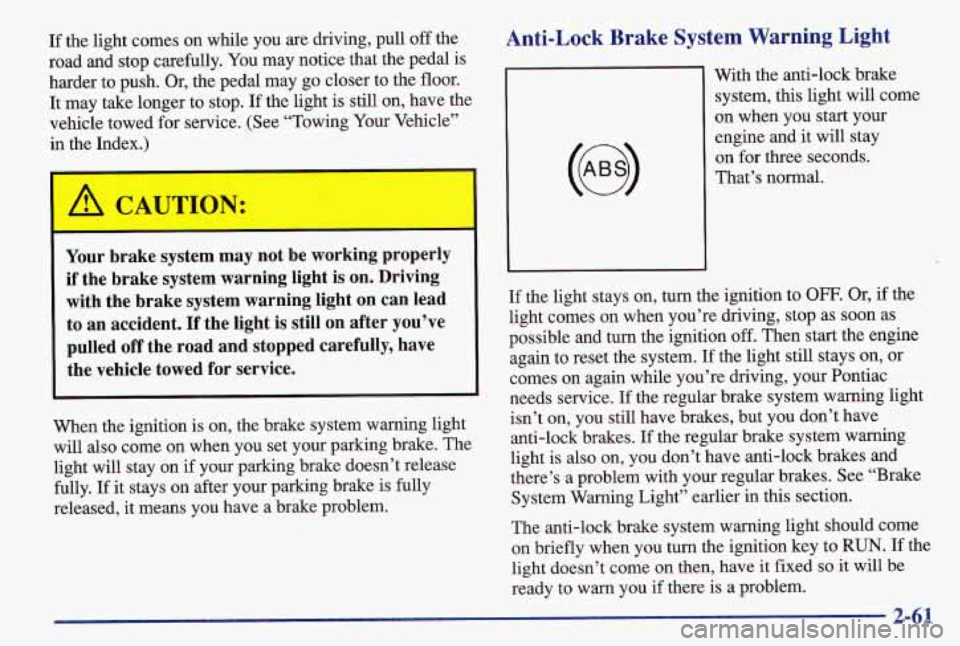
Anti-Lock Brake System Warning Light
With the anti-lock brake
system, this light will come
on when you start your
engine and it will stay
on for three seconds.
That’s normal.
If the light stays on, turn the ignition to OFF. Or, if the
light comes on when you’re driving, stop as soon as
possible and turn the ignition off. Then start the engine
again to reset the system. If the light still stays on, or
comes on again while you’re driving, your Pontiac
needs service.
If the regular brake system warning light
isn’t on, you still have brakes, but you don’t have
anti-lock brakes.
If the regular brake system warning
light is also on, you don’t have anti-lock brakes and
there’s a problem with your regular brakes. See “Brake
System Warning Light” earlier in this section.
The anti-lock brake system warning light should come on briefly when you turn the ignition key to
RUN. If the
light doesn’t come on then, have
it fixed so it will be
ready to warn you
if there is a problem.
2-61
Page 117 of 371
Enhanced Traction System Warning Light
(If Equipped)
ETS
OFF
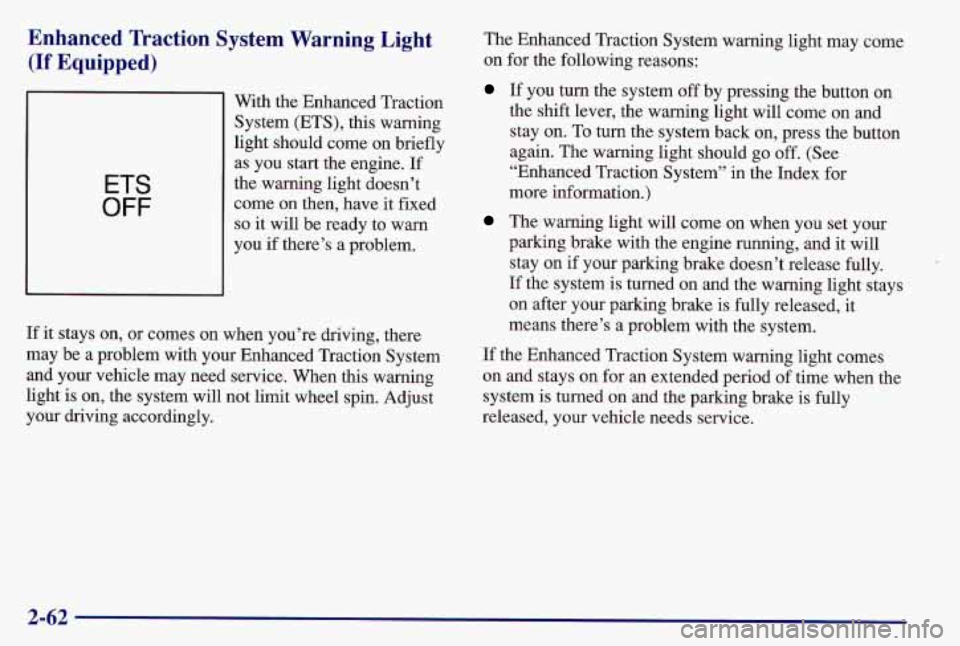
With the Enhanced Traction
System (ETS), this warning
light should come on briefly as you start the engine. If
the warning light doesn’t come on then, have
it fixed
so it will be ready to warn
you if there’s a problem.
If it stays on, or comes on when you’re driving, there
may be a problem with your Enhanced Traction System
and your vehicle may need service. When this warning
light is on, the system will not limit wheel spin. Adjust
your driving accordingly. The Enhanced
Traction System warning light may come
on for the following reasons:
If you turn the system off by pressing the button on
the shift lever, the warning light will come on and
stay on.
To turn the system back on, press the button
again. The warning light should go
off. (See
“Enhanced Traction System” in the Index for
more information.)
The warning light will come on when you set your
parking brake with the engine running, and
it will
stay on if your parking brake doesn’t release fully.
If the system is turned on and the warning light stays
on after your parking brake is fully released,
it
means there’s a problem with the system.
If the Enhanced Traction System warning light comes
on and stays on for an extended period of time when the
system is turned on and the parking brake is fully
released, your vehicle needs service.
2-62
Page 119 of 371

Low Coolant Warning Light
If this light comes on and
stays on, the vehicle should
be promptly pulled off the
road and the coolant level
checked. See “Engine
Coolant” in the Index.
If there are visible signs of steam see “Engine
Overheating” in the Index before opening the hood.
Malfunction Indicator Lamp
(Check Engine Light)
Your Pontiac is equipped
with a computer which
monitors operation
of the
fuel, ignition and emission
CHECK
ENGINE
This system is called OBD I1 (On-Board
Diagnostics-Second Generation) and is intended to
assure that emissions are at acceptable levels for the life
of the vehicle, helping to produce a cleaner
environment. (In Canada, OBD
I1 is replaced by
Enhanced Diagnostics.) The CHECK
ENGINE light
comes on
to indicate that there is a problem and service
is required. Malfunctions often will be indicated by the
system before any problem is apparent. This may
prevent more serious damage to your vehicle.
This
system is also designed to assist your service technician
in correctly diagnosing
any malfunction.
2-64
Page 120 of 371

NOTICE:
If you keep driving your vehicle with this light
on, after a while, your emission controls may not
work as well, your fuel economy may not be as
good and your engine may not run as smoothly.
This could lead
to costly repairs that may not be
covered by your warranty.
This light should come on, as a check to show you it is
working, when the ignition is on and the engine is not
running. If the light doesn’t come on, have it repaired.
This light will also come on during a malfunction in one
of
two ways:
0 Light Flashing -- A misfire condition has been
detected. A misfire increases vehicle emissions and
may damage the emission control system on your
vehicle. Dealer or qualified service center diagnosis
and service is required.
Light On Steady -- An emission control system
malfunction has been detected on your vehicle.
Dealer or qualified service center diagnosis and
service may be required.
If the Light Is Flashing
The following may prevent more serious damage to
your vehicle:
0 Reducing vehicle speed.
0 Avoiding hard accelerations.
0 Avoiding steep uphill grades.
0 If you are towing a trailer, reduce the amount of
cargo being hauled as soon as it is possible.
If the light stops flashing and remains on steady, see “If
the Light
Is On Steady” following.
If the light continues to flash, when it is safe to do
so,
stop the vehicle. Find a safe place to park your vehicle.
Turn the key off, wait at least 10 seconds and restart the
engine.
If the light remains on steady, see “If the Light
Is On Steady” following. If the light is still flashing,
follow the previous steps, and drive the vehicle to your
dealer or qualified service center for service.
2-65
Page 121 of 371
If the Light Is On Steady
You may be able to correct the emission system
malfunction by considering the following:
Did you recently put fuel into your vehicle?
If so, reinstall the fuel cap, making sure to fully install
the cap. The diagnostic system can determine
if the fuel
cap has been left off or improperly installed.
A loose or
missing fuel cap will allow fuel to evaporate into the
atmosphere.
A few driving trips with the cap properly
installed should turn the light off.
Did you just drive through a deep puddle of water?
If
so, your electrical system may be wet. The condition
will usually be corrected when the electrical system
dries out.
A few driving trips should turn the light off. Have
you recently changed brands of fuel?
If
so, be sure to fuel your vehicle with quality fuel (see
“Fuel” in the Index). Poor fuel quality will cause your
engine not to run as efficiently as designed. You may
notice this as stalling after start-up, stalling when you
put the vehicle into gear, misfiring, hesitation on
acceleration or stumbling on acceleration. (These
conditions may go away once the engine is warmed up.)
This will be detected by the system and cause the light
to
turn on.
If you experience one or more of these conditions,
change the fuel brand you use. It will require at least one
full tank of the proper fuel to turn the light off.
If none of the above steps have made the light turn off,
have your dealer or qualified service center check the
vehicle. Your dealer has the proper test equipment and
diagnostic tools to fix any mechanical or electrical
problems that may have developed.
2-66