Page 296 of 405
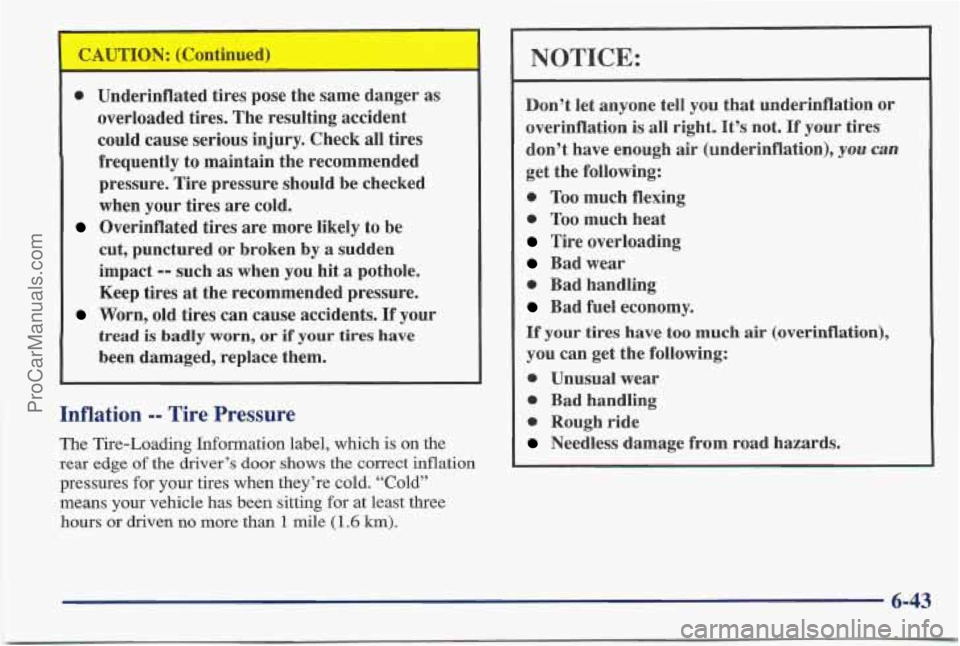
0 Underinflated tires pose the same danger as overloaded tires. The resulting accident
could cause serious injury. Check all tires
frequently to maintain the recommended
pressure. Tire pressure should be checked
when your tires are cold.
cut, punctured
or broken by a sudden
impact
-- such as when you hit a pothole.
Keep tires at the recommended pressure.
Worn, old tires can cause accidents. If your
tread
is badly worn, or if your tires have
been damaged, replace them.
Overinflated tires are more likely to be
Inflation -- Tire Pressure
The Tire-Loading Information label, which is on the
rear edge
of the driver’s door shows the correct inflation
pressures for your tires when they’re cold. “Cold”
means your vehicle has been sitting for at least three
hours or driven no more than 1 mile (1.6 km).
NOTICE:
Don’t let anyone tell you that underinflation or
overinflation is all right. It’s not. If your tires
don’t have enough air (underinflation),
you can
get the following:
0 Too much flexing
0 Too much heat
Tire overloading
Bad wear
0 Bad handling
Bad fuel economy.
If your tires have too much air (overinflation),
you can get the following:
e Unusual wear
0 Bad handling
0 Rough ride
Needless damage from road hazards.
~ ~~
~~ ~ ~ __ ~ -~
6-43
ProCarManuals.com
Page 297 of 405
When to Check
Check your tires once a month or more.
Don’t forget your compact spare tire. It should be at
60 psi (420 kPa).
How to Check
Use a good quality pocket-type gage to check tire
pressure.
You can’t tell if your tires are properly inflated
simply by looking at them. Radial tires may look
properly inflated even
when they’re underinflated.
Be sure to put
the valve caps back on the valve stems.
They help prevent leaks by keeping out
dirt and moisture.
Tire Inspection and Rotation
Tires should be rotated every 6,080 to 8,000 miles
(10 000 to 13 000 h). Any time you notice unusual
wear, rotate your tires as soon as possible and check
wheel alignment. Also check for damaged tires or
wheels. See “When It’s Time for New Tires’’
and
“Wheel Replacement” later in this section for
more information.
The purpose
of regular rotation is to achieve more
unifQm
wear .- - for .. dl tires ., on . h .. vehicle. . The first rotation
is the most important. See “Scheduled
Maintenance Services” in the Index for scheduled
rotation intervals.
m I
n
7
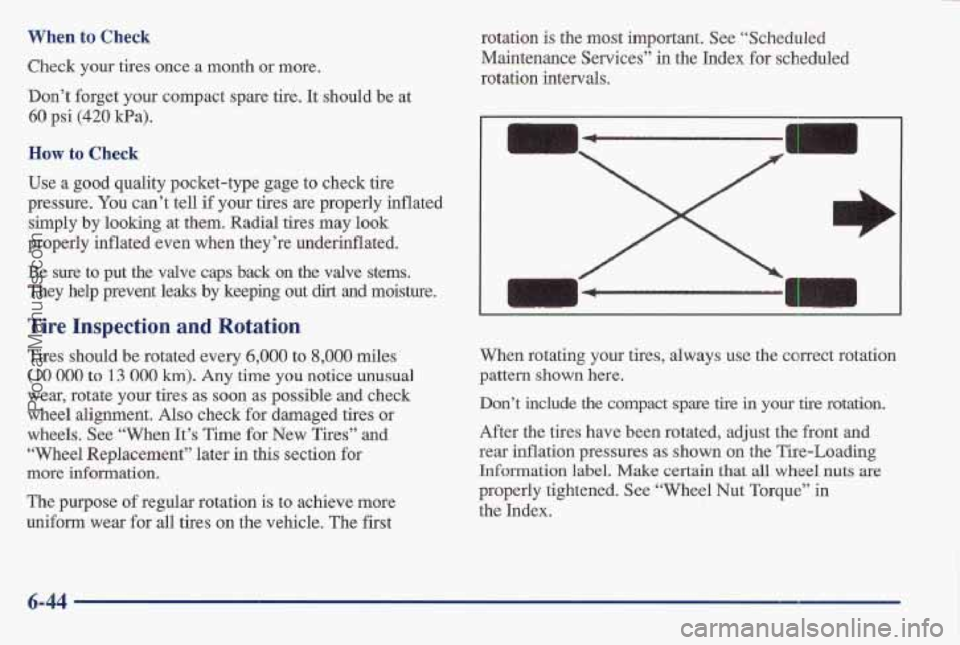
When rotating your tires, always use the correct rotation
pattern shown here.
Don’t include the compact spare tire in your tire rotation.
After the tires have been rotated, adjust the front and
rear inflation pressures
as shown on the Tire-Loading
Information label.
Make certain that all wheel nuts are
properly tightened. See “Wheel Nut Torque” in
the Index.
4-44
ProCarManuals.com
Page 304 of 405
Cleaning the Inside of Your Pontiac
Use a vacuum cleaner often to get rid of dust and loose
dirt. Wipe vinyl or leather with a clean, damp cloth.
Your Pontiac dealer has two cleaners, a solvent-type
spot lifter and a foam-type powdered cleaner. They will clean normal spots and stains very well.
Do not use
them on vinyl
or leather.
Here are some cleaning tips:
1. Always read the instructions on the cleaner label.
2. Clean up stains as soon as you can -- before they set.
3. Use a clean cloth or sponge, and change to a clean area
often.
A soft brush may be used if stains are stubborn.
4. Use solvent-type cleaners in a well-ventilated area
5. If a ring forms after spot cleaning, clean the entire
only. If you
use them, don’t saturate the stained area.
area immediately or
it will set.
Using Foam-Type Cleaner on Fabric
1. Vacuum and brush the area to remove any loose dirt.
2. Always clean a whole trim panel or section. Mask
3. Mix Multi-Purpose Powdered Cleaner following the
surrounding trim along
stitch or welt lines.
directions
on the container label.
4.
5.
6.
7.
8.
9.
Use suds only and apply with a clean sponge. Don’t
saturate the material and don’t rub it roughly.
As soon as you’ve cleaned the section, use a sponge
to remove the suds.
Rinse the section with a clean, wet sponge.
Wipe off what’s left with a slightly damp paper towel
or cloth.
Dry it immediately with a blow dryer.
Wipe with a clean cloth.
Using Solvent-Type Cleaner on Fabric
First, see if you have to use solvent-type cleaner at all.
Some spots and stains will clean off better with just
water
and mild soap.
If you need to use a solvent:
1.
2.
3.
4.
Gently scrape excess soil from the trim material with
a clean, dull knife or scraper.
Use very little cleaner, light pressure and clean cloths
(preferably cheesecloth). Cleaning should start at the
outside of the stain, “feathering” toward the center.
Keep changing to a clean section
of the cloth.
When you clean a stain from fabric, immediately
dry the
area with a blow dryer to help prevent a cleaning ring.
6-51
ProCarManuals.com
Page 319 of 405
Capacities and Spc Ltions
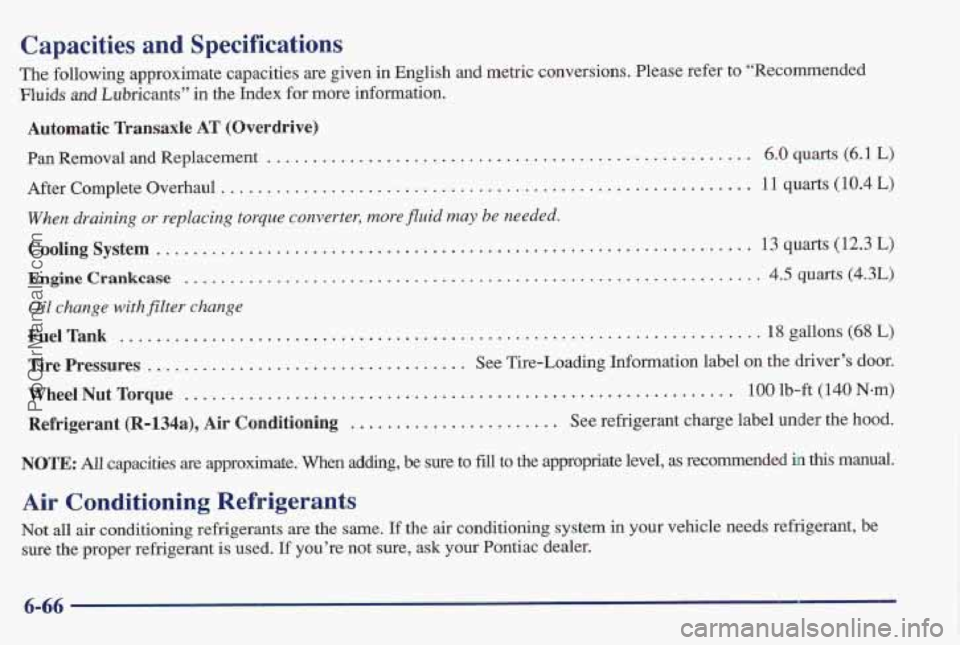
The following approximate capacities are given in English and metric conversions. Please refer to “Recommended
Fluids and Lubricants’’ in the Index for more information.
Automatic Transaxle AT (Overdrive)
Pan Removal and Replacement ......... ........................................ 6.0 quarts (6.1 L)
After Complete Overhaul .......................................................... 11 quarts (10.4 L)
Cooling System ................................................................. 13 quarts (12.3 L)
Engine Crankcase ............................................................... 4.5 quarts (4.3L)
When draining or replacing torque conver,ter, more fluid may be needed.
.......
Oil change with filter change
FuelTank ........................... ................................ 18 gallons (68 L)
Tire Pressures ................................... See Tire-Loading Information label on the driver’s door.
Refrigerant (R=134a), Air Conditioning ....................... See refrigerant charge label under the hood.
WheelNutTorque ............................................................ 100 lb-ft (140 N-m)
NOTE: All capacities are approximate. When adding, be sure to fill to the appropriate level, as recommended in this manual.
Air Conditioning Refrigerants
Not all air conditioning refrigerants are the same. If the air conditioning system in your vehicle needs refrigerant, be
sure the proper refrigerant is used.
If you’re not sure, ask your Pontiac dealer.
6-66
ProCarManuals.com