Page 161 of 353

Driving in Rain and on Wet Roads Rain and wet roads can mean driving trouble. On a wet
road, you can’t stop, accelerate or
turn as well because
your tire-to-road traction isn’t as good as on
dry roads.
And,
if your tires don’t have much tread left, you’ll get
even less traction. It’s always wise to go slower and be
cautious
if rain starts to fall while you are driving. The
surface may get wet suddenly when your reflexes are
tuned for driving on dry pavement.
The heavier the rain, the harder it is to see. Even
if your
windshield wiper blades are in good shape, a heavy rain
can make it harder to see road signs and traffic signals,
pavement markings, the edge of the road and even
people walking.
It’s wise to keep your windshield wiping equipment in
good shape and keep your windshield washer tank filled
with washer fluid. Replace your windshield wiper
inserts when they show
signs of streaking or missing
areas on the windshield, or when strips of rubber start to
separate from the inserts.
ProCarManuals.com
Page 164 of 353
City Driving
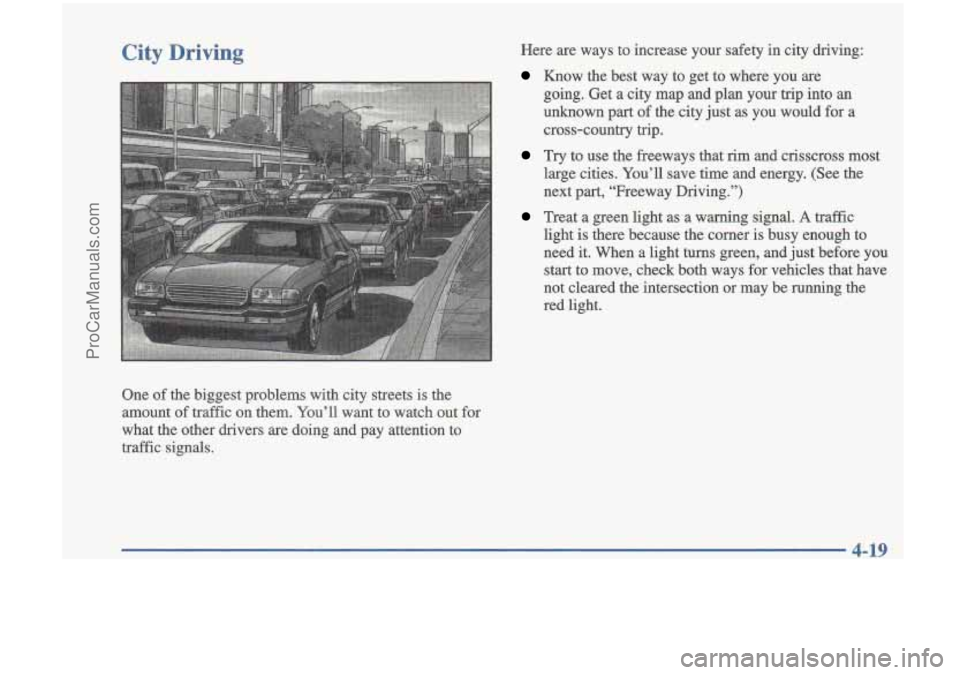
One of the biggest problems with city streets is the
amount
of traffic on them. You'll want to watch out for
what the other drivers are doing and pay attention to traffic signals. Here are ways to increase your safety in city driving:
Know the best way to get to where you are
going. Get a city map and plan your
trip into an
unknown part
of the city just as you would for a
cross-country trip.
Try to use the freeways that rim and crisscross most
large cities. You'll save time and energy. (See the
next
part, "Freeway Driving.")
Treat a green light as a warning signal. A traffic
light is there because the corner
is busy enough to
need it. When a light turns green, and just before you
start to move, check both ways
for vehicles that have
not cleared the intersection or may be running the
red light.
4-19
ProCarManuals.com
Page 182 of 353
Following Distance Making Turns
Stay at
least twice as far behind the vehicle ahead as you
would when driving your vehicle without a trailer. This can help you avoid situations that require heavy braking
and sudden turns.
Passing
You’ll need more passing distance up ahead when
you’re towing a trailer. And, because you’re
a good deal
longer, you’ll need to go much farther beyond the
passed vehicle before you can return to your lane.
Backing Up
Hold the bottom of the steering wheel with one hand.
Then, to move the trailer to the left, just move that hand
to the left.
To move the trailer to the right, move your
hand to the right. Always back up slowly and, if
possible, have someone guide you.
NOTICE:
Making very sharp turns while trailering could
cause the trailer
to come in contact with the
vehicle. Your vehicle could be damaged. Avoid
making very sharp turns while trailering.
When you’re turning with a trailer, make wider turns
than normal. Do this so your trailer won’t strike soft
shoulders, curbs, road signs, trees or other objects.
Avoid jerky or sudden maneuvers. Signal well
in advance.
4-37
ProCarManuals.com
Page 183 of 353

Turn Signals When Towing a Trailer
When you tow a trailer, your vehicle may need a
different turn signal flasher and/or extra wiring. Check
with your Oldsmobile retailer. The green arrows on your
instrument panel will flash whenever you signal a
turn
or lane change. Properly hooked up, the trailer lamps
will
also flash, telling other drivers you’re about to turn,
change lanes or stop.
When towing a trailer, the green arrows on your
instrument panel will flash
for turns even if the bulbs on
the trailer are burned out. Thus, you may
think drivers
behind you
are seeing your signal when they are not. It’s
important to check occasionally to be sure the
trailer
bulbs are still working.
Driving On Grades
I NOTICE:
Do not tow on steep continuous grades exceeding
6 miles (9.6 km). Extended, higher than normal
engine and transaxle temperatures may result
and damage your vehicle. Frequent stops are
very important to allow the engine and transaxle
to cool.
Reduce speed and shift to a lower gear before you start
down a long or steep downgrade. If you don’t shift
down, you might have to use your brakes
so much that
they would get hot and no longer work well.
On a long uphill grade, shift down and reduce your speed to around
45 mph (70 kmk) to reduce the
possibility
of engine and transaxle overheating.
Pay attention to the engine coolant gage.
If the indicator
is in the red area,
turn off the air conditioning (if you
have
this option) to reduce engine load (see “Engine
Overheating” in the Index).
4-38
ProCarManuals.com
Page 189 of 353
Hazard Warning Flashers
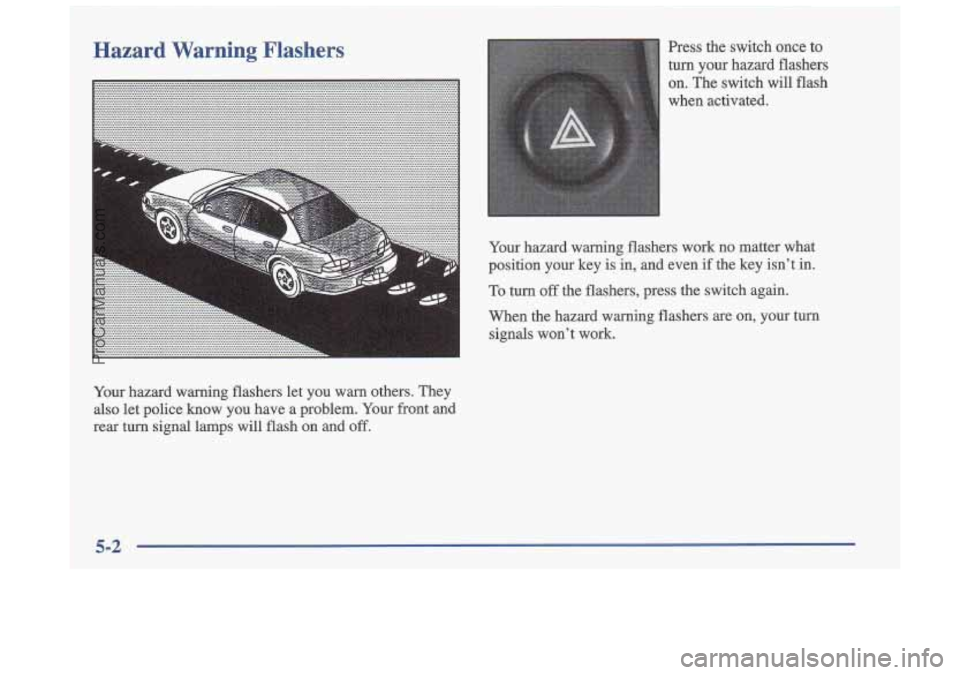
Your hazard warning flashers let you warn others. They
also let police know you have a problem. Your front and
rear turn signal lamps will flash on and
off.
Press the switch once to
turn your hazard flashers
on. The switch will flash
when activated.
Your hazard warning flashers work no matter what
position your key is in, and even
if the key isn’t in.
To turn
off the flashers, press the switch again.
When the hazard warning flashers are on, your turn signals won’t work.
ProCarManuals.com
Page 250 of 353
Front Exterior Bulbs
A
Headlamp and Front Wrn Signal Lamp
Bulb Replacement
When replacing a halogen bulb, do not touch the glass
portion of the bulb. The
oil from your fingers will
shorten the life of
your new halogen bulb. For the type
of bulb to use, see “Replacement Bulbs” in the Index.
I
1. With the hood open and the engine off, pull the
fastener out
of the plastic splash shield covering the
top of the headlamp assembly and remove it.
A. Front Turn Signal
B. High-Beam Headlamp
C. Low-Beam Headlamp
2. Carefully pull directly up on the two latches.
6-27
ProCarManuals.com
Page 252 of 353
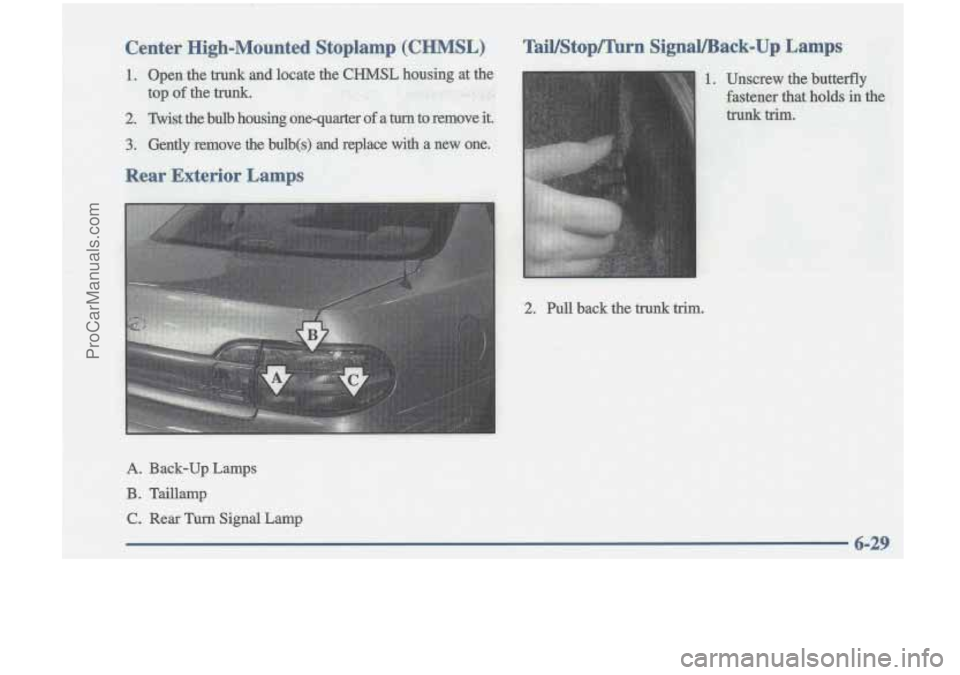
2. Fkll back the trunk trim.
A. Back-up Lamps
B. Taillamp
C. Rear Turn Signal Lamp
ProCarManuals.com
Page 275 of 353
Instrument Panel Fuse Block - Left
In the left instrument panel fuse block, there are spare
fuses and a fuse puller.
P-
I RELAY I MICRO
DR UNLOCK OK
DR LOCK DR UNLOCK DRIVERS
Usage
Radio
Wipers
Trunk Release and Remote
Lock Control
Turn Signals
Power Mirrors
Air Bag
Fuse
G)
H)
J)
K)
STOP LPS
HAZARD LPS
IPCENAC
BATT
MICRO RELAY
TRUNK REL CIRCUIT BRKR
PWR SEATS
MICRO RELAY
DR UNLOCK
MICRO RELAY
DR LOCK
MICRO RELAY
DRIVERS DR
UNLOCK
Usage
Body Function Control Module
Powertrain Control Module
Door Locks
Body Function Control Module,
Cluster
Stoplamps
Hazard Lamps Cluster, Climate Control
Remote Trunk Release
Power Seats
Door Locks
Door Locks
Not Used
6-52
ProCarManuals.com