1997 OLDSMOBILE CUTLASS ignition
[x] Cancel search: ignitionPage 78 of 353

Second-Gear Start
Your vehicle is equipped with a second-gear start
feature. Place the shift lever in SECOND
(2) gear to
provide more traction when you are starting on ice
or other slippery surfaces. The transaxle will be in
SECOND
(2) gear when the vehicle begins to move.
After starting in SECOND
(2) gear, place the shift lever
in THIRD
(3) or DRIVE (D).
This feature is only for improved traction only when
the road surface is slippery and
is not intended for
continuous use or when the vehicle is stuck in sand,
mud, ice, snow
or gravel.
Parking Brake
To set the parking brake,
hold the regular brake pedal
down with your right foot.
Push down the parking
brake pedal with your left
foot. If the ignition is on,
the brake system warning
light will come on. To
release the parking brake, hold the regular brake
pedal down with your right foot. Push down on the
parking brake pedal with your left foot.
If the parking
brake
is not released when you begin to drive, a chime
will sound warning you that the parking brake is still on.
NOTICE:
Driving with the parking brake on can cause
your rear brakes to overheat. You may have to
replace them, and you could
also damage other
parts
of your vehicle.
If you are towing a trailer and are parking on a hill, see
“Towing a Trailer” in the Index. That section shows
what to do first to keep the trailer from moving.
2-21
ProCarManuals.com
Page 79 of 353
Shifting-Into PARK (P)
I
It can be dangerous to get out of your vehicle if
the shift lever is not
fully in PARK (P) with the
parking brake firmly set. Your vehicle can roll.
If you have left the engine running, the vehicle
can move suddenly.
You or others could be
injured.
To be sure your vehicle won’t move,
even when you’re on fairly level ground, use the
steps that follow.
If you’re pulling a trailer, see
“Towing a Trailer” in the Index.
1. Hold the brake pedal down with your right foot and
set the parking brake.
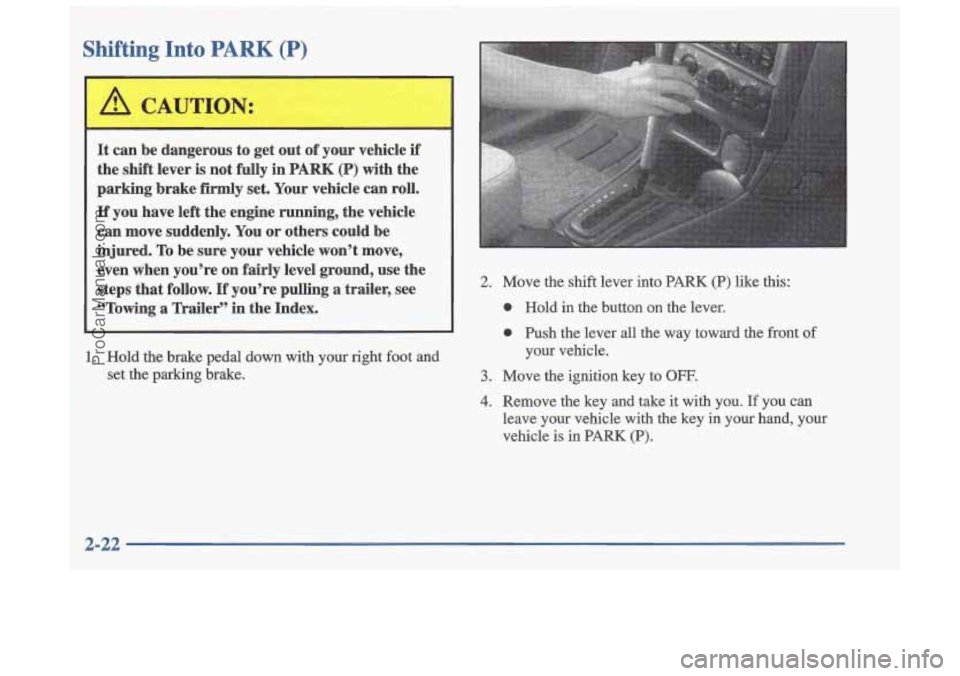
2. Move the shift lever into PARK (P) like this:
0 Hold in the button on the lever.
0 Push the lever all the way toward the front of
your vehicle.
3. Move the ignition key to OFF.
4. Remove the key and take it with you. If you can
leave your vehicle with the key in your hand, your
vehicle is in PARK
(P).
ProCarManuals.com
Page 81 of 353
Shifting Out of PARK (P)
Your Oldsmobile has a brake-transaxle shift interlock.
You have to apply your regular brake before you can
shift from PARK
(P) when the ignition is in ON. See
“Automatic Transaxle” in the Index.
If you cannot shift out of PARK (P), ease pressure on
the shift lever -- push the shift lever all the way into
PARK (P)
-- as you maintain brake application. Then
move the shift into the gear you wish. (Press the shift
lever button before moving the shift lever.)
If you ever hold the brake pedal down but still can’t
Shift QUt
Of PARK (P) , try this
1.
2.
3.
4.
5.
Turn the key to OFF.
Apply and hold the regular brake until the end
of Step
4.
Shift to NEUTRAL (N).
Start the vehicle and then shift to the drive gear
you want.
Have the vehicle fixed as soon as you can.
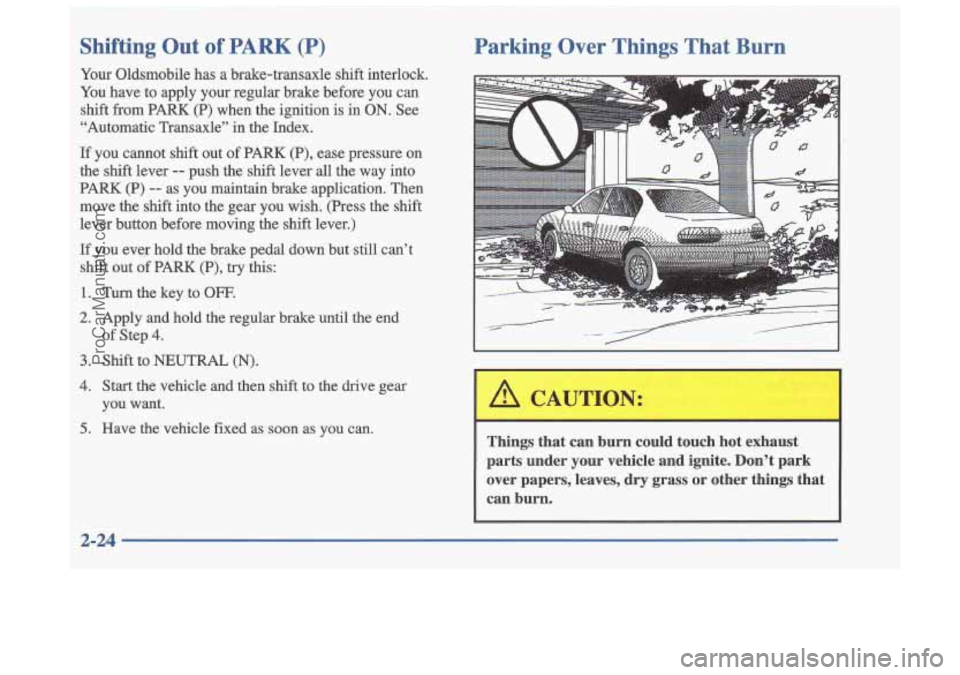
Parking Over Things That Burn
1 CAUTION:
Ih
I
Things that can burn could touch hot exhaust
parts under your vehicle and ignite. Don’t park
over papers, leaves, dry grass
or other things that
can burn.
I
2-24
ProCarManuals.com
Page 91 of 353

Increasing Speed While Using Cruise Control
There are two ways to go to a higher speed.
Use the accelerator pedal to get to the higher speed.
Push the SETDECEL button, then release the button
and the accelerator pedal. You’ll now cruise at the
higher speed.
Press the RESUME/ACCEL button. Hold it there
until you get up to the speed you want, and then
.release the button.
To increase your speed in very
small amounts, press the RESUME/ACCEL button
for less than half a second and then release
it. Each
time you do this, your vehicle will go about
1 mph
(1.6 kmk) faster.
The accelerate feature
will only work after you turn on
the cruise control by pushing
the SETDECEL button.
Reducing Speed While Using Cruise Control
There are two ways to reduce your speed while using
cruise control:
0 Push the SETDECEL button until you reach the
lower speed you want, then release it.
To slow down in very small mounts, push the
SETDECEL button for less than half a second. Each
time you do this, you’ll go
1 mph (1.6 kmk) slower.
Passing Another Vehicle While Using Cruise Control
Use the accelerator pedal to increase your speed. When
you take your foot
off the pedal, your vehicle will slow
down to the cruise control speed you set earlier.
Using Cruise Control on Hills
How well your cruise control will work on hills depends
upon your speed, load and the steepness of the hills.
When going up steep hills, you may have to step on the
accelerator pedal to maintain your speed. When going
downhill, you may have to brake or shift to
a lower gear
to keep your speed down. Of course, applying the brake
takes you out of cruise control. Many drivers find this to
be too much trouble and don’t use cruise control
on
steep hills.
Ending Out of Cruise Control
There are two ways to turn off the cruise control:
Step lightly on the brake pedal;
0 Press the cruise control ON/OFF button.
Erasing the Cruise Speed Memory
When you turn off the cruise control or the ignition,
your cruise control set speed memory is erased.
2-34 ~~
ProCarManuals.com
Page 93 of 353

Daytime Running Lamps / Automatic
Light
Control
Daytime Running Lamps (DRL) can make it easier for
others to see the front of your vehicle during the day.
DRL can be helpful in many different driving
conditions, but they can be especially helpful in the
short periods after dawn and before sunset.
A light sensor below the defroster grille makes the
DRL and Automatic Light Control (ALC) work, so
be sure it isn’t covered. The DRL system will make
your low-beam headlamps come on at
a reduced
brightness when:
0 The ignition is on,
0 The headlamp switch is off,
0 The transaxle is not in PARK (P) and
0 The park brake is not set. When the
DRL are on, only your low-beam headlamps
will be on. The taillamps, sidemarker and other
lamps won’t be on. Your instrument panel won’t be
lit up either.
When it’s dark enough outside, the
ALC system will
turn your headlamps on to full brightness. The other
lamps that come on with your headlamps will also
come on.
When it’s bright enough outside, the ALC system will
turn off your regular lamps, and your low-beam
headlamps change to the reduced brightness of DRL.
To idle your vehicle with the DIU
off, set the park
brake while the ignition is off. Then start the vehicle.
The
DRL will stay off until you release the park brake.
As with any vehicle, you should turn
on the regular
headlamp system when you need it.
2-36
ProCarManuals.com
Page 95 of 353

Illuminated EntryLExit System
When you lift the outside handle of either front door, or
open either rear door, the lamps inside your vehicle will
go on. These lamps will fade out after about
40 seconds,
or when the ignition is turned on after all doors have
been closed.
If the ignition was recently turned off, the
lamps will fade out after four seconds. These lamps
will also go on when you press the LOCK or
UNLOCK
button on the optional Remote Lock Control transmitter.
If the ignition has been off for less than two minutes,
the lamps inside your vehicle will stay on for about
15 seconds after your key is removed from the
ignition to provide an illuminated exit.
Mirror Reading Lamps
Press the switch on the lower front portion of the mirror
to turn on the lamp. Press the other side
of the switch to
turn the lamp off.
Three-Position Dome Lamp
The switch on this lamp has three positions. The ON
position will turn on the light. The DOOR position will
turn on the light whenever a door is opened. The OFF
position will shut off the lamp completely, even when
a door is opened.
Trunk Lamp
The trunk lamp comes on when you open your trunk.
Battery Saver
Your Oldsmobile is equipped with a battery saver
feature designed to protect your vehicle’s battery.
When any interior lamp
(trunk, reading, footwell or
glove box) is left on when the~ignition is turned
off, the
battery saver system will automatically shut the lamp
off
after 20 minutes. This will avoid draining the battery.
To reactivate the interior lamps, either:
The ignition must be turned on,
The activated lamp switch must be turned off and
then on or
0 A front door must be opened.
The battery saver feature will also be activated when
any door
of your vehicle is left open.
ProCarManuals.com
Page 104 of 353

Your instrument panel is designed to let you know at a
glance how your vehicle is running. You’ll know how
fast you’re going, how much fuel you’re using, and
many other things you’ll need to drive safely and
economically.
The main components of your instrument panel are:
A. Fog Lamp Switch
B. Instrument Panel intensity Control
C. Turn SignalMultifunction Lever
D. Cruise Control Switches (If Equipped)
E. Supplemental Restraint System (SRS) and Horn
F. Instrument Panel Cluster
G. Windshield Wipermasher Lever
H. Ignition Switch
J. Hazard Warning Flashers Switch
K. Supplemental Restraint System (SRS)
L. Fuse Panels
M. Climate Control System
N. Accessory Power Outlets
0. Gear Shift Lever
P. Audio System
Q. Park Brake Pedal
R. Tilt Wheel Lever
S. Hood Release Lever
T. Trunk Release Button
U. Instrument Panel Cupholder
2-47
-
ProCarManuals.com
Page 109 of 353

Air Bag Readiness Light
There is an air bag readiness light on the instrument
panel, which shows the air bag symbol. The system
checks the air bag’s electrical system for malfunctions.
The light tells you
if there is an electrical problem.
The system check includes the
air bag sensor, the air
bag modules, the wiring
and the crash sensing and
diagnostic module. For more information on the air
bag system, see “Air Bag” in the Index.
This light will come on
when you start your engine,
and it will flash for a few
seconds. Then the light
should
go out. This means
If the air bag readiness light stays on after you start the
engine
or comes on when you are driving, your air bag
system may not work properly. Have your vehicle
serviced right away. The
air bag readiness light should flash
for a few
seconds when you turn the ignition key to
ON. If the
light doesn’t come on then, have it fixed
so it will be
ready to
warn you if there is a problem.
Charging System Indicator Light
The charging system
indicator light will come
on when you turn
on the
ignition, but the engine is
not running, as a check to
show you it is worhg.
Then it should go out.
If it stays on, or comes on while you are driving and
you hear
a chime, you may have a problem with the
electrical charging system. It could indicate that you
have a loose generator drive belt or another electrical
problem. Have
it checked right away. Driving while
this light is on could drain your battery.
If you must drive a short distance with the light on, be
certain to turn
off all your accessories, such as the radio
and air conditioner.
2-52
ProCarManuals.com