1997 OLDSMOBILE BRAVADA heater
[x] Cancel search: heaterPage 201 of 358
I
Heater and radiator hoses, and other engine
parts, can be very hot. Don’t touch them.
If you
do, you can be burned.
Don’t run the engine
if there is a leak. If you run
the engine, it could lose all coolant. That could
cause an engine fire, and you could be burned.
Get any leak fixed before you drive the vehicle.
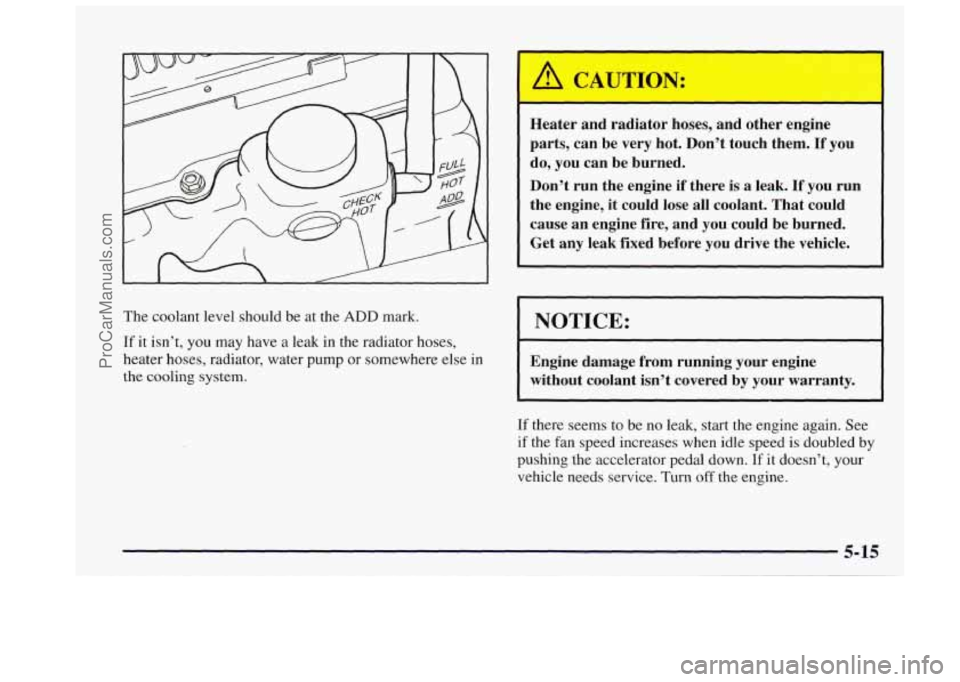
The coolant level should be at the ADD mark.
If it isn’t, you may have a leak in the radiator hoses,
heater hoses, radiator, water pump or somewhere else
in
the cooling system.
NOTICE:
Engine damage from running your engine
without coolant isn’t covered by your warranty.
If there seems to be no leak, start the engine again. See
if the fan speed increases when idle speed is doubled by
pushing the accelerator pedal down.
If it doesn’t, your
vehicle needs service.
Turn off the engine.
5-15
ProCarManuals.com
Page 202 of 358
How to Add Coolant to the Coolant
Recovery Tank
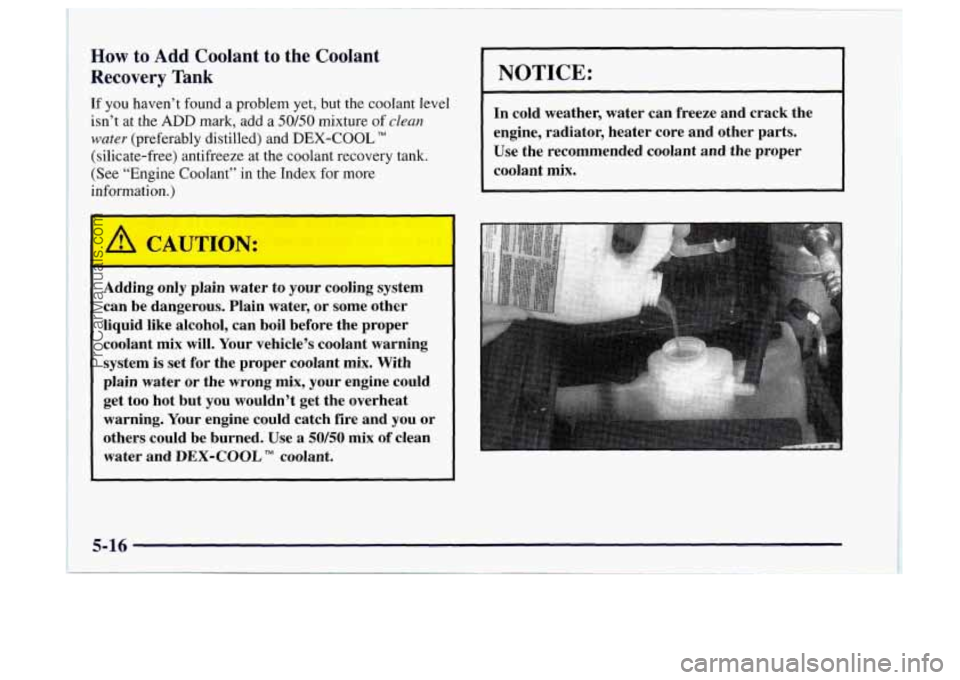
If you haven’t found a problem yet, but the coolant level
isn’t at the
ADD mark, add a 50/50 mixture of clean
water (preferably distilled) and DEX-COOL TM
(silicate-free) antifreeze at the coolant recovery tank.
(See “Engine Coolant’’ in the Index for more
information.)
Adding only plain water to your cooling system
can be dangerous. Plain water, or some other
liquid like alcohol, can boil before the proper
coolant mix will. Your vehicle’s coolant warning
system is set for the proper coolant mix. With
plain water or the wrong mix, your engine could
get too hot but you wouldn’t get the overheat
warning. Your engine could catch fire and you or
others could be burned. Use a
50/50 mix of clean
water and
DEX-COOL coolant.
I NOTICE:
In cold weather, water can freeze and crack the
engine, radiator, heater core and other parts.
Use the recommended coolant and the proper
coolant mix.
5-16 -
ProCarManuals.com
Page 240 of 358
1
; What to Use
I Refer to the Maintenance Schedule to determine what
’ kind of lubricant to use. See “Recommended Fluids and
i Lubricants” in the Index.
1 , I Engine Coolant
; The cooling system in your vehicle is filled with new
1 DEX-COOL” engine coolant. This coolant is designed
I to remain in your vehicle for 5 years or 150,000 miles
I (240 000 km), whichever occurs first, if you add only
~ DEX-COOL” extended life coolant.
I i The following explains your cooling system and how to
i
~
i
add coolant when it is low. If you have a problem with
engine overheating, see “Engine Overheating” in
the Index.
I
A 50/50 mixture of water and the proper coolant for
1 your Oldsmobile will:
’ 0 Give freezing protection down to -34°F (-37°C).
~ 0 Give boiling protection up to 265 “F (129°C). I
~ 0 Protect against rust and corrosion.
0 Help keep the proper engine temperature.
0 Let the warning lights and gages work as
they should.
NOTICE:
When adding coolant, it is important that you use
only
DEX-COOL TM (silicate-free) coolant.
If silicated coolant is added to the system,
premature engine, heater core or radiator
corrosion may result. In addition, the engine
coolant will require change sooner
-- at
30,000 miles (50 000 km) or 24 months,
whichever occurs first.
What to Use
Use a mixture of one-half clean water (preferably
distilled) and one-half DEX-COOL
TM coolant which
won’t damage aluminum parts. Use GM Engine Coolant
Supplement (sealer) (GM Part
No. 3634621) with any
complete coolant change.
If you use this mixture, you
don’t need to add anything else.
ProCarManuals.com
Page 241 of 358

1 NOTICE:
Adding only plain water to your cooling system
can be dangerous. Plain water, or some other
liquid like alcohol, can boil before the proper
coolant mix
will. Your vehicle’s coolant warning
system is set for the proper coolant mix. With
plain water or the wrong mix, your engine could
get too hot but you wouldn’t get the overheat
warning. Your engine could catch fire and you or
others could be burned. Use a
50150 mix of clean
water and
DEX-COOL TM coolant.
If you use an improper coolant mix, your engine
could overheat and be badly damaged. The
repair cost wouldn’t be covered by your
warranty.
Too much water in the mix can freeze
and crack the engine, radiator, heater core and
other parts.
If you have to add coolant more than four times a year,
have your retailer check your
cooling system.
NOTICE:
If you use the proper coolant, you don’t have to
add extra inhibitors or additives which claim to
improve the system. These can be harmful.
6-21
ProCarManuals.com
Page 277 of 358

FuseKircuit Breaker Usage
4
5
6
7
A/C Compressor Relay, Cluster
Chime Module, DRL Relay Coil,
Four-Wheel-Drive Indicator Lamp,
DRL Module, Rear Defog Timer,
Transfer Case Control Module Ignition, SIR Redundant Ignition,
RKE Ignition, Fuel Sender Module
Oxygen Sensor Heater, Exhaust Gas
Recirculation, Cam Sensor, CANN.
Purge, Canister Vent Solenoid, Mass
Airflow Sensor, Cam Shaft Sensor
Blower Motor, Temperature Door
Motor, HI Blower Relay Coil
Power Auxiliary Outlets, Assembly
Line Diagnostic Link
FuseKircuit
Breaker Usage
8
9
10
11
12
13
14
15
Rear Window Defogger
PCMNCM Battery, Fuel Pump
PCMNCM Ignition, Injectors, Crank
Sensor, Coil Driver Module
Radio, Inside Rearview Mirror Map
Lamp, Overhead Console Reading
Lamps, Rear Wiper, Rear Washer,
Overhead Console Display
Anti-Lock Braking System,
VCM IGN-3
Clock, Radio Battery, CD Player
A/C Compressor Battery Feed
Daytime Running Lamps, Fog Lamps,
Fog Lamp Relay
6-57
ProCarManuals.com
Page 278 of 358

17
18
19
20
21
22
Fuse/Circuit Breaker Usage
16 Turn Signals and Back-up Lamps,
Brake-Transmission Shift
Interlock Solenoid
Windshield Washer, Windshield
Wiper Motor
Not Used
Electric Shift Transfer Case
Crank Relay, Air Bag Module
Not Used
Air Bag Module
FuseKircuit
Breaker Usage
23
24
Cluster Illurnination, Radio Illumination, Heater Lamp,
4WD
Illumination, Chime Module, Fog
Lamp Illumination, Rear Wiper
Switch Illumination, Rear Defogger
Switch Illumination, Liftglass Release
Switch Illumination, Overhead
Console Illumination
PRNDL Power,
4L6OE
Automatic Transmission
ProCarManuals.com
Page 325 of 358
Part C: Periodic Maintenance
Inspections
Listed below are inspections and services which should
be performed at least twice
a year (for instance, each
spring and fall). You should let your GM retailer‘s
service department or other qualified service center
do
these jobs. Make sure any necessary repairs are
completed at once.
Proper procedures to perform these services may be
found
in a GM service manual. See “Service and Owner
Publications”
in the Index.
Steering, Suspension and Front Drive Axle
Boot and Seal Inspection
Inspect the front and rear suspension and steering
system for damaged, loose or missing parts, signs of
wear or lack
of lubrication. Inspect the power steering
lines and hoses for proper
hook-up, binding, leaks,
cracks, chafing, etc. Clean and then inspect the drive
axle boot seals for damage, tears or leakage. Replace
seals
if necessary.
Exhaust System Inspection
Inspect the complete exhaust system. Inspect the body
near
the exhaust system. Look for broken, damaged,
missing or out-of-position parts as well as open seams,
holes, loose connections or other conditions which could
cause
a heat build-up in the floor pan or could let
exhaust fumes into the vehicle. See “Engine Exhaust” in
the Index.
Radiator and Heater Hose Inspection
Inspect the hoses and have them replaced if they are
cracked, swollen or deteriorated. Inspect all pipes,
fittings and clamps; replace as needed.
ProCarManuals.com
Page 345 of 358

Climate Control System ........................... 3-2
Clock.Setting
................................... 3-6
Comfort Controls
................................ 3- 1
Compact Disc Care ............................. 3- 16
Compass
...................................... 2-37
Control of a Vehicle
.............................. 4-6
Convenience Net
............................... 2-40
Convex Outside Mirror
.......................... 2-35
Coolant
....................................... 6-20
Coolant Heater. Engine .......................... 2- 14
Courtesy Transportation
........................... 8-6
Cruise Control
................................. 2-28
Customer Assistance Information
................... 8- 1
Customer Satisfaction Procedure .................... 8-2
Damage. Finish
............................... 6-51
Damage. Sheet Metal
............................ 6-50
Daytime Running Lamps
......................... 2-32
Indicator Light
............................... 2-60
Dead Battery ................................... 5-3
Defects. Reporting Safety
......................... 8-8
Defensive Driving
............................... 4-2
Defogging and Defrosting
......................... 3-5
Dimensions. Vehicle
............................ 6-6 1
Dome Lamps .................................. 2-34 Door
Locks ....................................... 2-4
Storage
..................................... 2-39
Driver Info~-mation System
....................... 2-37
Driver Position ................................. 1 . 12
Driving
........................................ 4-1
Cily ........................................ 4-33
Defensive
.................................... 4-2
Drunken
..................................... 4-3
Foreign Countries
.............................. 6-4
Freeway .................................... 4-34
Guidelines
.................................. 4-15
Hill and Mountain Roads
....................... 4-36
In a Blizzard ................................. 4-40
Night ...................................... 4-28
On Curves
.......................... : ........ 4-9
Rainy Conditions
............................. 4-30
Snowy and Icy Conditions
...................... 4-38
Through Deep Standing Water
................... 4-32
WetRoads
.................................. 4-30
Winter
...................................... 4-38
With
a Trailer ................................ 4-49
Driving On Grades While Towing
a Trailer ........... 4-51
Drunken Driving
................................ 4-3
Off-Road
................................... 4-15
ProCarManuals.com