Page 288 of 372
Instrument Panel Fuse Block
I
The main fuse panel is located on the left side of the
instrument panel.
To access the fuses, open the fuse
panel door. Fuse Usage
PWR WDO Power Window (Circuit Breaker)
TURN Turn Signal Lamps INT LPS Alarm Module (Illuminated Entry, Warning Chimes, Overhead Lamps,
MapReading Lamps, Glove
Box
Lamp, Trunk Lamp, Radio,
Power Mirrors), Anti-Lock Brakes,
Variable Effort Steering
Page 289 of 372

Fuse
PWR ST
RDO IGN HTR-A/C
CRUISE
TAIL LPS
LTR
WIPER
02
DR UNLK
ALARM
Usage
Power Seat
Radio
Heater/Air Conditioning Blower,
Daytime Running Lamps, Automatic
Lamp Control
Cruise Control
Parking Lamps, Taillamps,
Sidemarker Lamps, License Lamps,
Instrument Panel Lights, Underhood
Lamp, Headlamp Warning Alarm
Cigarette Lighter, Auxiliary
Power Outlet
Windshield Wipers/Washers
Heated Oxygen Sensors
Automatic Door Unlock
Automatic Transaxle, Automatic Door
Unlock, Alarm Module (Illuminated
Entry, Warning Chimes), Traction
Telltale, Rear Window Defogger,
Remote Lock Control
Fuse
FOG/FTP
PRNDL
DR LK
2
AIR BAG
HORN
INST STOP HAZ
PCM
DR LK
1
INST LPS
RR DEF
HDLP
Usage
Fog Lamps
Instrument Cluster, Powertrain
Computer, Park-Lock Solenoid,
Electronic PRNDL
Door Locks
Air Bag-Power Horn, Service Tool Power
Instrument Cluster
Stoplamps, Hazard Lamps,
Anti-Lock Brakes
Powertrain Control Module
Door Locks, Remote Lock Control
Instrument Panel Lights, Fog Lamps
Rear Window Defogger
Headlamps, Daytime Running Lamps (Circuit Breaker)
Page 290 of 372
Engine Compartment Fuse Block
Fuse
F/P, INJ
ERLS
The engine compartment fuse block is located on the
driver’s side of the engine compartment, near the battery.
ABS
Usage
Fuel Pump, Fuel Injectors
Back-up Lamps, Canister
Purge Valve, EGR,
Automatic Transaxle,
Brake-Transaxle Shift
Interlock, Anti-Lock Brakes,
Variable Effort Steering, Air
Conditioning Compressor,
Park Lock Solenoid
Anti-Lock Brake Solenoids,
Variable Effort Steering
6-60
Page 291 of 372
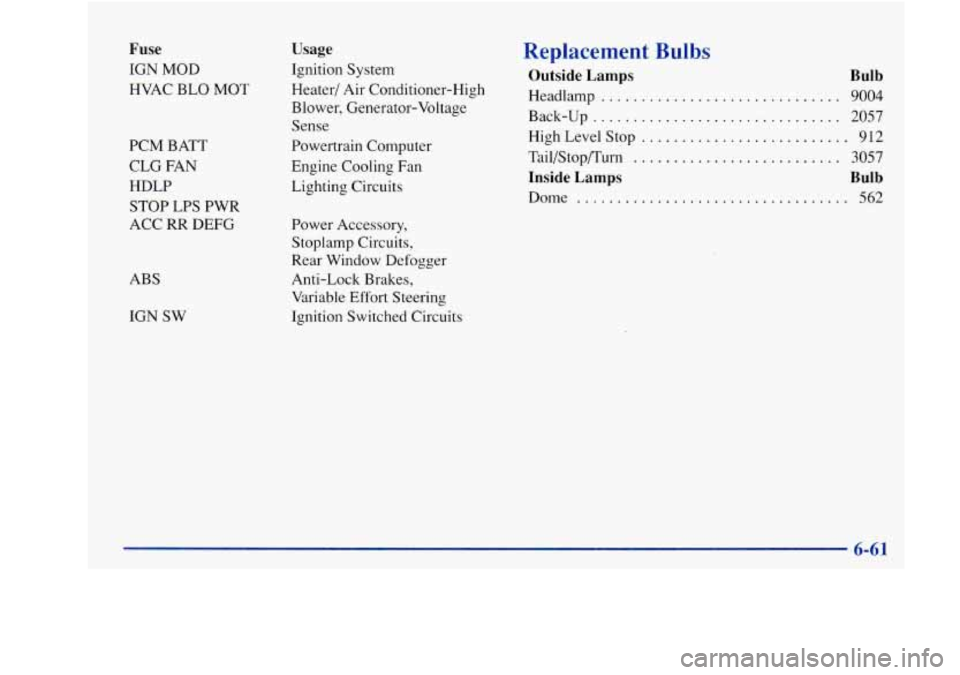
Fuse
IGN MOD
HVAC BLO MOT
PCM BATT
CLG FAN
HDLP
STOP
LPS PWR
ACC
RR DEFG
ABS
IGN SW
Usage
Ignition System
Heater/ Air Conditioner-High
Blower, Generator-Voltage
Sense
Powertrain Computer
Engine Cooling Fan
Lighting Circuits
Power Accessory,
Stoplamp Circuits,
Rear Window Defogger
Anti-Lock Brakes,
Variable
Effort Steering
Ignition Switched Circuits
Replacement Bulbs
Outside Lamps Bulb
Headlamp .............................. 9004
Back-up ............................... 2057
High Level Stop
.......................... 912
Tail/Stop/Turn
.......................... 3057
Inside Lamps Bulb
Dome .................................. 562
6-61
- . -
Page 301 of 372

I Short Trip/City Maintenance Schedule I
The services shown in this schedule up to 100,000 miles
(166 000 km) should be performed after 100,000 miles
(166 000 km) at the same intervals. The services shown
at
150,000 miles (240 000 km) should be performed at
the same interval after
150,000 miles (240 000 km).
See “Owner Checks and Services” and “Periodic
Maintenance Inspections” following.
Footnotes
? The U.S. Environmental Protection Agency or the
California Air Resources Board has determined that
the
failure to perform this maintenance item will not nullify
the emission warranty or limit recall liability prior to the
completion
of the vehicle’s useful life. We, however,
urge that all recommended maintenance services be
performed at the indicated intervals and
the maintenance
be recorded.
# Lubricate the suspension and steering linkage.
+ A good time to check your brakes is during tire
rotation. See “Brake System Inspection” under “Periodic
Maintenance Inspection” in Part C
of this schedule.
++ If you drive in a highly corrosive environment, your
brake calipers may require additional inspection and
service, at every other tire rotation. See “CaliperKnuckle
Maintenance Inspection” under “Periodic Maintenance
Inspections”
in Part C of this schedule.
7-7
Page 323 of 372

The services shown in this schedule up to 100,000 miles
(166
000 km) should be performed after 100,000 miles
(166
000 km) at the same intervals. The services shown
at
150,000 miles (240 000 km) should be performed at
the same interval after
150,000 miles (240 000 km).
See “Owner Checks and Services” and “Periodic
Maintenance Inspections” following.
Footnotes
The U.S. Environmental Protection Agency or the
California Air Resources Board has determined that the
failure to perform
this maintenance item will not nullify
the emission warranty or limit recall liability prior to the
completion of the vehicle’s useful life. We, however,
urge that all recommended maintenance services be
performed at the indicated intervals and the maintenance
be recorded.
# Lubricate the suspension and steering linkage.
+ A good time to check your brakes is during tire
rotation. See “Brake System Inspection” under “Periodic
Maintenance Inspections” in Part C
of this schedule.
++ If you drive in a highly corrosive environment, your
brake calipers may require additional inspection and service, at every other tire rotation. See ‘‘Caliperfiuckle
Maintenance Inspection” under “Periodic Maintenance
Inspections” in Part C of
this schedule.
7-29
Page 338 of 372

Ignition Transaxle Lock Check
While parked, and with the parking brake set, try to turn
the ignition key to LOCK in each shift lever position.
With an automatic transaxle, the key should turn to
LOCK only when the shift lever is in PARK (P).
With a manual transaxle, the key should turn to LOCK
only when the shift lever is in REVERSE (R).
On vehicles with
a key release button, try to turn the key
to
LOCK without pressing the button. The key should
turn to
LOCK only when you press the key button.
On all vehicles, the key should come out only
in LOCK.
Parking Brake and Automatic Transaxle PARK (P)
Mechanism Check
When you are doing this check, your vehicle
could begin
to move. You or others could be
injured and property could be damaged. Make
sure there
is room in front of your vehicle in case
it begins to roll. Be ready to apply the regular
brake at once should the vehicle begin to move. Park
on a fairly steep hill, with the vehicle facing
downhill. Keeping your foot
on the regular brake, set the
parking brake.
0
0
To check the parking brake’s holding ability: With
the engine running and transaxle in NEUTRAL
(N),
slowly remove foot pressure from the regular brake
pedal.
Do this until the vehicle is held by the parking
brake only.
To check the PARK (P) mechanism’s holding ability:
With the engine running, shift to PARK
(P). Then
release all brakes.
Underbody Flushing Service
At least every spring, use plain water to flush any
corrosive materials from the underbody. Take care to
clean thoroughly any areas where mud and other debris
can collect.
7-44
Page 340 of 372

Brake System Inspection
Inspect the complete system. Inspect brake lines and
hoses for proper hook-up, binding, leaks, cracks,
chafing, etc. Inspect disc brake pads for wear and rotors
for surface condition. Also inspect drum brake linings
for wear and cracks. Inspect other brake parts, including
drums, wheel cylinders, calipers, parking brake, etc. The
parking brake is self-adjusting
and no manual
adjustment is required. You
may need to have your
brakes inspected more often if your driving habits or
conditions result in frequent braking.
CalipedKnuckle Maintenance Inspection
If you operate your vehicle in a highly corrosive
environment, as indicated
by the shaded areas on the
map following this text, your vehicle may require
additional brake service. Refer to the appropriate
GM
Service Bulletin for the proper caliper inspection
procedure.
As necessary, caliper pins and knuckle brake pad
abutments should be lubricated at every other tire
rotation. Also, see your
GM retailer’s service
department or qualified service center for
additional information.
7-46