1997 NISSAN FRONTIER parking brake
[x] Cancel search: parking brakePage 144 of 204
WARNING
Be sure the engine and ignition switch
are off and that the parking brake is
engaged securely.
CAUTION
Be sure to use the correct socket to
remove the plugs. An incorrect socket
can cause damage.
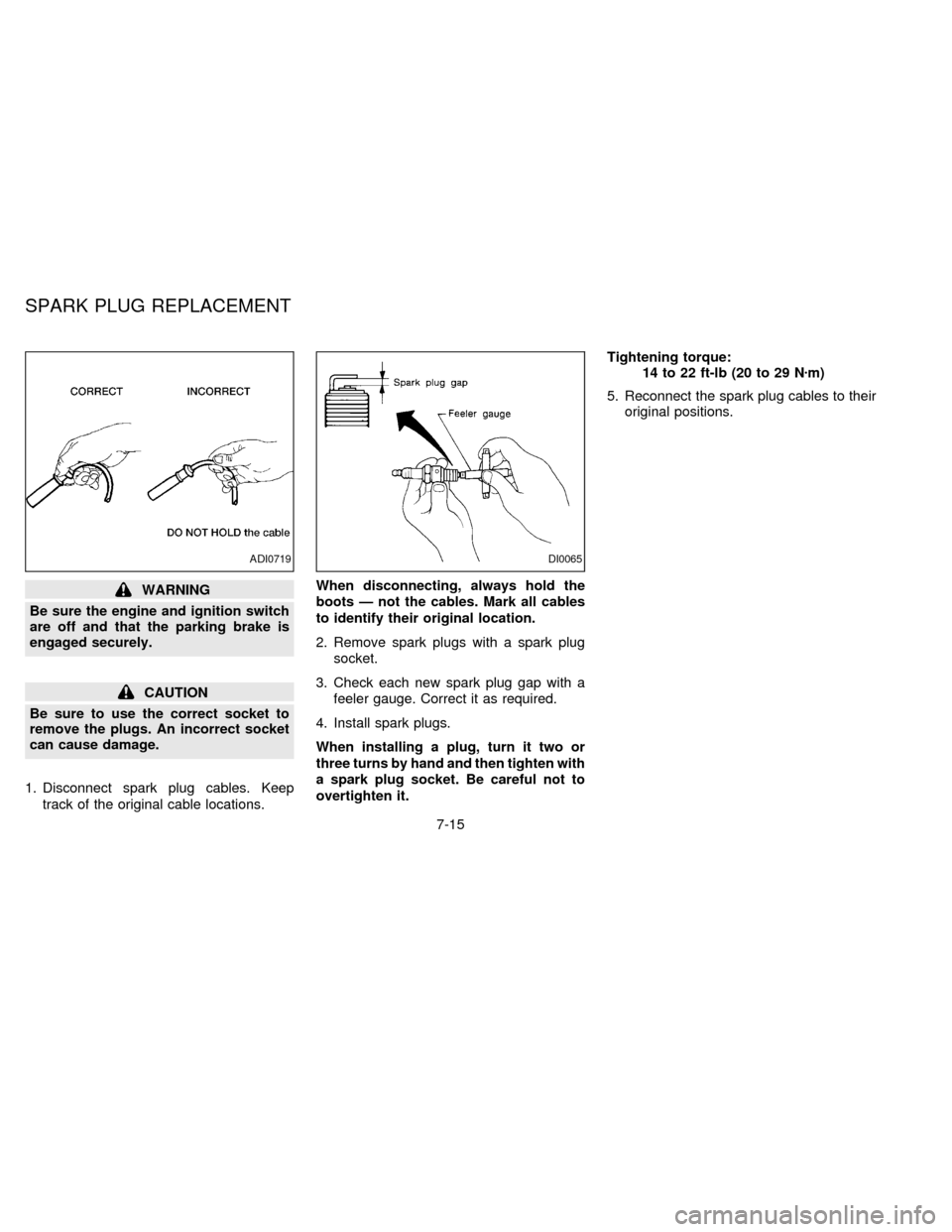
1. Disconnect spark plug cables. Keep
track of the original cable locations.When disconnecting, always hold the
boots Ð not the cables. Mark all cables
to identify their original location.
2. Remove spark plugs with a spark plug
socket.
3. Check each new spark plug gap with a
feeler gauge. Correct it as required.
4. Install spark plugs.
When installing a plug, turn it two or
three turns by hand and then tighten with
a spark plug socket. Be careful not to
overtighten it.Tightening torque:
14 to 22 ft-lb (20 to 29 Nzm)
5. Reconnect the spark plug cables to their
original positions.
ADI0719DI0065
SPARK PLUG REPLACEMENT
7-15
ZX
Page 147 of 204

If you wax the surface of the hood, be
careful not to let wax get into the washer
nozzle. This may cause clogging or im-
proper windshield washer operation. If
wax gets into the nozzle, remove it with a
needle or small pin.Pull the parking brake lever up. If the num-
ber of clicks is out of the range listed above,
see your NISSAN dealer.With the engine running, check distance A
between the upper surface of the pedal and
the metal floor.
Distance A:
4-3/4 in (120 mm) or more
If it is out of the range shown above, see
your NISSAN dealer.
MDI0005
ADI0722DI0453
PARKING BRAKE CHECK BRAKE PEDAL
7-18
ZX
Page 148 of 204
Self-adjusting brakes
Your vehicle is equipped with self-adjusting
brakes.
The front disc-type brakes self-adjust every
time the brake pedal is applied. The rear
drum-type brakes on two-wheel drive trucks
self-adjust every time the parking brake is
applied. The rear drum-type brakes on four-
wheel drive trucks self-adjust every time the
brake pedal is applied. If the brake pedal
goes down farther than normal, it may be
due to a lack of adjustment of the rear drum
brakes. Apply the parking brake several
times.
WARNING
If the brake pedal height does not re-
turn to normal, see your NISSAN dealer
and have it checked.
Brake pad wear indicators
The disc brake pads on your vehicle have
audible wear indicators. When a brake pad
requires replacement, it will make a high
pitched scraping or screeching sound when
the vehicle is in motion whether or not the
brake pedal is depressed. Have the brakeschecked as soon as possible if the wear
indicator sound is heard.
Under some driving or climate conditions,
occasional brake squeak, squeal or other
noise may be heard. Occasional brake
noise during light to moderate stops is nor-
mal and does not affect the function or
performance of the brake system.
The rear drum brakes (if so equipped) do
not have audible wear indicators. Should
you ever hear an unusually loud noise from
the rear drum brakes, have them inspected
as soon as possible by your NISSAN
dealer.
Proper brake inspection intervals should
be followed.For more information regard-
ing brake inspections, see the appropriate
maintenance schedule information in the
``Maintenance Schedule'' section of this
manual.Check the brake booster function with the
following steps:
1. With the engine off, press and release
the brake pedal several times. When
brake pedal movement (distance of
travel) remains the same from one pedal
application to the next, continue on to
next step.
2. While depressing the brake pedal, start
the engine. The pedal height should drop
a little.
3. With the brake pedal depressed, stop the
engine. Keeping the pedal depressed for
about 30 seconds, the pedal height
should not change.
4. Run the engine for one minute without
depressing the brake pedal, then turn it
off. Depress the brake pedal several
times. The pedal travel distance will de-
crease gradually with each depression
as the vacuum is released from the
booster.
If the brakes do not operate properly, have
the brakes checked by your NISSAN dealer.
BRAKE BOOSTER
7-19
ZX
Page 163 of 204

tion. Be certain to keep floormats away from
the pedal.
Parking brake*Check that the lever has
the proper travel and confirm that your
vehicle is held securely on a fairly steep hill
with only the parking brake applied.
Automatic transmission Park position
mechanismCheck that the lock release
button on the selector lever operates prop-
erly and smoothly. On a fairly steep hill
check that your vehicle is held securely with
the selector lever in the P position without
applying any brakes.
UNDER THE HOOD AND
VEHICLE
The maintenance items listed here should
be checked periodically (e.g., each time you
check the engine oil or refuel).
Additional information on the following
items with ``*'' is found in the ``Do-it-
yourself operations'' section.
Windshield washer fluid*Check that there
is adequate fluid in the tank.
Engine coolant level*Check the coolant
level when the engine is cold.Radiator and hosesCheck the front of the
radiator and clean off any dirt, insects,
leaves, etc., that may have accumulated.
Make sure the hoses have no cracks, de-
formation, rot or loose connections.
Brake and clutch fluid levels*Make sure
that the brake and clutch fluid level is be-
tween the MAX and MIN lines on the reser-
voir.
Battery*Check the fluid level in each cell. It
should be between the MAX and MIN lines.
Engine drive belts*Make sure no belt is
frayed, worn, cracked or oily.
Engine oil level*Check the level after
parking the vehicle on a level spot and
turning off the engine.
Power steering fluid level* and lines
Check the level when the fluid is cold and
the engine is turned off. Check the lines for
proper attachment, leaks, cracks, etc.
Automatic transmission fluid level*
Check the level after putting the selector
lever in P with the engine idling.
Exhaust systemMake sure there are no
loose supports, cracks or holes. If the sound
of the exhaust seems unusual or there is asmell of exhaust fumes, immediately locate
the trouble and correct it. (See the carbon
monoxide warning in the ``Starting and driv-
ing'' section.)
UnderbodyThe underbody is frequently
exposed to corrosive substances such as
those used on icy roads or to control dust. It
is very important to remove these sub-
stances, otherwise rust will form on the floor
pan, frame, fuel lines and around the ex-
haust system. At the end of winter, the
underbody should be thoroughly flushed
with plain water, being careful to clean
those areas where mud and dirt may accu-
mulate. See the ``Appearance and interior
care'' section for additional information.
Fluid leaksCheck under the vehicle for
fuel, oil, water or other fluid leaks after the
vehicle has been parked for a while. Water
dripping from the air conditioner after use is
normal. If you should notice any leaks or if
gasoline fumes are evident, check for the
cause and have it corrected immediately.
8-4
ZX
Page 169 of 204

EXPLANATION OF
MAINTENANCE ITEMS
Additional information on the following
items with ``*'' is found in the ``Do-it-
yourself operations'' section.
Emission control system
maintenance
Drive belts*Check drive belts for wear,
fraying or cracking and also for proper ten-
sion. Replace the drive belts if found dam-
aged or in accordance with the mainte-
nance schedule.
Air cleaner filterUnder normal driving con-
ditions, the air cleaner filter should be re-
placed in accordance with the maintenance
schedule. However, driving the vehicle in
dusty areas may cause more rapid clogging
of the element. Consequently, the element
may have to be replaced more frequently.
Positive crankcase ventilation (PCV) fil-
terUnder normal driving conditions, the
filter should be replaced in accordance with
the maintenance schedule. If the vehicle is
operated under extremely adverse weather
conditions or in areas where ambient tem-
peratures are either extremely low or ex-tremely high, the filter may become clogged
more rapidly. In such an event, replace the
filter immediately.
Vapor linesCheck vapor lines and connec-
tions for failure or looseness. If leaks are
found, replace the lines.
Fuel lines (hoses, piping, connections,
etc.)Check the fuel hoses, piping and con-
nections for leaks, looseness or deteriora-
tion. Replace any parts if they are damaged.
Fuel filterIf the vehicle is operated under
extremely adverse weather conditions or in
areas where ambient temperatures are ei-
ther extremely low or extremely high, the
filter might become clogged. In such an
event, replace the filter immediately.
Engine coolant*Flush and refill the cooling
system.
Engine oil and oil filter*Under normal
driving conditions, the engine oil and oil filter
should be replaced in accordance with the
maintenance schedule. However, under se-
vere driving conditions, they may have to be
replaced more frequently.
Spark plugs*Replace with new plugs hav-
ing the correct heat range.
Chassis and body maintenance
Brake lines and cablesCheck the brake
lines and hoses (including brake booster
vacuum hoses, connections & check valve)
and parking brake cables for proper attach-
ment, leaks, cracks, chafing, abrasion, de-
terioration, etc.
Brake pads, discs, drums and linings
Check these and the other neighboring
brake components for wear, deterioration
and leaks. Under severe driving conditions,
they may have to be inspected more fre-
quently.
Manual and automatic transmission,
transfer and differential gear oilVisually
inspect for signs of leakage and replace oil
for limited-slip differential. Under severe
driving conditions, the oil should be re-
placed at the specified interval.
Steering gear (box) and linkage, axle and
suspension parts and drive shaft boots
Check for damage, looseness and leakage
of oil or grease. Under severe driving con-
ditions, more frequent inspection should be
performed.
Steering linkage ball joints and front
suspension ball jointsCheck the ball
8-10
ZX
Page 193 of 204

prevent load shifts while driving.
cBe certain your outside mirrors conform
to all federal, state or local regulations. If
not, install any mirrors required for towing
before driving the vehicle.
Trailer towing tips
In order to gain skill and an understanding
of the vehicle's behavior, you should prac-
tice turning, stopping and backing up in an
area which is free from traffic. Steering,
stability and braking performance will be
somewhat different than under normal driv-
ing conditions.
cAlways secure items in the trailer to
prevent load shift while driving.
c
Avoid abrupt starts, acceleration or stops.
cAvoid sharp turns or lane changes.
cAlways drive your vehicle at a moderate
speed.
cAlways block the wheels on both vehicle
and trailer when parking. Parking on a
slope is not recommended; however, if
you must do so, and if your vehicle is
equipped with automatic transmission,
first block the wheels and apply the park-ing brake, and then move the transmis-
sion shift lever into the P position. If you
move the shift lever to the P position
before blocking the wheels and applying
the parking brake, transmission damage
could occur.
cWhen going down a hill, shift into a lower
gear and use the engine braking effect.
When ascending a long grade, downshift
the transmission to a lower gear and
reduce speed to reduce chances of en-
gine overloading and/or overheating.
However, for long steep grades, do not
stay in 1st or 2nd gear when driving
above 35 MPH (56 km/h).
cIf the engine coolant rises to an ex-
tremely high temperature when the air
conditioning system is on, turn off the air
conditioner. Coolant heat can be addi-
tionally vented by opening the windows,
switching the fan control to high and
setting the temperature control to the
HOT position.
cTrailer towing requires more fuel than
normal circumstances.
cAvoid towing a trailer for your vehicle's
first 500 miles (805 km).cHave your vehicle serviced more often
than at intervals specified in the recom-
mended Maintenance Schedule.
cWhen making a turn, your trailer wheels
will be closer to the inside of the turn than
your vehicle wheels. To compensate for
this, make a larger than normal turning
radius during the turn.
cCrosswinds and rough roads adversely
affect vehicle/trailer handling, possibly
causing vehicle sway. When being
passed by larger vehicles, be prepared
for possible changes in crosswinds that
could affect vehicle handling. If swaying
does occur, firmly grip the steering
wheel, steer straight ahead, and immedi-
ately (but gradually) reduce vehicle
speed. This combination helps to stabi-
lize the vehicle. Never increase speed.
cBe careful when passing other vehicles.
Passing while towing a trailer requires
considerably more distance than normal
passing. Remember the length of the
trailer must also pass the other vehicle
before you can safely change lanes.
cTo maintain engine braking efficiency
and electrical charging performance, do
9-22
ZX
Page 198 of 204

10 Index
A
Air bag (See supplemental restraint
system) ...................................................... 2-15
Air bag warning light .................................. 2-17
Air cleaner housing filter ............................ 7-16
Air conditioner
Air conditioner operation ........................ 3-5
Air conditioner service ............................ 3-9
Air conditioner specification label ......... 9-14
Air conditioner system refrigerant and
lubrication recommendations.................. 9-8
Heater and air conditioner controls ........ 3-3
Air flow charts .............................................. 3-6
Anchor point locations ............................... 2-29
Antenna (manual) ...................................... 3-20
Anti-lock brake system, rear (R-ABS) ....... 4-25
Ashtray (See cigarette lighter and
ashtray) ...................................................... 1-13
Audio system
AM-FM radio with cassette player ........ 3-11
AM-FM radio with cassette player
(100W) .................................................. 3-16
Auto-lock free-running hubs ...................... 4-16
Automatic
Automatic power window switch .......... 1-16
Automatic transmission fluid (ATF) ........ 7-9
Driving with automatic transmission ....... 4-6B
Battery........................................................ 7-13
Before starting the engine ........................... 4-6
Belts (See drive belts) ............................... 7-14
Brake
Anti-lock brake system, rear
(R-ABS) ................................................ 4-25
Brake booster ....................................... 7-19
Brake fluid ..................................... 7-11, 9-3
Brake light (See stop light) ................... 7-23
Brake pedal .......................................... 7-18
Brake system ........................................ 4-25
Brake warning light ................................. 1-7
Brake wear indicators ................... 1-9, 7-19
Parking brake check ............................. 7-18
Parking brake operation ....................... 4-11
Break-in schedule ...................................... 4-14
Bulb check/instrument panel ....................... 1-6
Bulb replacement ....................................... 7-23
C
Capacities and recommended fuel/
lubricants...................................................... 9-2
Cargo (See vehicle loading
information) ................................................ 9-15
Cassette player (See audio system) ......... 3-11CB radio or car phone ............................... 3-21
Check engine indicator light (See malfunction
indicator light) .............................................. 1-9
Child restraint with top tether strap ........... 2-28
Child restraints for infants and small
children ...................................................... 2-24
Cigarette lighter (accessory) and
ashtray ....................................................... 1-13
Cleaning exterior and interior ...................... 6-2
Clock ............................................................ 1-5
Clock-radio ................................................. 3-11
Clutch
Clutch fluid ............................................ 7-11
Clutch pedal.......................................... 7-20
Cold weather driving .................................. 4-27
Controls
Audio controls ............................. 3-11, 3-16
Heater and air conditioner controls ........ 3-3
Coolant
Capacities and recommended fuel/
lubricants ................................................ 9-2
Changing engine coolant........................ 7-5
Checking engine coolant level ............... 7-4
Engine coolant temperature gauge ........ 1-4
Corrosion protection .................................... 6-4
Cruise control............................................. 4-12
Cup holder ................................................. 1-13
ZX
Page 201 of 204

Checking engine oil level ....................... 7-6
Engine oil ................................................ 7-6
Engine oil and oil filter
recommendation ..................................... 9-6
Engine oil viscosity ................................. 9-7
Opera window ............................................ 1-17
Outside mirror control ................................ 2-30
Outside mirrors .......................................... 2-30
Overdrive switch .......................................... 4-8
Overheat
If your vehicle overheats ........................ 5-9
Owner's manual order form ....................... 9-26
P
Pantograph type jack ................................... 5-5
Parking
Parking brake check ............................. 7-18
Parking brake operation ....................... 4-11
Parking/parking on hills ........................ 4-23
Periodic maintenance schedules ................. 8-5
Power
Power door lock...................................... 2-3
Power steering fluid .............................. 7-11
Power steering system ......................... 4-24
Power windows..................................... 1-15
Precautions
Maintenance precautions ....................... 7-2
On-pavement and off-road driving
precautions ............................................. 4-3
Precautions on seat belt usage............ 2-19Precautions when starting and
driving ..................................................... 4-2
Push starting ................................................ 5-9
R
Radio
AM-FM radio with cassette player ........ 3-11
AM-FM radio with cassette player
(100W) .................................................. 3-16
CB radio or car phone .......................... 3-21
Readiness for inspection maintenance
(I/M) test..................................................... 9-25
Rear anti-lock brake warning light ............... 1-9
Rear sliding window................................... 1-16
Registering your vehicle in another
country ....................................................... 9-12
Reporting safety defects (USA) ................. 9-24
S
Safety
Reporting safety defects (USA) ............ 9-24
Screw type jack ........................................... 5-6
Seat
Jump seat ............................................. 2-13
Seat belt
2-point type without retractor................ 2-23
3-point type with retractor..................... 2-21
Precautions on seat belt usage............ 2-19
Seat belt extenders .............................. 2-24Seat belt maintenance.......................... 2-24
Seat belts.............................................. 2-19
Seat belt warning light ................................. 1-7
Seats
Adjustment .............................................. 2-8
Bench seat............................................ 2-12
Separate seats ....................................... 2-8
Service manual order form ........................ 9-26
Shifting
Automatic transmission .......................... 4-7
Manual transmission............................... 4-9
Spark plug replacement............................. 7-15
Speedometer ............................................... 1-3
Spotlights ................................................... 1-14
SRS warning label ..................................... 2-17
Starting
Before starting the engine ...................... 4-6
Jump starting .......................................... 5-8
Precautions when starting and
driving ..................................................... 4-2
Push starting........................................... 5-9
Starting the engine ............................... 4-10
Steering
Power steering fluid .............................. 7-11
Power steering system ......................... 4-24
Tilting steering wheel............................ 2-29
Stop light .................................................... 7-23
Sun shade.................................................. 1-18
Sunroof ...................................................... 1-17
Supplemental restraint system
(Supplemental air bag system).................. 2-14
10-4
ZX