1997 NISSAN ALTIMA fuel pressure
[x] Cancel search: fuel pressurePage 40 of 203
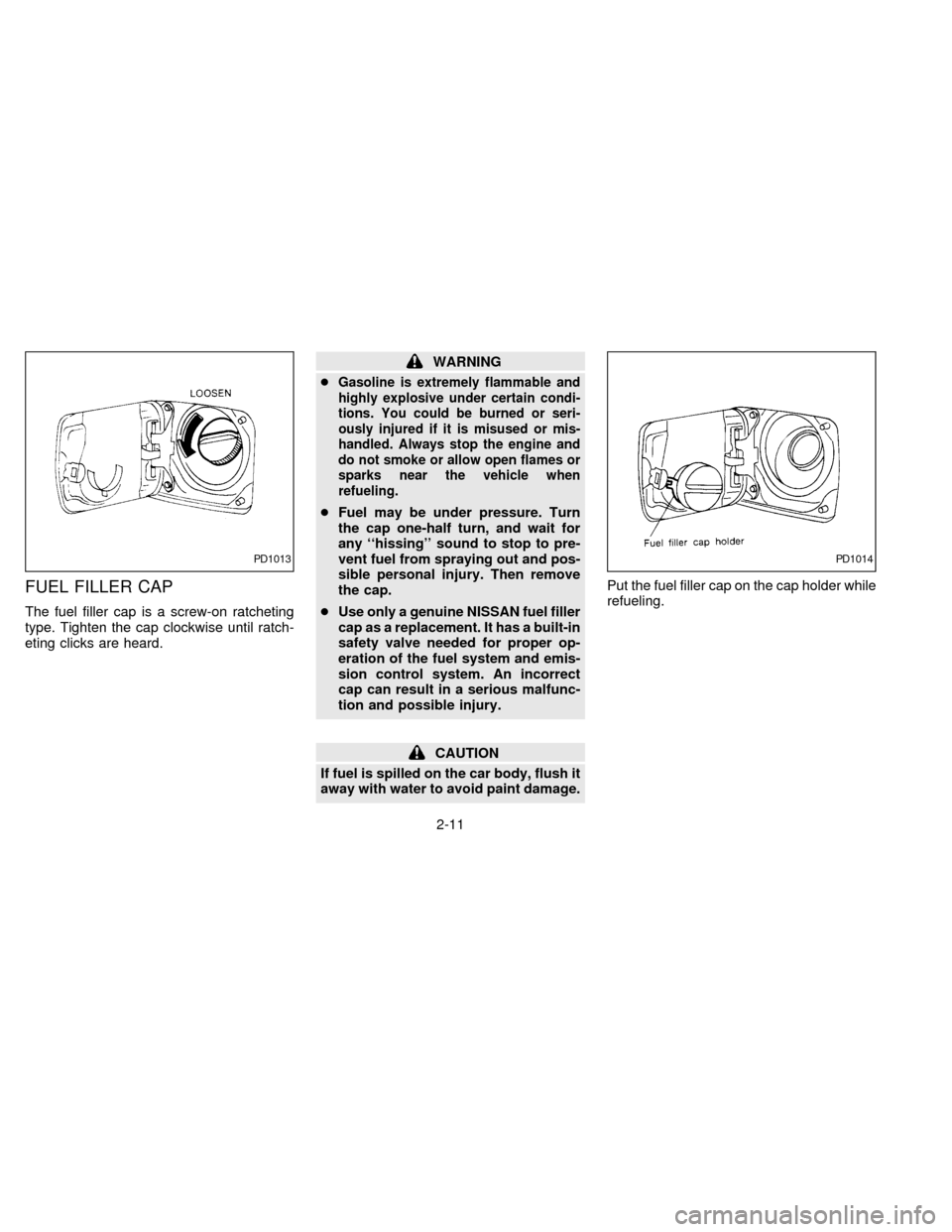
FUEL FILLER CAP
The fuel filler cap is a screw-on ratcheting
type. Tighten the cap clockwise until ratch-
eting clicks are heard.
WARNING
c
Gasoline is extremely flammable and
highly explosive under certain condi-
tions. You could be burned or seri-
ously injured if it is misused or mis-
handled. Always stop the engine and
do not smoke or allow open flames or
sparks near the vehicle when
refueling.
cFuel may be under pressure. Turn
the cap one-half turn, and wait for
any ``hissing'' sound to stop to pre-
vent fuel from spraying out and pos-
sible personal injury. Then remove
the cap.
cUse only a genuine NISSAN fuel filler
cap as a replacement. It has a built-in
safety valve needed for proper op-
eration of the fuel system and emis-
sion control system. An incorrect
cap can result in a serious malfunc-
tion and possible injury.
CAUTION
If fuel is spilled on the car body, flush it
away with water to avoid paint damage.Put the fuel filler cap on the cap holder while
refueling.
PD1013PD1014
2-11
ZX
Page 106 of 203
During the first 1,000 miles (1,600 km),
follow these recommendations for the future
reliability and economy of your new vehicle.
Failure to follow these recommendations
may result in vehicle damage or shortened
engine life.
cDo not drive over 55 MPH (90 km/h) and
do not run the engine over 4,000 rpm.
Avoid driving for long periods at constant
speed, either fast or slow.
cDo not accelerate at full throttle in any
gear.
cAvoid quick starts.
cAvoid hard braking as much as possible.
cDo not tow a trailer for the first 500 miles
(800 km).cAccelerate slowly and smoothly. Main-
tain cruising speeds with a constant ac-
celerator position.
cDrive at moderate speeds on the high-
way. Driving at high speed lowers fuel
economy.
cAvoid unnecessary stopping and brak-
ing. Maintain a safe distance behind
other vehicles.
cUse a proper gear range which suits road
conditions. On level roads, shift into high
gear as soon as possible.
cAvoid unnecessary engine idling.cKeep your engine tuned up.
cFollow the recommended periodic main-
tenance schedule.
cKeep the tires inflated at the correct
pressure. Low pressure increases tire
wear and wastes fuel.
cKeep the front wheels in correct align-
ment. Improper alignment increases tire
wear and lowers fuel economy.
cAir conditioner operation lowers fuel
economy. Use the air conditioner only
when necessary.
cWhen cruising at highway speeds, it is
more economical to use the air condi-
tioner and leave the windows closed to
reduce drag.
SD1001M
BREAK-IN SCHEDULE INCREASING FUEL
ECONOMY
4-14
ZX
Page 132 of 203
When performing any inspection or mainte-
nance work on your vehicle, always take
care to prevent serious accidental injury to
yourself or damage to the vehicle. The
following are general precautions which
should be closely observed.
WARNING
cPark the vehicle on a level surface,
apply the parking brake securely and
block the wheels to prevent the ve-
hicle from moving. For a manual
transmission, move the shift lever to
Neutral. For an automatic transmis-
sion, move the shift lever to P (Park).
cBe sure the ignition key is OFF when
performing any parts replacement or
repairs.
cYour vehicle is equipped with an
automatic engine cooling fan. It may
come on at any time without warn-
ing, even if the ignition key is in the
OFF position and the engine is not
running. To avoid injury, always dis-
connect the negative battery cable
before working near the fan.cIf you must work with the engine
running, keep your hands, clothing,
hair and tools away from moving
fans, belts and any other moving
parts.
cIt is advisable to remove ties and any
jewelry, such as rings, watches, etc.
before working on your vehicle.
cIf you must run the engine in an
enclosed space such as a garage, be
sure there is proper ventilation for
exhaust gases.
cNever get under the vehicle while it
is supported only by a jack. If it is
necessary to work under the vehicle,
support it with safety stands.
cKeep smoking materials, flame and
sparks away from fuel and the
battery.
cOn gasoline engine models with the
Multiport Fuel Injection (MFI) sys-
tem, the fuel filter or fuel lines
should be serviced by a NISSAN
dealer because the fuel lines are
under high pressure even when the
engine is off.
CAUTION
cDo not work under the hood while
the engine is hot. Turn off the engine
and wait until it cools down.
cNever connect or disconnect either
the battery or any transistorized
component connector while the igni-
tion is ON.
cNever leave the engine or the auto-
matic transmission related compo-
nent harness connector discon-
nected while the ignition is on.
c
Avoid contact with used engine oil.
Improperly disposed motor oil and/or
other vehicle fluids can hurt the en-
vironment. Always conform to local
regulations for disposal of vehicle
fluid.
This ``Do-it-yourself operations'' section
gives instructions regarding only those
items which are relatively easy for an owner
to perform.
You should be aware that incomplete or
improper servicing may result in operating
difficulties or excessive emissions, and
could affect your warranty coverage.If in
doubt about any servicing, have it done
by your NISSAN dealer.
MAINTENANCE
PRECAUTIONS
7-2
ZX
Page 153 of 203
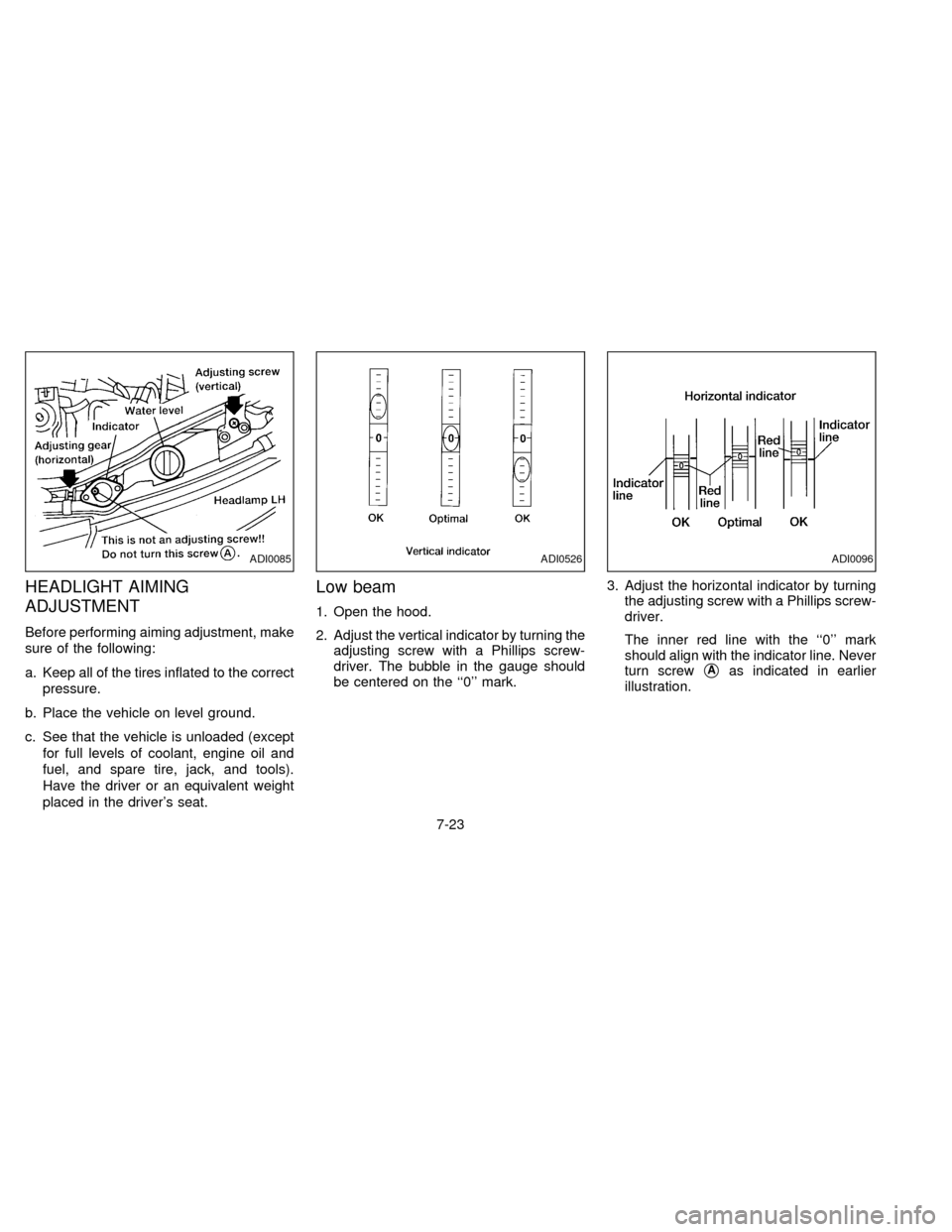
HEADLIGHT AIMING
ADJUSTMENT
Before performing aiming adjustment, make
sure of the following:
a. Keep all of the tires inflated to the correct
pressure.
b. Place the vehicle on level ground.
c. See that the vehicle is unloaded (except
for full levels of coolant, engine oil and
fuel, and spare tire, jack, and tools).
Have the driver or an equivalent weight
placed in the driver's seat.
Low beam
1. Open the hood.
2. Adjust the vertical indicator by turning the
adjusting screw with a Phillips screw-
driver. The bubble in the gauge should
be centered on the ``0'' mark.3. Adjust the horizontal indicator by turning
the adjusting screw with a Phillips screw-
driver.
The inner red line with the ``0'' mark
should align with the indicator line. Never
turn screw
sAas indicated in earlier
illustration.
ADI0085ADI0526ADI0096
7-23
ZX
Page 199 of 203
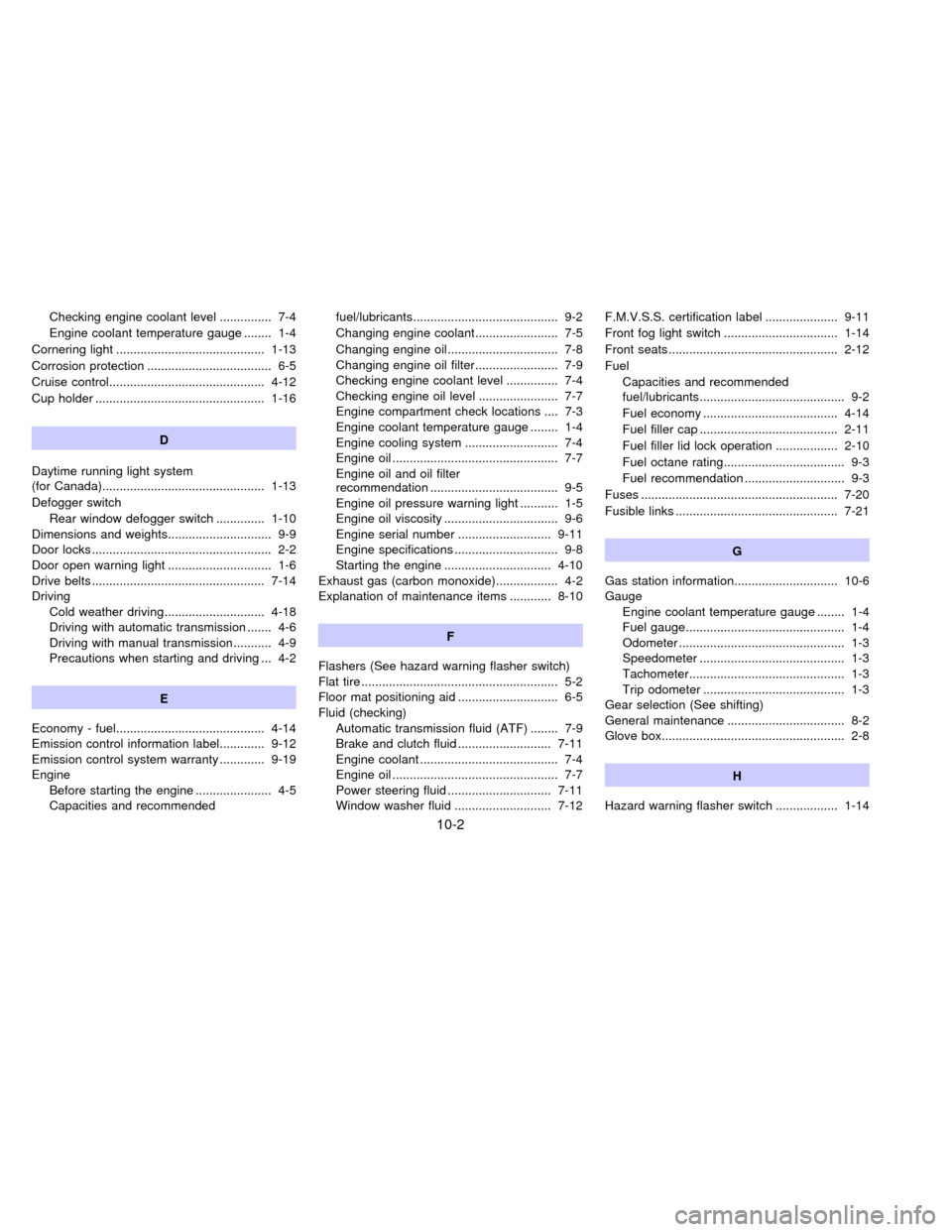
Checking engine coolant level ............... 7-4
Engine coolant temperature gauge ........ 1-4
Cornering light ........................................... 1-13
Corrosion protection .................................... 6-5
Cruise control............................................. 4-12
Cup holder ................................................. 1-16
D
Daytime running light system
(for Canada)............................................... 1-13
Defogger switch
Rear window defogger switch .............. 1-10
Dimensions and weights.............................. 9-9
Door locks .................................................... 2-2
Door open warning light .............................. 1-6
Drive belts .................................................. 7-14
Driving
Cold weather driving............................. 4-18
Driving with automatic transmission ....... 4-6
Driving with manual transmission ........... 4-9
Precautions when starting and driving ... 4-2
E
Economy - fuel........................................... 4-14
Emission control information label............. 9-12
Emission control system warranty ............. 9-19
Engine
Before starting the engine ...................... 4-5
Capacities and recommendedfuel/lubricants.......................................... 9-2
Changing engine coolant........................ 7-5
Changing engine oil................................ 7-8
Changing engine oil filter........................ 7-9
Checking engine coolant level ............... 7-4
Checking engine oil level ....................... 7-7
Engine compartment check locations .... 7-3
Engine coolant temperature gauge ........ 1-4
Engine cooling system ........................... 7-4
Engine oil ................................................ 7-7
Engine oil and oil filter
recommendation ..................................... 9-5
Engine oil pressure warning light ........... 1-5
Engine oil viscosity ................................. 9-6
Engine serial number ........................... 9-11
Engine specifications .............................. 9-8
Starting the engine ............................... 4-10
Exhaust gas (carbon monoxide).................. 4-2
Explanation of maintenance items ............ 8-10
F
Flashers (See hazard warning flasher switch)
Flat tire ......................................................... 5-2
Floor mat positioning aid ............................. 6-5
Fluid (checking)
Automatic transmission fluid (ATF) ........ 7-9
Brake and clutch fluid ........................... 7-11
Engine coolant ........................................ 7-4
Engine oil ................................................ 7-7
Power steering fluid .............................. 7-11
Window washer fluid ............................ 7-12F.M.V.S.S. certification label ..................... 9-11
Front fog light switch ................................. 1-14
Front seats ................................................. 2-12
Fuel
Capacities and recommended
fuel/lubricants.......................................... 9-2
Fuel economy ....................................... 4-14
Fuel filler cap ........................................ 2-11
Fuel filler lid lock operation .................. 2-10
Fuel octane rating................................... 9-3
Fuel recommendation ............................. 9-3
Fuses ......................................................... 7-20
Fusible links ............................................... 7-21
G
Gas station information.............................. 10-6
Gauge
Engine coolant temperature gauge ........ 1-4
Fuel gauge.............................................. 1-4
Odometer ................................................ 1-3
Speedometer .......................................... 1-3
Tachometer............................................. 1-3
Trip odometer ......................................... 1-3
Gear selection (See shifting)
General maintenance .................................. 8-2
Glove box..................................................... 2-8
H
Hazard warning flasher switch .................. 1-14
10-2
ZX
Page 203 of 203

Recommended fuel:
Unleaded gasoline, at least 87 AKI number
(RON 91).
For further details such as gasohol, see
``Fuel recommendation'' in the ``Technical
and consumer information'' section.
Recommended engine oil:
cAPI SG or SH and Energy Conserving II
cAPI Certification Mark
cSAE 5W-30 viscosity oil is preferred for
all ambient temperatures.
See ``Engine oil and oil filter recommenda-
tion'' in the ``Technical and consumer infor-
mation'' section.
Tire cold pressure:
See tire placard affixed to the center con-
sole lid.
Recommended new vehicle break-in
procedure:
During the first 1,000 miles (1,600 km) of
vehicle use, follow the recommendations
outlined in the ªBREAK-IN SCHEDULE In-
formation found in the ªStarting and Drivingº
section of this Owner's Manual. Follow these
recommendations for the future reliability
and economy of your new vehicle. Failure to
follow these recommendations may result in
vehicle damage or shortened engine life.
AGS0502
GAS STATION INFORMATION
ZX