1997 NISSAN ALTIMA lock
[x] Cancel search: lockPage 132 of 203
When performing any inspection or mainte-
nance work on your vehicle, always take
care to prevent serious accidental injury to
yourself or damage to the vehicle. The
following are general precautions which
should be closely observed.
WARNING
cPark the vehicle on a level surface,
apply the parking brake securely and
block the wheels to prevent the ve-
hicle from moving. For a manual
transmission, move the shift lever to
Neutral. For an automatic transmis-
sion, move the shift lever to P (Park).
cBe sure the ignition key is OFF when
performing any parts replacement or
repairs.
cYour vehicle is equipped with an
automatic engine cooling fan. It may
come on at any time without warn-
ing, even if the ignition key is in the
OFF position and the engine is not
running. To avoid injury, always dis-
connect the negative battery cable
before working near the fan.cIf you must work with the engine
running, keep your hands, clothing,
hair and tools away from moving
fans, belts and any other moving
parts.
cIt is advisable to remove ties and any
jewelry, such as rings, watches, etc.
before working on your vehicle.
cIf you must run the engine in an
enclosed space such as a garage, be
sure there is proper ventilation for
exhaust gases.
cNever get under the vehicle while it
is supported only by a jack. If it is
necessary to work under the vehicle,
support it with safety stands.
cKeep smoking materials, flame and
sparks away from fuel and the
battery.
cOn gasoline engine models with the
Multiport Fuel Injection (MFI) sys-
tem, the fuel filter or fuel lines
should be serviced by a NISSAN
dealer because the fuel lines are
under high pressure even when the
engine is off.
CAUTION
cDo not work under the hood while
the engine is hot. Turn off the engine
and wait until it cools down.
cNever connect or disconnect either
the battery or any transistorized
component connector while the igni-
tion is ON.
cNever leave the engine or the auto-
matic transmission related compo-
nent harness connector discon-
nected while the ignition is on.
c
Avoid contact with used engine oil.
Improperly disposed motor oil and/or
other vehicle fluids can hurt the en-
vironment. Always conform to local
regulations for disposal of vehicle
fluid.
This ``Do-it-yourself operations'' section
gives instructions regarding only those
items which are relatively easy for an owner
to perform.
You should be aware that incomplete or
improper servicing may result in operating
difficulties or excessive emissions, and
could affect your warranty coverage.If in
doubt about any servicing, have it done
by your NISSAN dealer.
MAINTENANCE
PRECAUTIONS
7-2
ZX
Page 152 of 203
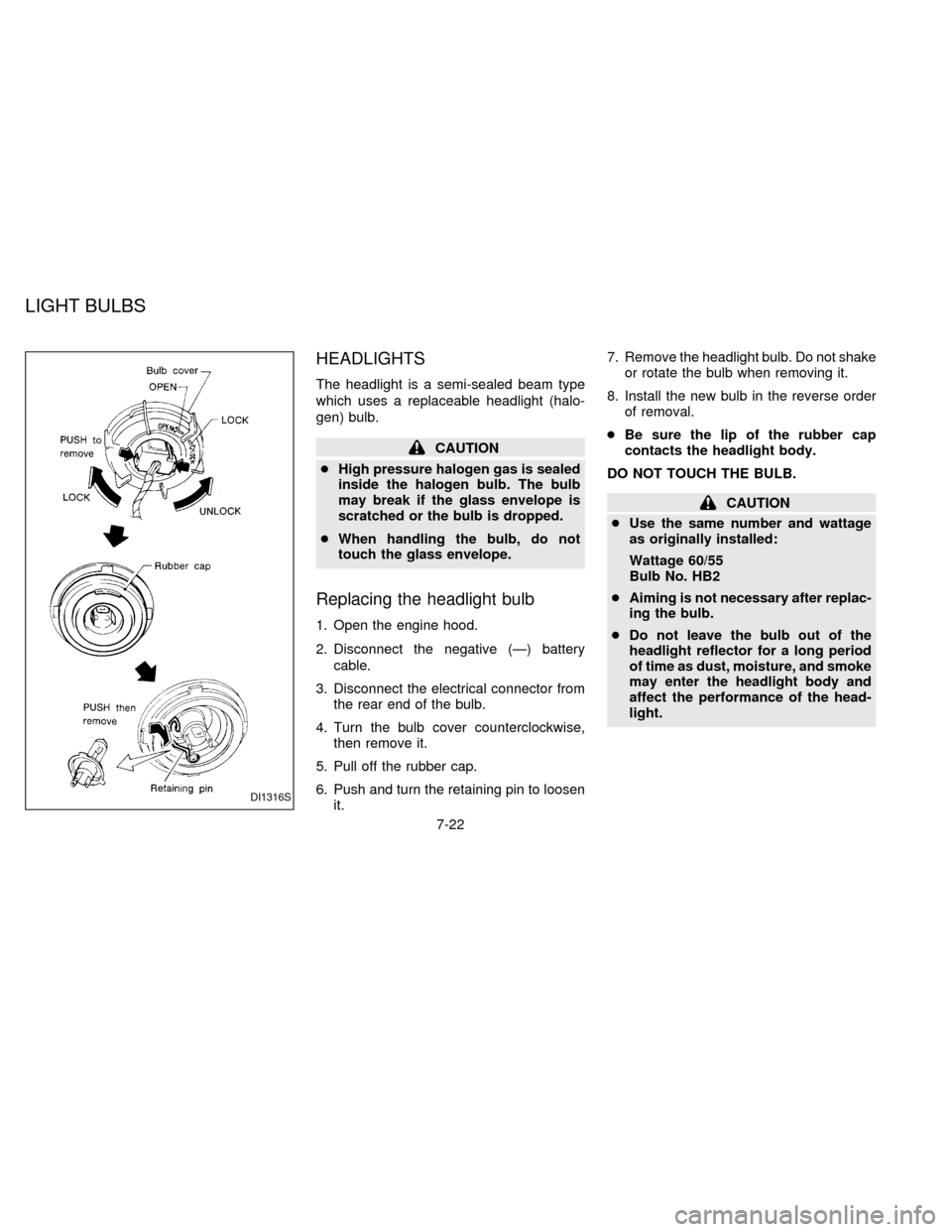
HEADLIGHTS
The headlight is a semi-sealed beam type
which uses a replaceable headlight (halo-
gen) bulb.
CAUTION
cHigh pressure halogen gas is sealed
inside the halogen bulb. The bulb
may break if the glass envelope is
scratched or the bulb is dropped.
cWhen handling the bulb, do not
touch the glass envelope.
Replacing the headlight bulb
1. Open the engine hood.
2. Disconnect the negative (Ð) battery
cable.
3. Disconnect the electrical connector from
the rear end of the bulb.
4. Turn the bulb cover counterclockwise,
then remove it.
5. Pull off the rubber cap.
6. Push and turn the retaining pin to loosen
it.7. Remove the headlight bulb. Do not shake
or rotate the bulb when removing it.
8. Install the new bulb in the reverse order
of removal.
cBe sure the lip of the rubber cap
contacts the headlight body.
DO NOT TOUCH THE BULB.
CAUTION
cUse the same number and wattage
as originally installed:
Wattage 60/55
Bulb No. HB2
cAiming is not necessary after replac-
ing the bulb.
cDo not leave the bulb out of the
headlight reflector for a long period
of time as dust, moisture, and smoke
may enter the headlight body and
affect the performance of the head-
light.
DI1316S
LIGHT BULBS
7-22
ZX
Page 167 of 203

Tire rotation*Ð Tires should be rotated
every 7,500 miles (12,000 km).
Wheel alignment and balanceÐIfthe
vehicle should pull to either side while driv-
ing on a straight and level road, or if you
detect uneven or abnormal tire wear, there
may be a need for wheel alignment.
If the steering wheel or seat vibrates at
normal highway speeds, wheel balancing
may be needed.
Windshield wiper blades*Ð Check for
cracks or wear if they do not wipe properly.
Doors and engine hoodÐ Check that all
doors and the engine hood operate prop-
erly. Also ensure all latches lock securely.
Lubricate hinges, latches, rollers and links if
necessary. Make sure the secondary latch
keeps the hood from opening when the
primary latch is released.
When driving in areas using road salt or
other corrosive materials, check lubrication
frequently.
Lights*Ð Make sure the headlights, stop
lights, tail lights, turn signal lights, and other
lights are all operating properly and installed
securely. Also check headlight aim.INSIDE THE VEHICLE
The maintenance items listed here should
be checked on a regular basis, such as
when performing periodic maintenance,
cleaning the vehicle, etc.
Warning lights and chimesÐ Make sure
all warning lights and buzzers/chimes are
operating properly.
Windshield wiper and washer*Ð Check
that the wipers and washer operate properly
and that the wipers do not streak.
Windshield defrosterÐ Check that the air
comes out of the defroster outlets properly
and in sufficient quantity when operating the
heater or air conditioner.
Steering wheelÐ Check for changes in
the steering conditions, such as excessive
freeplay, hard steering or strange noises.
SeatsÐ Check seat position controls such
as seat adjusters, seatback recliner, etc. to
ensure they operate smoothly and all
latches lock securely in every position.
Check that the head restraints move up and
down smoothly and the locks (if so
equipped) hold securely in all latched posi-
tions.Seat beltsÐ Check that all parts of the seat
belt system (for example, buckles, anchors,
adjusters and retractors) operate properly
and smoothly, and are installed securely.
Check the belt webbing for cuts, fraying,
wear or damage.
Accelerator pedalÐ Check the pedal for
smooth operation and make sure the pedal
does not catch or require uneven effort.
Keep the floor mats away from the pedal.
Clutch pedal*Ð Make sure the pedal
operates smoothly and check that it has the
proper free travel.
BrakesÐ Check that the brakes do not pull
the vehicle to one side when applied.
Brake pedal*Ð Check the pedal for
smooth operation and make sure it has the
proper distance under it when depressed
fully. Check the brake booster function. Be
certain to keep floor mats away from the
pedal.
Parking brake*Ð Check that the lever has
the proper travel and confirm that your
vehicle is held securely on a fairly steep hill
with only the parking brake applied.
8-3
ZX
Page 192 of 203

it has an abnormal nose-up or nose- down
condition; check for improper tongue load,
overload, worn suspension or other pos-
sible causes of either condition.
cAlways secure items in the trailer to
prevent load shifts while driving.
cBe certain your rear view mirrors conform
to all federal, state or local regulations. If
not, install any mirrors required for towing
before driving the vehicle.
Trailer towing tips
In order to gain skill and an understanding
of the vehicle's behavior, you should prac-
tice turning, stopping and backing up in an
area which is free from traffic. Steering
stability and braking performance will be
somewhat different than under normal driv-
ing conditions.
cAlways secure items in the trailer to
prevent load shift while driving.
cAvoid abrupt starts, acceleration or
stops.
cAvoid sharp turns or lane changes.
cAlways drive your vehicle at a moderate
speed.cAlways block the wheels on both vehicle
and trailer when parking. Parking on a
slope is not recommended; however, if
you must do so, and if your vehicle is
equipped with an automatic transmis-
sion, first block the wheels and apply the
parking brake, and then move the shift
lever into the P position. If you move the
shift lever to the P position before block-
ing the wheels and applying the parking
brake, transmission damage could occur.
cWhen going down a hill, shift into a lower
gear and use the engine braking effect.
When ascending a long grade, downshift
the transmission to a lower gear and
reduce speed to reduce chances of en-
gine overloading and/or overheating.
cIf the engine coolant rises to an ex-
tremely high temperature when the air
conditioner system is on, turn off the air
conditioner. Coolant heat can be addi-
tionally vented by opening the windows,
switching the fan control to high and
setting the temperature control to the
HOT position.
cTrailer towing requires more fuel than
normal circumstances.cAvoid towing a trailer for the first 500
miles (800 km).
cHave your vehicle serviced more often
than at intervals specified in the recom-
mended Maintenance Schedule.
cWhen making a turn, your trailer wheels
will be closer to the inside of the turn than
your vehicle wheels. To compensate for
this, make a larger than normal turning
radius during the turn.
cCrosswinds and rough roads will ad-
versely affect vehicle/trailer handling,
possibly causing vehicle sway. When
being passed by larger vehicles, be pre-
pared for possible changes in crosswinds
that could affect vehicle handling. If
swaying does occur, firmly grip the steer-
ing wheel, steer straight ahead, and im-
mediately (but gradually) reduce vehicle
speed. This combination will help stabi-
lize the vehicle. Never increase speed.
cBe careful when passing other vehicles.
Passing while towing a trailer requires
considerably more distance than normal
passing. Remember the length of the
trailer must also pass the other vehicle
before you can safely change lanes.
9-17
ZX
Page 198 of 203

10 Index
A
Adjustment after headlamp assembly
replacement ............................................... 7-24
Air bag (See supplemental restraint system)
Air bag warning light .......................... 1-6, 2-18
Air cleaner housing filter ............................ 7-16
Air conditioner
Air conditioner (Automatic) ..................... 3-8
Air conditioner (Manual) ......................... 3-2
Air conditioner-servicing ............................ 3-10
Air conditioner specification label .............. 9-12
Air conditioner system refrigerant and
lubrication recommendations ....................... 9-7
Alarm system (See Theft warning system)
Anchor point locations ............................... 2-31
Antenna
Manual .................................................. 3-23
Power.................................................... 3-22
Anti-lock brake system (ABS) .................. 4-17
Anti-lock brake warning light ....................... 1-7
Ash tray (See cigarette lighter (accessory)
and ash tray)
Audio system
AM-FM radio with cassette player ........ 3-12
AM-FM radio with cassette player and
compact disc player.............................. 3-17Automatic
Automatic air conditioner operation ........ 3-8
Automatic power window switch .......... 1-17
Automatic transmission fluid ................... 7-9
Driving with automatic transmission ....... 4-6
B
Battery........................................................ 7-13
Battery replacement..................................... 2-6
Before starting the engine ........................... 4-5
Belts
Inspection ............................................ 7-14
Size ......................................................... 9-8
Brake
Anti-lock brake system (ABS) .............. 4-17
Brake and clutch fluid ........................... 7-11
Brake booster ....................................... 7-19
Brake light (See stop light)
Brake pedal .......................................... 7-18
Brake system ........................................ 4-16
Brake warning light ................................. 1-6
Brake wear indicators ................... 1-7, 7-19
Parking brake check ............................. 7-18
Parking brake operation ....................... 4-11
Break-in schedule ...................................... 4-14
Bulb check/instrument panel ....................... 1-5
Bulb replacement ....................................... 7-25C
Capacities and recommended
fuel/lubricants ............................................... 9-2
Cargo (See vehicle loading information)
Cassette player (See audio system)
CB radio or car phone ............................... 3-23
Check engine indicator light (See Malfunction
indicator light)
Child restraints for infants and small
children ...................................................... 2-30
Child safety rear door lock .......................... 2-4
Cigarette lighter (accessory) and ash
tray ............................................................. 1-15
Cleaning exterior and interior ...................... 6-2
Clock Ð instrument panel ......................... 1-20
Clock-radio ................................................. 3-11
Clutch pedal ............................................... 7-20
Cold weather driving ................................. 4-18
Compact disc (CD) player operation ......... 3-21
Controls
Audio controls ............................. 3-12, 3-17
Heater and air conditioner (automatic) ... 3-8
Heater and air conditioner (manual)....... 3-2
Coolant
Capacities and recommended
fuel/lubricants.......................................... 9-2
Changing engine coolant........................ 7-5
ZX
Page 199 of 203

Checking engine coolant level ............... 7-4
Engine coolant temperature gauge ........ 1-4
Cornering light ........................................... 1-13
Corrosion protection .................................... 6-5
Cruise control............................................. 4-12
Cup holder ................................................. 1-16
D
Daytime running light system
(for Canada)............................................... 1-13
Defogger switch
Rear window defogger switch .............. 1-10
Dimensions and weights.............................. 9-9
Door locks .................................................... 2-2
Door open warning light .............................. 1-6
Drive belts .................................................. 7-14
Driving
Cold weather driving............................. 4-18
Driving with automatic transmission ....... 4-6
Driving with manual transmission ........... 4-9
Precautions when starting and driving ... 4-2
E
Economy - fuel........................................... 4-14
Emission control information label............. 9-12
Emission control system warranty ............. 9-19
Engine
Before starting the engine ...................... 4-5
Capacities and recommendedfuel/lubricants.......................................... 9-2
Changing engine coolant........................ 7-5
Changing engine oil................................ 7-8
Changing engine oil filter........................ 7-9
Checking engine coolant level ............... 7-4
Checking engine oil level ....................... 7-7
Engine compartment check locations .... 7-3
Engine coolant temperature gauge ........ 1-4
Engine cooling system ........................... 7-4
Engine oil ................................................ 7-7
Engine oil and oil filter
recommendation ..................................... 9-5
Engine oil pressure warning light ........... 1-5
Engine oil viscosity ................................. 9-6
Engine serial number ........................... 9-11
Engine specifications .............................. 9-8
Starting the engine ............................... 4-10
Exhaust gas (carbon monoxide).................. 4-2
Explanation of maintenance items ............ 8-10
F
Flashers (See hazard warning flasher switch)
Flat tire ......................................................... 5-2
Floor mat positioning aid ............................. 6-5
Fluid (checking)
Automatic transmission fluid (ATF) ........ 7-9
Brake and clutch fluid ........................... 7-11
Engine coolant ........................................ 7-4
Engine oil ................................................ 7-7
Power steering fluid .............................. 7-11
Window washer fluid ............................ 7-12F.M.V.S.S. certification label ..................... 9-11
Front fog light switch ................................. 1-14
Front seats ................................................. 2-12
Fuel
Capacities and recommended
fuel/lubricants.......................................... 9-2
Fuel economy ....................................... 4-14
Fuel filler cap ........................................ 2-11
Fuel filler lid lock operation .................. 2-10
Fuel octane rating................................... 9-3
Fuel recommendation ............................. 9-3
Fuses ......................................................... 7-20
Fusible links ............................................... 7-21
G
Gas station information.............................. 10-6
Gauge
Engine coolant temperature gauge ........ 1-4
Fuel gauge.............................................. 1-4
Odometer ................................................ 1-3
Speedometer .......................................... 1-3
Tachometer............................................. 1-3
Trip odometer ......................................... 1-3
Gear selection (See shifting)
General maintenance .................................. 8-2
Glove box..................................................... 2-8
H
Hazard warning flasher switch .................. 1-14
10-2
ZX
Page 200 of 203

Headlight and turn signal switch ............... 1-12
Headlights .................................................. 7-22
Head restraints .......................................... 2-14
Heater and air conditioner
Heater and air conditioner controls
(automatic) .............................................. 3-8
Heater and air conditioner controls
(manual).................................................. 3-2
Hood release ............................................... 2-8
I
Ignition switch .............................................. 4-4
Indicator lights and chimes (See warning/
indicator lights and chimes)
Inside mirror ............................................... 2-38
Instrument brightness control .................... 1-14
Interior light ................................................ 1-20
J
Jump starting ............................................... 5-7
K
Key ............................................................... 2-2L
Labels
Air conditioner specification label ......... 9-12
Emission control information label........ 9-12
Engine serial number ........................... 9-11
F.M.V.S.S.certification label ................. 9-11
Vehicle identification number plate ...... 9-10
Warning labels (for SRS) ..................... 2-21
License plate
Installing front license plate .................. 9-13
Light
Brake light (See stop light)
Bulb check/instrument panel .................. 1-5
Bulb replacement.................................. 7-25
Cornering light ...................................... 1-13
Front fog light switch ........................... 1-14
Headlight and turn signal switch .......... 1-12
Headlights ............................................. 7-22
Interior light ........................................... 1-20
Light bulbs ............................................ 7-22
Spotlight ................................................ 1-21
Supplemental air bag warning
light ................................................ 1-6, 2-18
Trunk light ............................................. 1-21
Warning/indicator lights and chimes ...... 1-5
Lock
Child safety rear door lock ..................... 2-4
Door locks............................................... 2-2
Fuel filler lid lock operation .................... 2-7
Glove box ............................................... 2-5
Power door lock...................................... 2-3Trunk lid lock operation .......................... 2-6
Luggage (See vehicle loading information)
M
Maintenance
General maintenance ............................. 8-2
Inside the vehicle.................................... 8-3
Outside the vehicle ................................. 8-2
Periodic maintenance schedules ............ 8-5
Seat belt maintenance.......................... 2-30
Under the hood and vehicle ................... 8-4
Malfunction indicator light ............................ 1-8
Manual antenna ......................................... 3-23
Manual transmission
Driving with manual transmission ........... 4-9
Manual transmission fluid ....................... 8-9
Manual windows ........................................ 1-15
Map light (See spotlight)
Meters and gauges ...................................... 1-2
Mirror
Inside mirror.......................................... 2-38
Outside mirror remote control .............. 2-37
Outside mirrors ..................................... 2-37
Vanity mirror ......................................... 2-38
Multi-remote control system ........................ 2-4
O
Octane rating (See fuel)
Odometer ..................................................... 1-3
10-3
ZX
Page 201 of 203

Oil
Capacities and recommended
fuel/lubricants.......................................... 9-2
Changing engine oil................................ 7-8
Changing engine oil filter........................ 7-9
Checking engine oil level ....................... 7-7
Engine oil ................................................ 7-7
Engine oil and oil filter
recommendation ..................................... 9-5
Opener lever for trunk lid........................... 2-10
Outside mirror remote control.................... 2-37
Outside mirrors .......................................... 2-37
Overdrive switch .......................................... 4-8
Overheat
If your vehicle overheats ........................ 5-9
Owner's manuals/service manual
order form .................................................. 9-21
P
Parking
Parking brake check ............................. 7-18
Parking brake operation ....................... 4-11
Parking/parking on hills ........................ 4-15
Periodic maintenance schedules ................. 8-5
Power
Power antenna ..................................... 3-22
Power door lock...................................... 2-3
Power steering fluid .............................. 7-11
Power steering system ......................... 4-16
Power windows..................................... 1-17
Rear power windows ............................ 1-18Precautions
Maintenance precautions ....................... 7-2
Precautions on seat belt usage............ 2-23
Precautions when starting and driving ... 4-2
Push starting ................................................ 5-9
Q
Quick reference (See gas station information)
R
Radio
AM-FM radio with cassette player ........ 3-12
AM-FM radio with cassette player and
compact disc player.............................. 3-17
CB radio or car phone .......................... 3-23
Readiness for inspection maintenance
(I/M) test..................................................... 9-20
Rear seat ................................................... 2-15
Rear window defogger switch ................... 1-11
Refrigerant recommendation ....................... 9-7
Registering your vehicle in another
country ....................................................... 9-10
Reporting safety defects (USA) ................. 9-19
S
Safety
Child safety rear door lock ..................... 2-4
Reporting safety defects (USA) ............ 9-19Seat adjustment ......................................... 2-12
Seat belt
Precautions on seat belt usage............ 2-20
Seat belt extenders .............................. 2-30
Seat belt maintenance.......................... 2-30
Seat belts.............................................. 2-23
Seat belt warning light ............................ 1-6
2-point type without retractor................ 2-28
3-point type with retractor..................... 2-26
Seats
Front seats............................................ 2-12
Rear seat .............................................. 2-15
Service manual/owner's manual
order form .................................................. 9-21
Shifting
Automatic transmission .......................... 4-7
Manual transmission............................... 4-9
Spark plug replacement............................. 7-15
Speedometer ............................................... 1-3
Spotlight ..................................................... 1-21
SRS warning labels ................................... 2-18
Starting
Before starting the engine ...................... 4-5
Jump starting .......................................... 5-7
Precautions when starting and driving ... 4-2
Push starting........................................... 5-9
Starting the engine .............................. 4-10
Steering
Power steering fluid .............................. 7-11
Tilting steering wheel............................ 2-37
Stop light .................................................... 7-28
Sunroof ...................................................... 1-18
10-4
ZX