Page 136 of 203

f. Wait 10 seconds before turning ignition
switch OFF.
cManual air conditioning
a. Turn the ignition switch ON and set the
temperature control lever to the maxi-
mum hot position. Wait 10 seconds, then
turn the switch OFF.
2. Open the radiator drain plug. Open the
drain plug on the engine water pipe.
3. Open the radiator cap to drain the cool-
ant.
4. Flush the cooling system by running
fresh water through the radiator.
5. Close the radiator drain plug and the
drain plug on the engine water pipe se-
curely.
6. See the ``Technical and consumer infor-
mation'' section for cooling system ca-
pacity. Fill the radiator slowly with the
proper mixture of coolant and water. Fill
the reservoir tank up to the MAX level.
7. Open and close the air release plug to
release air. Then fill the radiator again
and install the radiator cap.8. Start the engine and warm it up until it
reaches normal operating temperature.
Then race the engine 2 or 3 times under
no load. Watch the coolant temperature
gauge for signs of overheating.
9. Stop the engine. After it completely cools
down, refill the radiator up to the filler
opening. Fill the reservoir tank up to the
MAX level.
10. Open and close the air release plug to
release air. Then fill the radiator again
and install the radiator cap.11. Check the radiator drain plug and the
drain plug on the engine water pipe for
any sign of leakage, tighten if neces-
sary.
DI1351DI1299
7-6
ZX
Page 144 of 203
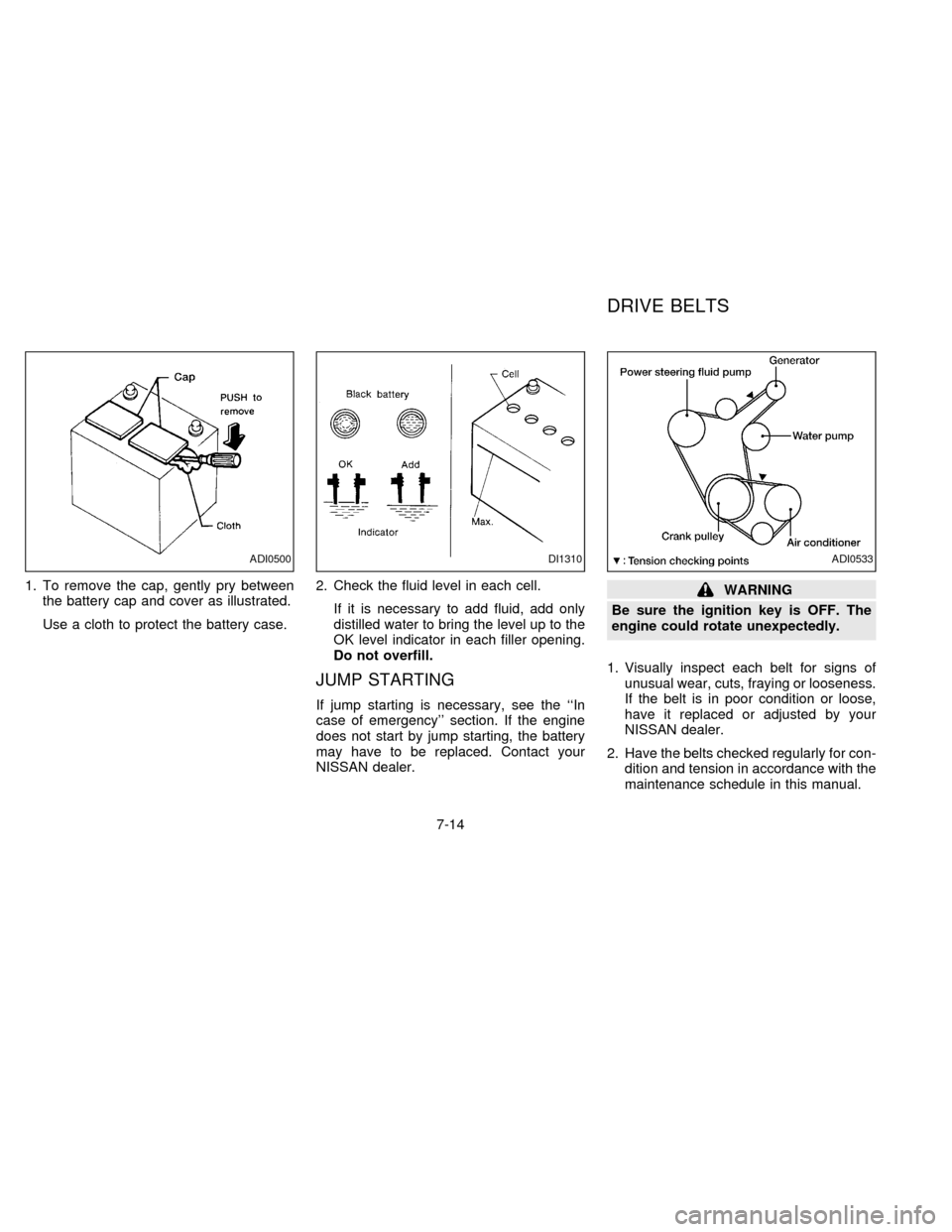
1. To remove the cap, gently pry between
the battery cap and cover as illustrated.
Use a cloth to protect the battery case.2. Check the fluid level in each cell.
If it is necessary to add fluid, add only
distilled water to bring the level up to the
OK level indicator in each filler opening.
Do not overfill.
JUMP STARTING
If jump starting is necessary, see the ``In
case of emergency'' section. If the engine
does not start by jump starting, the battery
may have to be replaced. Contact your
NISSAN dealer.
WARNING
Be sure the ignition key is OFF. The
engine could rotate unexpectedly.
1. Visually inspect each belt for signs of
unusual wear, cuts, fraying or looseness.
If the belt is in poor condition or loose,
have it replaced or adjusted by your
NISSAN dealer.
2. Have the belts checked regularly for con-
dition and tension in accordance with the
maintenance schedule in this manual.
ADI0500DI1310ADI0533
DRIVE BELTS
7-14
ZX
Page 145 of 203
WARNING
Be sure the engine and ignition switch
are off and that the parking brake is
engaged securely.
CAUTION
Be sure to use the correct socket to
remove the plugs. An incorrect socket
can cause damage.1. Remove brackets as necessary to give
access to the high tension spark plug
cables and spark plugs.
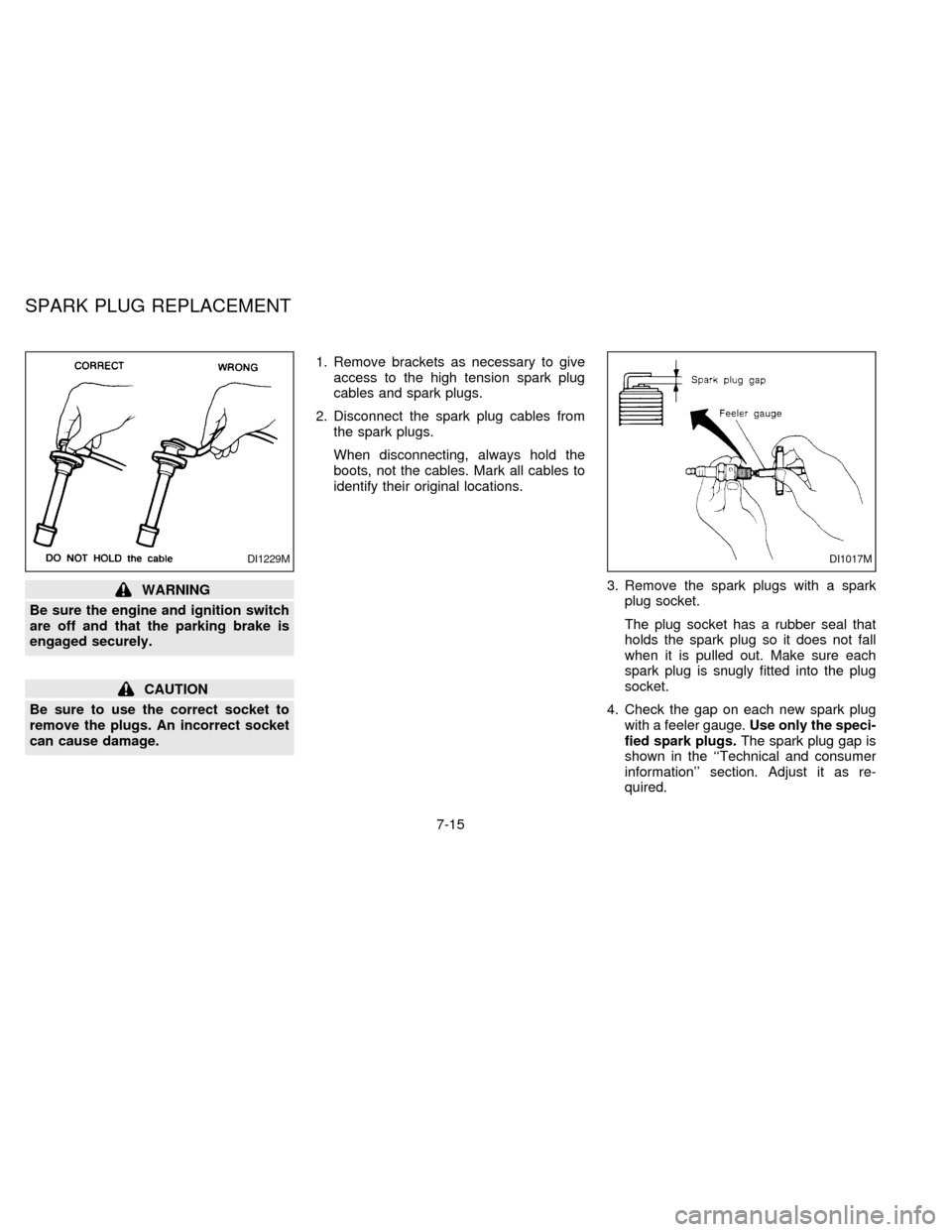
2. Disconnect the spark plug cables from
the spark plugs.
When disconnecting, always hold the
boots, not the cables. Mark all cables to
identify their original locations.
3. Remove the spark plugs with a spark
plug socket.
The plug socket has a rubber seal that
holds the spark plug so it does not fall
when it is pulled out. Make sure each
spark plug is snugly fitted into the plug
socket.
4. Check the gap on each new spark plug
with a feeler gauge.Use only the speci-
fied spark plugs.The spark plug gap is
shown in the ``Technical and consumer
information'' section. Adjust it as re-
quired.
DI1229MDI1017M
SPARK PLUG REPLACEMENT
7-15
ZX
Page 150 of 203
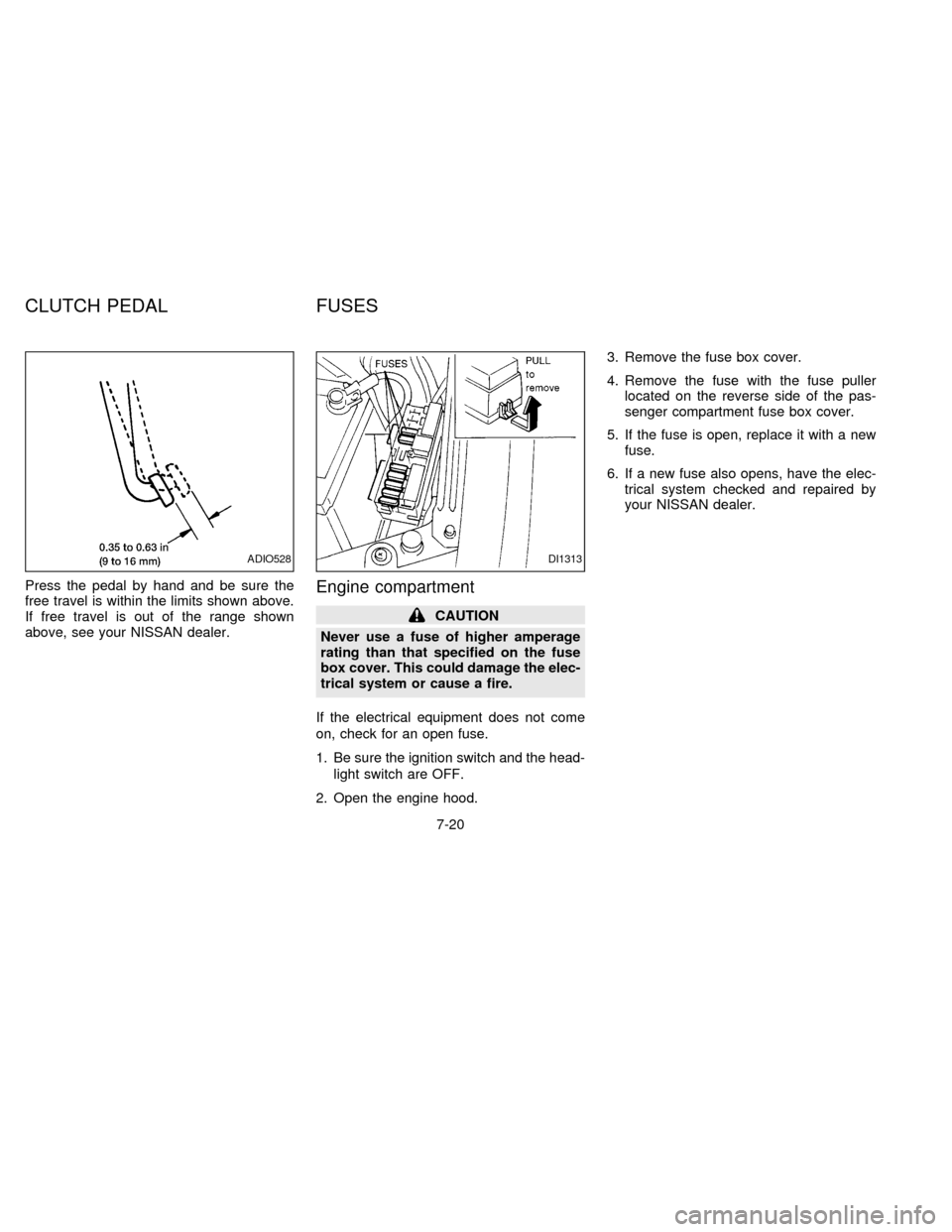
Press the pedal by hand and be sure the
free travel is within the limits shown above.
If free travel is out of the range shown
above, see your NISSAN dealer.Engine compartment
CAUTION
Never use a fuse of higher amperage
rating than that specified on the fuse
box cover. This could damage the elec-
trical system or cause a fire.
If the electrical equipment does not come
on, check for an open fuse.
1. Be sure the ignition switch and the head-
light switch are OFF.
2. Open the engine hood.3. Remove the fuse box cover.
4. Remove the fuse with the fuse puller
located on the reverse side of the pas-
senger compartment fuse box cover.
5. If the fuse is open, replace it with a new
fuse.
6. If a new fuse also opens, have the elec-
trical system checked and repaired by
your NISSAN dealer.
ADIO528DI1313
CLUTCH PEDAL FUSES
7-20
ZX
Page 151 of 203
Passenger compartment
CAUTION
Never use a fuse of higher amperage
rating than that specified on the fuse
box cover. This could damage the elec-
trical system or cause a fire.
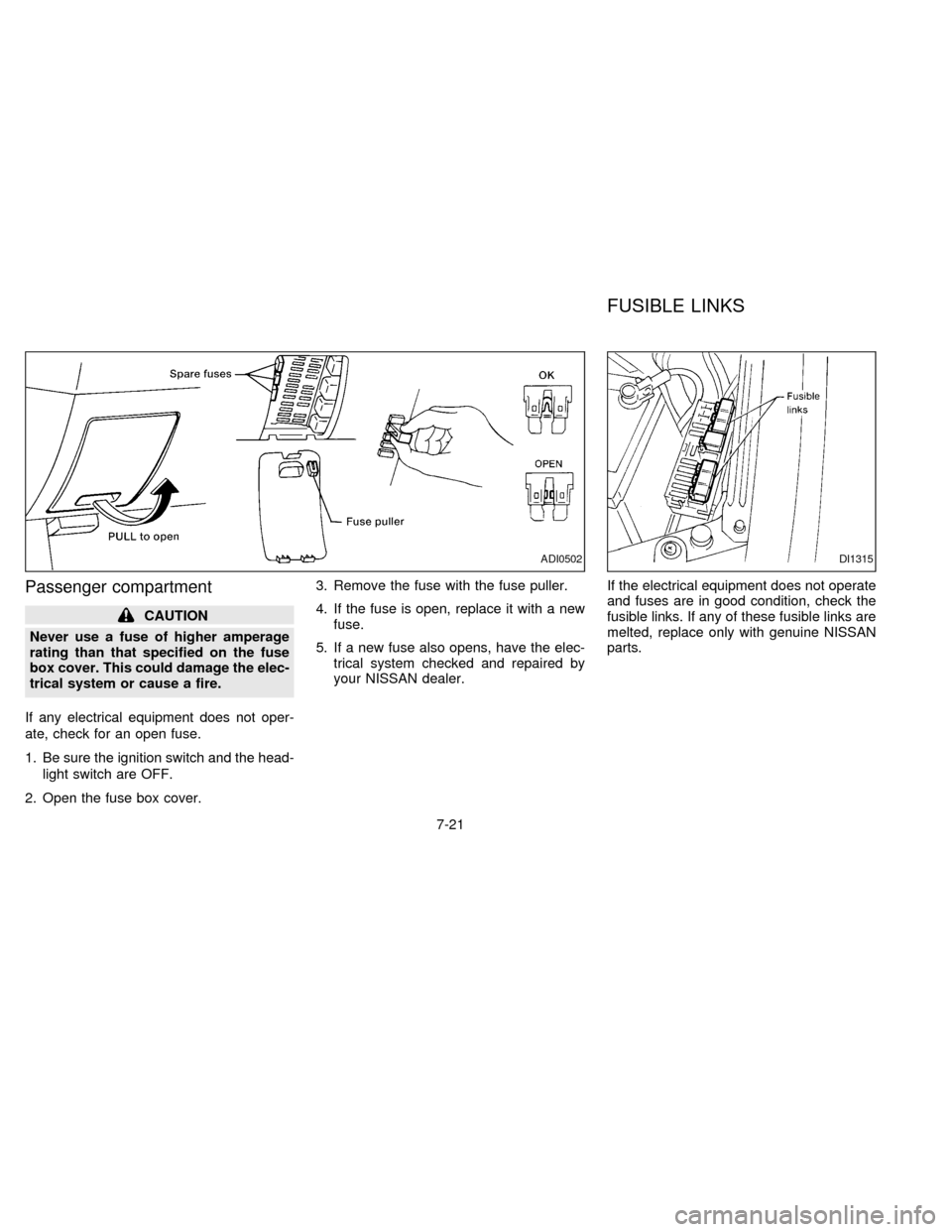
If any electrical equipment does not oper-
ate, check for an open fuse.
1. Be sure the ignition switch and the head-
light switch are OFF.
2. Open the fuse box cover.3. Remove the fuse with the fuse puller.
4. If the fuse is open, replace it with a new
fuse.
5. If a new fuse also opens, have the elec-
trical system checked and repaired by
your NISSAN dealer.If the electrical equipment does not operate
and fuses are in good condition, check the
fusible links. If any of these fusible links are
melted, replace only with genuine NISSAN
parts.
ADI0502DI1315
FUSIBLE LINKS
7-21
ZX
Page 179 of 203

of at least 87 AKI (Anti-Knock Index) num-
ber. However, you may use unleaded gaso-
line with an octane rating as low as 85 AKI
(Anti-Knock Index) number in high altitude
areas [over 4,000 ft (1,219 m)] such as:
Colorado, Montana, New Mexico, Utah,
Wyoming, northeastern Nevada, southern
Idaho, western South Dakota, western Ne-
braska, and that part of Texas which is
directly south of New Mexico.
Using unleaded gasoline with an octane
rating lower than stated above can cause
persistent, heavy ``spark knock.''
(``Spark knock'' is a metallic rapping
noise.) If severe, this can lead to engine
damage. If you detect a persistent heavy
spark knock even when using gasoline
of the stated octane rating, or if you hear
steady spark knock while holding a
steady speed on level roads, have your
dealer correct the condition. Failure to
correct the condition is misuse of the
vehicle, for which NISSAN is not respon-
sible.
Incorrect ignition timing results in knocking,
after-run or overheating. This in turn may
cause excessive fuel consumption or dam-
age to the engine. If any of the abovesymptoms are encountered, have your ve-
hicle checked at a NISSAN dealer or other
competent service facility.
However, now and then you may notice
light spark knock for a short time while
accelerating or driving up hills. This is
no cause for concern, because you get
the greatest fuel benefit when there is
light spark knock for a short time under
heavy engine load.
9-4
ZX
Page 183 of 203
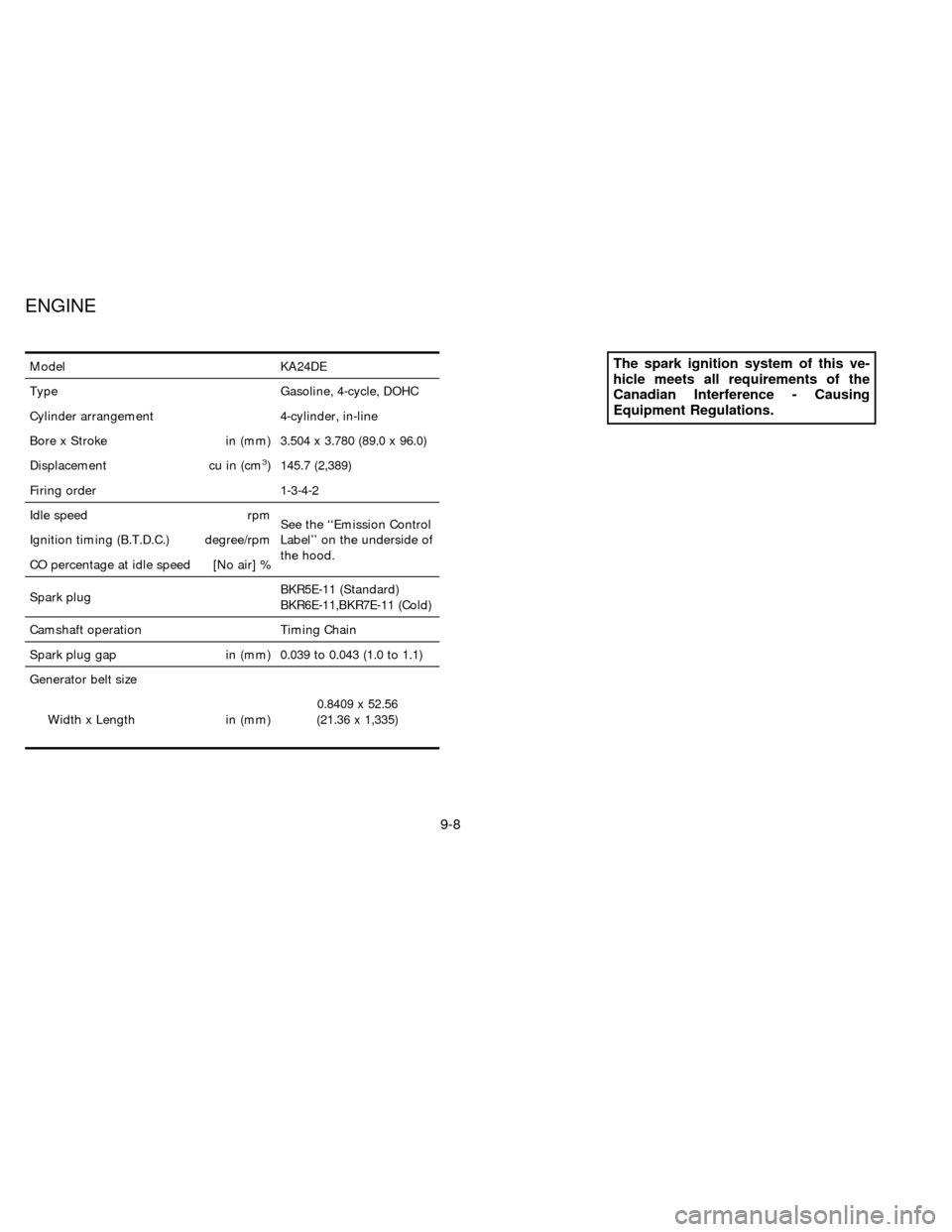
Model KA24DE
Type Gasoline, 4-cycle, DOHC
Cylinder arrangement 4-cylinder, in-line
Bore x Stroke in (mm) 3.504 x 3.780 (89.0 x 96.0)
Displacement cu in (cm
3) 145.7 (2,389)
Firing order 1-3-4-2
Idle speed rpm
See the ``Emission Control
Label'' on the underside of
the hood. Ignition timing (B.T.D.C.) degree/rpm
CO percentage at idle speed [No air] %
Spark plugBKR5E-11 (Standard)
BKR6E-11,BKR7E-11 (Cold)
Camshaft operation Timing Chain
Spark plug gap in (mm) 0.039 to 0.043 (1.0 to 1.1)
Generator belt size
Width x Length in (mm)0.8409 x 52.56
(21.36 x 1,335)
The spark ignition system of this ve-
hicle meets all requirements of the
Canadian Interference - Causing
Equipment Regulations.
ENGINE
9-8
ZX
Page 200 of 203
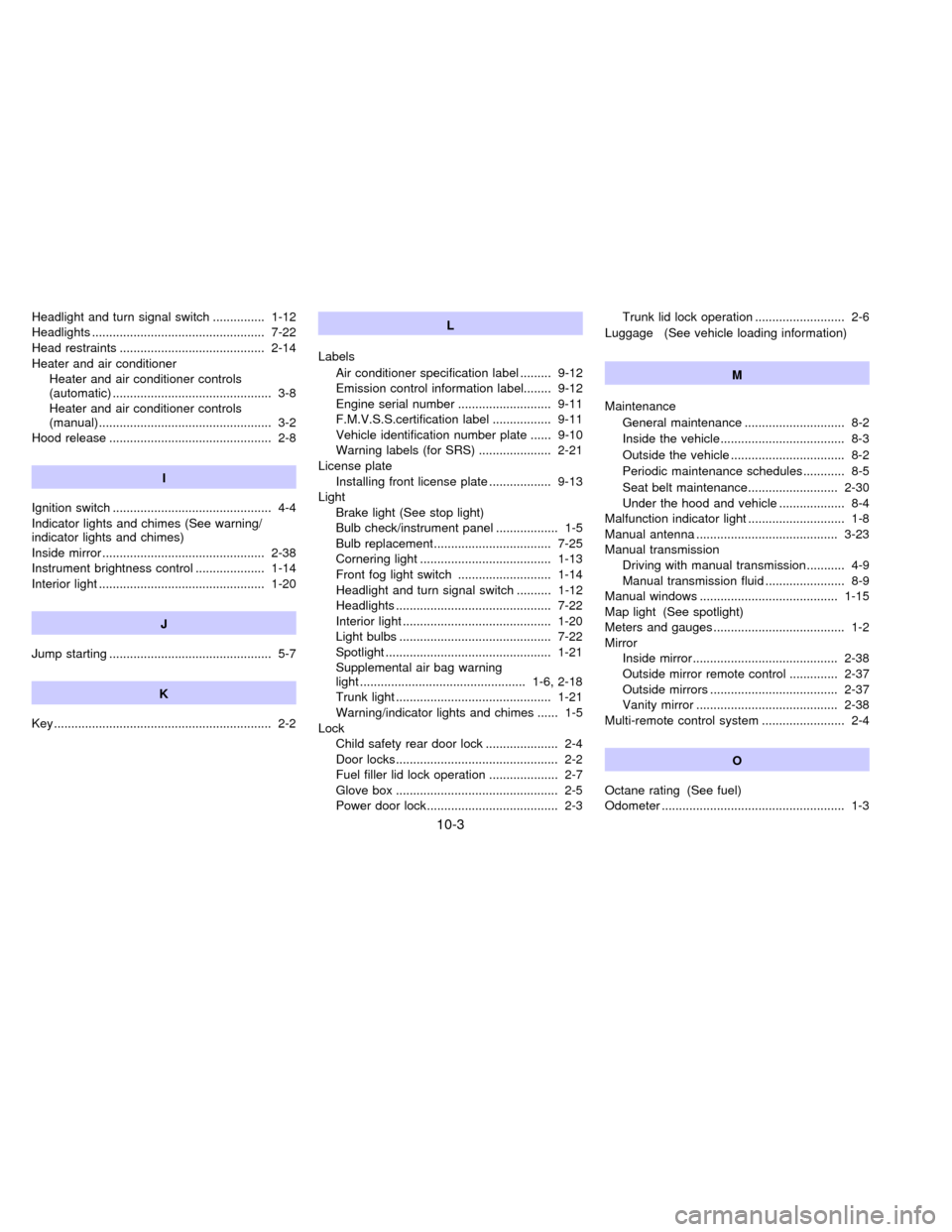
Headlight and turn signal switch ............... 1-12
Headlights .................................................. 7-22
Head restraints .......................................... 2-14
Heater and air conditioner
Heater and air conditioner controls
(automatic) .............................................. 3-8
Heater and air conditioner controls
(manual).................................................. 3-2
Hood release ............................................... 2-8
I
Ignition switch .............................................. 4-4
Indicator lights and chimes (See warning/
indicator lights and chimes)
Inside mirror ............................................... 2-38
Instrument brightness control .................... 1-14
Interior light ................................................ 1-20
J
Jump starting ............................................... 5-7
K
Key ............................................................... 2-2L
Labels
Air conditioner specification label ......... 9-12
Emission control information label........ 9-12
Engine serial number ........................... 9-11
F.M.V.S.S.certification label ................. 9-11
Vehicle identification number plate ...... 9-10
Warning labels (for SRS) ..................... 2-21
License plate
Installing front license plate .................. 9-13
Light
Brake light (See stop light)
Bulb check/instrument panel .................. 1-5
Bulb replacement.................................. 7-25
Cornering light ...................................... 1-13
Front fog light switch ........................... 1-14
Headlight and turn signal switch .......... 1-12
Headlights ............................................. 7-22
Interior light ........................................... 1-20
Light bulbs ............................................ 7-22
Spotlight ................................................ 1-21
Supplemental air bag warning
light ................................................ 1-6, 2-18
Trunk light ............................................. 1-21
Warning/indicator lights and chimes ...... 1-5
Lock
Child safety rear door lock ..................... 2-4
Door locks............................................... 2-2
Fuel filler lid lock operation .................... 2-7
Glove box ............................................... 2-5
Power door lock...................................... 2-3Trunk lid lock operation .......................... 2-6
Luggage (See vehicle loading information)
M
Maintenance
General maintenance ............................. 8-2
Inside the vehicle.................................... 8-3
Outside the vehicle ................................. 8-2
Periodic maintenance schedules ............ 8-5
Seat belt maintenance.......................... 2-30
Under the hood and vehicle ................... 8-4
Malfunction indicator light ............................ 1-8
Manual antenna ......................................... 3-23
Manual transmission
Driving with manual transmission ........... 4-9
Manual transmission fluid ....................... 8-9
Manual windows ........................................ 1-15
Map light (See spotlight)
Meters and gauges ...................................... 1-2
Mirror
Inside mirror.......................................... 2-38
Outside mirror remote control .............. 2-37
Outside mirrors ..................................... 2-37
Vanity mirror ......................................... 2-38
Multi-remote control system ........................ 2-4
O
Octane rating (See fuel)
Odometer ..................................................... 1-3
10-3
ZX