1997 NISSAN ALTIMA engine coolant
[x] Cancel search: engine coolantPage 174 of 203

Additional information on the following
items marked with ``*'' is found in the
``Do-it- yourself operations'' section.
Emission control system
maintenance
Drive belts*Ð Check drive belts for wear,
fraying or cracking and also for proper ten-
sion. Replace the drive belts if damaged.
Air cleaner filterÐ Under normal driving
conditions, the air cleaner filter should be
replaced in accordance with the mainte-
nance schedule. However, driving the ve-
hicle in dusty areas may cause more rapid
clogging of the element. Consequently, the
element may have to be replaced more
frequently.
Vapor linesÐ Check vapor lines and con-
nections for failure or looseness. If leaks are
found, replace them.
Fuel linesÐ Check the fuel hoses, piping
and connections for leaks, looseness or
deterioration. Replace any parts if they are
damaged.
Fuel filterÐ If the vehicle is operated under
extremely adverse weather conditions or in
areas where ambient temperatures are ei-
ther extremely low or extremely high, the
filter might become clogged. In such an
event, replace the filter immediately.
Engine coolant*Ð Drain and flush the
cooling system.
Engine oil & oil filter*Ð Under normal
driving conditions, the engine oil and oil filter
should be replaced in accordance with the
maintenance schedule. However, under se-
vere driving conditions, they may have to be
replaced more frequently.
Spark plugs*Ð Replace with new plugs
having the correct heat range.
Intake & exhaust valve clearanceÐ Check
the valve clearance if valve noise increases.
Chassis and body maintenance
Brake lines & cablesÐ Check the brake
lines and hoses (including brake booster
vacuum hoses, connections & check valve)
and parking brake cables for proper attach-
ment, leaks, cracks, chafing, abrasion, de-
terioration, etc.
Brake pads, discs, drums & liningsÐ
Check these and the other neighboring brake
components for wear, deterioration and
leaks. Under severe driving conditions, theymay have to be inspected more frequently.
Manual & automatic transmission fluid*
Ð Check the fluid level and visually inspect
for signs of leakage.
Under severe driving conditions, the fluid
should be replaced at the specified interval.
Steering gear & linkage, axle & suspen-
sion parts, and drive shaft bootsÐ
Check for damage, looseness and leakage
of oil or grease. Under severe driving con-
ditions, more frequent inspection should be
performed.
Steering linkage ball joints & front sus-
pension ball jointsÐ Check the ball joints
for damage, looseness and grease leakage.
Exhaust systemÐ Visually check the ex-
haust pipes, muffler, and hangers for proper
attachment, leaks, cracks, chafing, abra-
sion, deterioration, etc. Under severe driv-
ing conditions, inspection should be per-
formed more frequently.
Supplemental air bag systemÐ Check
the supplemental air bag system compo-
nents for proper attachment, damage, de-
formities, cracks, rust, etc. Work around and
on the supplemental air bag system should
be done by an authorized NISSAN dealer.
EXPLANATION OF
MAINTENANCE ITEMS
8-10
ZX
Page 177 of 203
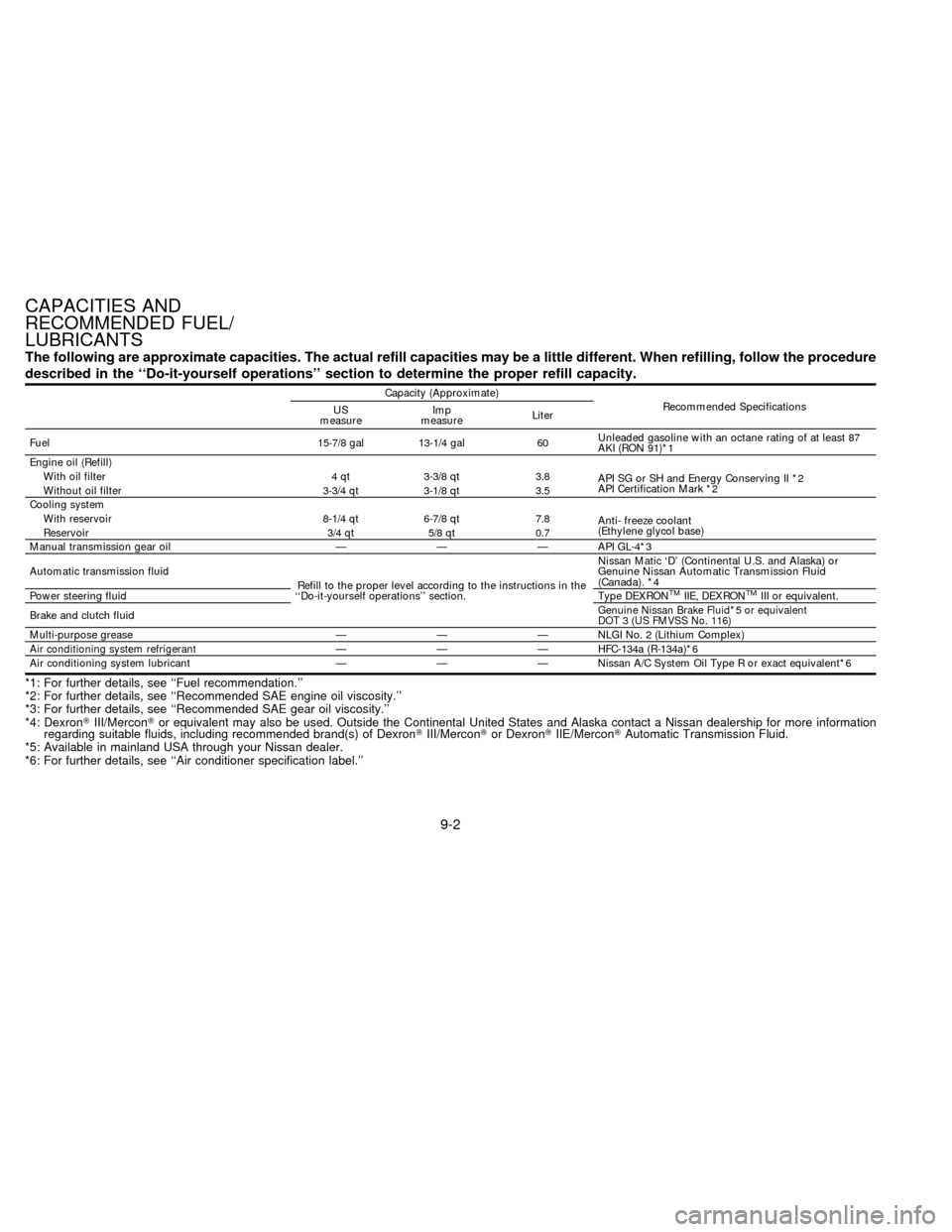
The following are approximate capacities. The actual refill capacities may be a little different. When refilling, follow the procedure
described in the ``Do-it-yourself operations'' section to determine the proper refill capacity.
Capacity (Approximate)
Recommended Specifications
US
measureImp
measureLiter
Fuel 15-7/8 gal 13-1/4 gal 60Unleaded gasoline with an octane rating of at least 87
AKI (RON 91)*1
Engine oil (Refill)
With oil filter 4 qt 3-3/8 qt 3.8
API SG or SH and Energy Conserving II *2
API Certification Mark *2
Without oil filter 3-3/4 qt 3-1/8 qt 3.5
Cooling system
With reservoir 8-1/4 qt 6-7/8 qt 7.8
Anti- freeze coolant
(Ethylene glycol base)
Reservoir 3/4 qt 5/8 qt 0.7
Manual transmission gear oil Ð Ð Ð API GL-4*3
Automatic transmission fluid
Refill to the proper level according to the instructions in the
``Do-it-yourself operations'' section.
Nissan Matic `D' (Continental U.S. and Alaska) or
Genuine Nissan Automatic Transmission Fluid
(Canada). *4
Power steering fluidType DEXRONTMIIE, DEXRONTMIII or equivalent.
Brake and clutch fluidGenuine Nissan Brake Fluid*5 or equivalent
DOT 3 (US FMVSS No. 116)
Multi-purpose grease Ð Ð Ð NLGI No. 2 (Lithium Complex)Air conditioning system refrigerantÐ Ð Ð HFC-134a (R-134a)*6
Air conditioning system lubricant Ð Ð Ð Nissan A/C System Oil Type R or exact equivalent*6
*1: For further details, see ``Fuel recommendation.''
*2: For further details, see ``Recommended SAE engine oil viscosity.''
*3: For further details, see ``Recommended SAE gear oil viscosity.''
*4: DexronTIII/MerconTor equivalent may also be used. Outside the Continental United States and Alaska contact a Nissan dealership for more information
regarding suitable fluids, including recommended brand(s) of DexronTIII/MerconTor DexronTIIE/MerconTAutomatic Transmission Fluid.
*5: Available in mainland USA through your Nissan dealer.
*6: For further details, see ``Air conditioner specification label.''
CAPACITIES AND
RECOMMENDED FUEL/
LUBRICANTS
9-2
ZX
Page 192 of 203

it has an abnormal nose-up or nose- down
condition; check for improper tongue load,
overload, worn suspension or other pos-
sible causes of either condition.
cAlways secure items in the trailer to
prevent load shifts while driving.
cBe certain your rear view mirrors conform
to all federal, state or local regulations. If
not, install any mirrors required for towing
before driving the vehicle.
Trailer towing tips
In order to gain skill and an understanding
of the vehicle's behavior, you should prac-
tice turning, stopping and backing up in an
area which is free from traffic. Steering
stability and braking performance will be
somewhat different than under normal driv-
ing conditions.
cAlways secure items in the trailer to
prevent load shift while driving.
cAvoid abrupt starts, acceleration or
stops.
cAvoid sharp turns or lane changes.
cAlways drive your vehicle at a moderate
speed.cAlways block the wheels on both vehicle
and trailer when parking. Parking on a
slope is not recommended; however, if
you must do so, and if your vehicle is
equipped with an automatic transmis-
sion, first block the wheels and apply the
parking brake, and then move the shift
lever into the P position. If you move the
shift lever to the P position before block-
ing the wheels and applying the parking
brake, transmission damage could occur.
cWhen going down a hill, shift into a lower
gear and use the engine braking effect.
When ascending a long grade, downshift
the transmission to a lower gear and
reduce speed to reduce chances of en-
gine overloading and/or overheating.
cIf the engine coolant rises to an ex-
tremely high temperature when the air
conditioner system is on, turn off the air
conditioner. Coolant heat can be addi-
tionally vented by opening the windows,
switching the fan control to high and
setting the temperature control to the
HOT position.
cTrailer towing requires more fuel than
normal circumstances.cAvoid towing a trailer for the first 500
miles (800 km).
cHave your vehicle serviced more often
than at intervals specified in the recom-
mended Maintenance Schedule.
cWhen making a turn, your trailer wheels
will be closer to the inside of the turn than
your vehicle wheels. To compensate for
this, make a larger than normal turning
radius during the turn.
cCrosswinds and rough roads will ad-
versely affect vehicle/trailer handling,
possibly causing vehicle sway. When
being passed by larger vehicles, be pre-
pared for possible changes in crosswinds
that could affect vehicle handling. If
swaying does occur, firmly grip the steer-
ing wheel, steer straight ahead, and im-
mediately (but gradually) reduce vehicle
speed. This combination will help stabi-
lize the vehicle. Never increase speed.
cBe careful when passing other vehicles.
Passing while towing a trailer requires
considerably more distance than normal
passing. Remember the length of the
trailer must also pass the other vehicle
before you can safely change lanes.
9-17
ZX
Page 195 of 203
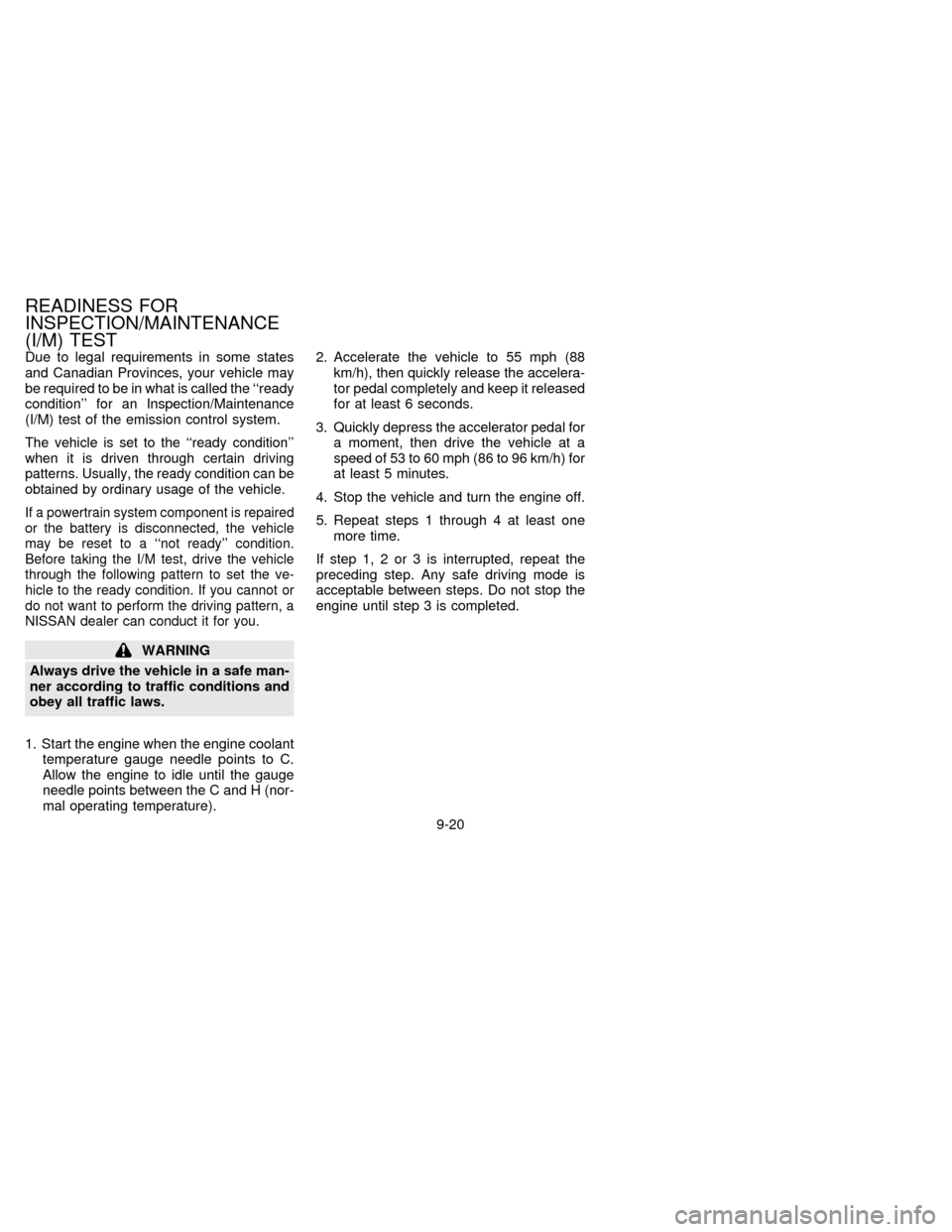
Due to legal requirements in some states
and Canadian Provinces, your vehicle may
be required to be in what is called the ``ready
condition'' for an Inspection/Maintenance
(I/M) test of the emission control system.
The vehicle is set to the ``ready condition''
when it is driven through certain driving
patterns. Usually, the ready condition can be
obtained by ordinary usage of the vehicle.
If a powertrain system component is repaired
or the battery is disconnected, the vehicle
may be reset to a ``not ready'' condition.
Before taking the I/M test, drive the vehicle
through the following pattern to set the ve-
hicle to the ready condition. If you cannot or
do not want to perform the driving pattern, a
NISSAN dealer can conduct it for you.
WARNING
Always drive the vehicle in a safe man-
ner according to traffic conditions and
obey all traffic laws.
1. Start the engine when the engine coolant
temperature gauge needle points to C.
Allow the engine to idle until the gauge
needle points between the C and H (nor-
mal operating temperature).2. Accelerate the vehicle to 55 mph (88
km/h), then quickly release the accelera-
tor pedal completely and keep it released
for at least 6 seconds.
3. Quickly depress the accelerator pedal for
a moment, then drive the vehicle at a
speed of 53 to 60 mph (86 to 96 km/h) for
at least 5 minutes.
4. Stop the vehicle and turn the engine off.
5. Repeat steps 1 through 4 at least one
more time.
If step 1, 2 or 3 is interrupted, repeat the
preceding step. Any safe driving mode is
acceptable between steps. Do not stop the
engine until step 3 is completed.
READINESS FOR
INSPECTION/MAINTENANCE
(I/M) TEST
9-20
ZX
Page 198 of 203
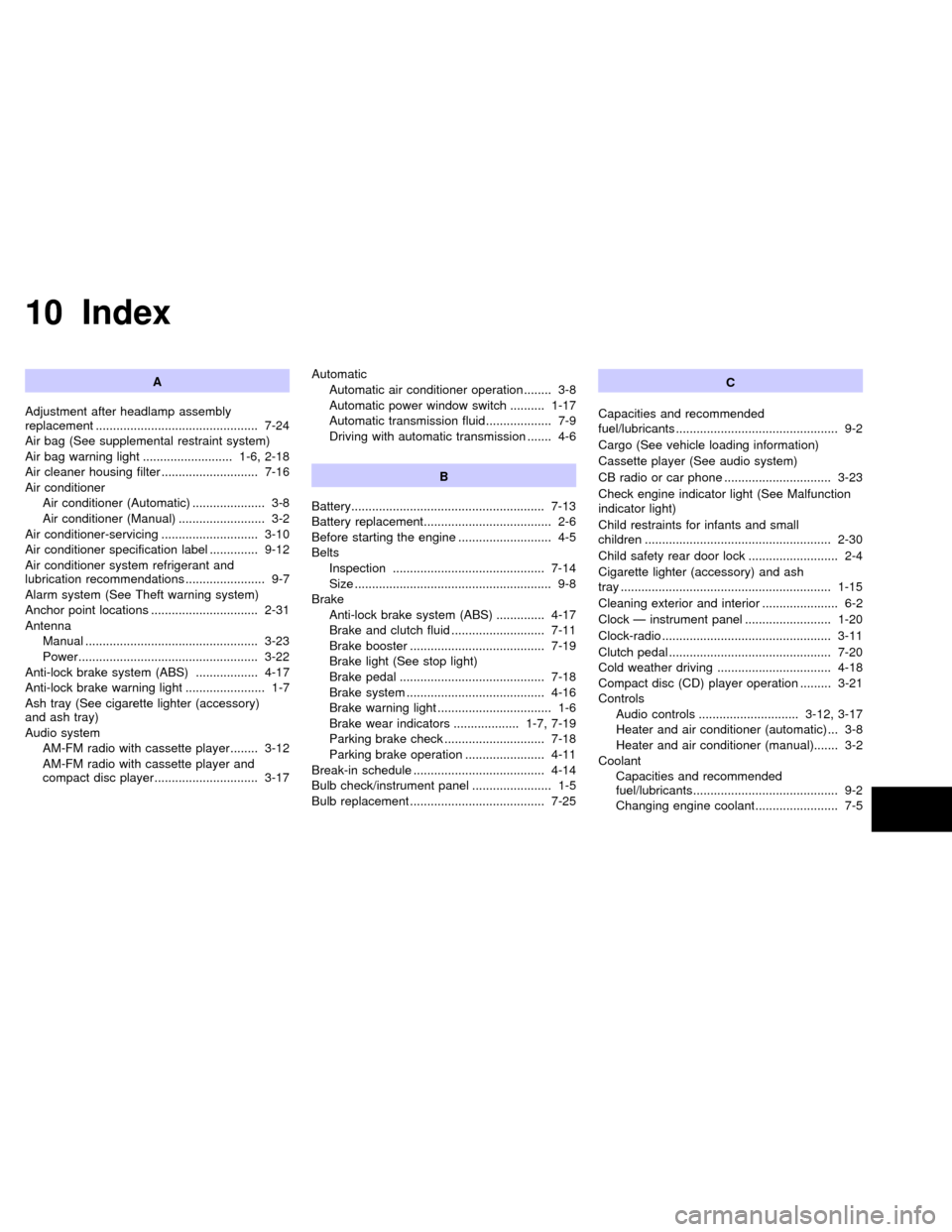
10 Index
A
Adjustment after headlamp assembly
replacement ............................................... 7-24
Air bag (See supplemental restraint system)
Air bag warning light .......................... 1-6, 2-18
Air cleaner housing filter ............................ 7-16
Air conditioner
Air conditioner (Automatic) ..................... 3-8
Air conditioner (Manual) ......................... 3-2
Air conditioner-servicing ............................ 3-10
Air conditioner specification label .............. 9-12
Air conditioner system refrigerant and
lubrication recommendations ....................... 9-7
Alarm system (See Theft warning system)
Anchor point locations ............................... 2-31
Antenna
Manual .................................................. 3-23
Power.................................................... 3-22
Anti-lock brake system (ABS) .................. 4-17
Anti-lock brake warning light ....................... 1-7
Ash tray (See cigarette lighter (accessory)
and ash tray)
Audio system
AM-FM radio with cassette player ........ 3-12
AM-FM radio with cassette player and
compact disc player.............................. 3-17Automatic
Automatic air conditioner operation ........ 3-8
Automatic power window switch .......... 1-17
Automatic transmission fluid ................... 7-9
Driving with automatic transmission ....... 4-6
B
Battery........................................................ 7-13
Battery replacement..................................... 2-6
Before starting the engine ........................... 4-5
Belts
Inspection ............................................ 7-14
Size ......................................................... 9-8
Brake
Anti-lock brake system (ABS) .............. 4-17
Brake and clutch fluid ........................... 7-11
Brake booster ....................................... 7-19
Brake light (See stop light)
Brake pedal .......................................... 7-18
Brake system ........................................ 4-16
Brake warning light ................................. 1-6
Brake wear indicators ................... 1-7, 7-19
Parking brake check ............................. 7-18
Parking brake operation ....................... 4-11
Break-in schedule ...................................... 4-14
Bulb check/instrument panel ....................... 1-5
Bulb replacement ....................................... 7-25C
Capacities and recommended
fuel/lubricants ............................................... 9-2
Cargo (See vehicle loading information)
Cassette player (See audio system)
CB radio or car phone ............................... 3-23
Check engine indicator light (See Malfunction
indicator light)
Child restraints for infants and small
children ...................................................... 2-30
Child safety rear door lock .......................... 2-4
Cigarette lighter (accessory) and ash
tray ............................................................. 1-15
Cleaning exterior and interior ...................... 6-2
Clock Ð instrument panel ......................... 1-20
Clock-radio ................................................. 3-11
Clutch pedal ............................................... 7-20
Cold weather driving ................................. 4-18
Compact disc (CD) player operation ......... 3-21
Controls
Audio controls ............................. 3-12, 3-17
Heater and air conditioner (automatic) ... 3-8
Heater and air conditioner (manual)....... 3-2
Coolant
Capacities and recommended
fuel/lubricants.......................................... 9-2
Changing engine coolant........................ 7-5
ZX
Page 199 of 203
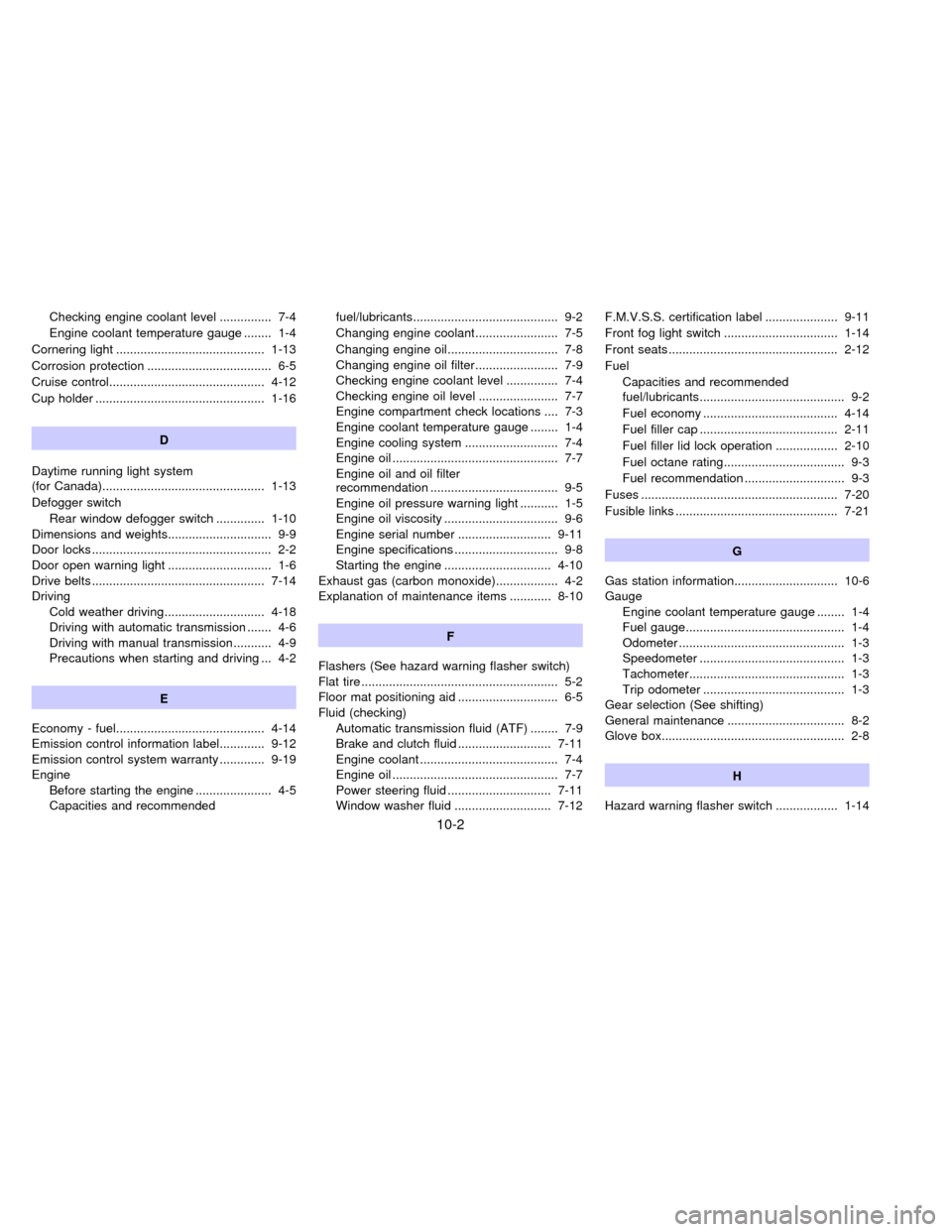
Checking engine coolant level ............... 7-4
Engine coolant temperature gauge ........ 1-4
Cornering light ........................................... 1-13
Corrosion protection .................................... 6-5
Cruise control............................................. 4-12
Cup holder ................................................. 1-16
D
Daytime running light system
(for Canada)............................................... 1-13
Defogger switch
Rear window defogger switch .............. 1-10
Dimensions and weights.............................. 9-9
Door locks .................................................... 2-2
Door open warning light .............................. 1-6
Drive belts .................................................. 7-14
Driving
Cold weather driving............................. 4-18
Driving with automatic transmission ....... 4-6
Driving with manual transmission ........... 4-9
Precautions when starting and driving ... 4-2
E
Economy - fuel........................................... 4-14
Emission control information label............. 9-12
Emission control system warranty ............. 9-19
Engine
Before starting the engine ...................... 4-5
Capacities and recommendedfuel/lubricants.......................................... 9-2
Changing engine coolant........................ 7-5
Changing engine oil................................ 7-8
Changing engine oil filter........................ 7-9
Checking engine coolant level ............... 7-4
Checking engine oil level ....................... 7-7
Engine compartment check locations .... 7-3
Engine coolant temperature gauge ........ 1-4
Engine cooling system ........................... 7-4
Engine oil ................................................ 7-7
Engine oil and oil filter
recommendation ..................................... 9-5
Engine oil pressure warning light ........... 1-5
Engine oil viscosity ................................. 9-6
Engine serial number ........................... 9-11
Engine specifications .............................. 9-8
Starting the engine ............................... 4-10
Exhaust gas (carbon monoxide).................. 4-2
Explanation of maintenance items ............ 8-10
F
Flashers (See hazard warning flasher switch)
Flat tire ......................................................... 5-2
Floor mat positioning aid ............................. 6-5
Fluid (checking)
Automatic transmission fluid (ATF) ........ 7-9
Brake and clutch fluid ........................... 7-11
Engine coolant ........................................ 7-4
Engine oil ................................................ 7-7
Power steering fluid .............................. 7-11
Window washer fluid ............................ 7-12F.M.V.S.S. certification label ..................... 9-11
Front fog light switch ................................. 1-14
Front seats ................................................. 2-12
Fuel
Capacities and recommended
fuel/lubricants.......................................... 9-2
Fuel economy ....................................... 4-14
Fuel filler cap ........................................ 2-11
Fuel filler lid lock operation .................. 2-10
Fuel octane rating................................... 9-3
Fuel recommendation ............................. 9-3
Fuses ......................................................... 7-20
Fusible links ............................................... 7-21
G
Gas station information.............................. 10-6
Gauge
Engine coolant temperature gauge ........ 1-4
Fuel gauge.............................................. 1-4
Odometer ................................................ 1-3
Speedometer .......................................... 1-3
Tachometer............................................. 1-3
Trip odometer ......................................... 1-3
Gear selection (See shifting)
General maintenance .................................. 8-2
Glove box..................................................... 2-8
H
Hazard warning flasher switch .................. 1-14
10-2
ZX