Page 940 of 4133
136 Controls in detailAutomatic climate controlThe automatic climate control is operatio-
nal whenever the engine is running. You
can operate the climate control system in
either the automatic or manual mode. The
system cools or heats the interior depend-
ing on the selected interior temperature
and the current outside temperature.
Nearly all dust particles, pollutants and
odors are filtered out before outside air en-
ters the passenger compartment through
the air distribution system.Warning!
G
When operating the automatic climate con-
trol, the air that enters the passenger com-
partment through the air vents in the
footwell can be very hot or very cold (de-
pending on the set temperature). This may
cause burns or frostbite on unprotected skin
in the immediate area of the air vents.
Always keep sufficient distance between un-
protected parts of the body and the footwell
air vents. If necessary, change the air flow
using the air distribution controls to direct
the air away from the footwell air vents
(�page 138).
Warning!
G
Follow the recommended settings for heat-
ing and cooling given on the following pag-
es. Otherwise the windows could fog up,
impairing visibility and endangering you and
others.
iSevere conditions (e.g. strong air pollu-
tion) may require replacement of the fil-
ter before its scheduled interval. A
clogged filter will reduce the air volume
to the interior.
If the vehicle interior is hot, ventilate
the interior before driving off.
Keep the air intake grille in front of the
windshield free of snow and debris.
Do not touch the interior temperature
sensor to maintain a precise tempera-
ture.
The set value is indicated by a lighted
segment on the control wheels.
Page 943 of 4133
139 Controls in detail
Automatic climate control
Activating�
Press buttonÄ (
�page 135).
The indicator lamp on the button
comes on.
Deactivating
�
Press buttonÄ (
�page 135).
The indicator lamp on the button goes
out.
Air conditioning
The air conditioning is operational while
the engine is running and cools the interior
air to the temperature set by the operator.Deactivating
It is possible to deactivate the air condi-
tioning (cooling) function of the automatic
climate control system. The air in the vehi-
cle will then no longer be cooled or dehu-
midified.
�
Press button° (
�page 135).
The indicator lamp on the button°
comes on.
Activating
Moist air can fog up the windows. You can
dehumidify the air with the air condition-
ing.
�
Press button° again.
The indicator lamp on the button°
goes out.
The air conditioning system uses the refrig-
erant R-134a. This refrigerant is free of
CFCs which are harmful to the ozone layer.
iTo achieve the fastest possible cooling
of the interior, the automatic climate
control automatically switches to air
recirculation. The indicator lamp in the
buttonÄ is not illuminated when
the system automatically switches to
air recirculation.
iThe air recirculation mode is
deactivated automatically�
after 30 minutes if the automatic
climate control is switched on
�
after five minutes if the air condi-
tioning is switched off
�
after five minutes if the outside
temperature is above approximate-
ly 45°F (7 °C)
iCondensation may drip out from under-
neath the vehicle. This is normal and
not an indication of a malfunction.
Page 946 of 4133
142 Controls in detailAutomatic climate control
Adjusting air distribution�
Press upper part of buttonÔ.
Air is directed upwards.
�
Press lower part of buttonÓ.
Air is directed to the footwell.
Front and rear air ventsAdjusting side air vents
�
Turn thumbwheel4 (
�page 135) to
one of the following positions:
!When in manual mode, the rear blower
setting cannot be increased beyond
the setting for the front blower setting.
For example, if the driver or front pas-
senger changes the blower setting to
level 3, the rear blower will not go high-
er than level 3 as well.
iFor draft-free ventilation, adjust the air
vents upwards.
To allow unrestricted operation of the
automatic climate control, the air vents
should remain open.
Symbol
Function
h
Open
l
Ventilation of side
windows in area of
exterior mirror
M
Closed
��
Page 948 of 4133
144 Controls in detailPower windows
�Power windowsOpening and closing the side windows
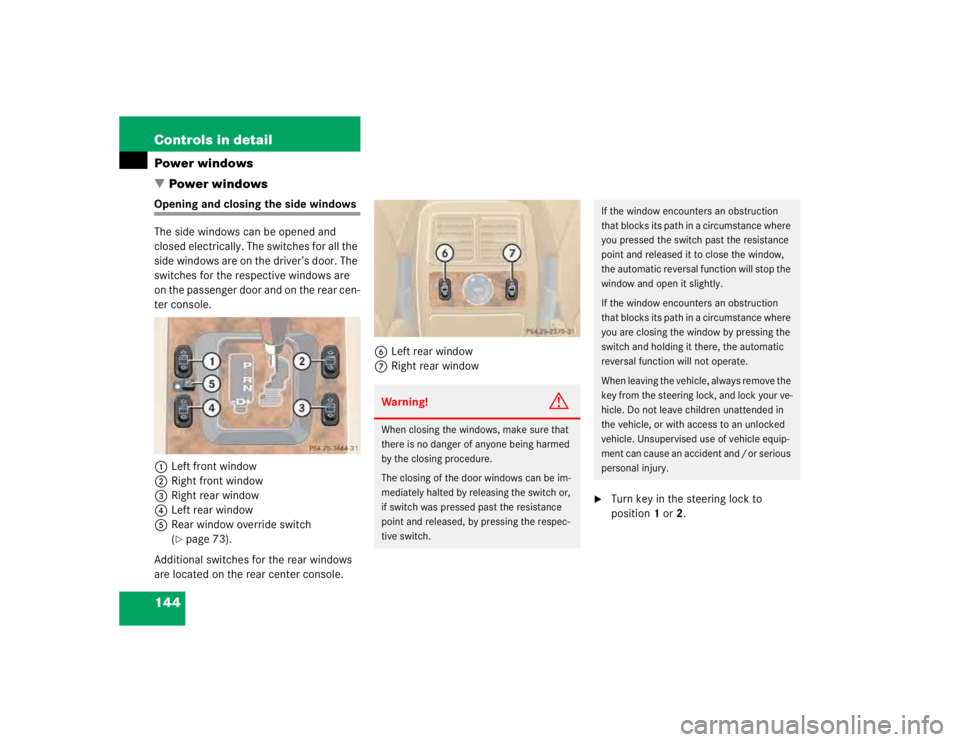
The side windows can be opened and
closed electrically. The switches for all the
side windows are on the driver’s door. The
switches for the respective windows are
on the passenger door and on the rear cen-
ter console.
1Left front window
2Right front window
3Right rear window
4Left rear window
5Rear window override switch
(
�page 73).
Additional switches for the rear windows
are located on the rear center console.6Left rear window
7Right rear window
�
Turn key in the steering lock to
position1 or2.
Warning!
G
When closing the windows, make sure that
there is no danger of anyone being harmed
by the closing procedure.
The closing of the door windows can be im-
mediately halted by releasing the switch or,
if switch was pressed past the resistance
point and released, by pressing the respec-
tive switch.
If the window encounters an obstruction
that blocks its path in a circumstance where
you pressed the switch past the resistance
point and released it to close the window,
the automatic reversal function will stop the
window and open it slightly.
If the window encounters an obstruction
that blocks its path in a circumstance where
you are closing the window by pressing the
switch and holding it there, the automatic
reversal function will not operate.
When leaving the vehicle, always remove the
key from the steering lock, and lock your ve-
hicle. Do not leave children unattended in
the vehicle, or with access to an unlocked
vehicle. Unsupervised use of vehicle equip-
ment can cause an accident and / or serious
personal injury.
Page 949 of 4133
145 Controls in detail
Power windows
Opening the windows�
Press switch1 to4 at the
symbolk to the resistance point.
The corresponding window will move
downwards until you release the
switch.
Closing the windows
�
Press switch1 to 4 at the
symbolj to the resistance point.
The corresponding window will move
upwards until you release the switch.Fully opening the windows
(Express-open)
�
Press switch1 to4 at the
symbolk past the resistance point
and release.
The corresponding window opens com-
pletely.
Fully closing the windows
(Express-close)
�
Press switch1 to4 at symbolj
past the resistance point and release.
The corresponding window closes com-
pletely.
Stopping windows
�
Press respective switch again.
Warning
G
If you pull and hold the switch up when clos-
ing the window, and upward movement of
the window is blocked by some obstruction
including but not limited to arms, hands, fin-
gers, etc., the automatic reversal will not op-
erate.
!If the upward movement of the window
is blocked during the closing proce-
dure, the window will stop and open
slightly.
Remove the obstruction, press the
switchj again past the resistance
point and release.
If the window still does not close when
there is no obstruction, then hold the
switchj down. The side window
will then close without the obstruction
sensor function.Warning!
G
Driver’s door only:
If within five seconds switch j is again
pressed past the resistance point and
released, the automatic reversal will not
operate.
Page 950 of 4133
146 Controls in detailPower windowsSynchronizing power windows
The power window must be resynchroni-
zed each time�
after the battery has been discon-
nected.
�
if the power windows cannot be fully
opened (Express-open) or closed (Ex-
press-close).
Synchronizing the power windows
�
Switch on ignition.
�
Press the power window switches at
the symbolj until the side win-
dows are closed.
Hold the switches for approximately
one second.
The power window are synchronized.
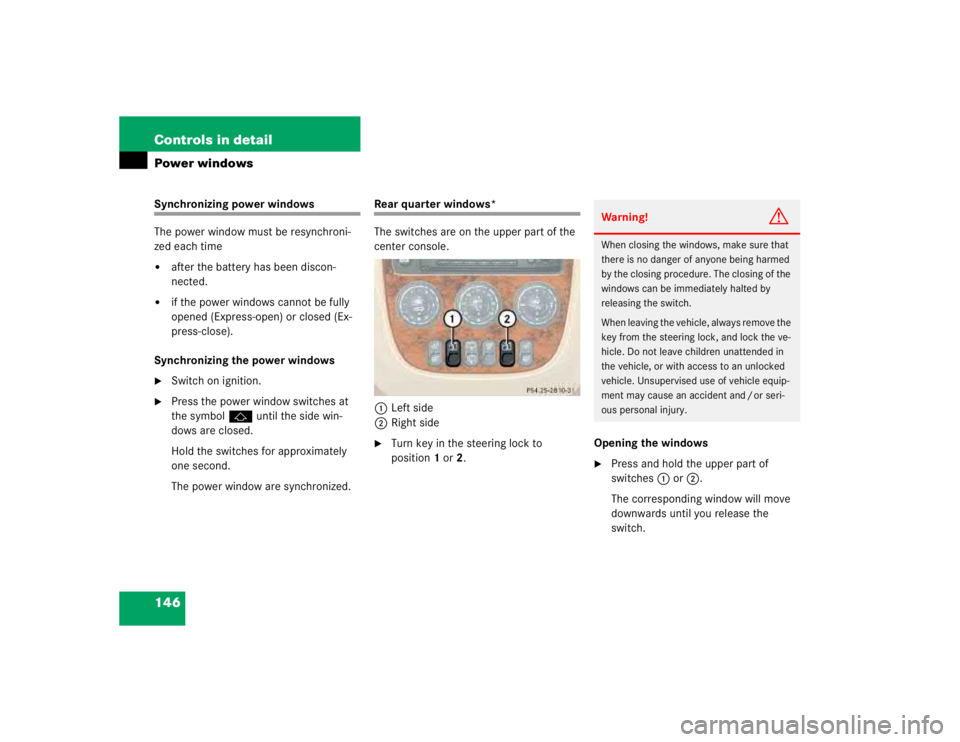
Rear quarter windows*
The switches are on the upper part of the
center console.
1Left side
2Right side�
Turn key in the steering lock to
position1 or2.Opening the windows
�
Press and hold the upper part of
switches1 or2.
The corresponding window will move
downwards until you release the
switch.Warning!
G
When closing the windows, make sure that
there is no danger of anyone being harmed
by the closing procedure. The closing of the
windows can be immediately halted by
releasing the switch.
When leaving the vehicle, always remove the
key from the steering lock, and lock the ve-
hicle. Do not leave children unattended in
the vehicle, or with access to an unlocked
vehicle. Unsupervised use of vehicle equip-
ment may cause an accident and / or seri-
ous personal injury.
Page 951 of 4133
147 Controls in detail
Power windows
Closing the windows�
Press and hold the lower part of
switches1 or2.
The corresponding window will move
upwards until you release the switch.
Page 1005 of 4133
201 Operation
Driving instructions
Special driving features for off-road
driving
The following driving features are available
for specific kind of operation:�
LOW RANGE mode (
�page 125)
�
LOW RANGE – ABS (
�page 77)
�
LOW RANGE – 4-ETS (
�page 80)
�
LOW RANGE – ESP (
�page 81)
Off-road driving rules
Engage the LOW RANGE mode before driv-
ing under off-road conditions
(
�page 125).
Fasten items being carried as securely as
possible (
�page 157).Checklist before off-road driving
Tires
�
Check the tread depth and maintain
specified tire pressure (see tire pres-
sure label inside the fuel filler flap).
�
Check tires for possible damage and
remove foreign objects.
�
Replace missing valve caps.
iWe recommend keeping doors, liftgate,
windows, and sliding / pop-up roof*
closed whenever driving in off-road
mode.
!Observe the following during off-road
driving:�
Adjust vehicle speed to condition of
terrain. The more uneven, rutty and
steeper the terrain, the lower the
speed should be
�
Watch out for obstacles, such as
rocks, holes, tree stumps and ruts.
�
Be especially careful when driving
in unknown territory. It may be nec-
essary to get out of the vehicle and
scout the path you intend to take.
�
Before driving through water, deter-
mine is depth.
�
Do not stop vehicle while immersed
in water, and do not shut off the
engine.
�
In sandy soil, please drive at a
steady speed as allowed by condi-
tions. This helps overcome the vehi-
cle rolling resistance and reduces
the likelihood of the vehicle sinking
into the ground.
�
Do not initiate jumps with the vehi-
cle. It interrupts the forward mo-
mentum of the vehicle.
�
Always drive onto slopes with the
the engine running and the vehicle
in gear.