1997 MERCEDES-BENZ ML320 weight
[x] Cancel search: weightPage 301 of 4133
251 Battery
Te ch n ica l
data Instruments
and controlsOperation DrivingInstrument
cluster displayPractical hintsCar care Index If a tire constantly loses air, it should be inspected for
damage.
The spare tire should be checked periodically for
condition and inflation. Spare tire will age and become
worn over time even if never used, and thus should be
inspected and replaced when necessary.Battery
Important!
Battery replacement information:
The maintenance-free battery is located in the engine
compartment.
The service life of the battery is dependent on its
condition of charge. The battery should always be kept
sufficiently charged, in order to last an optimum length
of time.
Wa r n i n g !
Do not overinflate tires. Overinflating tires can
result in sudden deflation (blowout) because they
are more likely to become punctured or damaged
by road debris, potholes etc.. Follow recommended
inflation pressures.Do not overload the tires by exceeding the specified
vehicle capacity weight (as indicated by the label
on the driver’s door latch post). Overloading the
tires can overheat them, possibly causing a
blowout.
Wa r n i n g !
Failure to follow these instructions can result in
severe injury or death.Never lean over batteries while connecting, you
might get injured.Battery fluid contains sulfuric acid. Do not allow
this fluid to come in contact with eyes, skin or
clothing. In case it does, immediately flush affected
area with water and seek medical help if necessary.A battery will also produce hydrogen gas, which is
flammable and explosive. Keep flames or sparks
away from battery, avoid improper connection of
jumper cables, smoking etc..
Page 359 of 4133

309 Index
Te ch n ica l
data Instruments
and controlsOperation DrivingInstrument
cluster displayPractical hints Car careIndex Special settings (Climate control) ............................... 101
Split rear seat bench ..................................................... 120
Easy entry/exit feature ............................................ 123
Rear seat head restraints ......................................... 124
SRS indicator lamp ........................................................ 219
SRS malfunction .............................................................. 57
Start lock-out .................................................................... 25
Starting and turning off the engine ............................ 164
Steering lock ................................................................... 162
Steering wheel
Adjustable .................................................................... 70
Indicator lamp ...........................................................222
Stop lamp, high mounted .............................................267
Storage compartments
Center console ............................................................115
Compartment under front passenger seat .............116
Glove box .....................................................................115
Stowing things in the vehicle ......................................230
Stranded vehicle ............................................................259
Sun visors ........................................................................113
Supplemental restraint system (SRS) ........................... 54
Synchronizing remote control ..................................... 271
TTachometer ........................................................................82
Technical data ................................................................ 287
Electrical system ...................................................... 290
Main dimensions ...................................................... 291
Rims and tires ..................................................288, 289
Weights ...................................................................... 290
Tele Aid ............................................................................ 148
Emergency calls ........................................................149
Information ................................................................ 154
Initiating an emergency call manually .................. 151
Roadside Assistance ................................................. 152
Telephone, general ......................................................... 139
Telephones and two-way radios ................................... 146
Telescoping steering column
Adjusting ......................................................................70
Indicator lamp .......................................................... 222
The first 1 000 miles (1 500 km) ................................147
Third row seats ...............................................................126
Tie-down rings, cargo .................................................... 132
Tire inflation pressure ................................................. 250
Tire traction ....................................................................178
Page 600 of 4133
133
Interior equipment
Te ch n ica l
data
Instruments
and controls Operation
Driving Instrument
cluster display Practical hints Car care Index
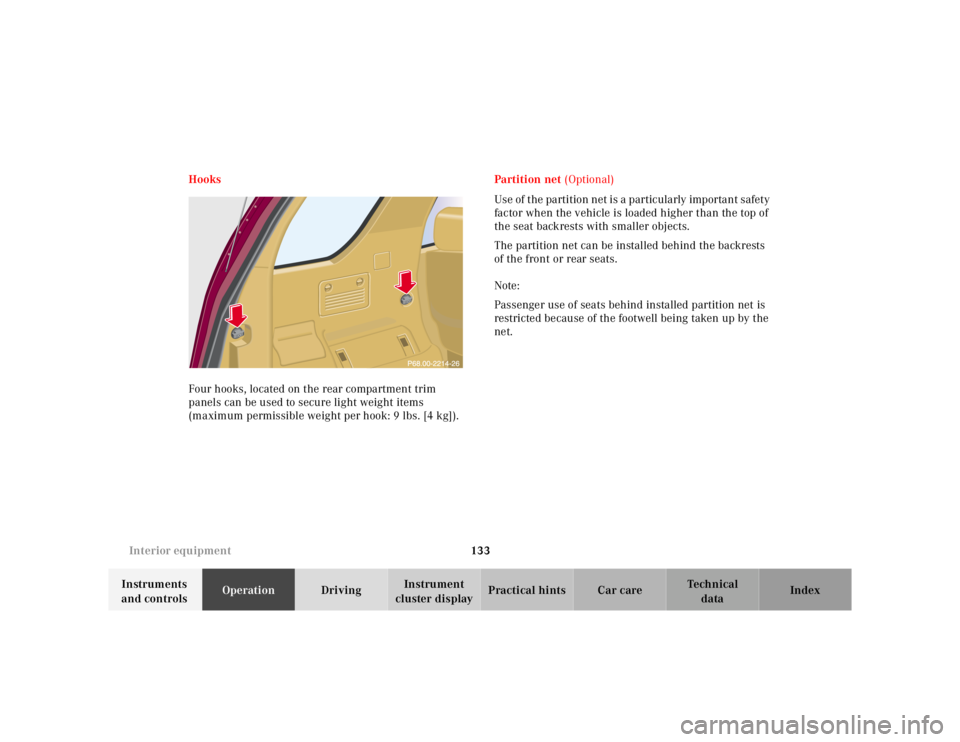
Hooks
Four hooks, located on the rear compartment trim
panels can be used to secure light weight items
(maximum permissible weight per hook: 9 lbs. [4 kg]). Partiti on net
(Optional)
Use of the partition net is a particularly important safety
factor when the vehicle is loaded higher than the top of
the seat backrests with smaller objects.
The partition net can be installed behind the backrests
of the front or rear seats.
Note:
Passenger use of seats behind installed partition net is
restricted because of the footwell being taken up by the
net.
Page 603 of 4133
136
Interior equipment
Te ch n ica l
data
Instruments
and controls Operation
Driving Instrument
cluster display Practical hints Car care Index
Loading instructions
The total load weight including vehicle occupants and
luggage / cargo should not exceed the vehicle capacity
weight indicated on the certification label which can be
found on the left door pillar.
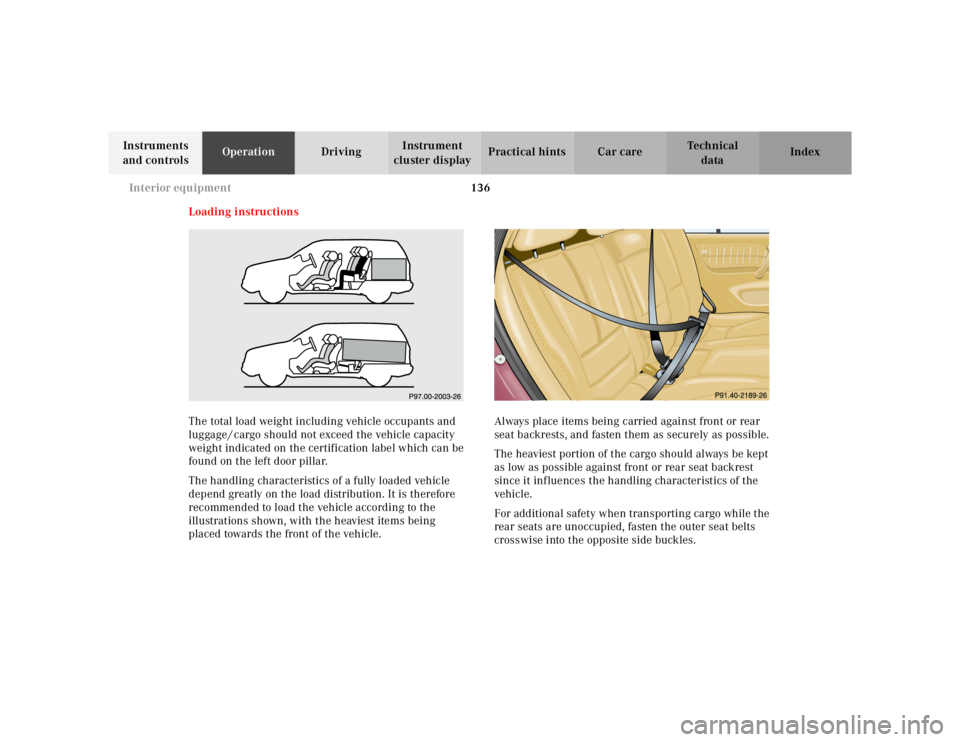
The handling characteristics of a fully loaded vehicle
depend greatly on the load distribution. It is therefore
recommended to load the vehicle according to the
illustrations shown, with the heaviest items being
placed towards the front of the vehicle. Always place items being carried against front or rear
seat backrests, and fasten them as securely as possible.
The heaviest portion of the cargo should always be kept
as low as possible against front or rear seat backrest
since it influences the handling characteristics of the
vehicle.
For additional safety when transporting cargo while the
rear seats are unoccupied, fasten the outer seat belts
crosswise into the opposite side buckles.
Page 604 of 4133
137
Interior equipment
Te ch n ica l
data
Instruments
and controls Operation
Driving Instrument
cluster display Practical hints Car care Index
Notes:
The trunk is the preferred place to carry objects. The
enlarged cargo area should only be used for items which
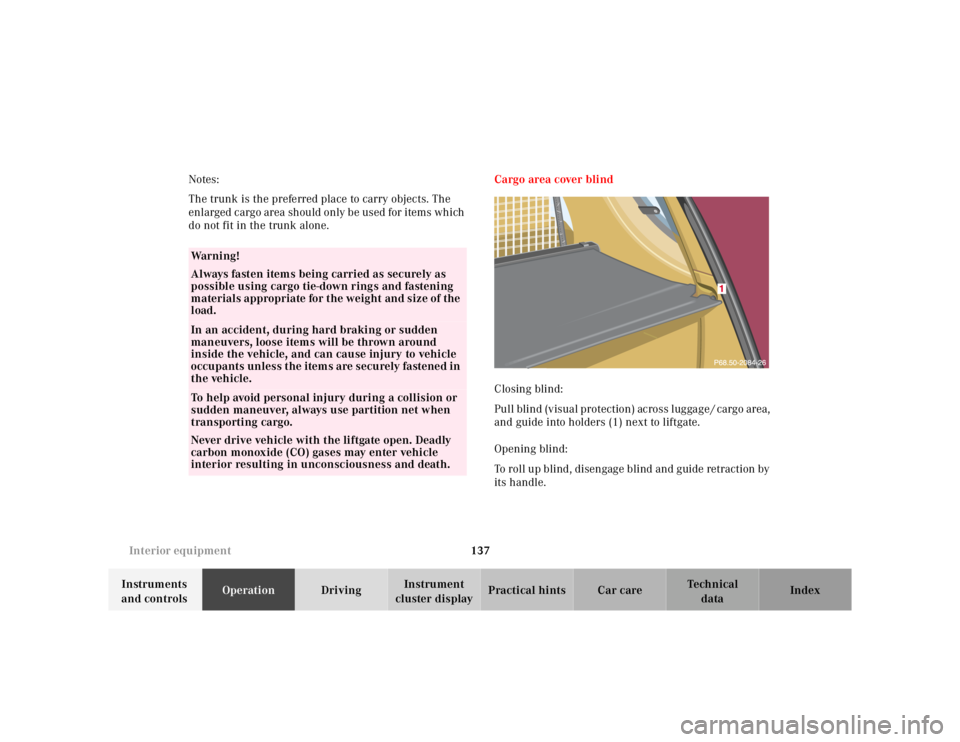
do not fit in the trunk alone. Cargo area cover blind
Closing blind:
Pull blind (visual protection) across luggage / cargo area,
and guide into holders (1) next to liftgate.
Opening blind:
To roll up blind, disengage blind and guide retraction by
its handle.
Wa r n i n g !
Always fasten items being carried as securely as
possible using cargo tie-down rings and fastening
materials appropriate for the weight and size of the
load.In an accident, during hard braking or sudden
maneuvers, loose items will be thrown around
inside the vehicle, and can cause injury to vehicle
occupants unless the items are securely fastened in
the vehicle.To help avoid personal injury during a collision or
sudden maneuver, always use partition net when
transporting cargo.
Never drive vehicle with the liftgate open. Deadly
carbon monoxide (CO) gases may enter vehicle
interior resulting in unconsciousness and death.
Page 652 of 4133

185
Driving instructions
Te ch n ica l
data
Instruments
and controls Operation
Driving Instrument
cluster display Practical hints Car care Index
Driving on embankments, slopes and other steep
inclines should only be done straight up or downhill, i.e.
in the line of gravity.
Do not drive along the side of a slope (danger of vehicle
rollover). If in doing so, the vehicle begins to show a
tendency to roll, immediately steer into a line of gravity
(straight up or downhill).
To help avoid the vehicle rolling over, never turn it
around on steep inclines. If the vehicle cannot complete
the attempted climb, back it down in reverse gear.
Utilize the engine’s braking power when descending a
slope, observe the engine speed (do not overrev the
engine). Apply the service brake as needed.
Check the brakes after a lengthy downgrade drive.
Notes:
Avoid excessive engine speeds – drive with moderate
engine speeds (max. 3000 RPM).
Select gear range “2” or “1” on the automatic
transmission, see page 165. Traction in steep terrain:
Be easy on the accelerator and watch for continuous
wheel traction when driving in steep terrain.
The 4-ETS+ helps greatly when starting out on a steep
incline. The front wheels have then the tendency to slip
due to the weight reduction over the front axle. The ETS
recognizes the situation and limits the torque for the
front wheels by braking them. Simultaneously the
torque for the rear wheels is increased.
See page 203 for four wheel electronic traction system
(4-ETS+).
Driving across a hilltop:
To prevent the vehicle from speeding up too much after
climbing a hill, decelerate just ahead of a hilltop (do not
select gear range “N”). Use the momentum of the
vehicle to drive across the hilltop. Driving in this
manner prevents the vehicle from jumping across the
hilltop and thus loosing its forward momentum.
Page 658 of 4133

191
Driving instructions
Te ch n ica l
data
Instruments
and controls Operation
Driving Instrument
cluster display Practical hints Car care Index
Electrical connections
The vehicle is prewired to accept the seven-wire harness
included in the Mercedes-Benz approved trailer hitch
receiver kit. An additional four-pole conversion plug is
included in the Mercedes-Benz supplied trailer hitch
receiver kit. For further information, please see your
authorized Mercedes-Benz Light Truck Center.
In order to prevent possible damage to the vehicle’s
electrical system by incorrectly installing the trailer
wiring plug, we recommend having the harness
connected at an authorized Mercedes-Benz Light Truck
Center. Vehicle and trailer weights and ratings
Gross Vehicle Weight Rating (GVWR) is the maximum
permissible vehicle weight: 6005 lbs. (2724 kg)
Gross Vehicle Weight (GVW): comprises weight of
vehicle including fuel, tools, spare wheel, installed
accessories, passengers, cargo and trailer tongue. It
must never exceed the GVWR.
Gross Axle Weight Rating (GAWR) is the maximum
permissible axle weight:
Gross Trailer Weight (GTW) is the maximum
permissible trailer weight to be towed:
5000 lbs. (2260 kg)
Trailer Tongue Weight Rating (TWR) is the maximum
permissible weight of the trailer tongue:
[500 lbs. (225 kg) limit for MB approved hitch receiver]
front
rear 2755 lbs.
3527 lbs. (1250 kg)
(1600 kg)
Page 659 of 4133

192
Driving instructions
Te ch n ica l
data
Instruments
and controls Operation
Driving Instrument
cluster display Practical hints Car care Index
Loading a trailer
When loading a trailer, you should observe that neither
the permissible GTW, nor the GVWR are exceeded.
Maximum permissible values are listed on the safety
compliance certification labels for the vehicle and for
the trailer to be towed. The lowest value listed must be
selected when determining how the vehicle and trailer
are loaded.
We recommend loading the trailer in such a manner
that it has a tongue weight (TW) between 10% and 15%
of the GTW.
The tongue weight at the hitch ball must be added to the
GVW to prevent exceeding your Mercedes-Benz tow
vehicle’s rear GAWR. Checking weights of vehicle and trailer
To assure that the tow vehicle and trailer are in
compliance with the maximum permissible weight
limits, and to know the actual weights, have the loaded
rig (tow vehicle including driver, passengers and cargo,
trailer fully loaded) weighed on a commercial scale.
Check the vehicle’s front and rear Gross Axle Weight
(GAW), the GTW and TW. The values as measured must
not be exceeded, according to the weight listed under
“Vehicle and trailer weight and ratings”.