Page 215 of 305

213
Precautions When Servicing Your
VehicleBe especially careful when inspecting or servicing
your vehicle. Here are some general precautions for
your safety:q
Do not work on a hot engine. The engine
cooling fan may come on unexpectedly. Always
turn the engine off and let it cool.
q
If you must work with the engine running,
avoid wearing loose clothing or jewelry that
could get caught in moving parts. Take
appropriate precautions with long hair.
q
Do not work on a vehicle in an enclosed space
with the engine running, unless you are sure
you have enough ventilation.
q
Never get under a vehicle while it is supported
by a jack only. If you must work under a
vehicle, use safety stands.
q
Keep all lit cigarettes and other smoking
materials away from the battery and all
fuel-related parts.
If you disconnect the battery, the engine must
ªrelearnº its idle conditions before your vehicle will
drive properly. To find out how the engine does
this, seeBatteryin this chapter.
Working with the engine off:1. Set the parking brake fully and make sure that
the gearshift is securely latched in P (Park).
2. Remove the key from the ignition after you
turn the engine off.
3. Block the wheels. This will prevent your
vehicle from moving unexpectedly.
File:11fnmct.ex
Update:Mon Jun 17 13:54:56 1996
Page 218 of 305
2163. Lift the hood until the lift cylinders hold it
open.
Whenever you close the hood, latch it securely.
NOTE:Apply lubricant to the hood latch at
six-month intervals to maintain smooth and
trouble-free operation.
NOTE:Read and understandPrecautions When
Servicing Your Vehicleat the beginning of this
chapter before opening the hood.
Engine CompartmentYour vehicle has a 4.6 liter engine. The following
page shows a diagram of where to find items that
you should regularly service.
File:11fnmct.ex
Update:Mon Jun 17 13:54:56 1996
Page 221 of 305
219
Checking and Adding Engine OilSince the proper amount of engine oil is important
for safe engine operation, check the oil using the
dipstick each time you put fuel in your vehicle.
Remember the engine must be off, the oil must be
warm and the vehicle must be parked on level
ground.
Checking the engine oil level:
1. Turn the engine off after it has warmed up and
allow a few minutes for the engine oil to drain
back into the oil pan.
2. Set the parking brake, making sure the gearshift
is securely latched in P (Park).
3. Open the hood. Protect yourself from engine
heat.
4. Locate the engine oil dipstick (highlighted in
yellow) and carefully pull it out of the engine.5. Wipe the dipstick clean and put it back into
position, making sure it is fully seated.
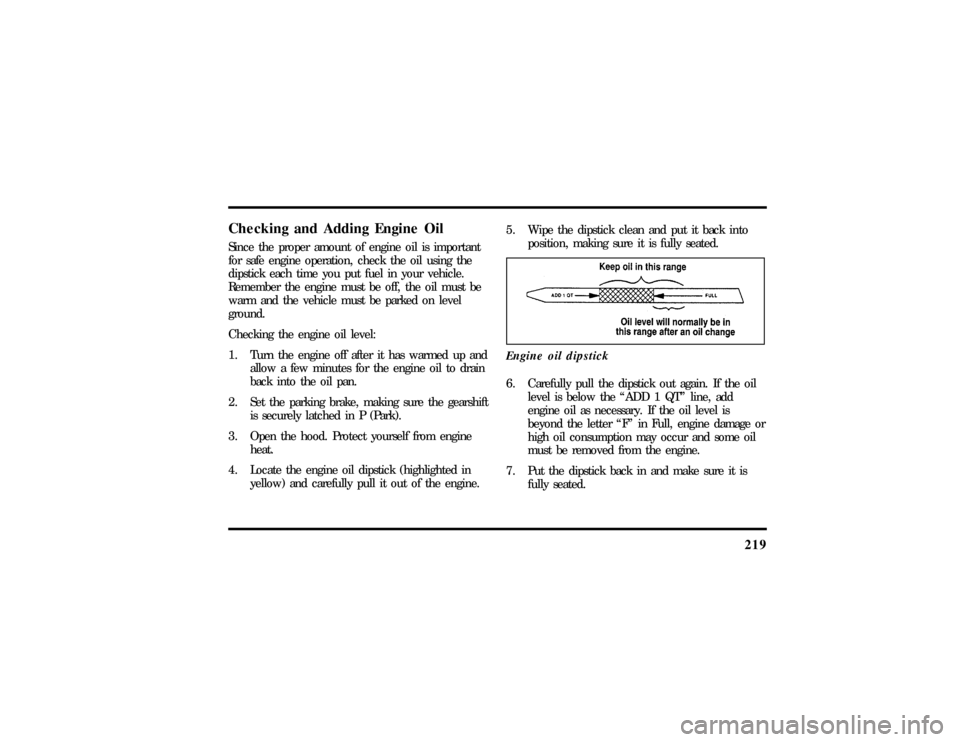
Engine oil dipstick
6. Carefully pull the dipstick out again. If the oil
level is below the ªADD 1 QTº line, add
engine oil as necessary. If the oil level is
beyond the letter ªFº in Full, engine damage or
high oil consumption may occur and some oil
must be removed from the engine.
7. Put the dipstick back in and make sure it is
fully seated.
File:11fnmct.ex
Update:Mon Jun 17 13:54:56 1996
Page 230 of 305

228q
With the engine OFF and cool, remove the
pressure cap, located on the coolant reservoir.
Remove the heater hose and clamp, located on
the rear of the intake manifold.
q
Add a 50/50 mixture of specified coolant and
water to the coolant reservoir. Refer toRefill
Capacitieslater in this chapter for the correct
amount. Add coolant to the reservoir until the
coolant continuously flows out of the tube in
the rear of engine. Reattach hose and secure
clamp.
q
Reinstall the pressure cap to the fully installed
position.
q
Start and idle the engine until the radiator
upper hose is warm (this indicates the
thermostat is open and coolant is flowing
through the entire system).
q
Immediately shut off the engine and let cool.
Cautiously remove the pressure relief cap and
add a 50/50 mixture of specified coolant and
water until the coolant is at the COLD FILL
level in the coolant reservoir.
q
Reinstall the pressure cap securely.
q
Check for leaks at the draincock.
q
Recheck the engine coolant level, using the
recommended procedure, after one or two
occasions of vehicle use.
File:11fnmct.ex
Update:Mon Jun 17 13:54:56 1996
Page 232 of 305

230If the power steering fluid is low, do not drive your
vehicle for a long period of time before adding fluid.
This can damage the power steering pump.Automatic Transmission FluidUnder normal circumstances, you do not need to
check the fluid level of the transmission, since your
vehicle does not use up transmission fluid. Refer to
theMaintenance Schedulebooklet for replacement
intervals. However, if the transmission is not
working properly Ð for instance, the transmission
may slip or shift slowly, or you may notice some
sign of fluid leakage Ð the fluid level should be
checked.
It is preferable to check the transmission fluid level
at normal operating temperature150ÊF-170ÊF
(66ÊC-77ÊC),after approximately 20 miles (30 km)
of driving. However, if necessary, you can check
the fluid level without having to drive 20 miles
(30 km) to obtain a normal operating temperature if
outside temperatures are above50ÊF(10ÊC).NOTE:If the vehicle has been operated for an
extended period at high speeds or in city traffic
during hot weather, or pulling a trailer, the vehicle
should be turned off for about 30 minutes to allow
the fluid to cool before checking.
Checking the Automatic Transmission
FluidWith the vehicle on a level surface and the brake
fully applied, start the engine and move the gear
shift selector through all of the gears allowing
sufficient time for each position to engage. Securely
latch the gear shift selector in the P (Park) position.
Fully set the parking brake and leave the engine
running.
NOTE:Your vehicle should not be driven if the
fluid level is below the bottom hole on the dipstick
and outside temperatures are above50ÊF(10ÊC).
Wipe off the dipstick cap and pull the dipstick out.
Wipe the indicator end clean. Put the dipstick back
into the filler tube and make sure it is fully seated.
File:11fnmct.ex
Update:Mon Jun 17 13:54:56 1996
Page:
< prev 1-8 9-16 17-24