Page 135 of 315
130Spare Key Programming ProcedureTwo electronically coded keys were supplied with
your vehicle, use one of these with the procedure
below:q
Using a coded key that you can start your
engine with, turn the ignition from the ON to
the OFF position.
q
Within 15 seconds, insert a new key into the
ignition and turn it to ON or START. The
vehicle does not have to be started.
If the key has been coded, the theft indicator will
illuminate for two seconds. The key can then be
used to start the vehicle.Repeat until all chosen keys have been coded
(max=8).
If the key coding failed, the theft indicator will flash
and the vehicle cannot be started. One of 3 causes
are possible:
q
The new key was not inserted within 15
seconds or
q
All 8 key codes have been stored or
q
The key does not have an electronic code
File:05fncf8.ex
Update:Thu Jun 27 10:02:20 1996
Page 140 of 315
135
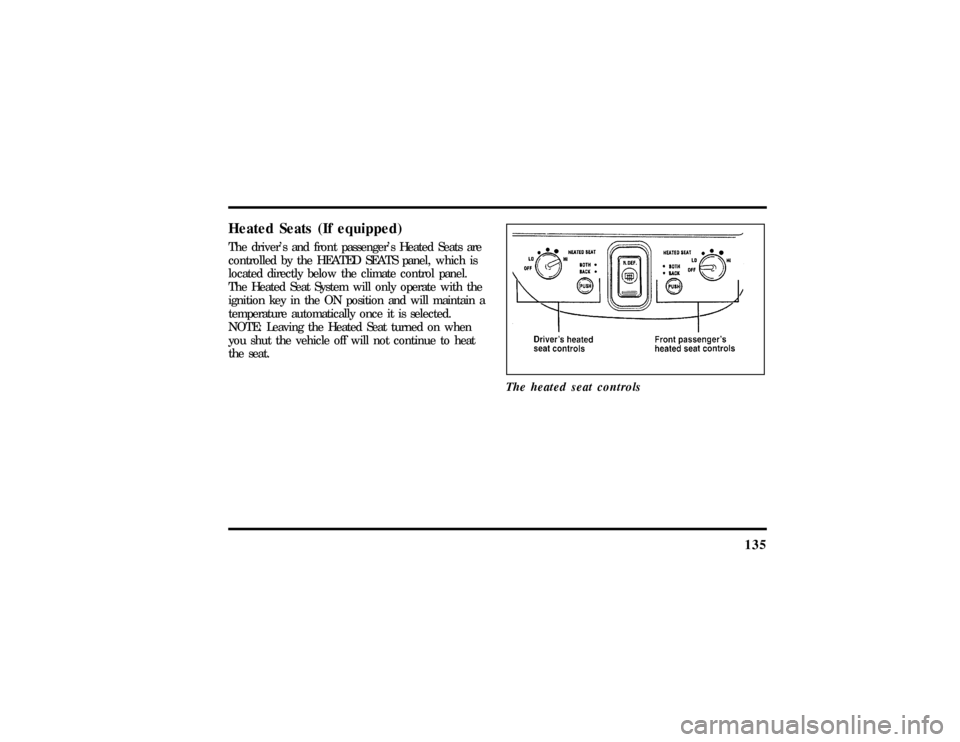
Heated Seats (If equipped)The driver's and front passenger's Heated Seats are
controlled by the HEATED SEATS panel, which is
located directly below the climate control panel.
The Heated Seat System will only operate with the
ignition key in the ON position and will maintain a
temperature automatically once it is selected.
NOTE: Leaving the Heated Seat turned on when
you shut the vehicle off will not continue to heat
the seat.
The heated seat controls
File:06fnss8.ex
Update:Wed Jun 19 15:04:39 1996
Page 141 of 315

136To operate the Heated Seat System:
1. Select mode.q
ªBothº to heat the seat back and seat cushion
q
ªBackº to heat the seat back only
2. Turn the knob to ªLOº (the lowest heat level).
Allow five minutes for the heat level to
stabilize.
3. If the heat level is not high enough for
comfort, select increased heat levels. Allow at
least two minutes for the heat level to stabilize
at any new level selected.
4. If the heated seat is not turned off, the seat
will heat up to the selected temperature level
each time the car is started.
NOTE:Cooling the seat down takes considerably
longer than increasing its heat level.
Auto-Glide SeatsAuto-Glide is a feature which automatically moves
the seat forward or rearward when the seatback is
tilted forward or rearward to allow ease of entry
into the rear seat.
NOTE:This feature can turned off. For more
information see theMessage Center Driver Settings
section in theInstrumentationchapter.
With the ignition OFF, the driver's seat Auto-Glide
will only function when the gearshift is in N
(Neutral) or P (Park), and at least one of the
vehicle's doors is open. If the ignition is ON,
Auto-Glide will function with the transmission
selector in N (Neutral) or P (Park).
With the ignition OFF, the passenger seat
Auto-Glide will only function when at least one of
the vehicle's doors are open. If the ignition is ON,
Auto-Glide will function. However, Auto-Glide will
operate while occupied during rear travel.
File:06fnss8.ex
Update:Wed Jun 19 15:04:39 1996
Page 142 of 315

137
If the seatback is moved from its forward stop angle
while the seat is traveling forward, the seat will
stop. If the seatback is returned to the forward stop
angle position, the seat will resume its forward
travel. If the seatback is returned to its upright
position, the seat will return to the original position.
If the transmission is shifted from N (Neutral) or P
(Park) while the driver's seat is moving, the seat
will stop where it is. Returning the gearshift to N
(Neutral) or P (Park) will allow seat movement to
continue. To allow movement without returning to
P (Park) or N (Neutral) will require the use of the
electric seat controls.
If you sit in the seat while the Auto-Glide is
moving rearward, the seat will continue to move.
If the seat stalls, or if any seat switch is
momentarily activated (excluding the lumbar switch)
while the seat is traveling forward, the seat will
stop. If the seatback is returned to its upright
position, the seat will return to the position it wasat when the ease of entry cycle was started. To
resume forward travel will require moving the
seatback off of its forward stop angle position and
returning it back to the same. Repositioning the seat
at this time using the seat controls will cancel
Auto-Glide.
If the ignition is off, and the last open door is
closed while a seat is moving, 30 seconds will be
allowed for the forward or rearward movement to
be completed.
Easy Access/Easy Out (driver side
only)The easy in/easy out feature of the driver seat
moves the seat two inches back when:q
the transmission is in N (Neutral) or P (Park)
q
the driver safety belt is buckled
q
the ignition switch is turned to OFF.
File:06fnss8.ex
Update:Wed Jun 19 15:04:39 1996
Page 143 of 315

138The easy in/easy out feature of the driver seat
moves the seat two inches forward when:q
the transmission is in N (Neutral) or P (Park)
q
the driver safety belt is buckled
q
the ignition switch is turned to ON.
Important Safety Belt InformationThe use of safety belts helps to restrain you and
your passengers in case of a collision. In most states
and in Canada, the law requires their use.
Safety belts provide best restraint when:q
the seatback is upright
q
the occupant is sitting upright (not slouched)
q
the lap belt is snug and low on the hips
q
the shoulder belt is snug against the chest
q
the knees are straight forward
To help you remember to fasten your safety belt, a
warning light may come on and a chime may
sound. SeeSafety Belt Warning Light and Chimein
theInstrumentationchapter.
See the following sections in this chapter for
directions on how to properly use these safety belts.
Also seeSafety Restraints for Childrenin this
chapter for special instructions about using safety
belts for children.
File:06fnss8.ex
Update:Wed Jun 19 15:04:39 1996
Page 154 of 315

149
q
and the electrical wiring which connects the
components.
The diagnostic module monitors its own circuits,
the air bag electrical system, the air bag readiness
light, the air bag power, and the air bag inflators.
Determining if System Is OperationalThe Air Bag Supplemental Restraint System uses a
readiness light and a tone to indicate the condition
of the system. The readiness light is in the
instrument cluster. When you turn the ignition key
to ON, this light will illuminate for approximately
six (6) seconds and then turn off. This indicates
that the system is operating normally. NOTE:
Routine maintenance of the air bag system is not
required.A problem with the system is indicated by one or
more of the following:
q
the readiness light will either flash or stay lit,
q
the readiness light will not light immediately
after ignition is turned on,
q
a group of five beeps will be heard. The tone
pattern will repeat periodically until the problem
and light are repaired.
If any of these things happen, even intermittently,
have the Air Bag Supplemental Restraint System
serviced at your Ford or Lincoln-Mercury dealer
immediately. Unless serviced, the system may not
function properly in the event of a collision.
File:06fnss8.ex
Update:Wed Jun 19 15:04:39 1996
Page 171 of 315

1663. Make sure that the gearshift is in P (Park) and
the parking brake is set before you turn the
key.
Before you start your vehicle, you should test the
warning lights on the instrument panel to make
sure that they work. Refer to theInstrumentation
chapter.Starting Your EngineTo start your engine:
1. Follow the steps underPreparing to Start Your
Vehicleat the beginning of this section.
2. Turn the ignition key to the ON position.
3. DO NOT depress the accelerator pedal when
starting your engine. DO NOT use the
accelerator while the vehicle is parked.
4. Turn the key to the START position (cranking)
until the engine starts. Allow the key to return
to the ON position after the engine has started.For a cold engine:
q
At temperatures10ÊF(-12ÊC) andbelow:If
the engine does not start infifteen (15)
secondson the first try, turn the key to OFF,
wait approximately ten (10) seconds so you do
not flood the engine, then try again.
q
At temperaturesabove10ÊF(-12ÊC):If the
engine does not start infive (5) secondson
the first try, turn the key to OFF, wait
approximately ten (10) seconds so you do not
flood the engine, then try again.
For a warm engine:
q
Do not hold the key in the START position for
more thanfive (5) secondsat a time. If the
engine does not start within five (5) seconds on
the first try, turn the key to the OFF position.
Wait a few seconds after the starter stops, then
try again.
File:08fnto8.ex
Update:Wed Jun 19 15:04:46 1996
Page 172 of 315

167
Whenever you start your vehicle, release the key as
soon as the engine starts. Excessive cranking could
damage the starter.
After you start the engine, let it idle for a few
seconds. Keep your foot on the brake pedal and put
the gearshift lever in gear. Release the parking
brake. Slowly release the brake pedal and drive
away in the normal manner.
NOTE:Your vehicle has an interlock that prevents
you from shifting out of P (Park) unless your foot is
on the brake pedal.
If the engine does not start after two attempts:
1. Turn the ignition key to the OFF position.
2. Press the accelerator all the way to the floor
and hold it.
3. Turn the ignition key to the START position.4. Release the ignition key when the engine starts.
5. Release the accelerator gradually as the engine
speeds up.
If the engine still does not start, the fuel pump
shut-off switch may have been activated. For
directions on how to reset the switch seeFuel
Pump Shut-Off Switchin the index.
A computer system controls the engine's idle speed.
When you start your vehicle, the engine's idle
speed normally runs higher than when it is warmed
up. These faster engine speeds will make your
vehicle move slightly faster than its normal idle
speed. It should, however, slow down after a short
time. If it does not, have the idle speed checked.
If the engine idle speed does not slow down
automatically, do not allow your vehicle to idle for
more than 10 minutes. Have the vehicle checked.
File:08fnto8.ex
Update:Wed Jun 19 15:04:46 1996