Page 179 of 315
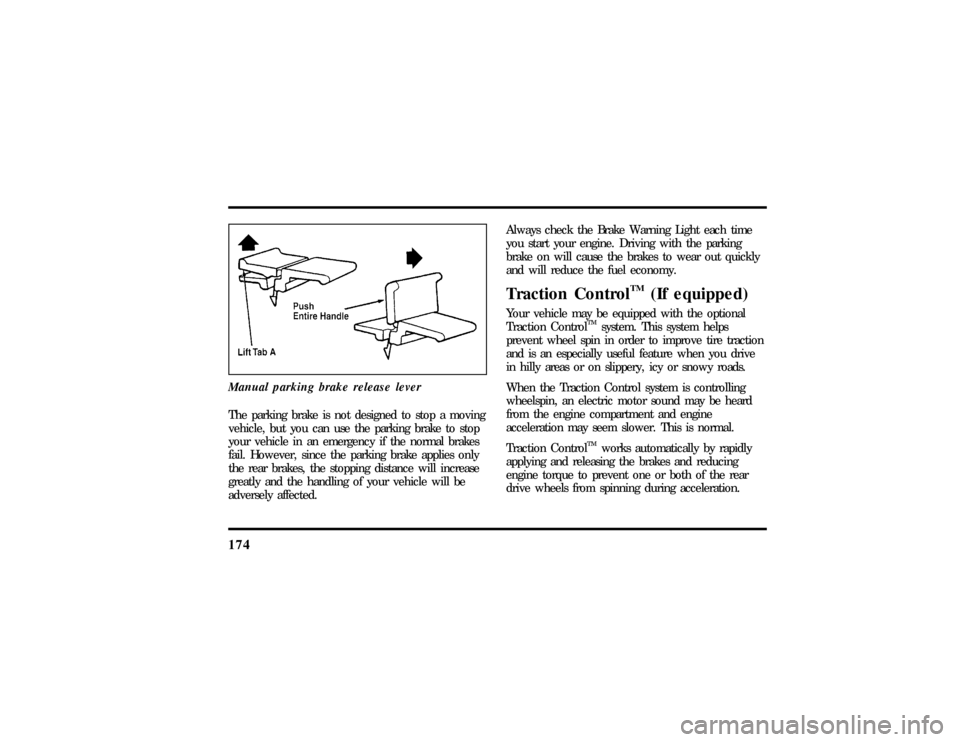
174Manual parking brake release leverThe parking brake is not designed to stop a moving
vehicle, but you can use the parking brake to stop
your vehicle in an emergency if the normal brakes
fail. However, since the parking brake applies only
the rear brakes, the stopping distance will increase
greatly and the handling of your vehicle will be
adversely affected.Always check the Brake Warning Light each time
you start your engine. Driving with the parking
brake on will cause the brakes to wear out quickly
and will reduce the fuel economy.
Traction Control
TM
(If equipped)
Your vehicle may be equipped with the optional
Traction Control
TM
system. This system helps
prevent wheel spin in order to improve tire traction
and is an especially useful feature when you drive
in hilly areas or on slippery, icy or snowy roads.
When the Traction Control system is controlling
wheelspin, an electric motor sound may be heard
from the engine compartment and engine
acceleration may seem slower. This is normal.
Traction Control
TM
works automatically by rapidly
applying and releasing the brakes and reducing
engine torque to prevent one or both of the rear
drive wheels from spinning during acceleration.
File:09fngf8.ex
Update:Wed Jun 19 10:45:23 1996
Page 185 of 315

180R (Reverse)With the gearshift in the R (Reverse) position, the
vehicle will move backward. You should always
come to a complete stop before shifting into or out
of R (Reverse).N (Neutral)With the gearshift in the N (Neutral) position, the
vehicle can be started and is free to roll. Hold the
brake pedal down while in this position.DrivingYour vehicle's gearshift is console-mounted on the
floor. The Transmission Control Switch (TCS) is
located on the gearshift handle. The Transmission
Control Indicator Light is located on the instrument
panel. You can put the gearshift lever in any of the
several positions.The O/D OFF light is off (not illuminated) during
normal vehicle operation. This allows the
transmission to upshift and downshift from 1st
through 4th gears. When the TCS is pressed, the
Transmission Control Indicator Light will illuminate
(O/D OFF) on the instrument panel. When this
O/D OFF is illuminated, the transmission will
upshift and downshift from 1st through 3rd gears.
If O/D OFF light does not come ªONº when TCS
is depressed or if the light flashes when you are
driving, have your vehicle serviced at the first
opportunity. If this condition persists, damage could
occur to the transmission.
To return the transmission to normal operation (1st
through 4th gear) depress the TCS again. This
switch may be used to cancel overdrive any time
the vehicle is being driven. Each time your vehicle
is started, the overdrive system will automatically be
in the normal overdrive mode and the light will not
be illuminated.
File:09fngf8.ex
Update:Wed Jun 19 10:45:23 1996
Page 228 of 315
223
Checking and Adding Engine OilSince the proper amount of engine oil is important
for safe engine operation, check the oil using the
dipstick each time you put fuel in your vehicle.
Remember the engine must be off, the oil must be
warm and the vehicle must be parked on level
ground.
Checking the engine oil level:
1. Turn the engine off after it has warmed up and
allow a few minutes for the engine oil to drain
back into the oil pan.
2. Set the parking brake, making sure the gearshift
is securely latched in P (Park).
3. Open the hood. Protect yourself from engine
heat.
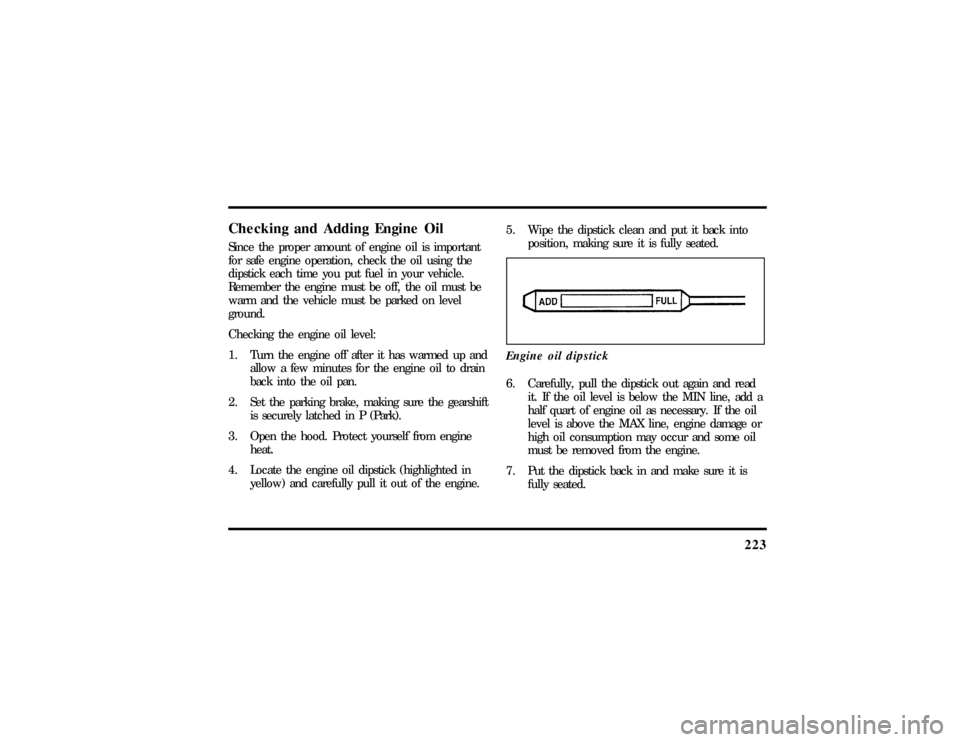
4. Locate the engine oil dipstick (highlighted in
yellow) and carefully pull it out of the engine.5. Wipe the dipstick clean and put it back into
position, making sure it is fully seated.
Engine oil dipstick
6. Carefully, pull the dipstick out again and read
it. If the oil level is below the MIN line, add a
half quart of engine oil as necessary. If the oil
level is above the MAX line, engine damage or
high oil consumption may occur and some oil
must be removed from the engine.
7. Put the dipstick back in and make sure it is
fully seated.
File:11fnmc8.ex
Update:Thu Jun 20 14:28:32 1996
Page 258 of 315

253
How to Prepare Your Vehicle for
Inspection/Maintenance (I/M) TestingIn some localities it may become a legal
requirement to pass an Inspection/Maintenance
(I/M) test of the On-Board Diagnostic (OBD) II
system. If the vehicle's powertrain system or its
battery has just been serviced, the OBD II system is
reset to a not ready for I/M testing condition. To
prepare for I/M testing, the law specifies that
additional mixed city and highway driving is
required to complete the check of the OBD II
system.
The driving modes required to reach the ready
condition consist of a minimum of 30 minutes of
city and highway driving as described below:q
At least twenty minutes driving in stop and go,
city type traffic with at least four idle periods.
q
At least ten minutes of driving on an
expressway or highway.Before completing the above driving modes, the
engine must be warmed up and at operating
temperature. Once started, the vehicle must not be
turned off during these driving modes.
Lights and Bulb ReplacementIt is a good idea to check the operation of the
following lights frequently:q
headlamps
q
high-mount brakelamp
q
tail lamps
q
brakelamps
q
hazard flasher
q
turn signals
q
license plate lamps
File:11fnmc8.ex
Update:Thu Jun 20 14:28:32 1996
Page 273 of 315
268Batteryq
Check and recharge as necessary.
q
Keep connections clean and covered with a
light coat of grease.
q
If storing your vehicle for more than 30 days
without recharging the battery, disconnect the
battery cables to ensure battery charge is
maintained for quick starting. NOTE: If battery
cables are disconnected, it will be necessary to
reset any memory features (eg. radio presets).
Brakesq
Make sure brakes and parking brake are fully
released.
Tiresq
Maintain recommended air pressures.
Miscellaneousq
Make sure all linkages, cables, levers and clevis
pins under vehicle are covered with grease to
prevent rust.
q
Move vehicles at least 25 feet (8 m) every 15
days to lubricate working parts and prevent
corrosion.
File:12fncs8.ex
Update:Thu Jun 20 14:28:48 1996
Page 296 of 315

295
Index
A
ABS warning light (see Anti-lock
brake system)............ 11
Accessory position on the ignition.... 83
Accident damage............ 216
Air bag supplemental restraint system . . . 145
and child safety seats......... 151
description............. 145
driver air bag............ 145
indicator light............ 45
operation.............. 147
passenger air bag........... 145
tone generator............ 149
Air cleaner filter
location............... 220
specifications............ 263Air conditioning, electronic automatic
temperature control system....... 69
Air suspension
air ride switch off, message center . . . 37
description............. 175
Alarm, activating remote personal..... 123
Aluminum wheels........... 242
Antenna, radio (see Electronic
sound system)............ 66
Antifreeze (see Engine coolant)...... 228
Anti-lock brake system (ABS)
description............. 171
see also Brake............ 171
warning light............ 11
Anti-theft lug nuts and key........ 208
File:fnix8.ex
Update:Thu Jun 27 10:02:38 1996
Page 297 of 315

296Anti-theft system
arming the system.......... 127
description............. 127
disarming an untriggered system.... 128
disarming a triggered system...... 128
triggering.............. 128
Appeals (see Dispute settlement board) . . 272
Assistance (see Customer assistance) . . . 271
Audio system (see Electronic
sound system)............ 49
Autolamp system (see Headlamps).... 78
Automatic transmission
driving an automatic overdrive..... 177
fluid, adding............. 235
fluid, checking............ 235
fluid, refill capacities......... 264
fluid, specification.......... 265
Axle
lubricant specifications........ 265
refill capacities............ 264
B
Basic vehicle warranty........... 3
Battery................ 236
acid, treating emergencies....... 237
battery saver............. 126
charging system warning light..... 13
disconnecting............ 212
how to service............ 236
jumping a disabled battery....... 209
maintenance-free........... 236
proper disposal, recycling....... 237
replacement, specifications....... 263
servicing.............. 236
when storing your vehicle....... 268
Brake fluid............... 225
brake warning light.......... 10
checking and adding......... 225
description............. 225
specifications............ 265
File:fnix8.ex
Update:Thu Jun 27 10:02:38 1996
Page 298 of 315

297
Brakes
adjustment............. 171
anti-lock.............. 171
anti-lock brake system (ABS)
warning light........... 11
applying the brakes.......... 171
brake warning light.......... 10
fluid, checking and adding....... 225
fluid, refill capacities......225, 264
fluid, specifications.......... 265
front disc.............. 171
if brakes do not grip well....... 171
master cylinder........... 225
new brake linings........... 5
noise................ 171
parking brake and auto-release..... 172
servicing.............. 225
trailer............... 187
when storing your vehicle....... 268Break-in period.............. 5
Brights (high beams).......... 14
Bulbs, replacing............ 253
halogen............... 254
headlamps.............. 254
C
Canada, customer assistance....... 276
Canada, warranty information....... 3
Canadian Motor Vehicle Arbitration Plan
(CAMVAP).............. 277
Capacities for refilling fluids....... 264
Carbon monoxide in exhaust....... 169
Car seats for children
(see Child safety seats)........ 151
Catalytic converter........... 250
File:fnix8.ex
Update:Thu Jun 27 10:02:38 1996