Page 184 of 321

182When to use D (Drive)D (Drive) eliminates the excessive shifting between
third and fourth gears that your vehicle sometimes
does when you are traveling through hilly terrain in
jOverdrive. It also gives more engine braking to
slow your vehicle on downgrades thanj
Overdrive.When to use 1 (First)Use 1 (First) when added engine braking is desired
when descending steep hills.
The automatic transaxle will shift to the proper gear
to ascend any grade without any need to shift to 1
(First).
P (Park)Always come to a complete stop before you shift
into P (Park). Make sure that the gearshift is
securely latched in P (Park). This locks the transaxle
and prevents the front wheels from rotating.
Always set the parking brake fully and make sure
the gearshift is latched in P (Park). Turn off the
ignition whenever you leave your vehicle.
You can tell a column-mounted gearshift is securely
latched in P (Park) if the lever is adjacent to the P
(Park) and you cannot move it without pulling it
toward you and rotating it downward.
You can tell a console-mounted gearshift is securely
latched in P (Park) if the lever is adjacent to the P
(Park) and you cannot move it without pushing in
the thumb button.
File:09fngfc.ex
Update:Fri Sep 6 08:48:49 1996
Page 191 of 321

189
Driving While You TowBe especially careful when driving while you tow a
trailer. Never drive faster than 45 mph (70 km/h)
when you tow in hilly country on hot days. Also,
anticipate stops so that you can brake gradually.
Towing a trailer increases the load on the engine
and transaxle, particularly in hilly country and with
heavier trailers. Under these conditions you may
experience an excessive amount of shifting between
Overdrive and Third gears. Moving the shift selector
to D (Overdrive Lockout) will keep this from
happening and will provide better engine braking.
When driving in less hilly country or with a lighter
trailer load, you may move the gearshift selector
lever toj(Overdrive) without experiencing
excessive shifting.When driving down steep hills, you should put the
gearshift selector lever in the 1 (First) position to
shift the transaxle into second gear. This will
provide additional engine braking.
The automatic transaxle will automatically
downshift to the proper gear for driving up a grade.
If you use the speed control while you are towing
on very long, steep grades, the speed control may
shut off.
Servicing Your Vehicle If You TowIf you tow a trailer for a long distance, your vehicle
will need to be serviced more frequently than usual.
Refer to theMaintenance Schedulebooklet for
additional information.
File:09fngfc.ex
Update:Fri Sep 6 08:48:49 1996
Page 192 of 321
191
Roadside EmergenciesHazard FlashersThe flashers work whether your vehicle is running
or not. The flashers work for up to two hours
when the battery is fully charged and in good
condition without draining the battery excessively. If
the flashers run for longer than two hours or if the
battery is not fully charged, the battery can be
drained.If the Engine Cranks but Does
Not Start or Does Not Start After
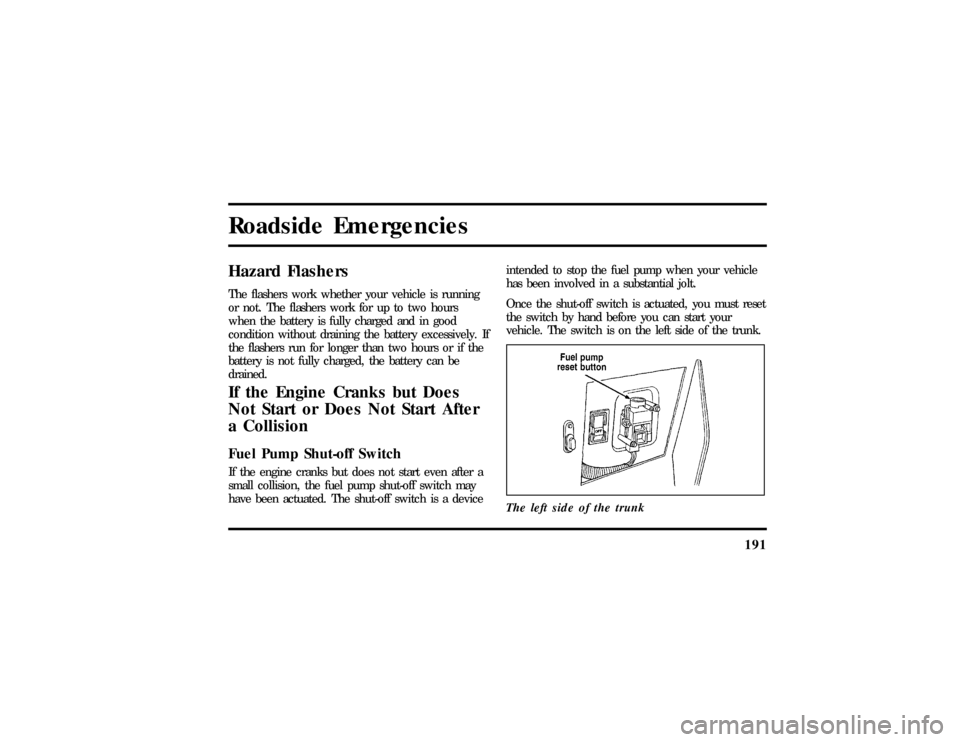
a CollisionFuel Pump Shut-off SwitchIf the engine cranks but does not start even after a
small collision, the fuel pump shut-off switch may
have been actuated. The shut-off switch is a deviceintended to stop the fuel pump when your vehicle
has been involved in a substantial jolt.
Once the shut-off switch is actuated, you must reset
the switch by hand before you can start your
vehicle. The switch is on the left side of the trunk.
The left side of the trunk
File:10fnerc.ex
Update:Fri Sep 6 08:49:57 1996
Page 209 of 321
208
2. Ge tou tth e spar etir ean djack.
WARNING
To avoi dinjury ,neve rru n theengine
WARNING
To lesse ntheris kof persona linjury,
Page 214 of 321
213
Preparing Your Vehicle1. Your vehicle has a 12-volt starting system, so
you need to use a 12-volt jumper system. You
will damage your starting motor, ignition
system, and other electrical parts if you connect
them to a 24-volt power supply (either two
12-volt batteries in series or a 24-volt generator
set).
2. Do not disconnect the battery of the disabled
vehicle. You could damage the vehicle's
electrical system.3. Park the booster vehicle close to the hood of
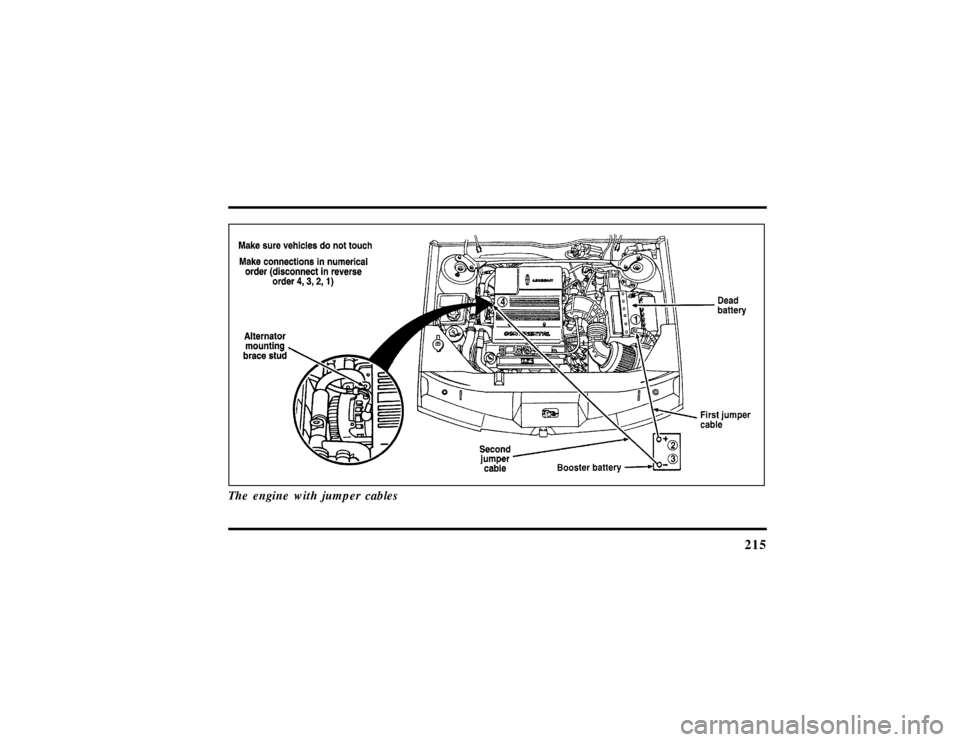
the disabled vehicle.Make sure the vehicles
do not touch each other.Set the parking
brake on both vehicles and stay clear of the
engine cooling fan and other moving parts.
4. Check all battery terminals and remove any
excessive corrosion before you attach the
jumper cables.
5. Turn on the heater fan in both vehicles. Press
the DEFROST button. Turning on the fan helps
protect the electrical system from voltage
surges. Turn off all other switches and gauges.
File:10fnerc.ex
Update:Fri Sep 6 08:49:57 1996
Page 216 of 321
215
The engine with jumper cables
File:10fnerc.ex
Update:Fri Sep 6 08:49:57 1996
Page 217 of 321

216Jump-Starting1. Make sure that the jumper cables are not in
the way of moving engine parts, then start the
booster vehicle. Run the engine at a moderate
speed.
2. Let the discharged battery charge for a few
minutes and then start the disabled vehicle. It
may take a couple of tries before the vehicle
starts. If the vehicle does not start after several
attempts, there may be a different problem.
3. When both vehicles are running, let them idle
for a few minutes to charge the discharged
battery.Removing jumper cables1.Always remove the jumper cables in the
reverse order.Remove the negative (s) end
of the jumper cable from the metallic surface
on the engine or frame of the disabled vehicle.2. Remove the negative (s) cable from the
booster battery.
3. Remove the positive (+) cable from the booster
battery.
4. Remove the other end of the positive (+) cable
from the discharged battery.
After the vehicle is started, let it idle for a while to
let the engine ªrelearnº its idle conditions. Drive it
around for a while with all electrical accessories
turned off to let the battery recharge. Driveability
may be deteriorated slightly until all drive modes
are ªrelearned.ºYou may need to use a battery
charger to fully recharge the battery.
If you need to replace your battery, seeBatteryin
theMaintenance and Carechapter.
File:10fnerc.ex
Update:Fri Sep 6 08:49:57 1996
Page 220 of 321

219
Maintenance and CareService Made EasyFord has two goals for servicing your vehicle.
1. When we can, we design parts that do not
need to be serviced.
2. We want to make servicing your vehicle as
easy as possible. To help you:q
We highlight do-it-yourself items in yellow in
the engine compartment so that you can find
them easily.
q
When possible, we design parts that can be
replaced without tools.
q
We give you a Maintenance Schedule that
makes tracking routine service for your vehicle
easy. The maintenance schedule is located in
theMaintenance Schedulebooklet.This chapter tells you about the basic parts that you
need to check and service regularly.
If your vehicle needs professional servicing, your
dealership can provide the parts and service
required. Check yourWarranty Information Booklet
to find out which parts and services are covered.
Also see theCustomer Assistancechapter of this
Owner Guide.
Ford Motor Company recommends that the Owner
Maintenance Checks listed in theMaintenance
Schedulebooklet be performed for the proper
operation of your vehicle. In addition to the
conditions listed in theOwner Maintenance
Checklist, be alert for any unusual noise, vibration,
or other indication that your vehicle may need
service. If you do notice something unusual, see
that your vehicle is serviced promptly.
File:11fnmcc.ex
Update:Fri Sep 6 08:51:16 1996