1997 JAGUAR XJ6 VIN
[x] Cancel search: VINPage 48 of 227

12Remove the four bolts in each camshaft
inner sprocket (see illustration). The bolts are
secured by sheetmetal “washer” plates. Bend
down the locking tabs with a hammer and
screwdriver tip to remove the bolts.
Caution: Stuff rags below the sprockets
while removing the bolts to prevent a bolt
from falling down into the front cover.
13Remove the two bolts retaining the upper
chain guide to the cylinder head (see
illustration).
14Pull the inner sprockets from each
camshaft (see illustration). Each camshaft
sprocket is comprised of an inner and outer,
each with a set of fine splines that lock them
together. The outer sprockets, with the teeth,
can rotate on the camshafts until the inner
sprocket bolts are tightened.
15Pull the outer sprockets from the
camshafts and allow the chain slacken.
16At this point the camshafts can be
carefully lifted straight up and off the cylinder
head. Take care not to nick any of the lobes or
journals during removal.
17Use a magnet to remove the lifters,
keeping them in order in a divided, numbered
box (see illustration). They must be returned
to their original location if reusing the original
camshafts!
18Removing the lifters exposes the
adjusting shims, sitting in a pocket in eachvalve spring retainer (see illustration). Keep
the shims with their matching lifters. Measure
the thickness of each shim with a micrometer
and record the measurements.
Inspection
19After the camshaft has been removed
from the engine, cleaned with solvent and
dried, inspect the bearing journals for uneven
wear, pitting and evidence of seizure. If the
journals are damaged, the bearing surfaces in
the cylinder head and caps may be damaged
as well, requiring renewal of the cylinder head.
20Measure the bearing journals with a
micrometer to determine if they are excessivelyworn or out-of-round (see illustration).
Compare the measurements to Specifications.
21Check the camshaft lobes for heat
discolouration, score marks, chipped areas,
pitting and uneven wear. Measure the lobe
heights with a micrometer and record the
measurements (see illustrations). If there is
variance of more than 0.005-inch, the
camshaft and lifters must be renewed. If the
lobes are in good condition, the camshaft can
be reused.
22Inspect the top, bottom and side surfaces
of the lifters for wear, grooving or scoring. If
the lifters are damaged, the camshaft and its
lifters must be renewed as a set.
Engine in-car repair procedures 2A•11
2A
10.13 Remove the two bolts and the upper
timing chain guide (arrowed)10.14 Pull the inner sprocket from the
outer sprocket of each camshaft
10.17 A magnet can be used to remove
the lifters (arrowed)10.18 The valve adjustment shims
(arrowed) fit into a pocket in the valve
spring retainer - use a magnet to remove
the shims and keep them with their
respective lifters10.20 Measure the bearing journals with a
micrometer to check diameter - measure
at several places around the journal to
check for taper or out-of-round
3261 Jaguar XJ6 10.12 Bend back the locking tabs
(arrowed) and remove the camshaft
sprocket bolts
10.21a Measure the camshaft lobe at its
greatest dimension . . .10.21b . . . and subtract the camshaft lobe
diameter at its smallest dimension to
obtain the lobe lift
Page 52 of 227

Refitting
5Remove all traces of old gasket material
and sealant from the engine block and sump.
Clean the mating surface with lacquer thinner
or acetone.
Caution: Do not use a sharp scraping tool.
Both the sump and the engine block are
aluminium and could be easily damaged.
6Make sure the threaded bolt holes in the
engine block and bellhousing are clean.
7Inspect the flange of the sump for any
cracks, pits or scratches that could cause an
oil leak.
8Remove the baffle plate at the rear of the
sump (see illustration). Clean the sump area
and the baffle, then refit the baffle.
9Inspect the oil pump pickup tube for
cracks, or foreign material blocking the screen
(see illustration).
10Apply a bead of RTV sealant to the sump
flange(see illustration). Note:The sump
must be installed within 5 minutes of sealer
application.
11Carefully position the sump on the engine
block and push it toward the transmission
adapter plate as you press it against the
engine block. Loosely refit four bolts, two on
each side of the sump. Tighten the four bolts
in a criss-cross pattern to the torque listed in
this Chapter’s Specifications, then loosen
each bolt 90°.
12Refit the two engine adapter-to-sump
bolts. Tighten the two bolts to the torque
listed in this Chapter’s Specifications, then
loosen each one 180°.
13Refit the remainder of the sump-to-engine
block bolts hand tight until all are installed,
then tighten them to the torque listed in this
Chapter’s Specifications. Lastly, tighten the
two adapter-to-sump bolts to the torque
listed in this Chapter’s Specifications.
Caution: Failure to follow this tightening
procedure could stress or possibly crack
the adapter plate.
14The remainder of refitting is the reverse of
removal. Be sure to add oil and refit a new oil
filter.
15Run the engine and check for oil pressure
and leaks.13 Oil pump- removal,
inspection and refitting
4
Removal
1Remove the sump (see Section 12).
2Unbolt the oil pickup tube and oil transfer
housing from the engine block (see
illustration). Note:Have a drain pan under the
transfer housing, as oil may drip out when the
housing is loosened from the engine block.
3Carefully pull the transfer housing and
transfer tubes to the rear to separate them
from the oil pump body.
4Bend back the locking tabs and remove thethree bolts retaining the oil pump drive
sprocket to the oil pump (see illustration).
Pull the chain and sprocket from the front of
the pump. Note:There are shims between the
sprocket and the pump. Collect them while
pulling off the sprocket.
5Remove the bolts and detach the oil pump
from the engine.
6Remove all traces of sealant and old gasket
material from the oil pump body and engine
block, then clean the mating surfaces with
lacquer thinner or acetone.
7Remove the screws and separate the front
and rear pump covers from the body. Lift out
the drive and driven rotors (see illustrations).
Note:Mark the front face of each rotor before
removing them.
Engine in-car repair procedures 2A•15
2A
12.8 Remove the bolts (arrowed) and the
sheetmetal baffle plate - clean the sump
area of the sump with the baffle removed12.9 Lubrication system components
A Oil pump
B Transfer tubesC Transfer housing
D Oil pump pickup12.10 Apply a bead of RTV sealant around
the perimeter of the sump mounting
flange, be sure to run the bead around the
outside all bolt the holes
13.7a Remove the bolts and separate the
front and rear pump covers13.7b Remove the outer rotor (A)
and inner rotor (B)
13.2 Unbolt the oil pump pickup (A) and
the bolts (B) retaining the transfer
assembly (C) to the engine block13.4 Pry back the locking tabs and remove
the three bolts retaining the oil pump drive
sprocket to the pump
3261 Jaguar XJ6
Page 54 of 227

2Use a centre punch or paint to make
alignment marks on the driveplate and
crankshaft to ensure correct alignment during
refitting(see illustration).
3Remove the bolts that secure the driveplate
to the crankshaft. If the crankshaft turns,
wedge a screwdriver through a hole in the
driveplate to keep it from turning (see
illustration).
4Remove the driveplate from the crankshaft.
A spacer is located behind the driveplate(see
illustration). Pry it off and store it with the
driveplate.
Warning: The ring-gear teeth
may be sharp, wear gloves to
protect your hands when
handling the driveplate.
Refitting
5Clean the driveplate to remove grease and
oil. Inspect the surface for cracks. Check for
cracked and broken ring gear teeth. Note:If
there is any damage to the driveplate, replace
the driveplate with a new driveplate, a new
spacer and new bolts. Improved parts are
available as a set from the dealer.
6Clean and inspect the mating surfaces of
the driveplate and the crankshaft. If the
crankshaft rear seal is leaking, renew it before
refitting the driveplate (see Section 15).
7Position the driveplate against the
crankshaft. Be sure to align the marks made
during removal. Some models may have an
alignment dowel or staggered bolt holes to
ensure correct refitting. Before refitting the
bolts, apply thread-locking compound to the
bolt threads.
8Wedge a screwdriver in the ring gear teeth
to keep the driveplate from turning and tighten
the bolts to the torque listed in this Chapter’s
Specifications. Follow a criss-cross pattern
and work up to the final torque in three or four
steps.
9The remainder of refitting is the reverse of
the removal procedure.
15 Crankshaft rear oil seal-
renewal
4
1The transmission adapter plate and
driveplate must be removed from the car for
this procedure (see Chapter 7).
2Remove the bolts, and detach the oil seal
retainer. Remove the gasket material from the
block and the seal retainer (see illustration).
3Position the oil seal and retainer assembly
between two wood blocks on a workbench
and drive the old seal out from the backside
(see illustration).
4The new seal must be driven into the
retainer plate from the engine side. Drive thenew seal into the retainer with a wood block
or a section of pipe slightly smaller in diameter
than the outside diameter of the seal (see
illustration). The seal should be driven in only
until it is flush with the transmission side of
the retainer.
Caution: The new seal comes with a
special plastic refitting sleeve inserted in
the seal. It is designed to allow the seal to
slide over the end of the crankshaft
without displacing the seal lip. Do NOT
remove this plastic sleeve until the retainer
and seal have been installed on the engine.
5Lubricate the seal area of the crankshaft
with engine oil. Apply a bead of RTV sealant
to the sealing surface of the retainer (see
illustration).
Engine in-car repair procedures 2A•17
2A
14.2 Mark the driveplate and the
crankshaft so they can be reassembled in
the same relative position14.3 Use a screwdriver to secure the
flywheel while the bolts are removed14.4 Pry off the driveplate spacer - if a
driveplate is replaced, the spacer should
be replaced also
15.2 Remove the bolts (arrowed) and the
crankshaft rear oil seal retainer from the
back of the engine block15.3 After removing the retainer assembly
from the engine block, support it between
two wood blocks and drive out the old seal
with a drift punch and hammer
15.4 Drive the new seal into the retainer
with a wood block
3261 Jaguar XJ6
15.5 Apply RTV sealant
to the sealing surface
Page 57 of 227

Engine block
Deck warpage limit . . . . . . . . . . . . . . . . . . . . . . . . . . . . . . . . . . . . . . . . . 0.076 mm (0.003 inch)
Cylinder bore diameter
Standard
Size group A . . . . . . . . . . . . . . . . . . . . . . . . . . . . . . . . . . . . . . . . . . 90.990 to 91.003 mm (3.5823 to 3.5828 inches)
Size group B . . . . . . . . . . . . . . . . . . . . . . . . . . . . . . . . . . . . . . . . . . 91.005 to 91.018 mm (3.5829 to 3.5834 inches)
Oversize
0.25 mm (0.010 inch) OS . . . . . . . . . . . . . . . . . . . . . . . . . . . . . . . . 91.259 to 91.272 mm (3.5929 to 3.5934 inches)
0.50 mm (0.020 inch) OS . . . . . . . . . . . . . . . . . . . . . . . . . . . . . . . . 91.513 to 91.526 mm (3.6029 to 3.6034 inches)
Pistons and rings
Piston-to-bore clearance . . . . . . . . . . . . . . . . . . . . . . . . . . . . . . . . . . . . 0.017 to 0.043 mm (0.0007 to 0.0017 inch)
Piston ring end gap
No.1 (top) compression ring . . . . . . . . . . . . . . . . . . . . . . . . . . . . . . . . 0.40 to 0.66 mm (0.016 to 0.026 inch)
No.2 (middle) compression ring . . . . . . . . . . . . . . . . . . . . . . . . . . . . . 0.40 to 0.66 mm (0.016 to 0.026 inch)
Oil ring . . . . . . . . . . . . . . . . . . . . . . . . . . . . . . . . . . . . . . . . . . . . . . . . . 0.30 to 0.55 mm (0.012 to 0.022 inch)
Piston ring groove clearance
No. 1 (top) compression ring . . . . . . . . . . . . . . . . . . . . . . . . . . . . . . . 0.040 to 0.076 mm (0.0016 to 0.0030 inch)
No. 2 (middle) compression ring . . . . . . . . . . . . . . . . . . . . . . . . . . . . . 0.040 to 0.076 mm (0.0016 to 0.0030 inch)
Torque wrench settingsNm lbf ft
Main bearing cap bolts . . . . . . . . . . . . . . . . . . . . . . . . . . . . . . . . . . . . . . 136 to 142 100 to 105
Connecting rod cap nuts . . . . . . . . . . . . . . . . . . . . . . . . . . . . . . . . . . . . 50 to 60 37 to 44
* Note:Refer to Part A for additional torque specifications.
2B•2 Engine removal and overhaul procedures
3261 Jaguar XJ6
1 General information
Included in this portion of Chapter 2 are the
general overhaul procedures for the cylinder
head and internal engine components.
The information ranges from advice
concerning preparation for an overhaul and
the purchase of replacement parts to detailed,
step-by-step procedures covering removal
and refitting of internal engine components
and the inspection of parts.
The following Sections have been written
based on the assumption that the engine has
been removed from the vehicle. For
information concerning in-vehicle engine
repair, as well as removal and refitting of the
external components necessary for the
overhaul, see Part A of this Chapter.
The Specifications included in this Part are
only those necessary for the inspection and
overhaul procedures which follow. Refer to
Part A for additional Specifications.
2 Engine overhaul-
general information
It’s not always easy to determine when, or if,
an engine should be completely overhauled,
as a number of factors must be considered.
High mileage is not necessarily an indication
that an overhaul is needed, while low mileage
doesn’t preclude the need for an overhaul.
Frequency of servicing is probably the most
important consideration. An engine that’s had
regular and frequent oil and filter changes, as
well as other required maintenance, will most
likely give many thousands of miles of reliableservice. Conversely, a neglected engine may
require an overhaul very early in its life.
Excessive oil consumption is an indication
that piston rings, valve seals and/or valve
guides are in need of attention. Make sure that
oil leaks aren’t responsible before deciding
that the rings and/or guides are bad. Perform a
cylinder compression check to determine the
extent of the work required (see Section 4).
Also check the vacuum readings under various
conditions (see Section 3).
Check the oil pressure with a gauge
installed in place of the oil pressure sender
unit (see illustrations)and compare it to this
Chapter’s Specifications. If it’s extremely low,
the bearings and/or oil pump are probably
worn out.
Loss of power, rough running, knocking or
metallic engine noises, excessive valve train
noise and high fuel consumption rates may
also point to the need for an overhaul,
especially if they’re all present at the same
time. If a complete tune-up doesn’t remedy
the situation, major mechanical work is the
only solution.An engine overhaul involves restoring the
internal parts to the specifications of a new
engine. During an overhaul, the piston rings
are replaced and the cylinder walls are
reconditioned (rebored and/or honed). If a
rebore is done by an automotive machine
workshop, new oversize pistons will also be
installed. The main bearings, big-end bearings
and camshaft bearings are generally replaced
with new ones and, if necessary, the
crankshaft may be reground to restore the
journals. Generally, the valves are serviced as
well, since they’re usually in less-than-perfect
condition at this point. While the engine is
being overhauled, other components, such as
the distributor, starter and alternator, can be
rebuilt as well. The end result should be a like
new engine that will give many trouble free
miles. Note:Critical cooling system
components such as the hoses, drivebelts,
thermostat and water pump should be
replaced with new parts when an engine is
overhauled. The radiator should be checked
carefully to ensure that it isn’t clogged or
leaking (see Chapter 3).If you purchase a
2.4a The oil pressure sender unit (arrowed)
is located in the right front corner of the
engine block, near the oil filter2.4b The oil pressure can be checked by
removing the sender unit and refitting a
pressure gauge in its place
Page 58 of 227
rebuilt engine or short block, some rebuilders
will not warranty their engines unless the
radiator has been professionally flushed. Also,
we don’t recommend overhauling the oil
pump - always refit a new one when an engine
is rebuilt.
Before beginning the engine overhaul, read
through the entire procedure to familiarise
yourself with the scope and requirements of
the job. Overhauling an engine isn’t difficult,
but it is time-consuming. Plan on the vehicle
being tied up for a minimum of two weeks,
especially if parts must be taken to an
automotive machine workshop for repair or
reconditioning. Check on availability of parts
and make sure that any necessary special
tools and equipment are obtained in advance.
Most work can be done with typical hand
tools, although a number of precision
measuring tools are required for inspecting
parts to determine if they must be renewed.
Often an automotive machine workshop will
handle the inspection of parts and offer
advice concerning reconditioning and
renewal. Note:Always wait until the engine
has been completely dismantled and all
components, especially the engine block,
have been inspected before deciding what
service and repair operations must be
performed by an automotive machine
workshop. Since the engine block’s condition
will be the major factor to consider when
determining whether to overhaul the original
engine or buy a rebuilt one, never purchase
parts or have machine work done on other
components until the engine block has been
thoroughly inspected. As a general rule, time
is the primary cost of an overhaul, so it
doesn’t pay to refit worn or substandard
parts.
If it turns out that a number of major
components are beyond reconditioning, it
may be cost effective to buy a factory-rebuilt
engine from a Jaguar dealership.
As a final note, to ensure maximum life and
minimum trouble from a rebuilt engine,
everything must be assembled with care in a
spotlessly-clean environment.
3 Vacuum gauge
diagnostic checks
2
A vacuum gauge provides valuable
information about what is going on in the
engine at a low cost. You can check for worn
rings or cylinder walls, leaking cylinder head or
intake manifold gaskets, incorrect carburettor
adjustments, restricted exhaust, stuck or
burned valves, weak valve springs, improper
ignition or valve timing and ignition problems.
Unfortunately, vacuum gauge readings are
easy to misinterpret, so they should be used
with other tests to confirm the diagnosis.
Both the absolute readings and the rate of
needle movement are important for accurate
interpretation. Most gauges measure vacuumin inches of mercury (in-Hg). As vacuum
increases (or atmospheric pressure decreases),
the reading will decrease. Also, for every
1000 foot increase in elevation above sea level;
the gauge readings will decrease about one
inch of mercury.
Connect the vacuum gauge directly to
intake manifold vacuum, not to ported (above
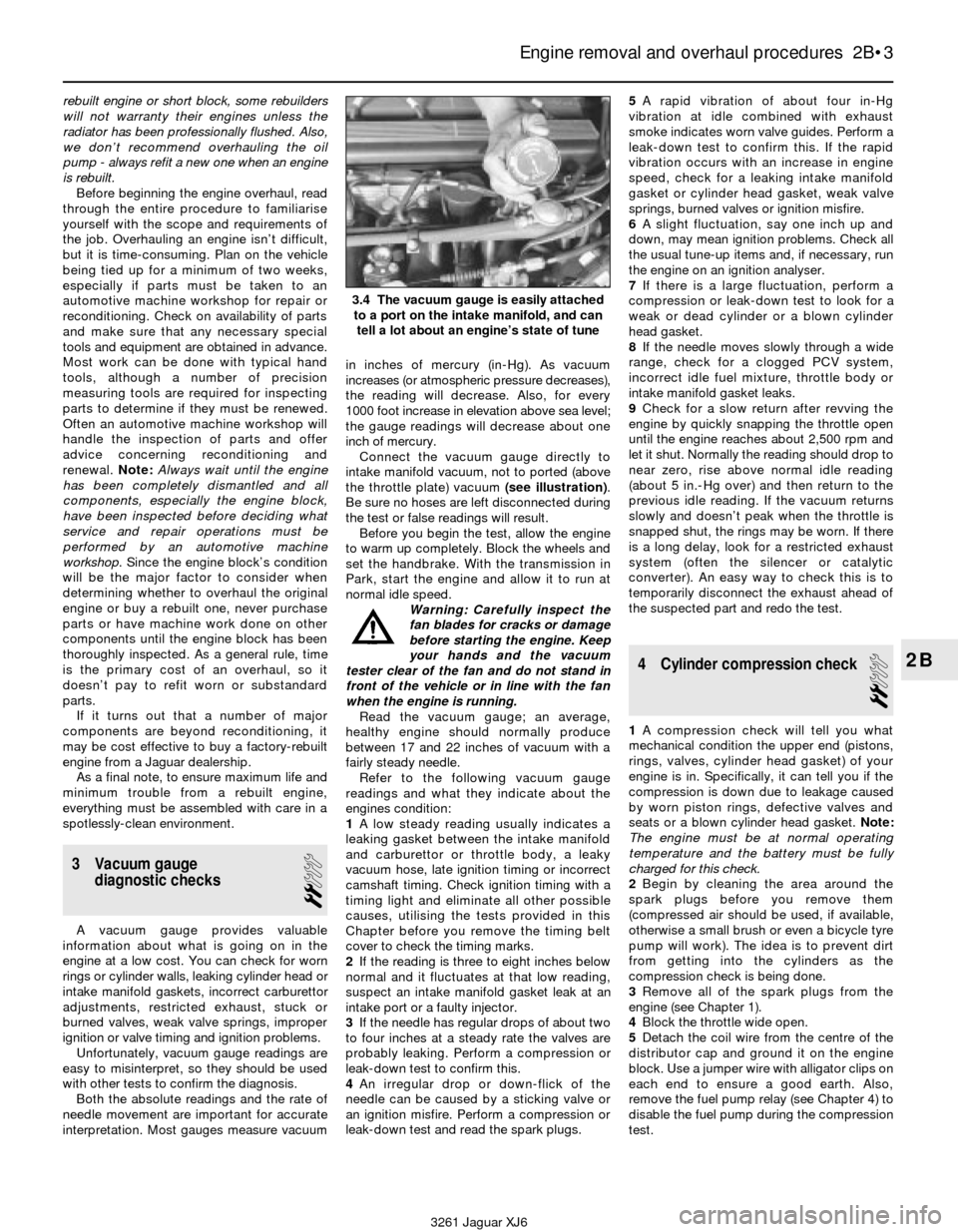
the throttle plate) vacuum (see illustration).
Be sure no hoses are left disconnected during
the test or false readings will result.
Before you begin the test, allow the engine
to warm up completely. Block the wheels and
set the handbrake. With the transmission in
Park, start the engine and allow it to run at
normal idle speed.
Warning: Carefully inspect the
fan blades for cracks or damage
before starting the engine. Keep
your hands and the vacuum
tester clear of the fan and do not stand in
front of the vehicle or in line with the fan
when the engine is running.
Read the vacuum gauge; an average,
healthy engine should normally produce
between 17 and 22 inches of vacuum with a
fairly steady needle.
Refer to the following vacuum gauge
readings and what they indicate about the
engines condition:
1A low steady reading usually indicates a
leaking gasket between the intake manifold
and carburettor or throttle body, a leaky
vacuum hose, late ignition timing or incorrect
camshaft timing. Check ignition timing with a
timing light and eliminate all other possible
causes, utilising the tests provided in this
Chapter before you remove the timing belt
cover to check the timing marks.
2If the reading is three to eight inches below
normal and it fluctuates at that low reading,
suspect an intake manifold gasket leak at an
intake port or a faulty injector.
3If the needle has regular drops of about two
to four inches at a steady rate the valves are
probably leaking. Perform a compression or
leak-down test to confirm this.
4An irregular drop or down-flick of the
needle can be caused by a sticking valve or
an ignition misfire. Perform a compression or
leak-down test and read the spark plugs.5A rapid vibration of about four in-Hg
vibration at idle combined with exhaust
smoke indicates worn valve guides. Perform a
leak-down test to confirm this. If the rapid
vibration occurs with an increase in engine
speed, check for a leaking intake manifold
gasket or cylinder head gasket, weak valve
springs, burned valves or ignition misfire.
6A slight fluctuation, say one inch up and
down, may mean ignition problems. Check all
the usual tune-up items and, if necessary, run
the engine on an ignition analyser.
7If there is a large fluctuation, perform a
compression or leak-down test to look for a
weak or dead cylinder or a blown cylinder
head gasket.
8If the needle moves slowly through a wide
range, check for a clogged PCV system,
incorrect idle fuel mixture, throttle body or
intake manifold gasket leaks.
9Check for a slow return after revving the
engine by quickly snapping the throttle open
until the engine reaches about 2,500 rpm and
let it shut. Normally the reading should drop to
near zero, rise above normal idle reading
(about 5 in.-Hg over) and then return to the
previous idle reading. If the vacuum returns
slowly and doesn’t peak when the throttle is
snapped shut, the rings may be worn. If there
is a long delay, look for a restricted exhaust
system (often the silencer or catalytic
converter). An easy way to check this is to
temporarily disconnect the exhaust ahead of
the suspected part and redo the test.
4 Cylinder compression check
2
1A compression check will tell you what
mechanical condition the upper end (pistons,
rings, valves, cylinder head gasket) of your
engine is in. Specifically, it can tell you if the
compression is down due to leakage caused
by worn piston rings, defective valves and
seats or a blown cylinder head gasket. Note:
The engine must be at normal operating
temperature and the battery must be fully
charged for this check.
2Begin by cleaning the area around the
spark plugs before you remove them
(compressed air should be used, if available,
otherwise a small brush or even a bicycle tyre
pump will work). The idea is to prevent dirt
from getting into the cylinders as the
compression check is being done.
3Remove all of the spark plugs from the
engine (see Chapter 1).
4Block the throttle wide open.
5Detach the coil wire from the centre of the
distributor cap and ground it on the engine
block. Use a jumper wire with alligator clips on
each end to ensure a good earth. Also,
remove the fuel pump relay (see Chapter 4) to
disable the fuel pump during the compression
test.
Engine removal and overhaul procedures 2B•3
2B
3.4 The vacuum gauge is easily attached
to a port on the intake manifold, and can
tell a lot about an engine’s state of tune
3261 Jaguar XJ6
Page 59 of 227

6Refit the compression gauge in the spark
plug hole (see illustration).
7Crank the engine over at least seven
compression strokes and watch the gauge.
The compression should build up quickly in a
healthy engine. Low compression on the first
stroke, followed by gradually increasing
pressure on successive strokes, indicates
worn piston rings. A low compression reading
on the first stroke, which doesn’t build up
during successive strokes, indicates leaking
valves or a blown cylinder head gasket (a
cracked cylinder head could also be the
cause). Deposits on the undersides of the
valve heads can also cause low compression.
Record the highest gauge reading obtained.
8Repeat the procedure for the remaining
cylinders and compare the results to this
Chapter’s Specifications.
9Add some engine oil (about three squirts
from a plunger-type oil can) to each cylinder,
through the spark plug hole, and repeat the
test.
10If the compression increases after the oil
is added, the piston rings are definitely worn.
If the compression doesn’t increase
significantly, the leakage is occurring at the
valves or cylinder head gasket. Leakage past
the valves may be caused by burned valve
seats and/or faces or warped, cracked or bent
valves.
11If two adjacent cylinders have equally low
compression, there’s a strong possibility that
the cylinder head gasket between them is
blown. The appearance of coolant in the
combustion chambers or the crankcase
would verify this condition.
12If one cylinder is 20 percent lower than the
others, and the engine has a slightly rough
idle, a worn exhaust lobe on the camshaft
could be the cause.
13If the compression is unusually high, the
combustion chambers are probably coated
with carbon deposits. If that’s the case, the
cylinder head(s) should be removed and
decarbonised.
14If compression is way down or varies
greatly between cylinders, it would be a goodidea to have a leak-down test performed by
an automotive repair workshop. This test will
pinpoint exactly where the leakage is
occurring and how severe it is.
5 Engine removal-
methods and precautions
If you’ve decided that an engine must be
removed for overhaul or major repair work,
several preliminary steps should be taken.
Locating a suitable place to work is
extremely important. Adequate work space,
along with storage space for the vehicle, will
be needed. If a workshop or garage isn’t
available, at the very least a flat, level, clean
work surface made of concrete or asphalt is
required.
Cleaning the engine compartment and
engine before beginning the removal
procedure will help keep tools clean and
organised.
An engine hoist or A-frame will also be
necessary. Make sure the equipment is rated
in excess of the combined weight of the
engine and transmission. Safety is of primary
importance, considering the potential hazards
involved in lifting the engine out of the vehicle.
If the engine is being removed by a novice,
a helper should be available. Advice and aid
from someone more experienced would also
be helpful. There are many instances when
one person cannot simultaneously perform all
of the operations required when lifting the
engine out of the vehicle.
Plan the operation ahead of time. Arrange
for or obtain all of the tools and equipment
you’ll need prior to beginning the job. Some of
the equipment necessary to perform engine
removal and refitting safely and with relative
ease are (in addition to an engine hoist) a
heavy duty trolley jack, complete sets of
spanners and sockets as described in the
front of this manual, wooden blocks and
plenty of rags and cleaning solvent for
mopping up spilled oil, coolant and petrol. If
the hoist must be rented, make sure that you
arrange for it in advance and perform all of the
operations possible without it beforehand.
This will save you money and time.
Plan for the vehicle to be out of use for
quite a while. A machine workshop will be
required to perform some of the work which
the do-it-yourselfer can’t accomplish without
special equipment. These shops often have a
busy schedule, so it would be a good idea to
consult them before removing the engine in
order to accurately estimate the amount of
time required to rebuild or repair components
that may need work.
Always be extremely careful when removing
and refitting the engine. Serious injury can
result from careless actions. Plan ahead, take
your time and a job of this nature, although
major, can be accomplished successfully.
6 Engine- removal and refitting
3
Note:Read through the entire Section before
beginning this procedure. It is recommended
to remove the engine and transmission from
the top as a unit, then separate the engine
from the transmission on the workshop floor. If
the transmission is not being serviced, it is
possible to leave the transmission in the
vehicle and remove the engine from the top by
itself, by removing the crankshaft damper and
tilting up the front end of the engine for
clearance,but access to the upper
bellhousing bolts is only practical when the
rear transmission mount and driveshaft have
been removed and the transmission is angled
down with a trolley jack.
Removal
1Relieve the fuel system pressure (see
Chapter 4).
2Disconnect the battery negative cable.
Caution: If the stereo in your vehicle is
equipped with an anti-theft system, make
sure you have the correct activation code
before disconnecting the battery.
3Place protective covers on the wings and
cowl and remove the bonnet (see Chapter 11).
4Remove the battery and battery tray.
5Remove the air cleaner assembly (see
Chapter 4).
6Raise the vehicle and support it securely on
axle stands. Drain the cooling system and
engine oil and remove the drivebelts (see
Chapter 1).
7Clearly label, then disconnect all vacuum
lines, coolant and emissions hoses, wiring
harness connectors and earth straps.
Masking tape and/or a touch up paint
applicator work well for marking items (see
illustration). Take instant photos or sketch
the locations of components and brackets.
8Remove the cooling fan(s) and radiator (see
Chapter 3).
9Disconnect the heater hoses.
10Release the residual fuel pressure in the
tank by removing the petrol cap, then detach
the fuel lines connecting the engine to the
chassis (see Chapter 4). Plug or cap all open
fittings.
2B•4 Engine removal and overhaul procedures
4.6 A compression gauge with a threaded
fitting for the spark plug hole is preferred
over the type that requires hand pressure
to maintain the seal - be sure to block
open the throttle valve as far as possible
during the compression check!
6.7 Label both ends of each wire and hose
before disconnecting it
3261 Jaguar XJ6
Page 61 of 227

incorporated throughout. The refitting of
manifolds and external parts is all that’s
necessary. Engines in this rebuilt form are
available from Jaguar dealers, and some
independent rebuilders.
Give careful thought to which alternative is
best for you and discuss the situation with
local automotive machine shops, auto parts
dealers and experienced rebuilders before
ordering or purchasing replacement parts.
8 Engine overhaul-
dismantling sequence
1It’s much easier to dismantle and work on
the engine if it’s mounted on a portable
engine stand. A stand can often be rented
quite cheaply from an equipment rental yard.
Before the engine is mounted on a stand, the
driveplate and rear oil seal retainer should be
removed from the engine.
2If a stand isn’t available, it’s possible to
dismantle the engine with it blocked up on the
floor. Be extra careful not to tip or drop the
engine when working without a stand.
3If you’re going to obtain a rebuilt engine, all
external components must come off first, to
be transferred to the replacement engine, just
as they will if you’re doing a complete engine
overhaul yourself. These include:
Alternator and brackets
Emissions control components
Distributor, spark plug leads and spark
plugs
Thermostat and housing cover
Water pump
EFI components
Intake/exhaust manifolds
Oil filter
Engine mounts
Driveplate
Transmission adapter plate
Note:When removing the external
components from the engine, pay close
attention to details that may be helpful or
important during refitting. Note the installed
position of gaskets, seals, spacers, pins,
brackets, washers, bolts and other small items.
4If you’re obtaining a short block, which
consists of the engine block, crankshaft,
pistons and connecting rods all assembled,
then the cylinder head, sump and oil pump will
have to be removed as well from your engine
so that your short-block can be turned in to
the rebuilder as a core. See Engine rebuilding
alternativesfor additional information
regarding the different possibilities to be
considered.
5If you’re planning a complete overhaul, the
engine must be dismantled and the internal
components removed in the following order:
Intake and exhaust manifolds
Valve cover
Upper timing chain and camshaft
sprocketsCamshafts
Timing chain cover
Cylinder head
Sump
Oil pump
Piston/connecting rod assemblies
Crankshaft rear oil seal retainer
Crankshaft and main bearings
6Before beginning the dismantling and
overhaul procedures, make sure the following
items are available. Also, refer to Section 21
for a list of tools and materials needed for
engine reassembly.
Common hand tools
Small cardboard boxes or plastic bags for
storing parts
Gasket scraper
Ridge reamer
Micrometers
Telescoping gauges
Dial indicator set
Valve spring compressor
Cylinder surfacing hone
Piston ring groove-cleaning tool
Electric drill motor
Tap and die set
Wire brushes
Oil gallery brushes
Cleaning solvent
Special Jaguar tools
Engine lifting brackets (18G 1465)
Timing damper simulator (18E 1436)
Camshaft TDC tool (18G 1433)
9 Cylinder head- dismantling
2
Note: New and rebuilt cylinder heads are
available from Jaguar and some independent
rebuilders. Due to the fact that some
specialised tools are necessary for the
dismantling and inspection procedures, and
replacement parts may not be readily
available, it may be more practical and
economical for the home mechanic to
purchase a replacement cylinder head rather
than taking the time to dismantle, inspect and
recondition the original.1Cylinder head dismantling involves removal
of the intake and exhaust valves and related
components. It’s assumed that the lifters and
camshafts have already been removed (see
Part A as needed).
2Before the valves are removed, arrange to
label and store them, along with their related
components, so they can be kept separate
and reinstalled in the same valve guides they
are removed from (see illustration).
3Compress the springs on the first valve with
a spring compressor and remove the keepers
(see illustration). Carefully release the valve
spring compressor and remove the retainer,
the spring and the spring seat (if used). Note:
If your spring compressor does not have an
end (such as the one shown) with cut-outs on
the side, an adapter is available to use with a
standard spring compressor.
Caution: Be very careful not to nick or
otherwise damage the lifter bores when
compressing the valve springs.
4Pull the valve out of the cylinder head, then
remove the oil seal from the guide. If the valve
binds in the guide (won’t pull through), push it
back into the cylinder head and deburr the
area around the keeper groove with a fine file
or whetstone.
5Repeat the procedure for the remaining
valves. Remember to keep all the parts for
each valve together so they can be reinstalled
in the same locations.
6Once the valves and related components
have been removed and stored in an
organised manner, the cylinder head should
be thoroughly cleaned and inspected. If a
complete engine overhaul is being done,
finish the engine dismantling procedures
before beginning the cylinder head cleaning
and inspection process.
10 Cylinder head-
cleaning and inspection
2
1Thorough cleaning of the cylinder head(s)
and related valve train components, followed
by a detailed inspection, will enable you to
decide how much valve service work must be
2B•6 Engine removal and overhaul procedures
9.2 A small plastic bag, with an appropriate
label, can be used to store the valve train
components so they can be kept together
and reinstalled in the correct guide
3261 Jaguar XJ6
9.3 Compress the spring until the keepers
can be removed with a small magnetic
screwdriver or needle-nose pliers - use a
valve spring compressor with an adapter
(arrowed) to remove the keepers
Page 63 of 227

15Check the valve stem-to-guide clearance
with a small hole gauge and micrometer, or a
small dial bore gauge (see illustration). Also,
check the valve stem deflection with a dial
indicator attached securely to the cylinder
head. The valve must be in the guide and
approximately 1/16-inch off the seat. The total
valve stem movement indicated by the gauge
needle must be noted, then divided by two to
obtain the actual clearance value. If it exceeds
the stem-to-guide clearance limit found in this
Chapter’s Specifications, the valve guides
should be renewed. After this is done, if
there’s still some doubt regarding the
condition of the valve guides they should be
checked by an automotive machine workshop
(the cost should be minimal).
Valves
16Carefully inspect each valve face for
uneven wear, deformation, cracks, pits and
burned areas. Check the valve stem for
scuffing and galling and the neck for cracks.
Rotate the valve and check for any obvious
indication that it’s bent. Look for pits and
excessive wear on the end of the stem. The
presence of any of these conditions indicates
the need for valve service by an automotive
machine workshop.
17Measure the margin width on each valve
(see illustration). Any valve with a margin
narrower than 1/32-inch will have to be
replaced with a new valve.
Valve components
18Check each valve spring for wear (on the
ends) and pits. Measure the free length and
compare it to this Chapter’s Specifications
(see illustration). Any springs that are shorter
than specified have sagged and should not be
re-used. The tension of all springs should be
pressure checked with a special fixture before
deciding that they’re suitable for use in a
rebuilt engine (take the springs to an
automotive machine workshop for this check).
Note:If any valve springs are found broken on
1988 or 1989 engines, all springs should be
replaced with the improved springs used in
1990 (after VIN 9EPCLA120245) and later
engines. They are identified with a white
stripe. If your engine has springs with white-
stripes, they have already been replaced, and
only broken ones need be replaced.
19Stand each spring on a flat surface and
check it for squareness (see illustration). If
any of the springs are distorted or sagged,
renew all of the springs.
20Check the spring retainers and keepers
for obvious wear and cracks. Any
questionable parts should be renewed, as
extensive damage will occur if they fail during
engine operation.
21If the inspection process indicates that the
valve components are in generally poor
condition and worn beyond the limits specified,
which is usually the case in an engine that’s
being overhauled, reassemble the valves in the
cylinder head and refer to Section 11 for valve
servicing recommendations.
11 Valves- servicing
5
1Because of the complex nature of the job
and the special tools and equipment needed,
servicing of the valves, the valve seats and the
valve guides, commonly known as a valve job,
should be done by a professional.
2The home mechanic can remove and
dismantle the cylinder head(s), do the initial
cleaning and inspection, then reassemble and
deliver them to a dealer service department or
an automotive machine workshop for the
actual service work. Doing the inspection will
enable you to see what condition the cylinder
head(s) and valvetrain components are in and
will ensure that you know what work and new
parts are required when dealing with an
automotive machine workshop.
3The dealer service department, or
automotive machine workshop, will remove
the valves and springs, will recondition or
renew the valves and valve seats, recondition
the valve guides, check and renew the valve
springs, spring retainers and keepers (as
necessary), replace the valve seals with new
ones, reassemble the valve components and
make sure the installed spring height is
correct. The cylinder head gasket surface will
also be resurfaced if it’s warped.
4After the valve job has been performed by a
professional, the cylinder head(s) will be in like
new condition. When the cylinder heads are
returned, be sure to clean them again before
refitting on the engine to remove any metal
particles and abrasive grit that may still be
present from the valve service or cylinder
head resurfacing operations. Use compressed
air, if available, to blow out all the oil holes and
passages.
12 Cylinder head- reassembly
2
1Regardless of whether or not the cylinder
head was sent to an automotive machine
workshop for valve servicing, make sure it’s
clean before beginning reassembly. Renew
the cylinder head rear plate gasket any time
that the engine is overhauled or the cylinder
head is reconditioned (see Part A of this
Chapter for renewal procedure).
2If the cylinder head was sent out for valve
servicing, the valves and related components
will already be in place. Begin the reassembly
procedure with paragraph 8.
3Refit new seals on each of the valve guides.
Gently push each valve seal into place until
it’s seated on the guide.
Caution: Don’t hammer on the valve seals
once they’re seated or you may damage
them. Don’t twist or cock the seals during
refitting or they won’t seat properly on the
valve stems.
2B•8 Engine removal and overhaul procedures
10.15 Use a small dial bore gauge to
determine the inside diameter of the valve
guides - subtract the valve stem diameter
to determine the stem-to-guide clearance10.17 The margin width on each valve
must be as specified (if no margin exists,
the valve cannot be re-used)
10.18 Measure the free length of each
valve spring with a dial or vernier caliper10.19 Check each valve spring for
squareness
3261 Jaguar XJ6