1997 HONDA ODYSSEY brakes
[x] Cancel search: brakesPage 128 of 241
The Braking System, Driving in Bad Weather
If anything goes wrong, the ABS
indicator on the instrument panel
comes on (see page 35). This means
the anti-lock function of the braking
system has shut down. The brakes
still work like a conventional system
without anti-lock, providing normal stopping ability. You should have the
dealer inspect your vehicle as soon
as possible if this light stays on after
you start the engine, or comes on while driving. Driving in Bad Weather
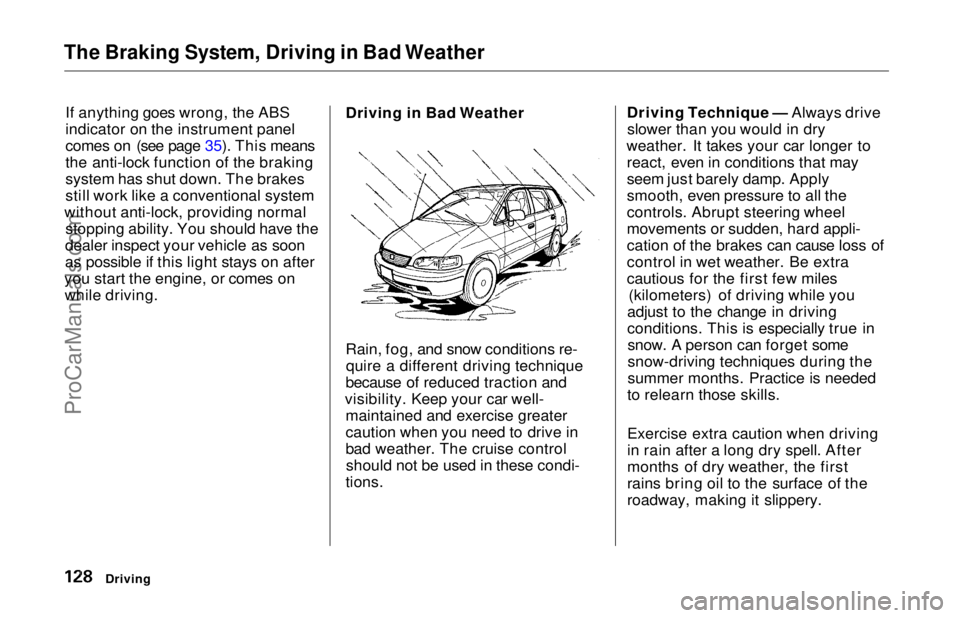
Rain, fog, and snow conditions re-
quire a different driving technique
because of reduced traction and
visibility. Keep your car well- maintained and exercise greater
caution when you need to drive in
bad weather. The cruise controlshould not be used in these condi-
tions. Driving Technique — Always drive
slower than you would in dry
weather. It takes your car longer to react, even in conditions that may
seem just barely damp. Apply
smooth, even pressure to all the
controls. Abrupt steering wheel
movements or sudden, hard appli-
cation of the brakes can cause loss of
control in wet weather. Be extra
cautious for the first few miles (kilometers) of driving while you
adjust to the change in driving
conditions. This is especially true in snow. A person can forget some
snow-driving techniques during the
summer months. Practice is needed
to relearn those skills.
Exercise extra caution when driving
in rain after a long dry spell. After
months of dry weather, the first
rains bring oil to the surface of the
roadway, making it slippery.
DrivingProCarManuals.comMain Menu Table of Contents s t
Page 132 of 241
Towing a Trailer
Mirrors
Many states and provinces have laws
requiring special outside mirrors
when you are towing a trailer. Check the laws in your area. You may want
to install mirrors, even if they are not
required. Hook up the trailer and see
how much it obscures your ability to see behind you with the standard
mirrors. If you cannot see directly
behind you, or have a large blind spot next to the trailer or the car,
you should install mirrors intended for towing. Connecting the Trailer
Most trailers that have a gross
weight of 1,000 Ibs (450 kg) do not
have their own braking system. If
you are thinking of getting a trailer that does have brakes, make sure
they are electrically-operated. Thereare no provisions in your car to tap
into its hydraulic braking system.
Any attempt to attach the trailer's brakes to your car's hydraulicsystem, no matter how successful it
may seem, will lower braking effectiveness and create a potential
hazard.
Always use a safety chain when
towing a trailer. Connect the safetychain securely at both ends. Make
sure the chain crosses under the
tongue so it will catch the trailer if it becomes unhitched. Leave enoughslack in the chain so it can't bind in a
sharp turn. Do not let it drag on the
ground.
DrivingProCarManuals.comMain Menu Table of Contents s t
Page 134 of 241
Towing a Trailer
Towing Safety
Your car will not stop as quickly with a trailer in tow. Leave extra distance
between your car and other vehicles.
Avoid braking or turning suddenly.
This could cause the trailer to
jackknife or possibly turn over.
Keep in mind that your total vehicle
is now much longer. Leave more
room when making turns. The trailer
tracks a smaller arc than the car and
can hit or run over something that
the car misses. When passing another vehicle, make sure the
trailer is clear before changing lanes. The car/trailer combination is more
affected by crosswinds and buffeting.
When being passed by a large vehicle, keep a constant speed and steer straight ahead. If there is too
much wind buffeting, slow down to
get out of the other vehicle's air
turbulence.
Towing a trailer puts an extra load on your car. You should have your
car serviced according to the
"Maintenance Schedule under
severe driving conditions" on page 143. This extra load is magnified when
you are driving in hilly terrain.
Watch the temperature gauge closely when climbing hills. If it gets
near the hot area, turn off the air
conditioning (if it is on). If this does
not reduce the heat, it may be
necessary to pull to the side of the
road and wait for the engine to cool.
If the automatic transmission shifts
frequently between 3rd and 4th gears, put it in D3. This will help
prevent the transmission fromoverheating. Help keep the brakes
from overheating by shifting to a lower gear when going downhill.
DrivingProCarManuals.comMain Menu Table of Contents s t
Page 139 of 241
Maintenance Schedule
The Maintenance Schedule specifies how often you should have your carserviced and what things need
attention. It is essential that you have
your car serviced as scheduled to retain its high level of safety,dependability, and emission control
performance.
The services and time or distance
intervals shown in the maintenance
schedule assume you will use your
car as normal transportation for
passengers and their possessions.
You should also follow these
recommendations:
Avoid exceeding your car's loadlimit. This puts excess stress on
the engine, brakes, and manyother parts of your car. The load
limit is shown on the label on the driver's doorjamb.
Operate your car on reasonable
roads within the legal speed limit.
Drive your car regularly over a
distance of several miles
(kilometers).
Always use unleaded gasoline with the proper octane rating (see page
108
).
Which Schedule to Follow:
Service your car according to the
time and mileage periods on one of
the Maintenance Schedules on the
following pages. Select the schedule
for "Severe Conditions" if most of
your driving is done under one or more of the conditions listed on that
page. Otherwise, follow the schedule
for "Normal Conditions."
MaintenanceProCarManuals.comMain Menu Table of Contents s t
Page 145 of 241
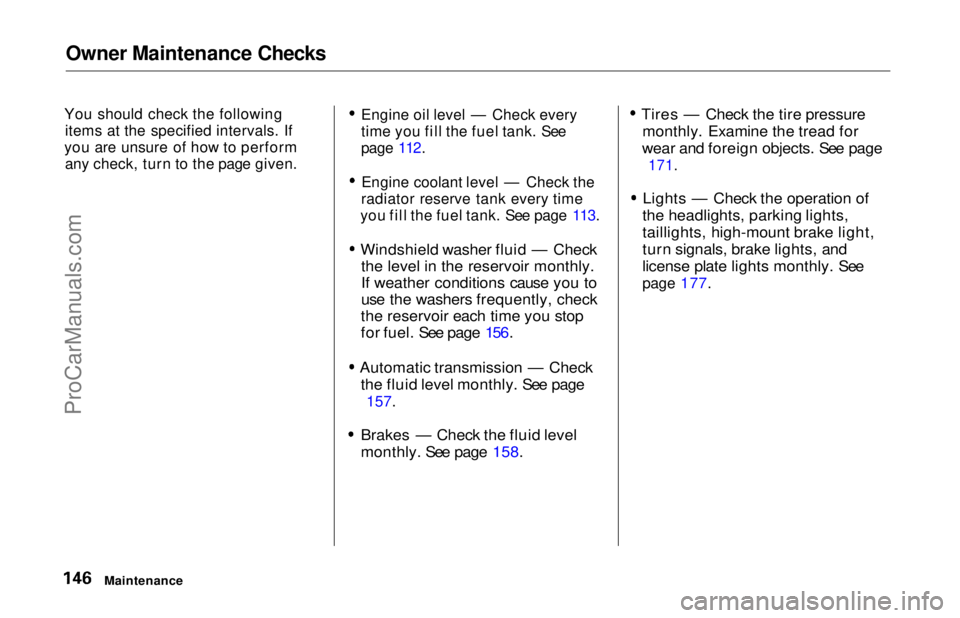
Owner Maintenance Checks
You should check the following items at the specified intervals. If
you are unsure of how to perform any check, turn to the page given. Engine oil level — Check every
time you fill the fuel tank. See
page 112.
Engine coolant level — Check the
radiator reserve tank every time
you fill the fuel tank. See page 113.
Windshield washer fluid — Check the level in the reservoir monthly.
If weather conditions cause you to
use the washers frequently, check
the reservoir each time you stop
for fuel. See page 156.
Automatic transmission — Check the fluid level monthly. See page
157.
Brakes — Check the fluid level
monthly. See page 158. Tires — Check the tire pressure
monthly. Examine the tread for
wear and foreign objects. See page
171.
Lights — Check the operation of
the headlights, parking lights,
taillights, high-mount brake light,
turn signals, brake lights, and
license plate lights monthly. See
page 177.
MaintenanceProCarManuals.comMain Menu Table of Contents s t
Page 233 of 241
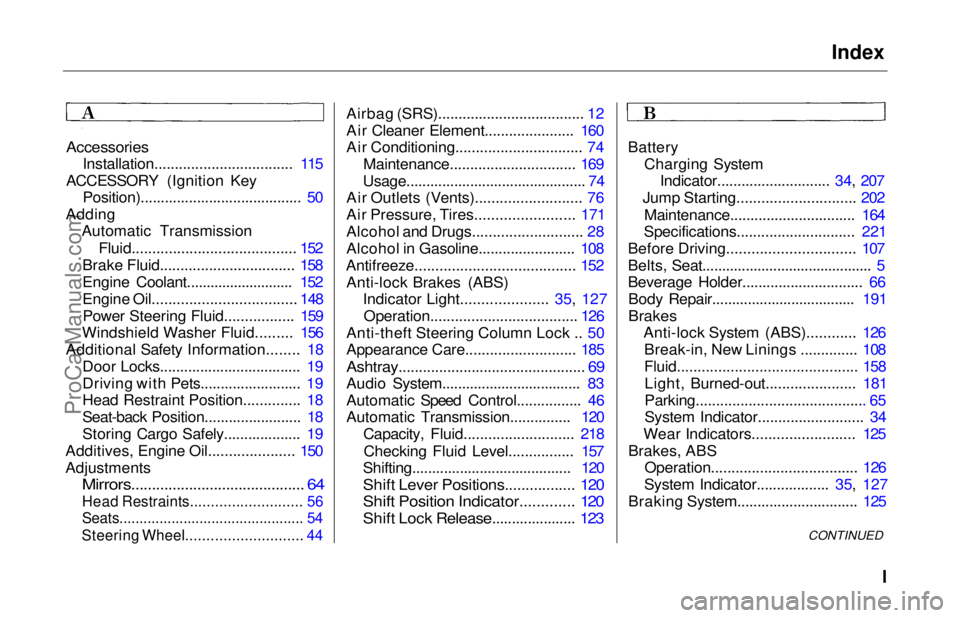
Index
Accessories
Installation.................................. 115
ACCESSORY (Ignition Key Position)........................................ 50
Adding Automatic Transmission
Fluid........................................ 152
Brake Fluid................................. 158
Engine Coolant........................... 152
Engine Oil................................... 148 Power Steering Fluid................. 159
Windshield Washer Fluid......... 156
Additional Safety Information........ 18 Door Locks................................... 19
Driving with Pets......................... 19
Head Restraint Position.............. 18
Seat-back Position........................ 18
Storing Cargo Safely................... 19
Additives, Engine Oil..................... 150
Adjustments
Mirrors.......................................... 64
Head Restraints........................... 56
Seats.............................................. 54
Steering Wheel............................ 44
Airbag (SRS).................................... 12
Air Cleaner Element...................... 160
Air Conditioning............................... 74
Maintenance............................... 169
Usage............................................. 74
Air Outlets (Vents).......................... 76
Air Pressure, Tires........................ 171
Alcohol and Drugs........................... 28
Alcohol in Gasoline........................ 108
Antifreeze....................................... 152 Anti-lock Brakes (ABS) Indicator Light..................... 35, 127
Operation.................................... 126
Anti-theft Steering Column Lock .. 50
Appearance Care........................... 185
Ashtray.............................................. 69
Audio System................................... 83
Automatic Speed Control................ 46
Automatic Transmission............... 120 Capacity, Fluid........................... 218
Checking Fluid Level................ 157
Shifting........................................ 120
Shift Lever Positions................. 120
Shift Position Indicator............. 120
Shift Lock Release..................... 123
Battery
Charging SystemIndicator............................ 34, 207
Jump Starting............................. 202
Maintenance............................... 164
Specifications............................. 221
Before Driving............................... 107
Belts, Seat........................................... 5
Beverage Holder.............................. 66 Body Repair.................................... 191
Brakes
Anti-lock System (ABS)............ 126
Break-in, New Linings .............. 108
Fluid............................................ 158
Light, Burned-out...................... 181
Parking.......................................... 65
System Indicator.......................... 34
Wear Indicators......................... 125
Brakes, ABS Operation.................................... 126
System Indicator.................. 35, 127
Braking System.............................. 125
CONTINUEDProCarManuals.comMain Menu s t