Page 30 of 241
Carbon Monoxide Hazard
Your car's exhaust contains carbon monoxide gas. You should have no
problem with carbon monoxide
entering the car in normal driving if
you maintain your car properly. Have the exhaust system inspected
for leaks whenever: The car is raised for an oil change.
You notice a change in the sound
of the exhaust. The car was in an accident that
may have damaged the underside. High levels of carbon monoxide can
collect rapidly in enclosed areas,
such as a garage. Do not run the
engine with the garage door closed.
Even with the door open, run the
engine only long enough to move the
car out of the garage. With the tailgate open, air flow can
pull exhaust gas into your car's
interior and create a hazardouscondition. If you must drive with the
tailgate open, open all the windows and set the heating and cooling
system as shown below.
If you must sit in your parked car,
even in an unconfined area, with the
engine running, adjust the heating
and cooling system as follows: 1. Push the button.
2. Select the mode.
3. Turn the fan on high speed.
4. Set the temperature control to a comfortable setting.
Driver and Passenger Safety
Carbon monoxide gas is toxic.
Breathing it can cause
unconsciousness and even kill
you.
Avoid any enclosed areas or
activities that expose you to
carbon monoxide.ProCarManuals.comMain Menu Table of Contents s t
Page 35 of 241
Indicator Lights
Seat Belt Reminder Light
This indicator lights when you turn the ignition ON (II). It is a reminderto you and your passengers to
protect yourselves by fastening theseat belts. A beeper also sounds if
you have not fastened your seat belt.
If you do not fasten your seat belt,
the beeper will stop after a few seconds but the light stays on until
you do. Both the light and the beeper stay off if you fasten your seat belt
before turning on the ignition.
Malfunction Indicator
Lamp
See page 208.
Low Oil Pressure
Indicator
The engine can be severely damaged if this light flashes or stays on when
the engine is running. For complete
information, see page 206 .
Charging System
Indicator
If this light comes on when the engine is running, the battery is not
being charged. For complete
information, see page 207 .
Supplemental Restraint
System Indicator
This indicator lights when you turn the ignition ON (II). If it comes on atany other time, it indicates a problem
in the supplemental restraint system.
For complete information, see page 16 . Parking Brake
and Brake
System
Indicator
This light has two functions:
1. It lights as a reminder that you have not released the parking
brake. Driving with the parking
brake applied can damage the
brakes and tires, and cause the
Anti-lock brake system to turn off (see page 126).
2. If it remains lit after you release the parking brake, or comes on
while driving, it can indicate that the brake fluid level is low. This is
normally due to worn brake pads.Have your dealer check the
braking system for worn pads or
fluid leaks.
Instruments and Controls
U.S.
Canada
SRS
BRAKE
ProCarManuals.comMain Menu Table of Contents s t
Page 107 of 241

Before Driving
Before you begin driving your Honda,
you should know what gasoline to use, and how to check the levels of
important fluids. You also need to
know how to properly store luggage or packages. The information in thissection will help you. If you plan to
add any accessories to your car,
please read the information in this section first.
Break-in Period.............................. 108
Gasoline.......................................... 108
Oxygenated Fuels...................... 108
Driving in Foreign Countries... 109
Service Station Procedures .......... 110
Filling the Fuel Tank................. 110Opening the Hood..................... 111
Oil Check.................................... 112
Engine Coolant Check.............. 113
Fuel Economy................................ 114 Vehicle Condition...................... 114Driving Habits............................ 114
Accessories..................................... 115 Loading Cargo................................ 116
Before DrivingProCarManuals.comMain Menu s t
Page 112 of 241
Service Station Procedures
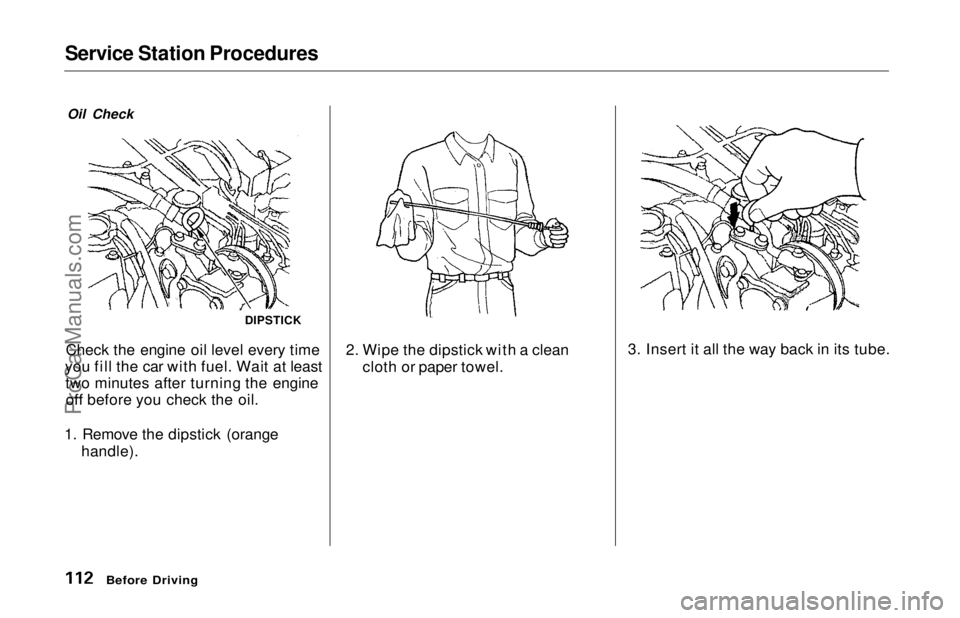
Oil Check
Check the engine oil level every time
you fill the car with fuel. Wait at least two minutes after turning the engineoff before you check the oil.
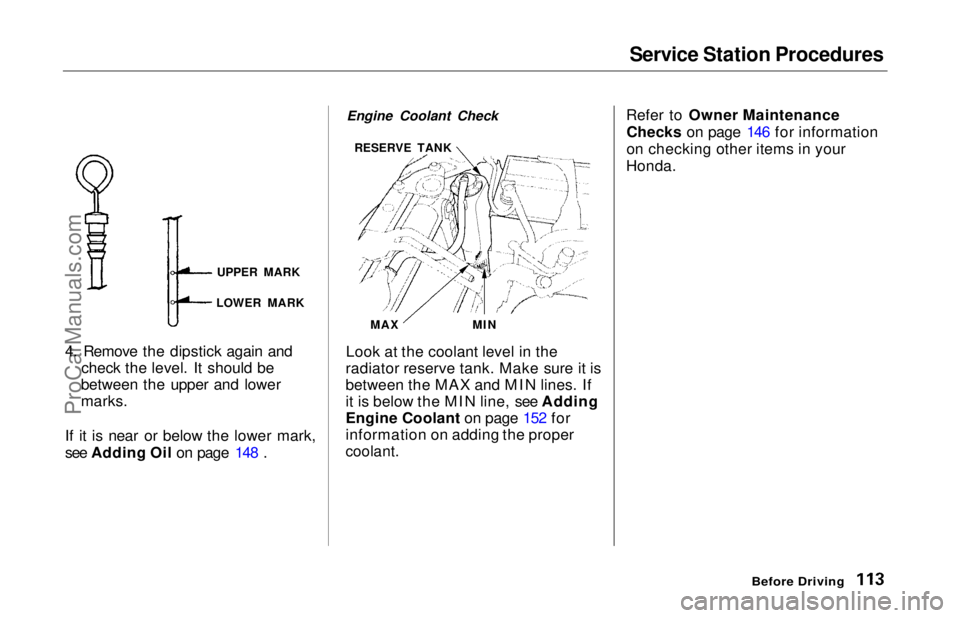
1. Remove the dipstick (orange handle). 2. Wipe the dipstick with a clean
cloth or paper towel.
Before Driving
DIPSTICK
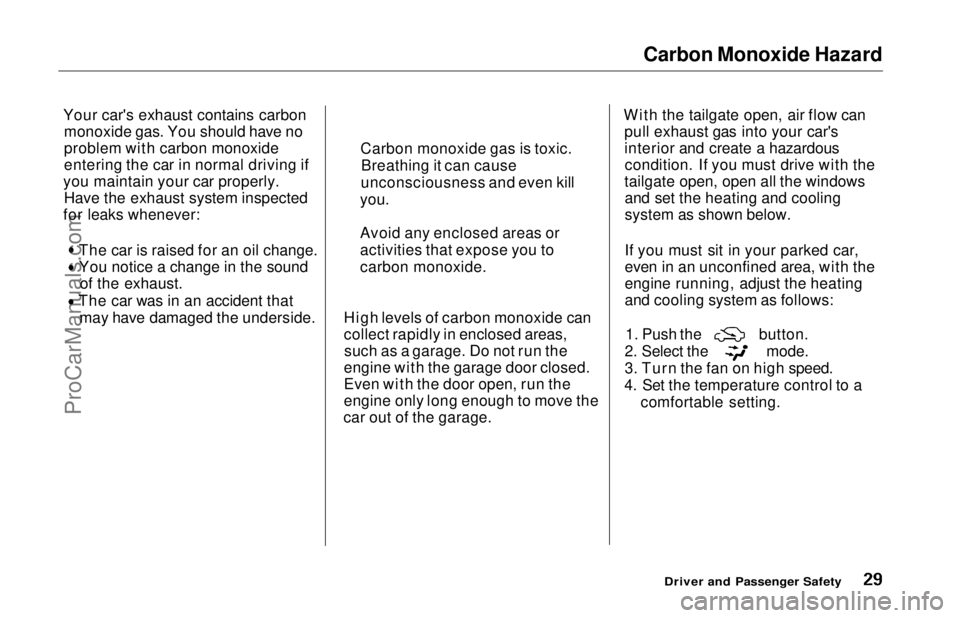
3. Insert it all the way back in its tube.ProCarManuals.comMain Menu Table of Contents s t
Page 113 of 241
Service Station Procedures
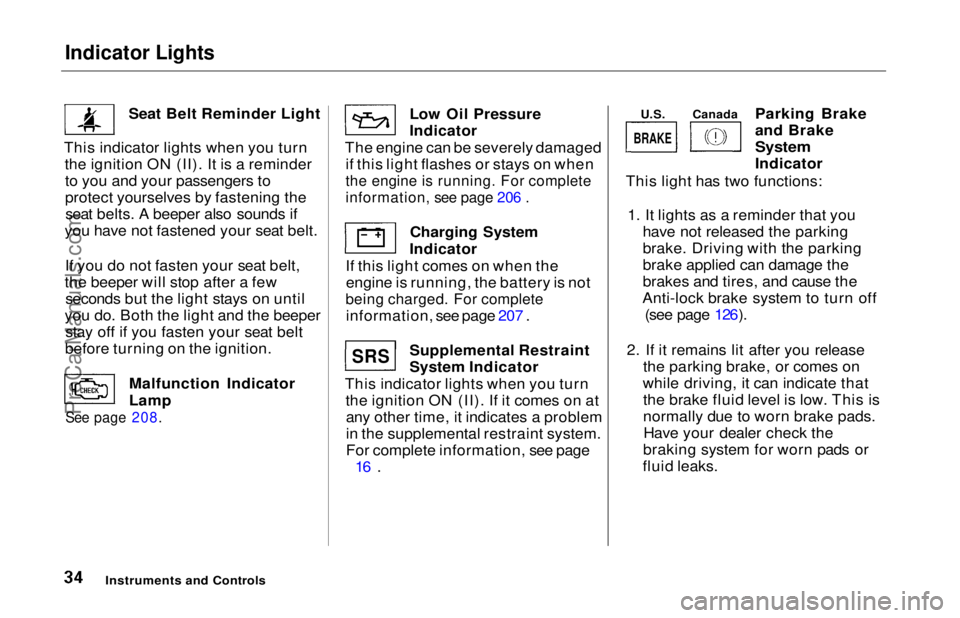
4. Remove the dipstick again and check the level. It should be
between the upper and lower
marks.
If it is near or below the lower mark,
see Adding Oil on page 148 . Engine Coolant Check
Look at the coolant level in the
radiator reserve tank. Make sure it is
between the MAX and MIN lines. If
it is below the MIN line, see Adding
Engine Coolant on page 152 for
information on adding the proper
coolant.
Refer to Owner Maintenance
Checks on page 146 for information
on checking other items in your
Honda.
Before Driving
UPPER MARK
LOWER MARK MIN
MAX
RESERVE TANKProCarManuals.comMain Menu Table of Contents s t
Page 145 of 241
Owner Maintenance Checks
You should check the following items at the specified intervals. If
you are unsure of how to perform any check, turn to the page given. Engine oil level — Check every
time you fill the fuel tank. See
page 112.
Engine coolant level — Check the
radiator reserve tank every time
you fill the fuel tank. See page 113.
Windshield washer fluid — Check the level in the reservoir monthly.
If weather conditions cause you to
use the washers frequently, check
the reservoir each time you stop
for fuel. See page 156.
Automatic transmission — Check the fluid level monthly. See page
157.
Brakes — Check the fluid level
monthly. See page 158. Tires — Check the tire pressure
monthly. Examine the tread for
wear and foreign objects. See page
171.
Lights — Check the operation of
the headlights, parking lights,
taillights, high-mount brake light,
turn signals, brake lights, and
license plate lights monthly. See
page 177.
MaintenanceProCarManuals.comMain Menu Table of Contents s t
Page 147 of 241
Engine Oil
Adding Oil
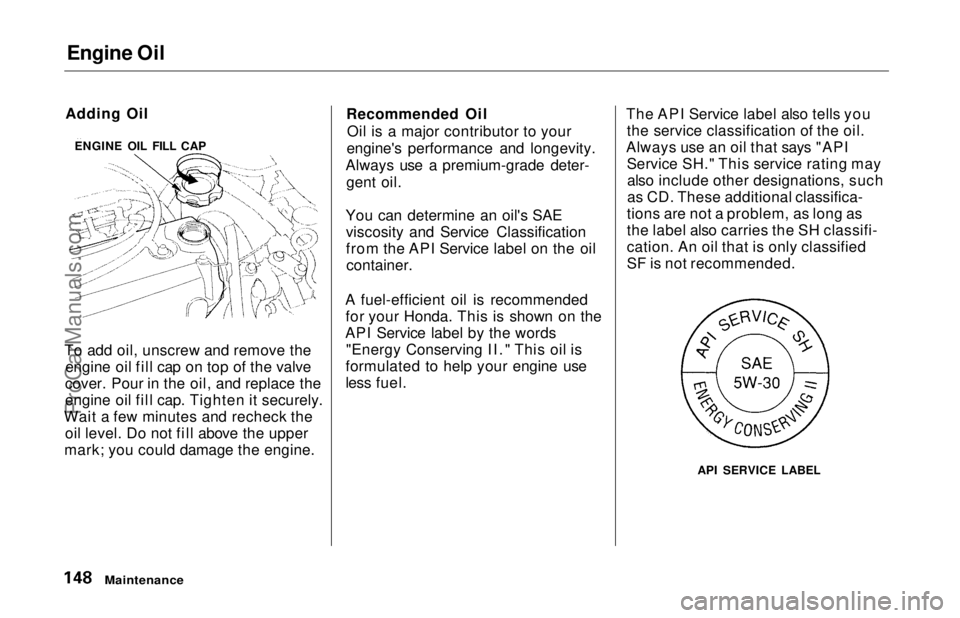
To add oil, unscrew and remove the engine oil fill cap on top of the valve
cover. Pour in the oil, and replace the
engine oil fill cap. Tighten it securely.
Wait a few minutes and recheck the oil level. Do not fill above the upper
mark; you could damage the engine. Recommended Oil
Oil is a major contributor to your
engine's performance and longevity.
Always use a premium-grade deter- gent oil.
You can determine an oil's SAE viscosity and Service Classification
from the API Service label on the oilcontainer.
A fuel-efficient oil is recommended for your Honda. This is shown on the
API Service label by the words "Energy Conserving II." This oil is
formulated to help your engine use
less fuel. The API Service label also tells you
the service classification of the oil.
Always use an oil that says "API Service SH." This service rating mayalso include other designations, such
as CD. These additional classifica-
tions are not a problem, as long as
the label also carries the SH classifi-
cation. An oil that is only classified
SF is not recommended.
API SERVICE LABEL
Maintenance
ENGINE OIL FILL CAPProCarManuals.comMain Menu Table of Contents s t
Page 150 of 241
Engine Oil
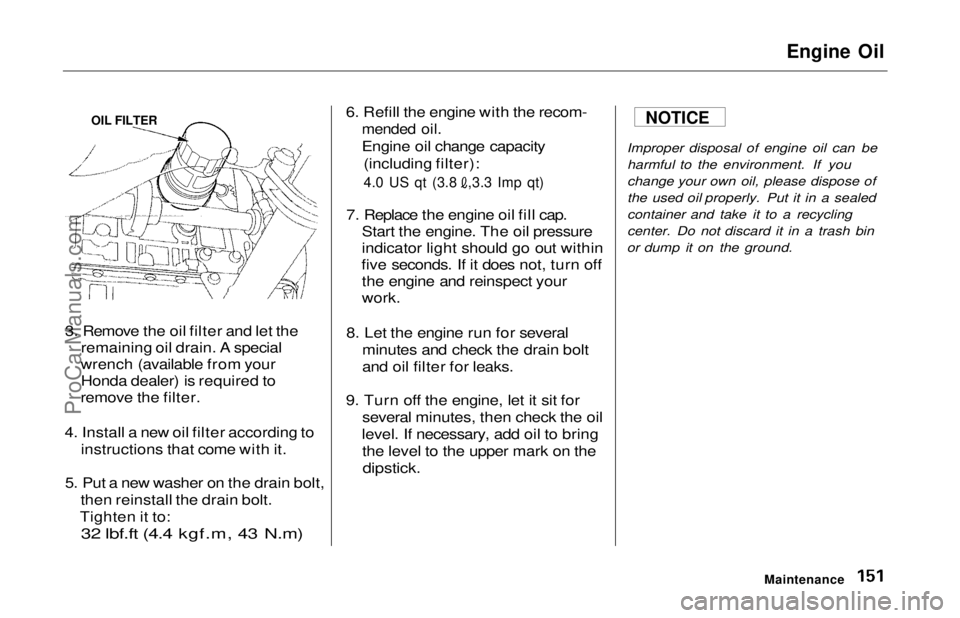
3. Remove the oil filter and let the remaining oil drain. A special
wrench (available from your Honda dealer) is required to
remove the filter.
4. Install a new oil filter according to instructions that come with it.
5. Put a new washer on the drain bolt, then reinstall the drain bolt.
Tighten it to:32 lbf.ft (4.4 kgf.m, 43 N.m)
6. Refill the engine with the recom-
mended oil.
Engine oil change capacity
(including filter):
4.0 US qt (3.8 ,3.3 Imp qt)
7. Replace the engine oil fill cap. Start the engine. The oil pressure
indicator light should go out within
five seconds. If it does not, turn off the engine and reinspect your
work.
8. Let the engine run for several minutes and check the drain bolt
and oil filter for leaks.
9. Turn off the engine, let it sit for several minutes, then check the oil
level. If necessary, add oil to bring the level to the upper mark on the
dipstick.
Improper disposal of engine oil can be
harmful to the environment. If you
change your own oil, please dispose of
the used oil properly. Put it in a sealed
container and take it to a recycling
center. Do not discard it in a trash bin
or dump it on the ground.
Maintenance
OIL FILTER
NOTICE
ProCarManuals.comMain Menu Table of Contents s t