1997 HONDA ODYSSEY weight
[x] Cancel search: weightPage 14 of 241
Supplemental Restraint System
After the crash, you may see what looks like smoke. This is actually
powder from the airbag's surface.People with respiratory problems
may experience some temporary discomfort from the chemicals used
by the airbag's activators.
Important Facts About Airbags
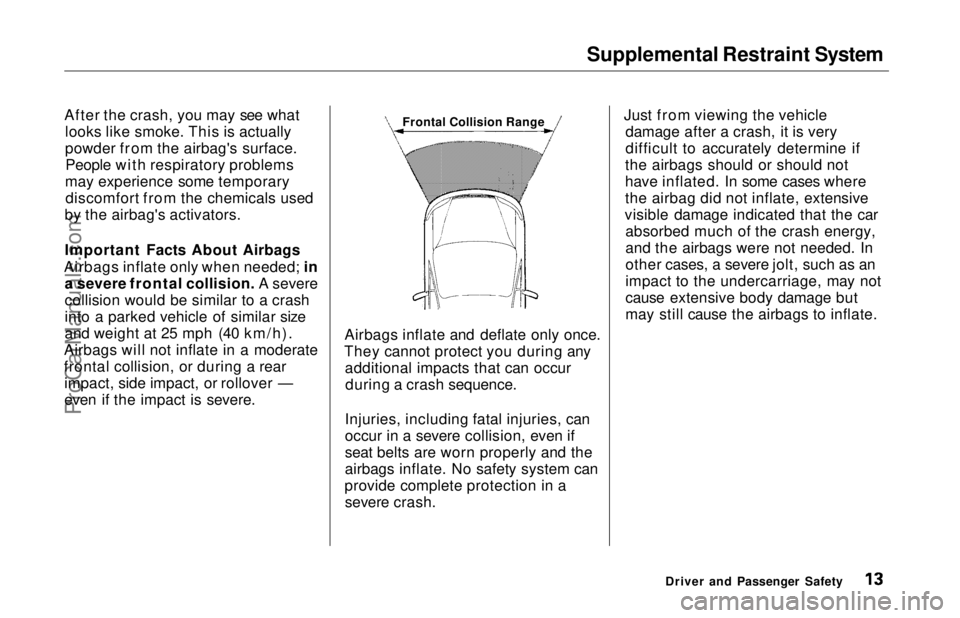
Airbags inflate only when needed; in a severe frontal collision. A severe
collision would be similar to a crash
into a parked vehicle of similar size
and weight at 25 mph (40 km/h).
Airbags will not inflate in a moderate
frontal collision, or during a rear impact, side impact, or rollover —
even if the impact is severe. Airbags inflate and deflate only once.
They cannot protect you during any additional impacts that can occurduring a crash sequence.
Injuries, including fatal injuries, can
occur in a severe collision, even if
seat belts are worn properly and the
airbags inflate. No safety system can
provide complete protection in a severe crash. Just from viewing the vehicle
damage after a crash, it is very
difficult to accurately determine if
the airbags should or should not
have inflated. In some cases where
the airbag did not inflate, extensive
visible damage indicated that the car absorbed much of the crash energy,
and the airbags were not needed. In
other cases, a severe jolt, such as an
impact to the undercarriage, may not
cause extensive body damage but
may still cause the airbags to inflate.
Driver and Passenger Safety
Frontal Collision RangeProCarManuals.comMain Menu Table of Contents s t
Page 23 of 241
Child Safety
General Guidelines for
Restraining Children Under 40 Ibs (18 kg)
Use an approved child seat. The seat
must meet Federal Motor Vehicle Safety Standard 213 (FMVSS-213) orCanadian Motor Vehicle Safety
Standards. Look for the manufac-
turer's statement of compliance on
the box and seat.
Use a seat of the right size. Make sure
the seat fits your child. Check the seat manufacturer's instructions and
labels for height and weight limits.
Secure the child seat to the car. All
approved child seats are designed to
be secured to the car seat by the lap
belt or the lap belt portion of a lap/ shoulder belt. A child whose seat is
not properly secured to the car can
be endangered in a crash. To properly route a seat belt through
a child seat, follow the seat maker's
instructions. If you use a lap/shoulder belt, be sure to follow the
instructions for securing a child seat
with a lap/shoulder belt on page 25 .
Secure the child in the child seat. Make
sure the infant or child is firmly
secured to the child seat. Use the
straps provided, and carefully follow
the manufacturer's instructions. Restraining an Infant Who
Weighs Less Than 20 Ibs (9 kg)
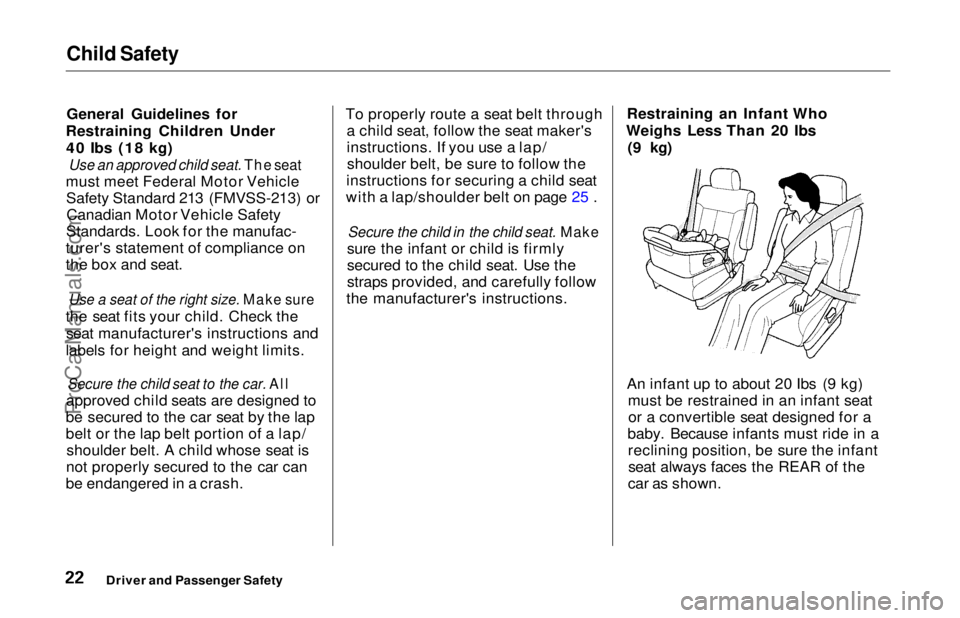
An infant up to about 20 Ibs (9 kg) must be restrained in an infant seator a convertible seat designed for a
baby. Because infants must ride in a reclining position, be sure the infantseat always faces the REAR of the
car as shown.
Driver and Passenger SafetyProCarManuals.comMain Menu Table of Contents s t
Page 114 of 241
Fuel Economy
The condition of your car and your driving habits are the two most
important things that affect the fuel
mileage you get.
Vehicle Condition
Always maintain your car according to the maintenance schedule. This
will keep it in top operating condition.
An important part of that mainte- nance is the Owner Maintenance
Checks (see page 146). For
example, an underinflated tire
causes more "rolling resistance,"
which uses fuel. It also wears out
faster, so check the tire pressure at
least monthly.
In winter, the build-up of snow on
your car's underside adds weight and
rolling resistance. Frequent cleaning
helps your fuel mileage and reduces
the chance of corrosion. Driving Habits
You can improve fuel economy by driving moderately. Rapid acceler-
ation, abrupt cornering, and hard
braking use more fuel.
Always drive in the highest gear that allows the engine to run and acceler-
ate smoothly.
Depending on traffic conditions, try
to maintain a constant speed. Every
time you slow down and speed up,
your car uses extra fuel. Use the cruise control, when appropriate, to
increase fuel economy. A cold engine uses more fuel than a
warm engine. It is not necessary to"warm-up" a cold engine by letting it
idle for a long time. You can drive
away in about a minute, no matter
how cold it is outside. The engine
will warm up faster, and you get better fuel economy. To cut down on
the number of "cold starts," try to combine several short trips into one.
The air conditioning puts an extra load on the engine which makes it use more fuel. Turn off the A/C to
cut down on air conditioning use. Use the flow-through ventilation
when the outside air temperature is moderate.
Before DrivingProCarManuals.comMain Menu Table of Contents s t
Page 116 of 241
Loading Cargo
The maximum load you can carry in your Honda is 1,150 Ibs (535 kg). It
includes the total weight of all
passengers and their belongings, any
accessories, and the tongue weight
of a trailer. This 1,150 Ibs (535 kg)
figure is shown as the Vehicle Capacity Weight on the tire infor-
mation label attached to the driver's doorjamb.
To figure out how much cargo you
can cany: Figure the total "occupant weight"
you will be transporting. To do this, multiply the number of people (driver and all passengers) by 150
Ibs (70 kg). Subtract this number from the
Vehicle Capacity Weight (1,150 lbs/535 kg). If you are towing a trailer, subtract
the tongue weight. See Towing a
Trailer on page 130 .
This final number is the total weight of cargo you can load in or on the car.
With seven occupants (driver and six passengers), the maximum recom-
mended weight for cargo is 100 Ibs
(45 kg).
Where you store this cargo, and how
well you secure it, are just as important as how much it weighs.
Make sure you load cargo so it will
not shift while driving. Items stored
in the cargo area behind the third
seat should be stored as far forward
as possible. You could store addi-
tional items on the floor behind the
front seats. Make sure they cannot roll under the front seat and
interfere with the pedals.
For greater cargo capacity, the thirdseat can be folded into the floor and
the second row seats can either be removed or folded up (depending onmodel). Passengers should never sit
in the open cargo area while the car
is moving. They should sit in one of
the seats and wear their seat belts.
If you must carry large objects that
prevent you from closing the tailgate,
be aware that exhaust gas can enter the interior. See Carbon Monoxide
Hazard on page 29 .
Before DrivingProCarManuals.comMain Menu Table of Contents s t
Page 130 of 241
Towing a Trailer
Your Honda is designed primarily tocarry passengers and their cargo.
You can use it to tow a trailer if you carefully observe some general rules.
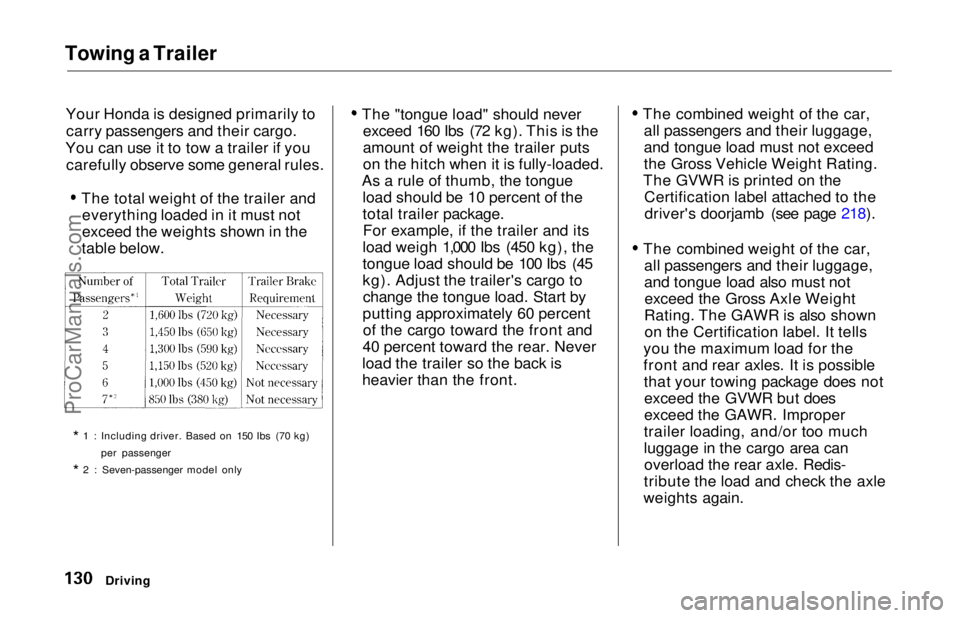
The total weight of the trailer andeverything loaded in it must not
exceed the weights shown in the
table below.
* 1 : Including driver. Based on 150 Ibs (70 kg)
per passenger
* 2 : Seven-passenger model only The "tongue load" should never
exceed 160 Ibs (72 kg). This is the
amount of weight the trailer puts
on the hitch when it is fully-loaded.
As a rule of thumb, the tongue load should be 10 percent of the
total trailer package.For example, if the trailer and its
load weigh 1,000 Ibs (450 kg), the
tongue load should be 100 Ibs (45
kg). Adjust the trailer's cargo to change the tongue load. Start by
putting approximately 60 percent of the cargo toward the front and
40 percent toward the rear. Never
load the trailer so the back is
heavier than the front. The combined weight of the car,
all passengers and their luggage,
and tongue load must not exceed
the Gross Vehicle Weight Rating.
The GVWR is printed on the Certification label attached to thedriver's doorjamb (see page 218).
The combined weight of the car, all passengers and their luggage,
and tongue load also must notexceed the Gross Axle Weight
Rating. The GAWR is also shown on the Certification label. It tells
you the maximum load for the
front and rear axles. It is possible that your towing package does notexceed the GVWR but does
exceed the GAWR. Improper
trailer loading, and/or too much
luggage in the cargo area can overload the rear axle. Redis-
tribute the load and check the axle
weights again.
DrivingProCarManuals.comMain Menu Table of Contents s t
Page 131 of 241

Towing a Trailer
The best way to confirm that your total towing package is within these specifications is to get it weighed.
Load the car and trailer as you
normally would while towing, and
take them to a public scale. Have
them check the total weight and the
weight at each axle, then compare the weights to the specifications.
Trailer Hitches
Your Honda dealer, or the Honda Customer Relations Zone Office, can
give you advice on the proper hitch
for your car. Never use a hitch that mounts only to the rear bumper. The
bumper is not designed to handle
that type of load. The hitch should
bolt to the underbody of the car and distribute the load over a wide area.
Always have a trailer hitch installed by a qualified technician.
A trailer hitch that is not adequate for the size of the trailer, or a hitch that is
improperly installed, can cause damage
to the underside of your car.
Driving
NOTICE
Improperly loading your car and
trailer can seriously affect its
steering and braking performance, causing a crash
in which you can be seriously
injured.
Check the loading of your car
and trailer carefully before
starting to drive.ProCarManuals.comMain Menu Table of Contents s t
Page 132 of 241
Towing a Trailer
Mirrors
Many states and provinces have laws
requiring special outside mirrors
when you are towing a trailer. Check the laws in your area. You may want
to install mirrors, even if they are not
required. Hook up the trailer and see
how much it obscures your ability to see behind you with the standard
mirrors. If you cannot see directly
behind you, or have a large blind spot next to the trailer or the car,
you should install mirrors intended for towing. Connecting the Trailer
Most trailers that have a gross
weight of 1,000 Ibs (450 kg) do not
have their own braking system. If
you are thinking of getting a trailer that does have brakes, make sure
they are electrically-operated. Thereare no provisions in your car to tap
into its hydraulic braking system.
Any attempt to attach the trailer's brakes to your car's hydraulicsystem, no matter how successful it
may seem, will lower braking effectiveness and create a potential
hazard.
Always use a safety chain when
towing a trailer. Connect the safetychain securely at both ends. Make
sure the chain crosses under the
tongue so it will catch the trailer if it becomes unhitched. Leave enoughslack in the chain so it can't bind in a
sharp turn. Do not let it drag on the
ground.
DrivingProCarManuals.comMain Menu Table of Contents s t
Page 148 of 241
Engine Oil
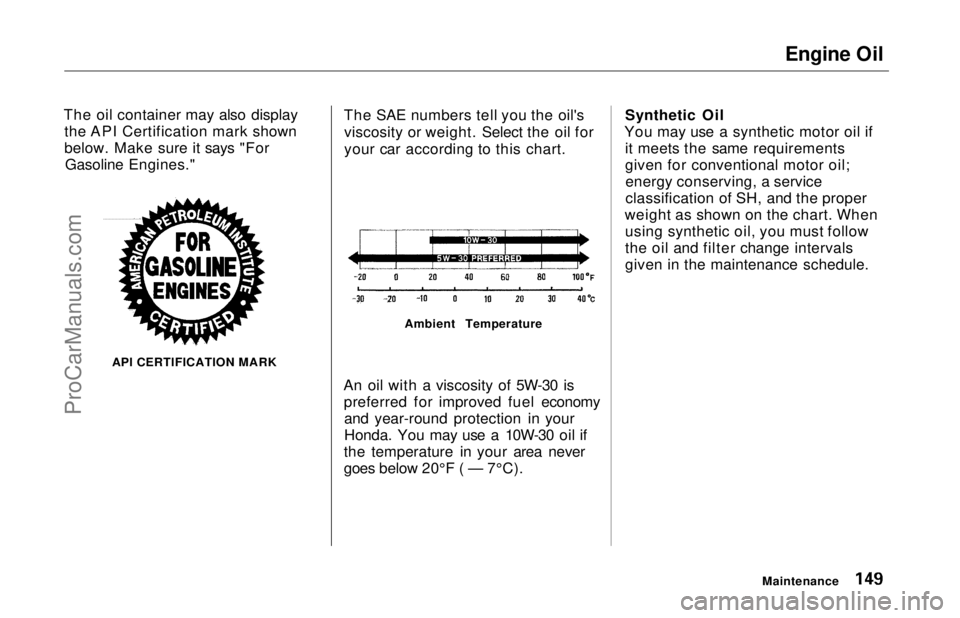
The oil container may also display the API Certification mark shown
below. Make sure it says "ForGasoline Engines."
API CERTIFICATION MARK The SAE numbers tell you the oil's
viscosity or weight. Select the oil for
your car according to this chart.
An oil with a viscosity of 5W-30 is preferred for improved fuel economyand year-round protection in your
Honda. You may use a 10W-30 oil if
the temperature in your area never
goes below 20°F ( — 7°C). Synthetic Oil
You may use a synthetic motor oil if it meets the same requirements
given for conventional motor oil;energy conserving, a service
classification of SH, and the proper
weight as shown on the chart. When using synthetic oil, you must follow
the oil and filter change intervals
given in the maintenance schedule.
Maintenance
Ambient TemperatureProCarManuals.comMain Menu Table of Contents s t