1997 GMC SIERRA service schedule
[x] Cancel search: service schedulePage 3 of 436
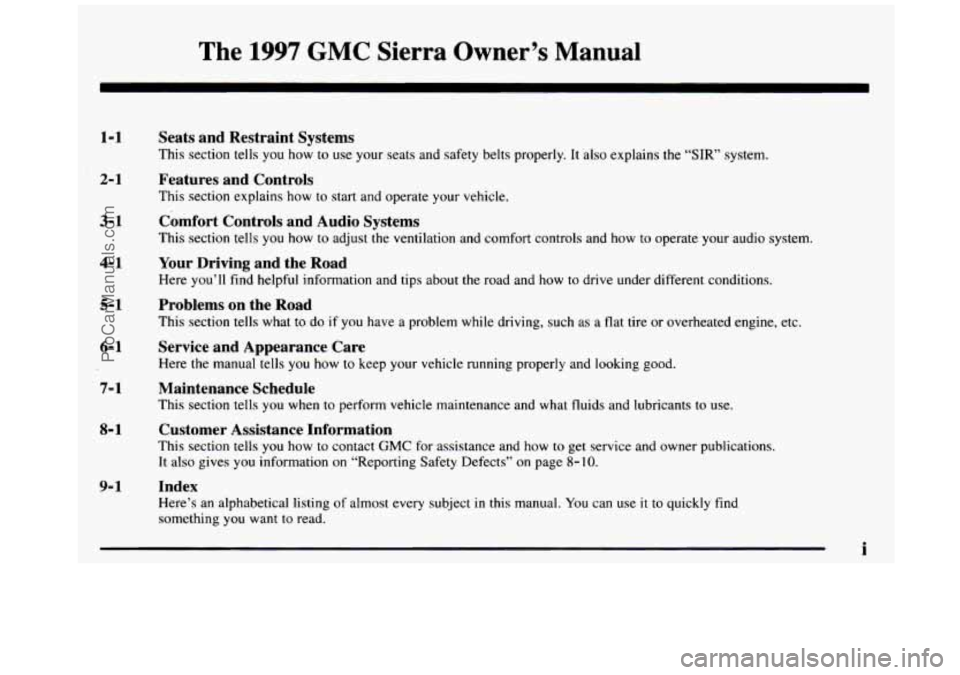
The 1997 GMC Sierra Owner’s Manual
1-1
2- 1
3- 1
4- 1
5-1
6-1
7- 1
8-1
9-1
Seats and Restraint Systems
This section tells you how to use your seats and safety belts properly. It also explains the “SIR’ system.
Features and Controls
This section explains how to start and operate your vehicle.
Comfort Controls and Audio Systems
This section tells you how to adjust the ventilation and comfort controls and how to operate your audio system.
Your Driving and the Road
Here you’ll find helpful information and tips about the road and how to drive under different conditions.
Problems on the Road
This section tells what to do if you have a problem while driving, such as a flat tire or overheated engine, etc.
Service and Appearance Care
Here the manual tells you how to keep your vehicle running properly and looking good.
Maintenance Schedule
This section tells you when to perform vehicle maintenance and what fluids and lubricants to use.
Customer Assistance Information
This section tells you how to contact GMC for assistance and how to get service and owner publications.
It also gives you information on “Reporting Safety Defects” on page
8- 10.
Index
Here’s an alphabetical listing of almost every subject in this manual. You can use it to quickly find
something you want to read.
ProCarManuals.com
Page 204 of 436
If the water isn’t too deep, then drive through it slowly.
At fast speeds, water splashes on your ignition system
and your vehicle can stall. Stalling can also occur
if you
get your tailpipe under water. And, as long as your
tailpipe is under water, you’ll never be able
to start your
engine. When you go through water, remember that when
your brakes get wet, it may
take you longer to stop.
ki CAU IN:
Driving through rushing water can be dangerous.
Deep water can sweep your vehicle downstream
and you and your passengers could drown.
If it’s
only shallow water, it can still wash away the
ground from under your tires, and
you could lose
traction and roll the vehicle
over. Don’t drive
through rushing water.
After Off-Road Driving
Remove any brush or debris that has collected on
the underbody, chassis or under the hood. These
accumulations can be
a fire hazard.
After operation
in mud or sand, have the brake linings
cleaned and checked. These substances can cause
glazing and
uneven braking. Check the body structure,
steering, suspension, wheels, tires and exhaust system
for damage. Also, check
the fuel lines and cooling
system for any leakage.
Your vehicle will require more frequent service due to
off-road use. Refer to the Maintenance Schedule for
additional information.
See “Driving Through Water”
in the Index for more
information on driving through water.
4-26
ProCarManuals.com
Page 236 of 436
When You Are Ready to Leave After
Parkine
on a Hill
1. Apply your regular brakes and hold the pedal down
while you:
Start your engine;
Shift into a gear; and
Release the parking brake.
2. Let up on the brake pedal.
3. Drive slowly until the trailer is clear of the chocks.
4. Stop and have someone pick up and store the chocks.
Maintenance When Trailer Towing
Your vehicle will need service more often when you’re
pulling a trailer. See the Maintenance Schedule for more
on this. Things that are especially important
in trailer
operation are automatic transmission fluid (don’t
overfill), engine oil, axle lubricant, belt, cooling system
and brake adjustment. Each
of these is covered in this
manual, and
the Index will help you find them quickly.
If you’re trailering, it’s a good idea to review these
sections before you start your trip.
Trailer Wiring Harness
A seven-wire harness is stored under the rear end of
your vehicle, between
the frame rails. An electrical
connector will need to be installed at the trailer end of
the harness, by a qualified electrical technician. For
additional trailer wiring and towing information please
consult your
GM dealer. Securely attach the harness to
the trailer, then tape or strap
it to your vehicle’s frame
rail. Be sure you leave it loose enough
so the wiring
won’t bind or break when turning with the trailer, but
not
so loose that it drags on the ground. Store the
harness in its original position. Wrap the harness
together and tie
it neatly so it won’t be damaged. If you
tow
a trailer, your Center High-Mounted Stoplamp
(CHMSL) may not be properly visible from behind.
You
should select a trailer with a CHMSL on it or, if one is
not available, have one installed. See your
GM dealer
about how to connect your vehicle’s wiring
to a
trailer CHMSL.
Check periodically to see that all hitch nuts and bolts
are tight.
4-58
ProCarManuals.com
Page 294 of 436
Engine Oil Additives
Don’t add anything to your oil. Your GM dealer is ready
to advise if you think something should be added.
When to Change Engine Oil
If any one of these is true for you, use the short tripkity
maintenance schedule:
0
0
0
0
0
Most trips are less than 5 to 10 miles (8 to 16 km).
This is particularly important when outside
temperatures
are below freezing.
Most trips include extensive idling (such as frequent
driving in stop-and-go traffic).
You operate your vehicle in dusty areas or
off-road frequently.
You frequently tow a trailer.
The vehicle is used for delivery service, police, taxi
or other commercial application.
Driving under these conditions causes engine oil to
break down sooner. If any one of these is true for your
vehicle, then you need to change your oil and filter
every
3,000 miles (5 000 km) or 3 months -- whichever
occurs first. If
none
of them is true, use the long triphighway
maintenance schedule. Change the oil and filter
every
7,500 miles (12 500 km) or 12 months -- whichever
occurs first. Driving
a vehicle with a fully warmed
engine under highway conditions causes engine oil to
break down slower.
What to Do with Used Oil
Did you know that used engine oil contains certain
elements that may be unhealthy for your skin and could
even cause cancer? Don’t let used oil stay on your skin
for very long. Clean your skin and nails with soap and
water,
or a good hand cleaner, Wash or properly throw
away clothing or rags containing used engine oil. (See
the manufacturer’s warnings about the use and disposal
of oil products.)
Used oil can be a real threat to the environment.
If you
change your own oil, be sure to drain all free-flowing oil
from the filter before disposal. Don’t ever dispose of oil
by putting it in the trash, pouring it on the ground, into
sewers, or into streams or bodies of water. Instead,
recycle
it by taking it to a place that collects used oil. If
you have a problem properly disposing of your used oil,
ask your dealer, a service station or a local recycling
center for help.
6-18
ProCarManuals.com
Page 297 of 436
Refer to the Maintenance Schedule to determine when to
replace the air filter. See “Owner Checks and Services”
in
the Index.
Operating the engine with the
air cleaner off
can cause you OF others to be burned. The air
cleaner not only cleans the air,
it stops flame if
the engine backfires.
If it isn’t there, and the
engine backfires, you could be burned. Don’t
drive with it
off, and be careful working on the
engine with the air cleaner
off.
I NOTICE:
If the air cleaner is off, a backfire can cause a
damaging engine fire. And, dirt can easily get
into your engine, which will damage it. Always
have the air cleaner in place when you’re driving.
Automatic Transmission Fluid
When to Check and Change
A good time to check your automatic transmission fluid
level is
when the engine oil is changed.
Change both the fluid and filter every
50,000 miles
(83
000 km) if the vehicle’s CVWR is over 8,600 or
if the vehicle is mainly driven under one or more
of
these conditions:
In heavy city traffic where the outside temperature
regularly reaches
90°F (32°C) or higher.
In hilly or mountainous terrain.
When doing frequent trailer towing.
Uses such as found in taxi, police or delivery service.
If your vehicle’s GVWR is not over
8,600 and you do
not use your vehicle under any
of these conditions, the
fluid and filter do
not require changing.
See “Scheduled Maintenance Services’’
in the Index.
ProCarManuals.com
Page 302 of 436
How to Add Fluid When to Check and What to Use
Here’s how to add
fluid. Refer to the Maintenance
Schedule to determine what kind of fluid to use. See
“Recommended Fluids and Lubricants” in the Index.
1. Remove the filler plug.
2. Add fluid at the filler plug hole. Add only enough
fluid to bring the fluid level
up to the bottom of the
filler plug hole.
3. Install the filler plug. Be sure the plug is fully seated.
Hydraulic Clutch
The hydraulic clutch system in your vehicle is
self-adjusting.
A slight amount of play (114 inch to
1/2 inch or 6 mm to 12 mm) in the pedal is normal.
It isn’t
a good idea to “top off’ your clutch fluid. Adding
fluid won’t correct
a leak. A fluid loss in this system
could indicate a problem. Have the system inspected
and repaired. Refer
to the Maintenance
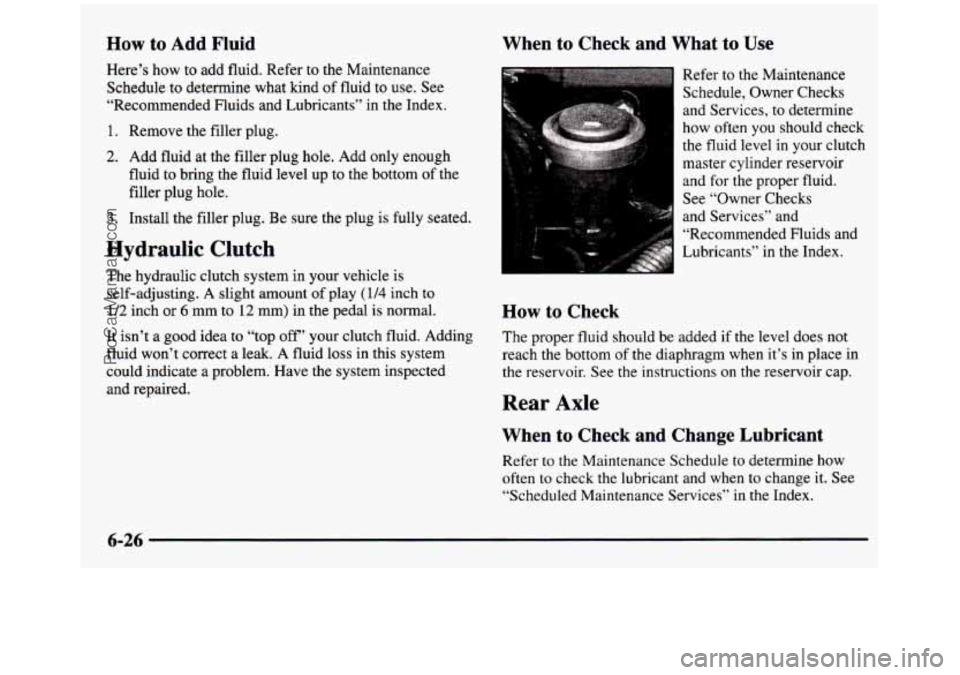
yk I Schedule, Owner Checks
and
Services,
to determine
how often you should check
the fluid level in your clutch
master cylinder reservoir
and for the proper fluid.
See “Owner Checks
and Services” and “Recommended Fluids and
Lubricants” in the Index.
How to Check
The proper fluid should be added if the level does not
reach the bottom of the diaphragm when it’s in place in
the reservoir. See the instructions on the reservoir cap.
Rear Axle
When to Check and Change Lubricant
Refer to the Maintenance Schedule to determine how
often
to check the lubricant and when to change it. See
“Scheduled Maintenance Services” in
the Index.
6-26
ProCarManuals.com
Page 304 of 436
How to Check Lubricant Front Axle
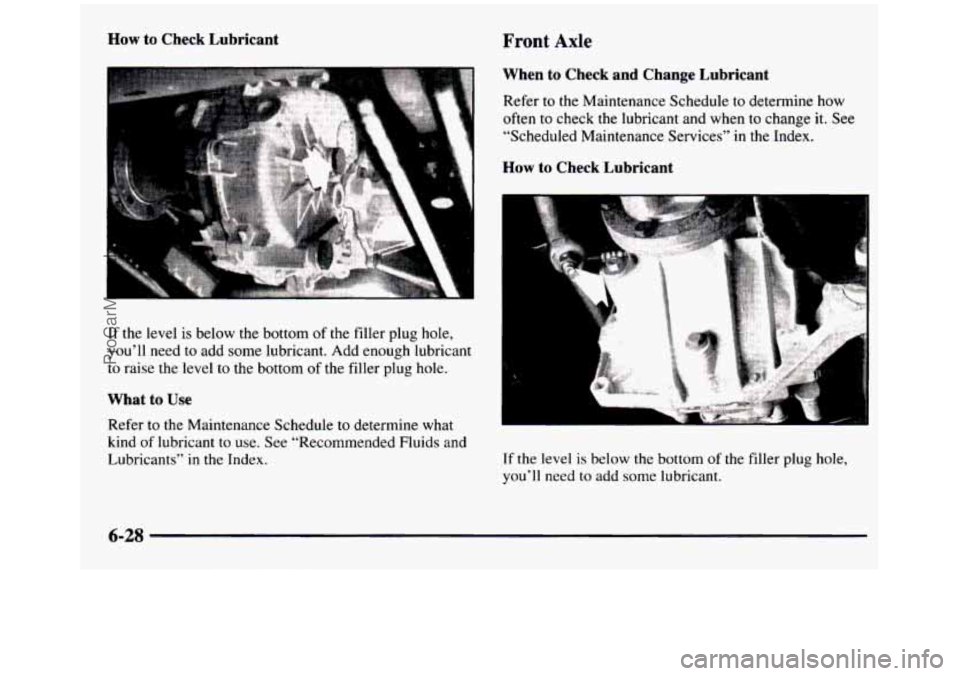
If the level is below the bottom of the filler plug hole,
you’ll need to add some lubricant. Add enough lubricant
to raise the level
to the bottom of the filler plug hole.
What to Use
Refer to the Maintenance Schedule to determine what
kind
of lubricant to use. See “Recommended Fluids and
Lubricants” in
the Index.
When to Check and Change Lubricant
Refer to the Maintenance Schedule to determine how
often to check the lubricant and when to change it. See
“Scheduled Maintenance Services”
in the Index.
How to Check Lubricant
If the level is below the bottom of the filler plug hole,
you’ll need
to add some lubricant.
6-28
-
ProCarManuals.com
Page 328 of 436
When to Check
Check your tires once a month or more. Also, check the
tire pressure of the spare tire.
How to Check
Use a good quality pocket-type gage to check tire
pressure.
You can’t tell if your tires are properly inflated
simply by looking at them. Radial tires may look
properly inflated even when they’re underinflated.
Be sure
to put the valve caps back on the valve stems.
They help prevent leaks by keeping out
dirt and moisture.
Tire Inspection and Rotation
Tires should be rotated every 6,000 to 8,000 miles
(10 000 to 13 000 km). Any time you notice unusual
wear, rotate your tires as soon as possible and check
wheel alignment.
Also check for damaged tires or
wheels. See “When It’s Time for New Tires” and
“Wheel Replacement” later
in this section for more
information. If your vehicle has dual rear wheels, also
see “Dual Tire Operation” later in this section. The
purpose of regular rotation is to achieve more
uniform wear for all tires
on the vehicle. The first
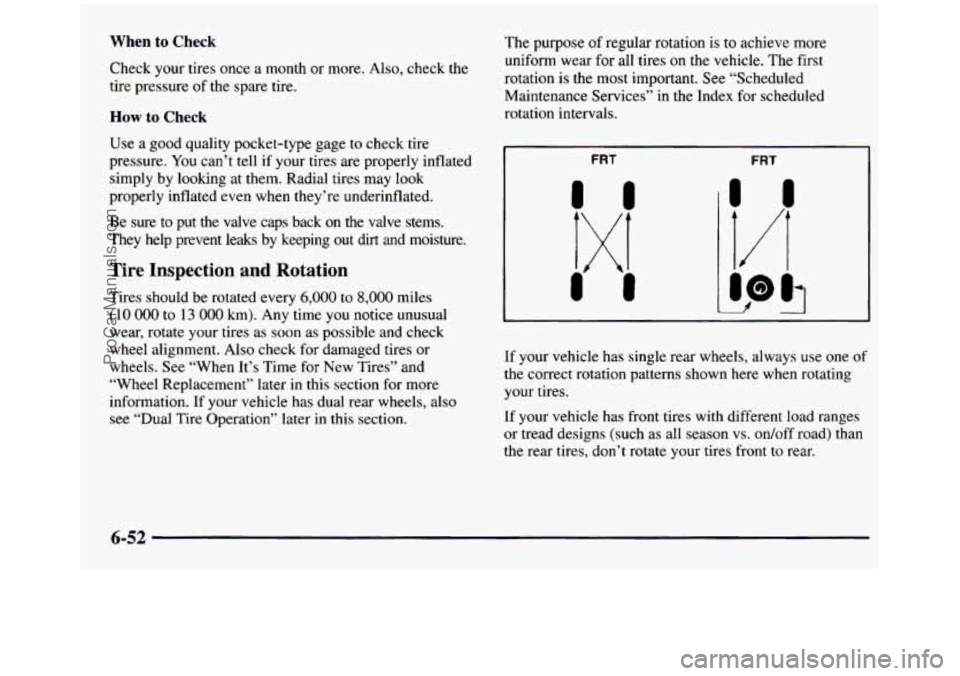
rotation is the most important. See “Scheduled
Maintenance Services” in the Index for scheduled
rotation intervals.
I FRT FRT
I
If your vehicle has single rear wheels, always use one of
the correct rotation patterns shown here when rotating
your tires.
If your vehicle has front tires with different load ranges
or tread designs (such as all season vs. odoff road)
than
the rear tires, don’t rotate your tires front to rear.
6-52
ProCarManuals.com