1997 GMC SIERRA key
[x] Cancel search: keyPage 90 of 436
If your vehcle is equipped with an automatic transmission,
it now features an electronic shift position indicator within
the instrument cluster. This display must be powered
anytime the
shift lever is capable of being moved out of
PARK (P). This means that if your key is in OFF, rather
than
LOCK, there will be a small current drain on your
battery which could discharge your battery over
a period
of time. If you have to leave your key in the
ignition
in OFF for an extended period, it is recommended
that you disconnect the battery cable from the battery to
prevent discharging your battery.
PARK
(P): This locks your rear wheels. It’s the best
position to use when you start your engine because your
vehicle can’t move easily.
It is dangerous to get out of your vehicle if the
shift lever is not fully in PARK
(P) with the
parking brake firmly set. Your vehicle can roll.
CAUTION: (Continued)
I
Don’t leave your vehicle when the engine is
running unless you have to. If you have left the
engine running, the vehicle can move suddenly.
You or others could be injured. To be sure your
vehicle won’t move, even when you’re on fairly
level ground,
always set your parking brake and
move the shift lever to PARK
(P).
If you have four-wheel drive, your vehicle
will be free to roll -- even if your shift lever
is in PARK
(P) -- if your transfer case is in
NEUTRAL
(N). So, be sure the transfer case is in
a drive gear, two-wheel high
(2H) or four-wheel
high
(4H) or four-wheel low (4L) -- not in
NEUTRAL
(N). See “Shifting Into PARK (P)” in
the Index.
If you’re pulling a trailer, see “Towing
a Trailer” in the Index.
2-16
ProCarManuals.com
Page 103 of 436
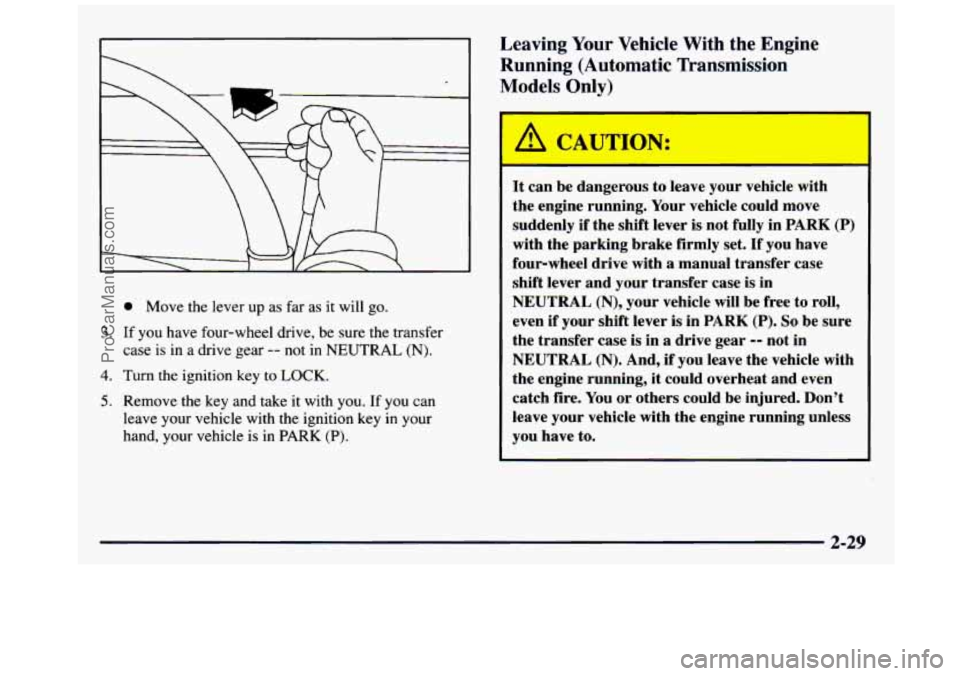
0 Move the lever up as far as it will go.
3. If you have four-wheel drive, be sure the transfer
case is in a drive gear
-- not in NEUTRAL (N).
4. Turn the ignition key to LOCK.
5. Remove the key and take it with you. If you can
leave your vehicle with the ignition key in your
hand, your vehicle
is in PARK (P).
Leaving Your Vehicle With the Engine
Running (Automatic Transmission
Models Only)
It can be dangerous to leave your vehicle with
the engine running. Your vehicle could move
suddenly if the shift lever is not fully in PARK (P)
with the parking brake firmly set.
If you have
four-wheel drive with
a manual transfer case
shift lever and your transfer case is in
NEUTRAL
(N), your vehicle will be free to roll,
even if your shift lever is in PARK
(P). So be sure
the transfer case is in
a drive gear -- not in
NEUTRAL
(N). And, if you leave the vehicle with
the engine running, it could overheat and even
catch fire.
You or others could be injured. Don’t
leave your vehicle with the engine running unless
you have
to.
ProCarManuals.com
Page 104 of 436
If you have to leave your vehicle with the engine
running, be sure your vehicle is in PARK (P) and the
parking brake is firmly set before you leave
it. After you
move the shift lever into PARK (P), hold the regular
brake pedal down. Then,
see if you can move the shift
lever away from PARK (P) without first pulling it
toward
you. If you can, it means that the shift lever
wasn’t fully locked into PARK
(P).
Torque Lock (Automatic Transmission)
If you are parking on a hill and you don’t shift your
transmission into PARK (P) properly, the weight of the
vehicle may put
too much force on the parking pawl in
the transmission. You may find
it difficult to pull the
shift lever out of PARK (P). This is called “torque lock.”
To prevent torque lock, set the parking brake and then
shift into PARK (P) properly before you leave the
driver’s seat.
To find out how, see “Shifting Into
PARK (P)” in the Index.
When you are ready
to drive, move the shift lever out of
PARK (P)
before you release the parking brake.
If torque lock does occur, you may need to have another
vehicle push yours a little uphill
to take some of the
pressure from the parking pawl in the transmission,
so
you can pull the shift lever out of PARK (P).
Shifting Out of PARK (P)
(Automatic Transmission)
Your vehicle has a brake-transmission shift interlock
system. You have
to fully apply your regular brakes
before you can shift from PARK (P) when the ignition
is in RUN. See “Automatic Transmission” in the Index.
If you cannot shift out of PARK (P), ease pressure on
the shift lever and push the shift lever all the way up
into PARK (P) as you maintain brake application. Then,
move the shift lever to any gear you want.
If you ever hold the brake pedal down but still can’t
shift out
of PARK (P), try this:
1. Turn the key to OFF,
2. Apply and hold the brake until the end of Step 4.
3. Shift to NEUTRAL (N).
4. Start the vehicle and shift to the drive gear you want.
5. Have the brake-transmission shift interlock system
fixed as soon as you can.
2-30
ProCarManuals.com
Page 118 of 436
Headlamps On Reminder
A buzzer will sound when your headlamps are turned
on and the key is turned to the
OFF, LOCK or
ACCESSORY position. If
you need to use your
headlamps when the key is turned to
OFF, LOCK or
ACCESSORY, the buzzer can be turned
off by turning
the thumb wheel next to the parking lampheadlamp
knob all the way down.
Daytime Running Lamps
Daytime Running Lamps (DRL) can make it easier for
others to see the front
of your vehicle during the
day. DRL can be helpful in many different driving
conditions, but they can be especially helpful
in the
short periods after dawn and before sunset.
The DRL system will make your headlamps come
on at
a reduced brightness when:
the ignition is on,
When the DRL are on, only your headlamps will be on.
The taillamps, sidemarker and other lamps won’t be on.
Your instrument panel won’t be
lit up either.
When it begins to get dark, your DRL indicator light
is a
reminder to turn your headlamp switch on. The other
lamps that come on with your headlamps will also
come
on.
When you turn off the headlamp switch, the regular
lamps will go off, and your headlamps will change to
the reduced brightness
of DRL.
To idle your vehicle with the DRL off, set the parking
brake. The DRL will stay off until you release the
parking brake.
As with any vehicle, you should turn on the regular
headlamp system when you need it.
the headlamp switch is off and
the parking brake is released.
2-44
ProCarManuals.com
Page 141 of 436
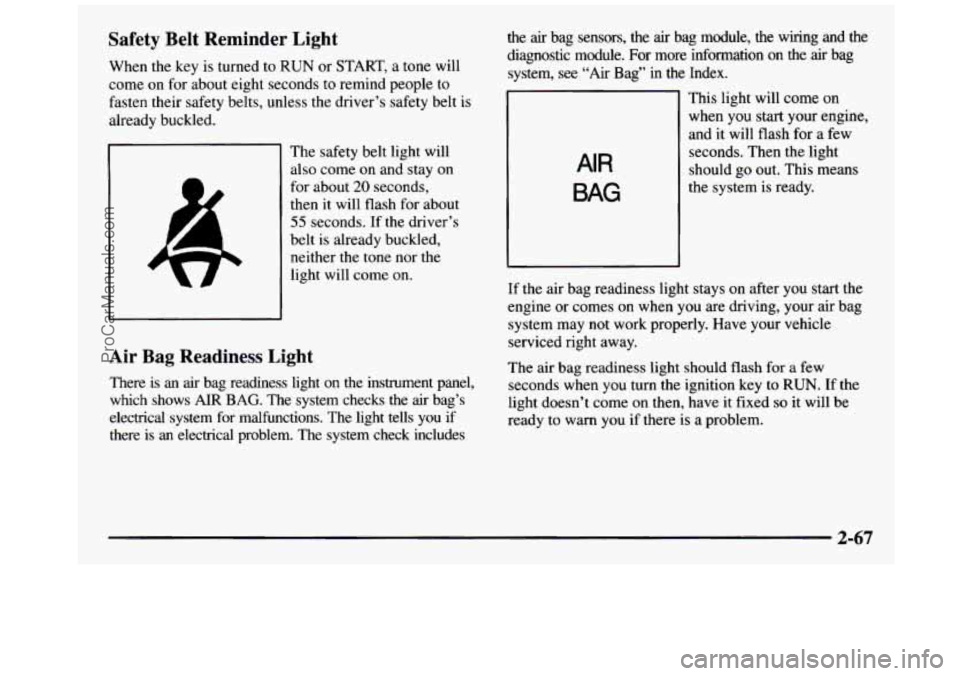
Safety Belt Reminder Light
When the key is turned to RUN or START, a tone will
come on for about eight seconds to remind people to
fasten their
safety belts, unless the driver’s safety belt is
already buckled.
The safety belt light will
also come on and stay on
for about
20 seconds,
then it will flash for about
55 seconds. If the driver’s
belt is already buckled,
neither the tone nor the
light will come on.
Air Bag Readiness Light
There is an air bag readiness light on the instrument panel,
which shows
AIR BAG. The system checks the air bag’s
electrical system for malfunctions. The light tells you if there is an electrical problem. The system check includes the
air bag sensors, the air bag module, the wiring and the
diagnostic module.
For more information on the air bag
system,
see “Air Bag” in the Index.
AIR
BAG
This light will come on
when you start your engine,
and it will
flash for a few
seconds. Then the light
should go out. This means
the system is ready.
If the air bag readiness light stays on after you start the
engine or comes on when you are driving, your air bag
system may not work properly. Have your vehicle
serviced right away.
The air bag readiness light should flash for
a few
seconds when you turn the ignition key to
RUN. If the
light doesn’t come on then, have it fixed
so it will be
ready to warn you if there
is a problem.
2-67
ProCarManuals.com
Page 145 of 436
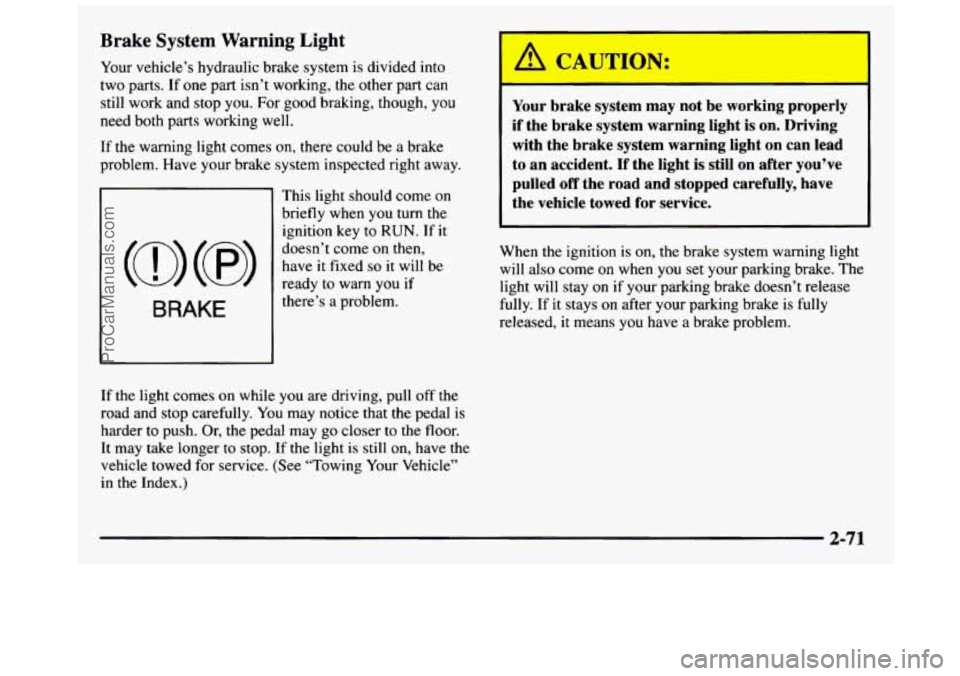
Brake System Warning Light
Your vehicle’s hydraulic brake system is divided into
two parts. If
one part isn’t working, the other part can
still work and stop you. For good braking, though,
you
need both parts working well.
If the warning light comes on, there could be a brake
problem. Have your brake system inspected right away.
This light should come on
briefly when
you turn the
ignition key to
RUN. If it
doesn’t come on then,
have it fixed so it will be
ready to warn
you if
there’s
a problem.
I
Your brake system may not be working properly
if the brake system warning light is on. Driving
with the brake system warning light
on can lead
to an accident. If the light is still on after you’ve
pulled
off the road and stopped carefully, have
the vehicle towed for service.
When the ignition is on, the brake system warning light
will also come
on when you set your parking brake. The
light will stay on
if your parking brake doesn’t release
fully. If it stays on after your parking brake is fully
released,
it means you have a brake problem.
If the light comes on while you are driving, pull off
the
road and stop carefully. You may notice that the pedal is
harder to push. Or, the pedal may go closer to the floor.
It may take longer
to stop. If the light is still on, have the
vehicle towed for service. (See “Towing Your Vehicle”
in the Index.)
2-71
ProCarManuals.com
Page 146 of 436
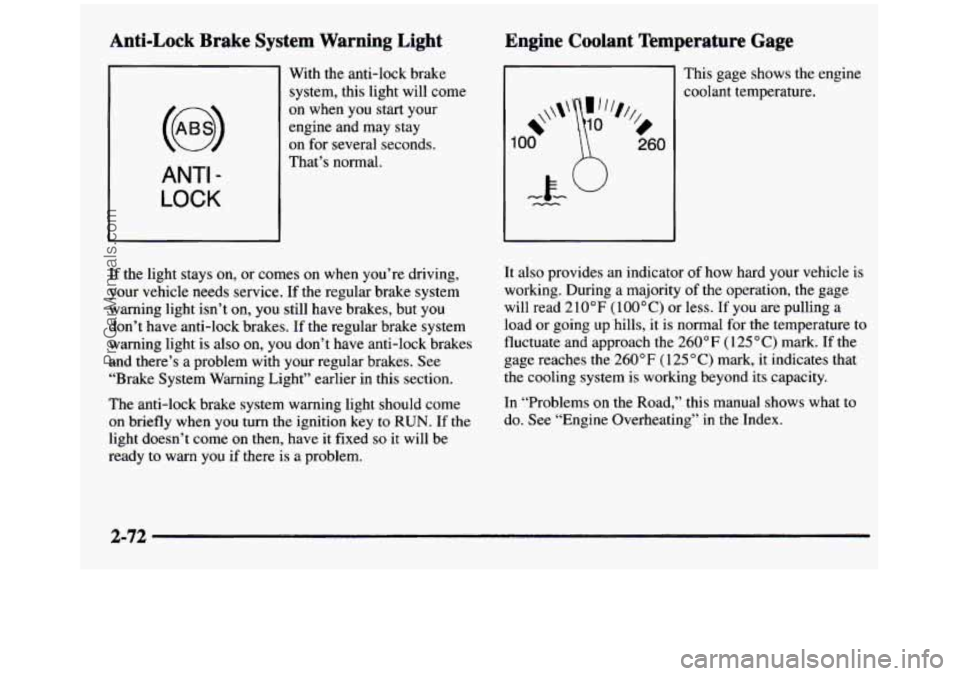
Anti-Lock Brake System Warning Light
ANTI -
LOCK
With the anti-lock brake
system, this light will come
on when you start your
engine and may stay
on for several seconds.
That’s normal.
If the light stays on, or comes
on when you’re driving,
your vehicle needs service. If
the regular brake system
warning light isn’t on, you still have brakes, but you
don’t have anti-lock brakes. If the regular brake system
warning light is
also on, you don’t have anti-lock brakes
and there’s a problem with your regular brakes. See
“Brake System Warning Light” earlier in this section.
The anti-lock brake system warning light should come
on briefly when you
turn the ignition key to RUN. If the
light doesn’t come on then, have it fixed
so it will be
ready to warn you
if there is a problem.
Engine Coolant Temperature Gage
Ill This gage shows the engine
1
*\\I‘
00
%,
0
260
coolant temperature.
It also provides an indicator
of how hard your vehicle is
working. During a majority of the operation, the gage
will read 210°F
(lOO°C) or less. If you are pulling a
load or going up hills, it is normal for
the temperature to
fluctuate and approach the
260°F (125°C) mark. If the
gage reaches the 260°F ( 125 “C) mark, it indicates that
the cooling system is working beyond its capacity.
In “Problems on the Road,” this manual shows what to
do. See “Engine Overheating” in the Index.
2-72
ProCarManuals.com
Page 148 of 436
If the Light Is Flashing If the Light Is On Steady
The following may prevent more serious damage to
your vehicle:
0 Reducing vehicle speed.
0 Avoiding hard accelerations.
0 Avoiding steep uphill grades.
0 If you are towing a trailer, reduce the amount of
cargo being hauled as soon as it is possible.
If the light stops flashing and remains on steady, see “If
the Light Is On Steady” following.
If the light continues to flash, when
it is safe to do so,
stup the vehicle. Find a safe place to park your vehicle.
Turn the key off, wait at least
10 seconds and restart the
engine. If the light remains on steady, see “If the Light
Is On Steady” following. If the light is still flashing,
follow the previous steps, and drive the vehicle to your
dealer or qualified service center for service. You
may be able to correct the emission system
malfunction by considering the following:
Did you recently put fuel into your vehicle?
If
so, reinstall the fuel cap, making sure to fully install
the cap. The diagnostic system can determine if the fuel
cap has been
left off or improperly installed. A loose or
missing fuel cap
will allow fuel to evaporate into the
atmosphere.
A few driving trips with the cap properly
installed should turn the light off.
Did you just drive through a deep puddle of water?
If
so, your electrical system may be wet. The condition
will usually be corrected when the electrical system
dries out.
A few driving trips should turn the light off.
Are you low on
fuel?
As your engine starts to run out of fuel, your engine may
not run as efficiently as designed since small amounts of
air are sucked into the fuel line causing a misfire. The
system can detect this. Adding fuel should correct this
condition. Make sure to install
the fuel cap properly. It
will take a
few driving trips to turn the light off.
2-74
ProCarManuals.com