1997 GMC SIERRA weight
[x] Cancel search: weightPage 222 of 436
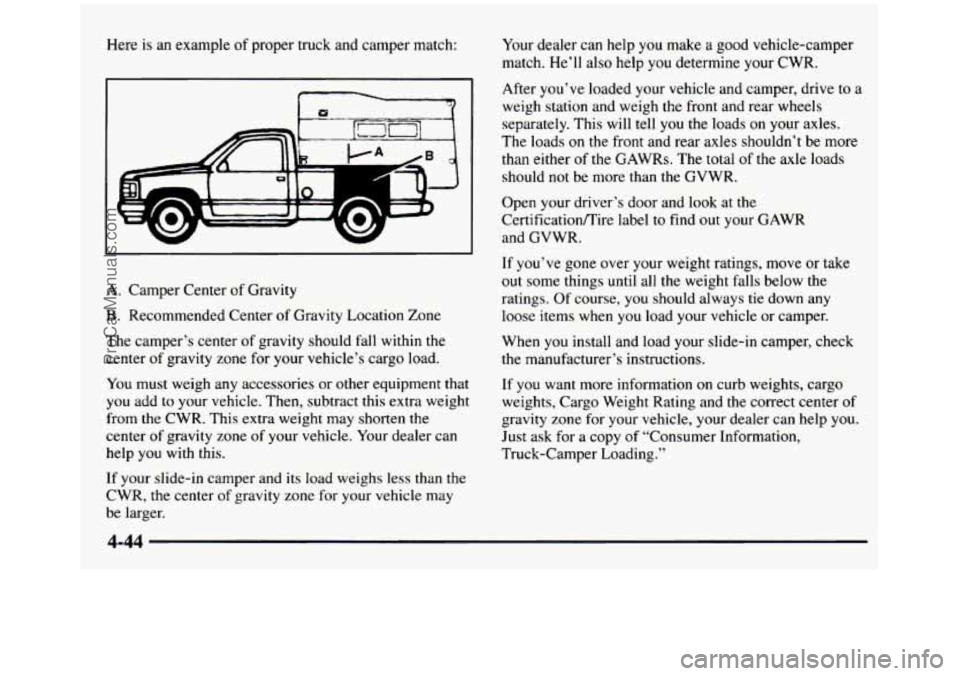
Here is an example of proper truck and camper match:
r ‘J
A. Camper Center of Gravity
B. Recommended Center of Gravity Location Zone
The camper’s center
of gravity should fall within the
center of gravity zone for your vehicle’s cargo load.
You must weigh any accessories or other equipment that
you add to your vehicle. Then, subtract this extra weight
from the CWR. This extra weight may shorten the
center of gravity zone of your vehicle. Your dealer can
help
you with this.
If your slide-in camper and its load weighs less than the
CWR, the center
of gravity zone for your vehicle may
be larger. Your
dealer can help you make a good vehicle-camper
match. He’ll also help
you determine your CWR.
After
you’ve loaded your vehicle and camper, drive to a
weigh station and weigh the front and rear wheels
separately. This will tell you the loads on your axles.
The loads
on the front and rear axles shouldn’t be more
than either of
the GAWRs. The total of the axle loads
should not be more than
the GVWR.
Open your driver’s door and look at the
CertificationRire label to find out your GAWR
and GVWR.
If you’ve gone over your weight ratings, move or take
out some things until all the weight falls below the
ratings. Of course, you should always tie down any
loose items when you load your vehicle or camper.
When
you install and load your slide-in camper, check
the manufacturer’s instructions.
If you want more information
on curb weights, cargo
weights, Cargo Weight Rating and the correct center
of
gravity zone for your vehicle, your dealer can help you.
Just ask for a copy of “Consumer Information,
Truck-Camper Loading.”
4-44
ProCarManuals.com
Page 223 of 436
Trailer Recommendations
You must subtract your hitch loads from the CWR for
your vehicle. Weigh your vehicle with the trailer attached,
so that you won’t go over the GVWR or GAWR.
You’ll get
the best performance if you spread out the
weight of your load the right way, and if you choose the
correct hitch and trailer brakes.
For more information, see ‘Trailer Towing”
in the Index.
Camper Wiring Harness (If Equipped)
A five-wire harness is stored in the front stake pocket on
the driver’s side of the bed. The harness has no connector
and should be wired by
a qualified electrical technician. It
must be routed out of your vehicle and securely attached
so that it won’t be pulled or rubbed while you’re using
it. Store the harness in its original position. Wrap the
harness together and tie
it neatly so it won’t be damaged.
Pickup Conversion to Chassis Cab
General Motors is aware that some vehicle owners
may consider having the pickup box removed and a
commercial or recreational body installed. Before
you
do so, first contact the GM Zone Office for your area for
information on such conversions specific to this vehicle.
(See the “Warranty and Owner Assistance” booklet for Zone
Office.) Owners should be aware that,
as
manufactured, there are differences between a chassis
cab and a pickup with the box removed which may
affect vehicle safety. The components necessary to adapt
a pickup to permit its safe use with
a specialized body
should be installed by a body builder in accordance with
the information available from the Zone Office.
Towing a Trailer
If you don’t use the correct equipment and drive
properly, you can lose control when you pull a
trailer. For example, if the trailer is too heavy, the
brakes may not work well
-- or even at all. You
and your passengers could be seriously injured.
Pull a trailer only if you have followed all the
steps in this section.
Ask your GM dealer for
advice and information about towing a trailer with your vehicle.
4-45
ProCarManuals.com
Page 225 of 436
a If you have an automatic transmission, you can tow
in OVERDRIVE (@). You may want to shift the
transmission to THIRD
(3) or, if necessary, a lower
gear selection if the transmission shifts too often
(e.g., under heavy loads and/or hilly conditions). If
you have a manual transmission and you are towing
a trailer, it’s better not to use FIFTH (5) gear. Just
drive in
FOURTH (4) gear (or, as you need to,
a lower gear).
Three important considerations have to do with weight:
the weight of the trailer,
the weight of the trailer tongue
and the weight on your vehicle’s tires.
Weight of the Trailer
How heavy can a trailer safely be?
It depends on how you plan to use your rig. For example,
speed, altitude, road grades, outside temperature and
how much your vehicle is used to pull a trailer are all
important. And, it can also depend
on any special
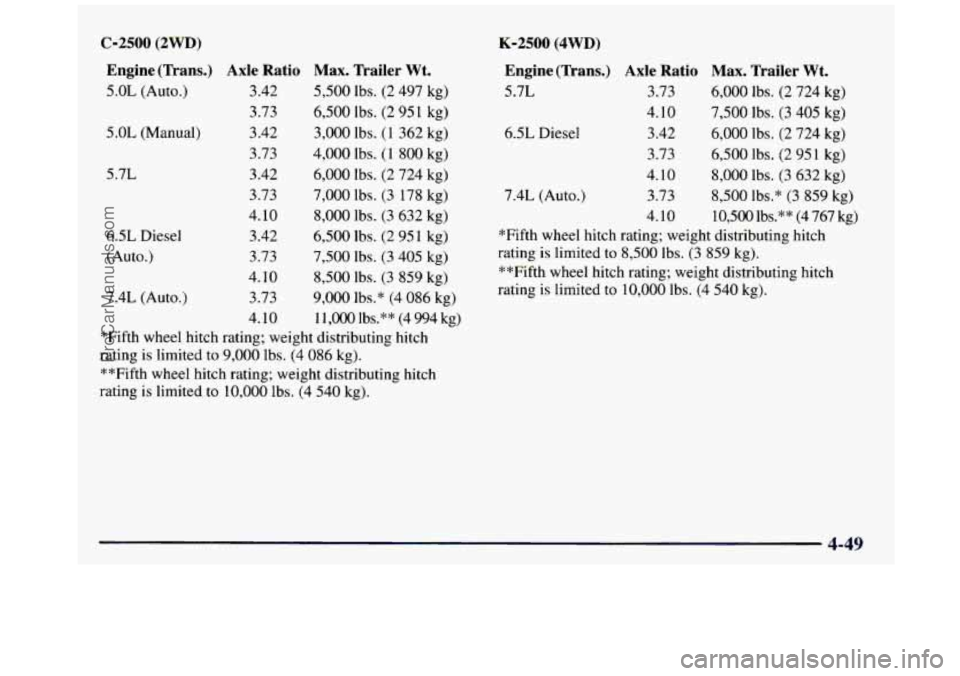
equipment that you have on your vehicle. Use
one of the following charts to determine how much
your vehicle can weigh, based upon your vehicle model
and options.
Maximum trailer weight is calculated assuming the
driver and one passenger are in the tow vehicle and it
has all
the required trailering equipment. The weight of
additional optional equipment, passengers and cargo in
the tow vehicle must be subtracted from the maximum
trailer weight.
Above the
2,000 lbs. (908 kg) trailer rating, the engine
oil cooler is required
on C/K-1500 and C/K-2500
models with gas engines. Refer to the Trailering Guide
for oil cooler recommendations.
Above the
5,000 lbs. (2 270 kg) trailer rating, heavy-duty
or gas shock absorbers are required on
C- 1500 models,
and heavy-duty shock absorbers or the off-road chassis
package are required on
K- 1500 models.
4-47
ProCarManuals.com
Page 227 of 436
C-2500 (2WD) K-2500 (4WD)
5 .OL (Manual)
5.7L
Engine (Trans.) Axle Ratio Max. Trailer Wt.
5.0L (Auto.) 3.42 5,500 lbs. (2 497 kg)
3.42 3,000 lbs.
(1 362 kg)
3.42 6,000 lbs. (2 724 kg)
4.10
8,000 lbs. (3 632 kg)
6.5L Diesel 3.42 6,500 lbs. (2 951 kg)
(Auto.) 3.73
7,500 lbs. (3 405 kg)
4.10 8,500 lbs. (3 859 kg)
7.4L (Auto.) 3.73 9,000 lbs.* (4 086 kg)
4.10
1 I ,OOO lbs.** (4 994 kg)
3.73 6,500
lbs.
(2 95 1 kg)
3.73
4,000 lbs. (1 800 kg)
3.73 7,000 lbs.
(3 178 kg)
*Fifth wheel hitch rating; weight distributing hitch
rating is limited to 9,000 lbs. (4 086 kg).
**Fifth wheel hitch rating; weight distributing hitch
rating is limited to 10,000 lbs. (4 540 kg). 6.5L Diesel
Engine (Trans.) Axle Ratio Max. Trailer Wt.
5.7L
3.73 6,000 lbs. (2 724 kg)
4.10 7,500 lbs. (3 405 kg)
3.42 6,000 lbs. (2 724 kg)
4.10 8,000 lbs. (3 632 kg)
7.4L (Auto.) 3.73
8,500 lbs.* (3 859 kg)
4.10 10,500 lbs.** (4 767 kg)
*Fifth wheel hitch rating; weight distributing hitch
rating is limited to
8,500 lbs. (3 859 kg).
**Fifth wheel hitch rating; weight distributing hitch
rating is limited to 10,000 lbs. (4 540 kg).
3.73
6,500 lbs.
(2 951 kg)
4-49
--
ProCarManuals.com
Page 228 of 436
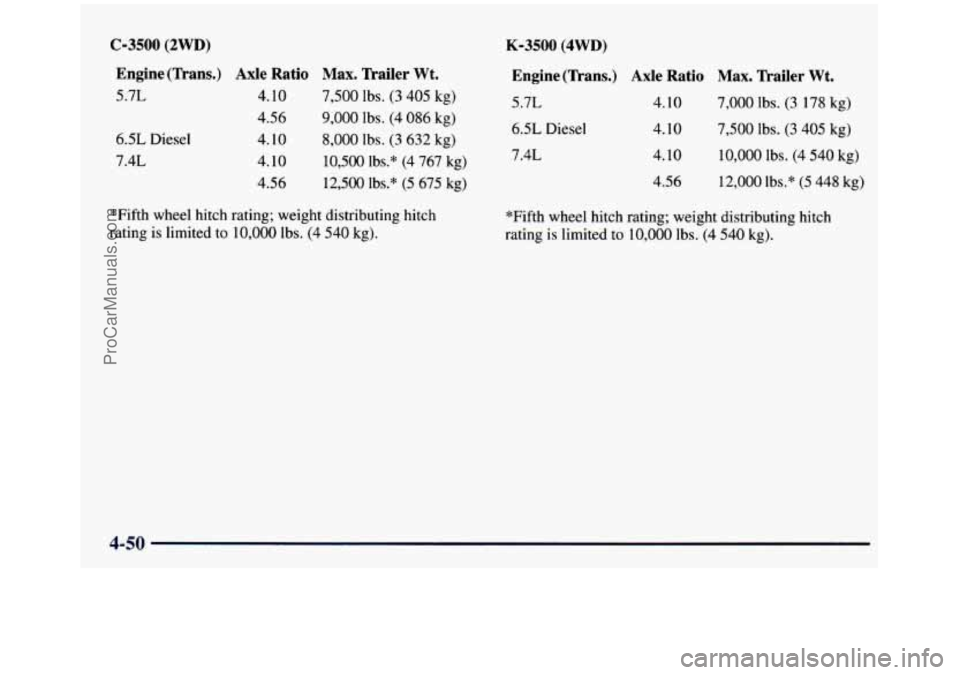
C-3500 (2WD) K-3500 (4WD)
6.5L Diesel
7.4L
Engine (Trans.) Axle Ratio Max. Trailer Wt.
5.7L 4.10 7,500 lbs. (3 405 kg)
4.10
8,000 lbs. (3 632 kg)
4.56
9,000 lbs. (4 086 kg)
4.10 10,500 lbs.* (4 767 kg)
4.56 12,500 lbs.*
(5 675 kg)
*Fifth wheel hitch rating; weight distributing hitch
rating is limited to
10,000 Ibs. (4 540 kg).
Engine(Trans.) Axle Ratio Max. Trailer Wt.
5.7L 4.10 7,000 lbs. (3 178 kg)
6.5L Diesel 4.10 7,500 lbs. (3 405 kg)
7.4L 4.10 10,000 lbs. (4 540 kg)
4.56 12,000 lbs.* (5 448 kg)
*Fifth wheel hitch rating; weight distributing hitch
rating is limited to
10,000 lbs. (4 540 kg).
4-50
ProCarManuals.com
Page 229 of 436
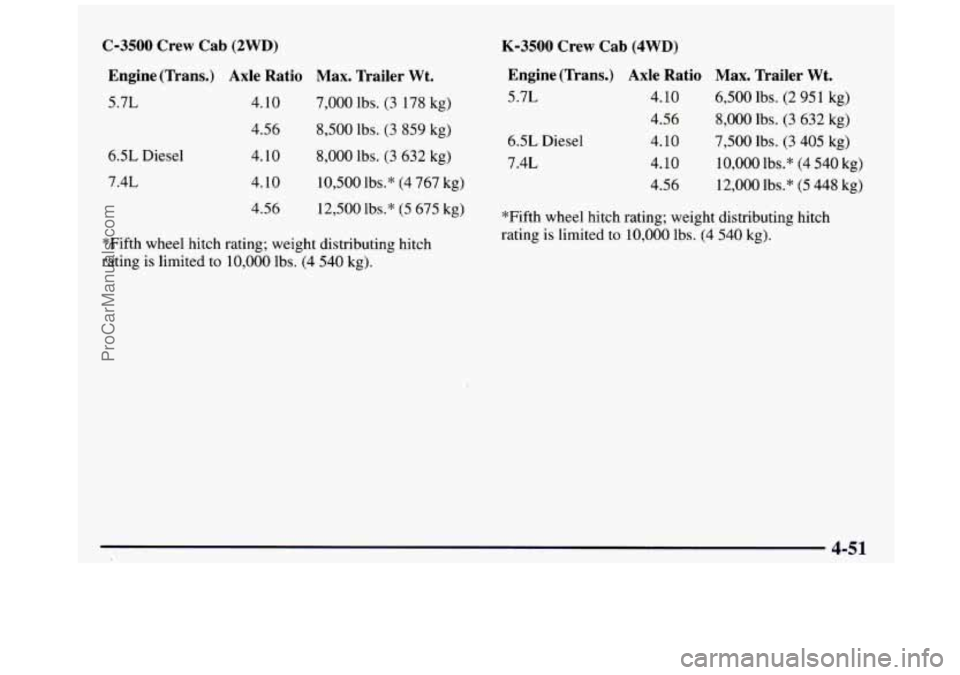
C-3500 Crew Cab (2WD)
6.5L Diesel
7.4L
Engine (Trans.) Axle Ratio Max. Trailer Wt.
5.7L 4.10 7,000 lbs. (3 178 kg)
4.56 8,500 lbs.
(3 859 kg)
4.10 8,000 lbs.
(3 632 kg)
4.10 10,500 lbs.* (4 767 kg)
4.56 12,500 lbs.*
(5 675 kg)
*Fifth wheel hitch rating; weight distributing hitch
rating is limited to
10,000 lbs. (4 540 kg).
K-3500 Crew Cab (4WD)
6.5L Diesel
7.4L
Engine (Trans.) Axle Ratio Max. Trailer Wt.
5.7L 4.10 6,500 lbs. (2 951 kg)
4.56
8,000 lbs. (3 632 kg)
4.10 7,500 lbs.
(3 405 kg)
4.10 10,000 lbs.* (4 540 kg)
4.56 12,000 Ibs.*
(5 448 kg)
*Fifth wheel hitch rating; weight distributing hitch
rating is limited to 10,000 lbs. (4
540 kg).
4-51
ProCarManuals.com
Page 230 of 436
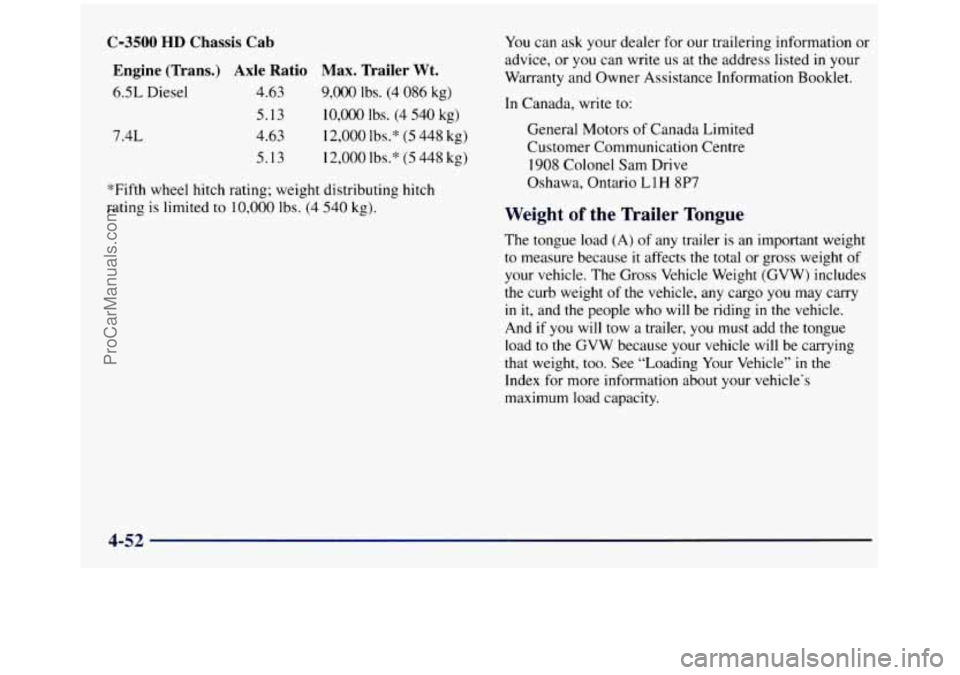
C-3500 HD Chassis Cab
Engine (Trans.) Axle Ratio
Max. Trailer
Wt.
6.5L Diesel 4.63 9,000 lbs. (4 086 kg)
5.13 10,000 lbs. (4 540 kg)
4.63 12,000 lbs.*
(5 448 kg)
5.13
12,000 lbs.* (5 448 kg)
7.4L
*Fifth wheel hitch rating; weight distributing hitch
rating is limited to
10,000 lbs. (4 540 kg). You
can ask your dealer for our trailering information or
advice, or you can write us at the address listed in your
Warranty and Owner Assistance Information Booklet.
In Canada, write to:
General Motors of Canada Limited
Customer Communication Centre 1908 Colonel Sam Drive
Oshawa, Ontario L1H 8P7
Weight of the Trailer Tongue
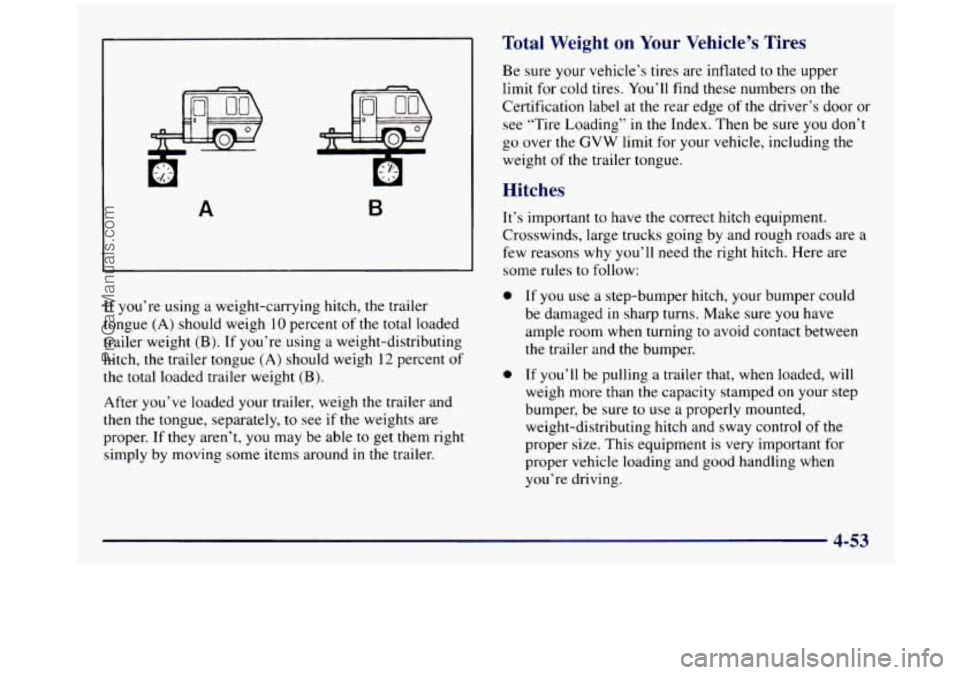
The tongue load (A) of any trailer is an important weight
to measure because it affects
the total or gross weight of
your vehicle. The Gross Vehicle Weight (GVW) includes
the curb weight
of the vehicle, any cargo you may carry
in it, and the people who will be riding in the vehicle.
And
if you will tow a trailer, you must add the tongue
load to the GVW because your vehicle will be carrying
that weight, too.
See “Loading Your Vehicle” in the
Index for more information about your vehicle‘s
maximum load capacity.
4-52
ProCarManuals.com
Page 231 of 436
A B
If you’re using a weight-carrying hitch, the trailer
tongue
(A) should weigh 10 percent of the total loaded
trailer weight
(B). If you’re using a weight-distributing
hitch, the trailer tongue
(A) should weigh 12 percent of
the total loaded trailer weight (B).
After you’ve loaded your trailer, weigh the trailer and
then
the tongue, separately, to see if the weights are
proper. If they aren’t,
you may be able to get them right
simply by moving some items around
in the trailer.
Total Weight on Your Vehicle’s Tires
Be sure your vehicle’s tires are inflated to the upper
limit for cold tires. You’ll find these numbers on the
Certification label at the rear edge
of the driver’s door or
see “Tire Loading”
in the Index. Then be sure you don’t
go over the GVW limit for your vehicle, including the
weight of the trailer tongue.
Hitches
It’s important to have the correct hitch equipment.
Crosswinds, large trucks going by and rough roads are a
few reasons why
you’ll need the right hitch. Here are
some rules to follow:
0 If you use a step-bumper hitch, your bumper could
be damaged in sharp turns. Make sure
you have
ample room when turning
to avoid contact between
the trailer and the bumper.
0 If you’ll be pulling a trailer that, when loaded, will
weigh more than
the capacity stamped on your step
bumper, be sure
to use a properly mounted,
weight-distributing hitch and sway control of the
proper size. This equipment
is very important for
proper vehicle loading and good handling when
you’re driving.
4-53
ProCarManuals.com