1997 GMC SIERRA tire pressure
[x] Cancel search: tire pressurePage 327 of 436
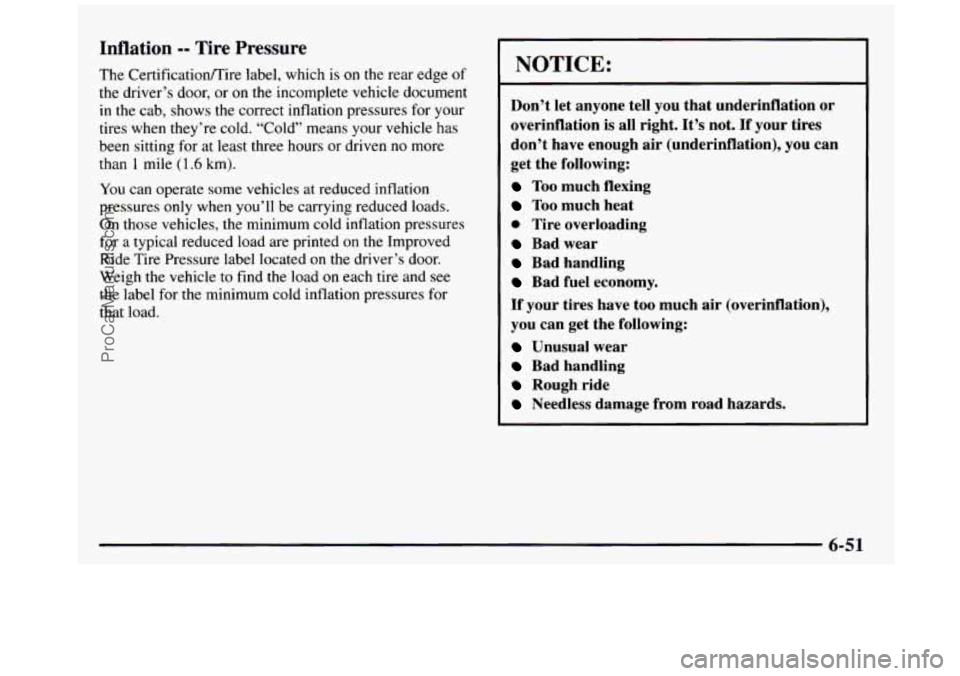
Inflation -- Tire Pressure
The Certificationmire label, which is on the rear edge of
the driver’s door, or on the incomplete vehicle document
in the cab, shows the correct inflation pressures for your
tires when they’re cold. “Cold” means your vehicle has
been sitting for at least three hours or driven no more
than
1 mile (1.6 km).
You can operate some vehicles at reduced inflation
pressures only when you’ll be carrying reduced loads.
On those vehicles, the minimum cold inflation pressures
for
a typical reduced load are printed on the Improved
Ride Tire Pressure label located on the driver’s door.
Weigh the vehicle to find the load on each tire and see
the label for the minimum cold inflation pressures for
that load.
NOTICE:
Don’t let anyone tell you that underinflation or
overinflation is all right.
It’s not. If your tires
don’t have enough air (underinflation), you can
get the following:
Too much flexing
Too much heat
0 Tire overloading
Bad wear
Bad handling
Bad fuel economy.
If your tires have too much air (overinflation),
you can get the following:
Unusual wear
Bad handling
Rough ride
Needless damage from road hazards.
6-51
-
ProCarManuals.com
Page 328 of 436
When to Check
Check your tires once a month or more. Also, check the
tire pressure of the spare tire.
How to Check
Use a good quality pocket-type gage to check tire
pressure.
You can’t tell if your tires are properly inflated
simply by looking at them. Radial tires may look
properly inflated even when they’re underinflated.
Be sure
to put the valve caps back on the valve stems.
They help prevent leaks by keeping out
dirt and moisture.
Tire Inspection and Rotation
Tires should be rotated every 6,000 to 8,000 miles
(10 000 to 13 000 km). Any time you notice unusual
wear, rotate your tires as soon as possible and check
wheel alignment.
Also check for damaged tires or
wheels. See “When It’s Time for New Tires” and
“Wheel Replacement” later
in this section for more
information. If your vehicle has dual rear wheels, also
see “Dual Tire Operation” later in this section. The
purpose of regular rotation is to achieve more
uniform wear for all tires
on the vehicle. The first
rotation is the most important. See “Scheduled
Maintenance Services” in the Index for scheduled
rotation intervals.
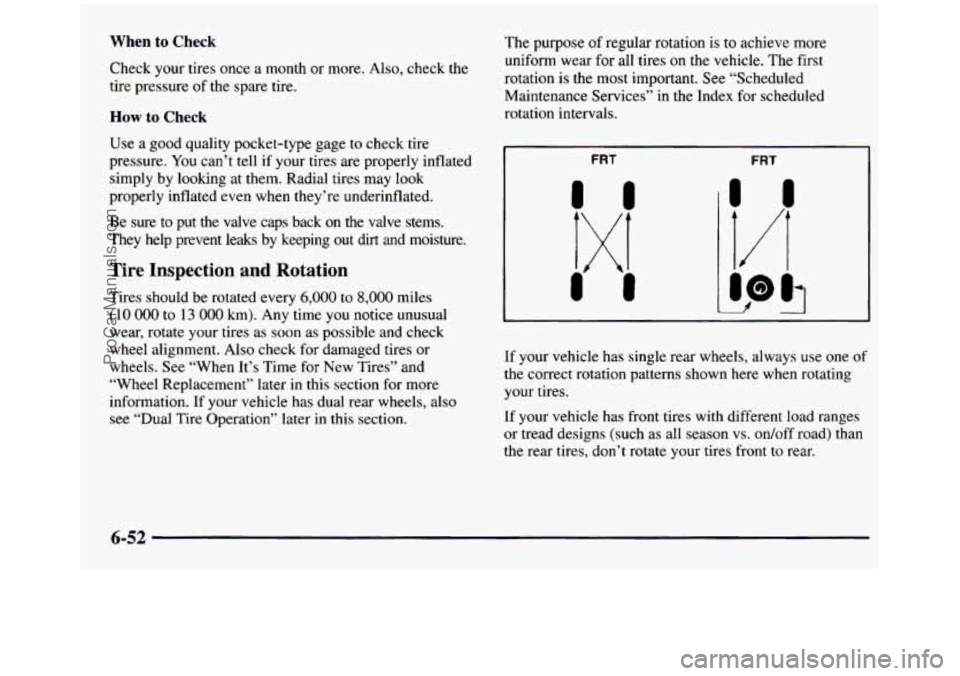
I FRT FRT
I
If your vehicle has single rear wheels, always use one of
the correct rotation patterns shown here when rotating
your tires.
If your vehicle has front tires with different load ranges
or tread designs (such as all season vs. odoff road)
than
the rear tires, don’t rotate your tires front to rear.
6-52
ProCarManuals.com
Page 329 of 436
111
V
n
111
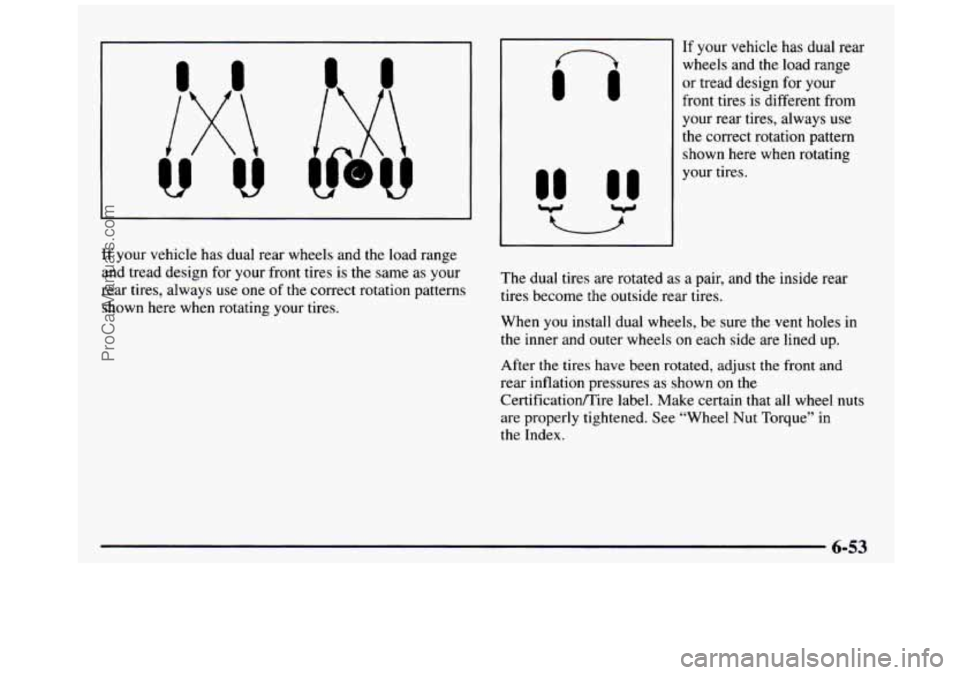
If your vehicle has dual rear
wheels and the load range
or tread design for your
front tires is different from
your rear tires, always use
the correct rotation pattern
shown here
when rotating
your tires.
If your vehicle has dual rear wheels and the load range
and tread design for your front tires is the same as your
rear tires, always use one of the correct rotation patterns
shown here when rotating your tires. The dual tires are rotated as
a pair, and the inside rear
tires become the outside rear tires.
When you install dual wheels, be sure the vent holes
in
the inner and outer wheels on each side are lined up.
After the tires have been rotated,
adjust the front and
rear inflation pressures as shown on the
Certificatiomire label. Make certain that all wheel nuts
are properly tightened. See “Wheel Nut Torque” in
the Index.
ProCarManuals.com
Page 331 of 436
Dual Tire Operation Buying New Tires
To find
out what kind and size of tires you need, look
at the CertificationEire label. When the vehicle is new, or whenever a wheel, wheel bolt
or wheel
nut is replaced, check the wheel nut torque after
100,
1,OOO and 6,000 miles (160, 1 600 and 10 OOO km)
of driving. For proper torque, see “Wheel Nut Torque” in
the Index.
The outer tire on a dual wheel setup generally wears faster
than
the inner tire. Your tires will wear more evenly and
last longer if you rotate the tires periodically.
If you’re
going to be doing a lot of driving on high-crown roads,
you can reduce tire wear by adding 5 psi (35 kPa) to the
tire pressure in the outer tires.
Be sure to return to the
recommended pressures when no longer driving under
those conditions. See “Changing a Flat Tire”
in the
Index for more information.
If you operate your vehicle with a tire that is badly
underinflated, the
tire can overheat. An overheated
tire
can lose air suddenly or catch fire. You or others
could be injured. Be sure all tires (including the
spare,
if any) are properly inflated.
The tires installed on your vehicle when it was new had
a Tire Performance Criteria Specification
(TPC Spec)
number on each
tire’s sidewall. When you get new tires,
get ones with that same TPC Spec number. That way
your vehicle will continue to have tires that are designed
to give proper endurance, handling, speed rating,
traction, ride and other things during normal service
on your vehicle.
If your tires have an all-season tread
design, the TPC number will be followed by an
“MS”
(for mud and snow).
If you ever replace your tires with those not having a
TPC Spec number, make sure they are the same size,
load range, speed rating and construction type (bias,
bias-belted or radial) as your original tires.
ProCarManuals.com
Page 352 of 436
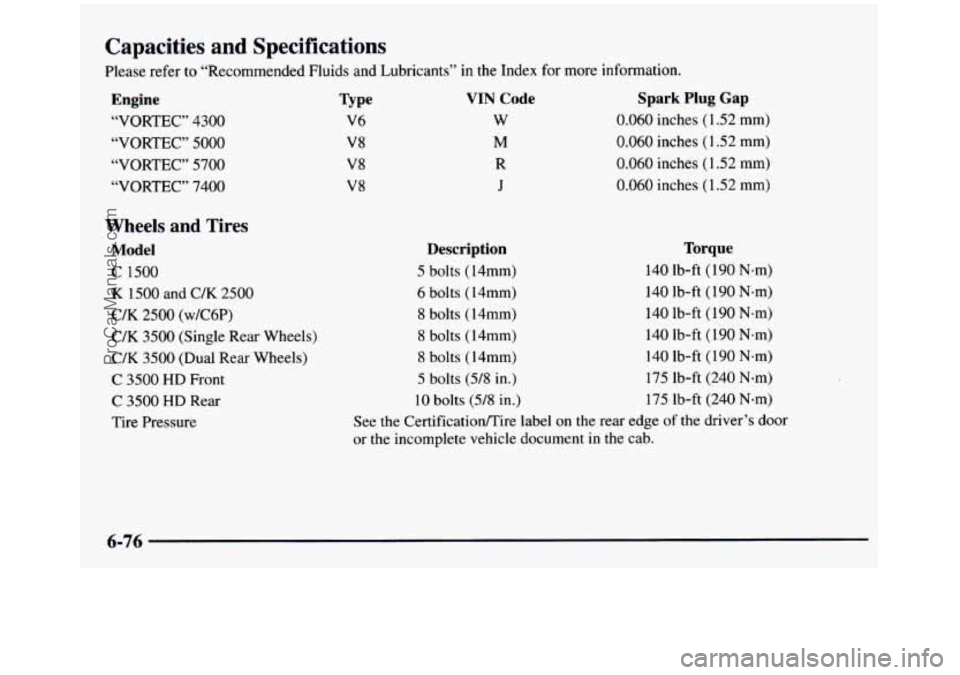
Capacities and Specifications
Please refer to “Recommended Fluids and Lubricants” in the Index for more information.
Engine Type VIN Code Spark Plug Gap
“VORTEC”
4300 V6 W 0.060 inches (1.52 mm)
“VORTEC” 5000 V8 M 0.060 inches (1.52 mm)
“VORTEC”
5700 V8 R 0.060 inches (1.52 mm)
“VORTEC” 7400
V8 J 0.060 inches (1.52 mm)
Wheels and Tires
Model
C 1500
K 1500 and C/K 2500
C/K 2500 (w/C6P)
C/K
3500 (Single Rear Wheels)
C/K 3500 (Dual Rear Wheels)
C 3500 HD Front
C 3500 HD Rear
Tire Pressure
Description Torque
5 bolts (14mm) 140 lb-ft (190 N-m)
6 bolts (14mm) 140 lb-ft ( 190 Nam)
8 bolts (14mm)
140 lb-ft ( 190 N-m)
8 bolts (14mm) 140 lb-ft ( 190 N-m)
8 bolts (14mm) 140 lb-ft ( 190 N-m)
5 bolts (5/8 in.) 175 lb-ft (240 N-m)
10 bolts (5/8 in.) 175
lb-ft (240 N-m)
See the CertificatiodTire label on the rear edge of the driver’s door
or the incomplete vehicle document
in the cab.
6-76
ProCarManuals.com
Page 399 of 436
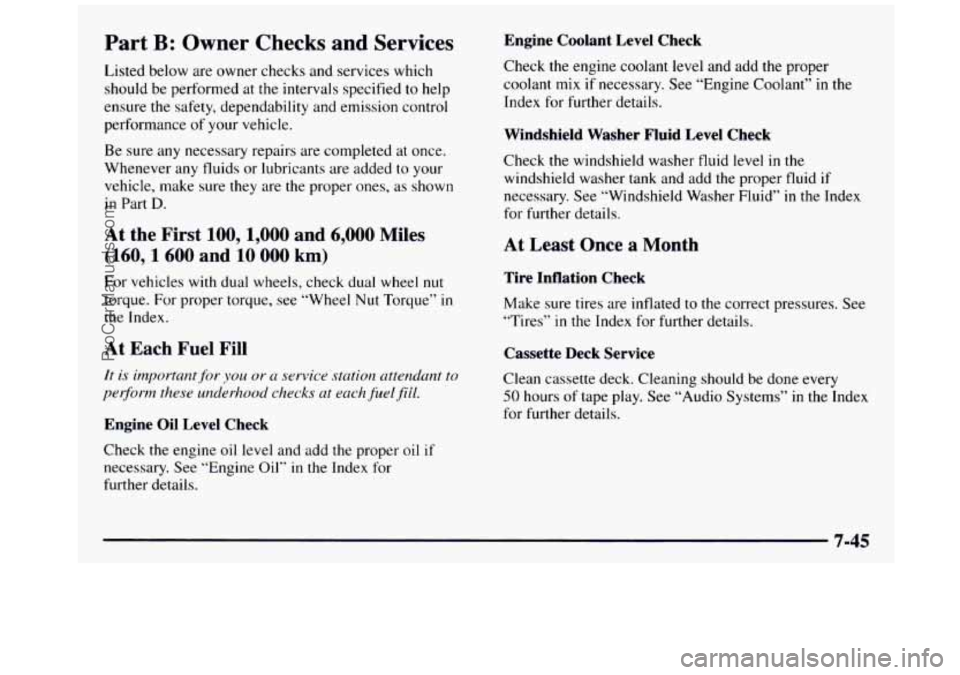
Part B: Owner Checks and Services
Listed below are owner checks and services which
should be performed at the intervals specified
to help
ensure the safety, dependability and emission control
performance
of your vehicle.
Be sure any necessary repairs are completed at once.
Whenever any fluids or lubricants are added
to your
vehicle, make sure they are the proper ones,
as shown
in Part
D.
At the First 100, 1,000 and 6,000 Miles
(160,1600 and 10 000 km)
For vehicles with dual wheels, check dual wheel nut
torque. For proper torque, see “Wheel Nut Torque” in
the Index.
At Each Fuel Fill
It is important for you or ~1 service station attendant to
per$orm these underhood
checks ut eachjbtelfiE1.
Engine Oil Level Check Engine Coolant Level Check
Check the
engine coolant level and add the proper
coolant mix if necessary. See “Engine Coolant’’ in the
Index for further details.
Windshield Washer Fluid Level Check
Check the windshield washer fluid level in the
windshield washer tank and add
the proper fluid if
necessary. See “Windshield Washer Fluid”
in the Index
for further details.
At Least Once a Month
Tire Inflation Check
Make sure tires are inflated to the correct pressures. See
“Tires”
in the Index for further details.
Cassette Deck Service
Clean cassette deck. Cleaning should be done every
50 hours of tape play. See “Audio Systems” in the Index
for further details.
Check
the engine oil level and add the proper oil if
necessary. See “Engine Oil” in the Index for
further details.
7-45
ProCarManuals.com
Page 426 of 436
Electrical System ............................... 6-70
Engine
.................................. 6-10. 6-12
Electrochromic
Daymight Rearview Mirror
.......... 2-48
Coolant
..................................... 6-29
Coolant Heater
............................... 2- 14
Coolant Level Check
.......................... 7-45
Coolant Temperature Gage
..................... 2-72
Cooling System Capacity
....................... 6-78
Exhaust
..................................... 2-32
FuseBlocks
............................ 6-71, 6-73
Identification
................................ 6-69
OilLevelCheck
.............................. 7-45
Overheating
................................. 5-11
Running While Parked
......................... 2-32
Specifications
................................ 6-76
StartingYour
................................ 2-13
Underhood Fuse/Relay Center
................... 6-73
Engineoil
.................................... 6-15
Adding
..................................... 6-15
Additives
................................... 6-18
Checking
................................... 6-15
Used
....................................... 6-18
Whentochange
.............................. 6-18
Exhaust. Engine
................................ 2-32
Pressure Gage
................................ 2-75
Fabric Cleaning
............................... 6-60
Fan Control. Climate Control System ............ 3.2. 3.3
Fender Marker Lamp
Bulb Replacement ............. 6-44
FillingYourTank
................................ 6-5
Filter. Air ..................................... 6-19
Finish Care
.................................... 6-64
Finish Damage
................................. 6-66
Flashers. Hazard Warning
......................... 5-2
Flat Tire. Changing
............................. 5-22
Fluid Capacities
................................ 6-78
Fluids and Lubricants
............................ 7-51
Fog Lamps
.................................... 2-45
Foreign Countries. Fuel
........................... 6-4
Four-wheel Drive
......................... 2-22. 6-27
French LanguageManual
11
Front Axle .................................... 6-28
Front Axle Locking Feature
....................... 2-23
FrontTowing
.................................. 5-10
Front Turn Signal Lamp Bulb Replacement ..... 6-42. 6-43
Fuel
.......................................... 6-3
Filling Your Tank
.............................. 6-5
Gage ....................................... 2-78
In Foreign Countries ........................... 6-4
Tank Capacity
............................... 6-78
Fuses and Circuit Breakers
....................... 6-71
FusibleLinks
.................................. 6-71
.. ...........................
bages Engine Coolant Temperature
.................... 2-72
Engine Oil Pressure
........................... 2-75 "
Fuel ....................................... 2-78
Speedometer
................................. 2-65
Tachometer
.................................. 2-65
Voltmeter
................................... 2-70
9-4
ProCarManuals.com