Page 297 of 436
Refer to the Maintenance Schedule to determine when to
replace the air filter. See “Owner Checks and Services”
in
the Index.
Operating the engine with the
air cleaner off
can cause you OF others to be burned. The air
cleaner not only cleans the air,
it stops flame if
the engine backfires.
If it isn’t there, and the
engine backfires, you could be burned. Don’t
drive with it
off, and be careful working on the
engine with the air cleaner
off.
I NOTICE:
If the air cleaner is off, a backfire can cause a
damaging engine fire. And, dirt can easily get
into your engine, which will damage it. Always
have the air cleaner in place when you’re driving.
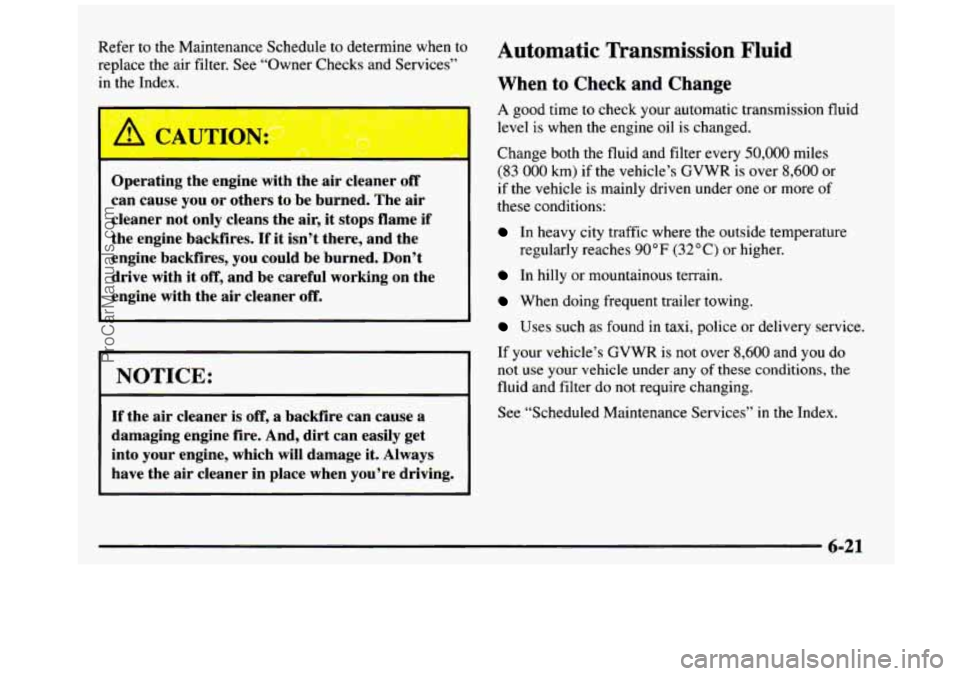
Automatic Transmission Fluid
When to Check and Change
A good time to check your automatic transmission fluid
level is
when the engine oil is changed.
Change both the fluid and filter every
50,000 miles
(83
000 km) if the vehicle’s CVWR is over 8,600 or
if the vehicle is mainly driven under one or more
of
these conditions:
In heavy city traffic where the outside temperature
regularly reaches
90°F (32°C) or higher.
In hilly or mountainous terrain.
When doing frequent trailer towing.
Uses such as found in taxi, police or delivery service.
If your vehicle’s GVWR is not over
8,600 and you do
not use your vehicle under any
of these conditions, the
fluid and filter do
not require changing.
See “Scheduled Maintenance Services’’
in the Index.
ProCarManuals.com
Page 301 of 436
Manual Transmission Fluid
When to Check
A good time to have it checked is when the engine oil is
changed. However, the fluid
in your manual
transmission doesn’t require changing.
How to Check
Because this operation can be a little difficult, you may
choose to have this done at your
GM dealership
Service Department.
If you do it yourself, be sure to follow all the
instructions here, or you could get a false reading.
NOTICE:
Too much or too little fluid can damage your
transmission.
Too much can mean that some of
the fluid could come out and
fall on hot engine
parts or exhaust system parts, starting
a fire. Be
sure to get an accurate reading if
you check your
transmission fluid.
Check the fluid level only when your engine is off, the
vehicle is parked on
a level place and the transmission is
cool enough for you to rest your fingers on the
transmission case.
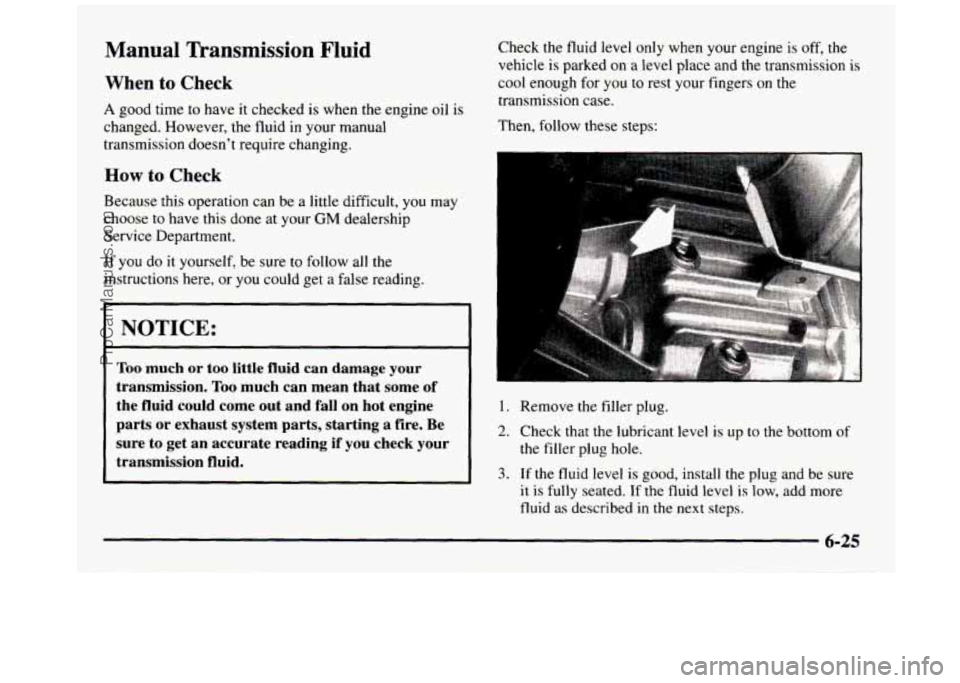
Then, follow these steps:
1. Remove the filler plug.
2. Check that the lubricant level is up to the bottom of
3. If the fluid level is good, install the plug and be sure
the
filler plug hole.
it
is fully seated. If the fluid level is low, add more
fluid as described
in the next steps.
ProCarManuals.com
Page 305 of 436
If the differential is at operating temperature (warm),
add enough lubricant to raise the level to the bottom of
the filler plug hole.
If the differential is cold, add enough lubricant to raise
the level to 1/2 inch (12 mm) below the filler plug hole.
What to Use
Refer to the Maintenance Schedule to determine what
kind of lubricant to use. See “Recommended Fluids and
Lubricants” in the Index.
Engine Coolant
The cooling system in your vehicle is filled with
new DEX-COOL@ engine coolant. This coolant is
designed to remain in your vehicle for
5 years or
150,000 miles (240
000 km), whichever occurs first,
if
you add only DEX-COOL@ extended life coolant.
The following explains your cooling system and how to
add coolant when
it is low. If you have a problem with
engine overheating, see “Engine Overheating” in
the Index.
A 50/50 mixture of water and the proper coolant for
your vehicle will:
0 Give freezing protection down to -34°F (-37°C).
0 Give boiling protection up to 265 “F (1 29°C).
Protect against rust and corrosion.
Help keep the proper engine temperature.
0 Let the warning gages work as they should.
NOTICE:
When adding coolant, it is important that you use
only
DEX-COOL@(silicate-free) coolant.
If coolant other than DEX-COOL@ is added to
the system, premature engine, heater core or
radiator corrosion may result. In addition, the
engine coolant will require change sooner
-- at
30,000 miles (50 000 km) or 24 months,
whichever occurs first. Damage caused by the use
of coolant other than DEX-COOL@ is not
covered by your new vehicle warranty.
ProCarManuals.com
Page 354 of 436
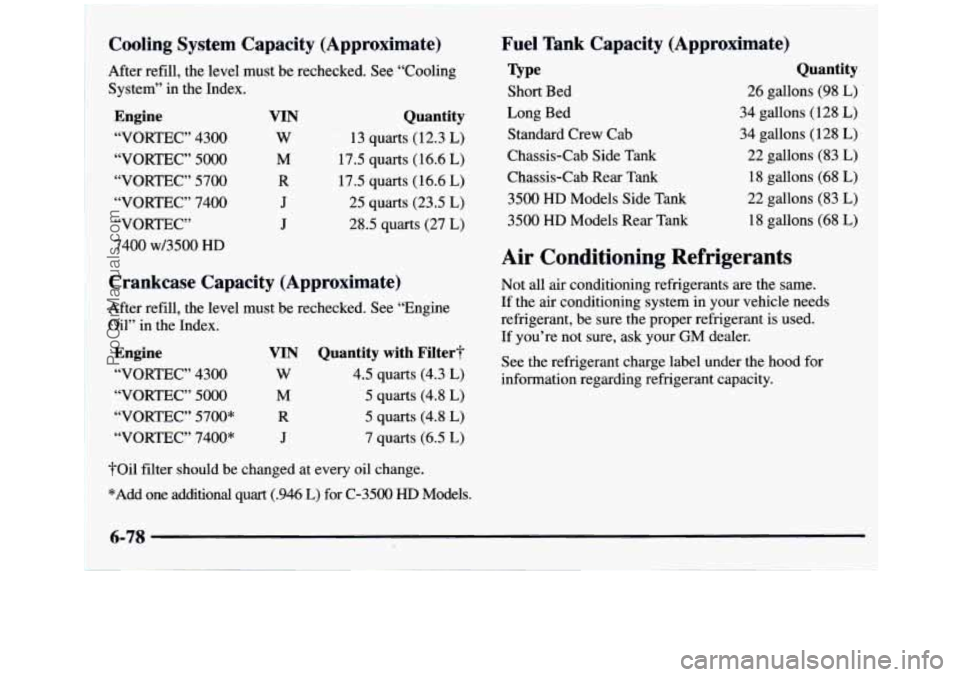
Fuel Tank Capacity (Approximate)
Type
Short Bed
Long Bed Standard Crew Cab
Chassis-Cab Side Tank
Chassis-Cab Rear Tank 3500
HD Models Side Tank
3500
HD Models Rear Tank
Cooling System Capacity (Approximate)
After refill, the level must be rechecked. See “Cooling
System” in the Index.
Engine
“VORTEC” 4300
“VORTEC”
5000
“VORTEC” 5700
“VORTEC” 7400
“VORTEC”
7400
w/3500 HD
VIN
W
M
R
J
J
Quantity
13 quarts (12.3 L)
17.5 quarts (16.6 L)
17.5 quarts (16.6 L)
25 quarts (23.5 L)
28.5 quarts (27 L)
Crankcase Capacity (Approximate)
After refill, the level must be rechecked. See “Engine
Oil” in the Index.
Engine
“VORTEC” 4300
“VORTEC”
5000
“VORTEC” 5700”
“VORTEC” 7400*
VIN
W
M
R
J
Quantity with Filter?
5 quarts (4.8 L)
5 quarts (4.8 L)
7 quarts (6.5 L)
4.5 quarts (4.3
L)
?Oil
filter should be changed at every oil change.
*Add one additional quart (.946
L) for C-3500 HD Models.
Quantity
26 gallons (98 L)
34 gallons (128 L)
34 gallons (128 L)
22 gallons (83 L)
18 gallons (68 L)
22 gallons (83 L)
18 gallons (68 L)
Air Conditioning Refrigerants
Not all air conditioning refrigerants are the same.
If the
air conditioning system in your vehicle needs
refrigerant, be sure the proper refrigerant
is used.
If you’re not sure, ask your GM dealer.
See the refrigerant charge label under the hood for
information regarding refrigerant capacity.
6-78
ProCarManuals.com
Page 356 of 436
Introduction
IMPORTANT:
KEEP ENGINE OIL
AT THE PROPER
LEVEL AND CHANGE AS
RECOMMENDED
I
Your Vehicle and the Environment
Proper vehicle maintenance not only helps to keep your
vehicle
in good working condition, but also helps the
environment. All recommended maintenance procedures
are important. Improper vehicle maintenance can
even
affect the quality of the air we breathe. Improper fluid
levels or the wrong tire inflation can increase the level
of emissions from your vehicle. To help protect our
environment, and to keep your vehicle in good
condition, please maintain your vehicle properly.
Have you purchased the GM Protection Plan? The Plan
supplements
your new vehicle warranties. See your
Warranty and Owner Assistance booklet, or your
GM dealer for details.
7-2
ProCarManuals.com
Page 362 of 436
Short TripKity Maintenance Schedule -- Gasoline Engines
** Drive axle service (see “Recommended Fluids and
Lubricants”
in the Index for proper lubricant to use):
0
e
0
0
Locking Differential -- Drain fluid and refill at first
engine oil change. At subsequent oil changes, check
fluid level and add fluid as needed. If driving in
dusty areas
or towing a trailer, drain fluid and refill
every 15,000 miles
(25 000 km).
Standard Differential -- Check fluid level and add
fluid
as needed at every oil change. If driving in
dusty areas or towing a trailer, drain fluid and refill
every
15,000 miles (25 000 km).
More frequent lubrication may be required for
heavy-duty
or off-road use.
3500 HD Models with applications requiring extreme
overloadtrailer towing conditions and high-speed (above
45 mph or 70 km/h) conditions for extended
periods of time must have the drive axle fluid changed every
30,000 miles (50 OOO km). See “Recommended
Fluids and Lubricants” in this section.
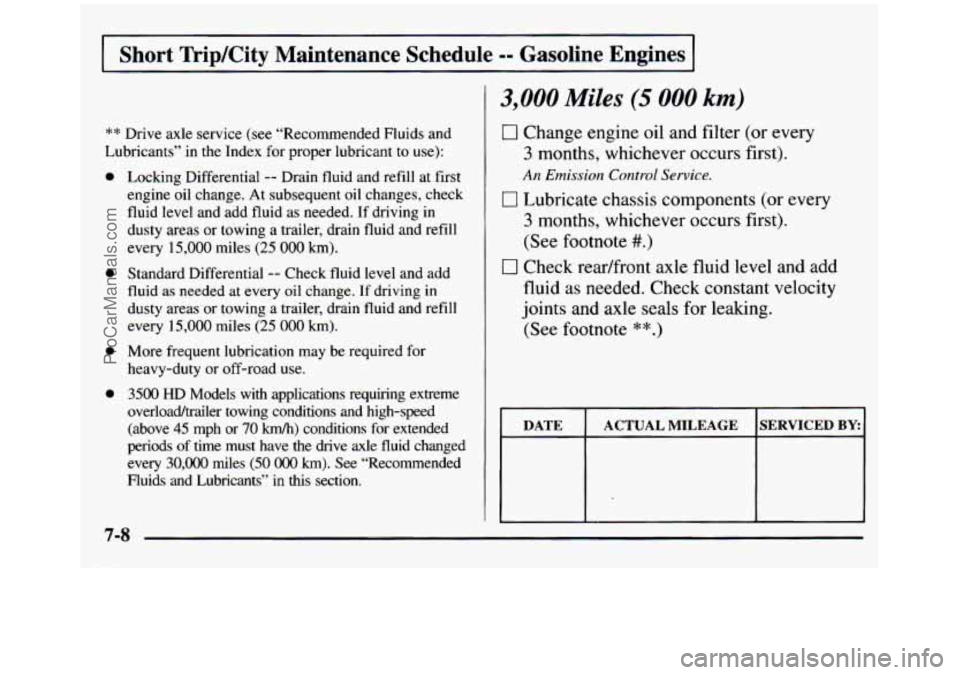
3,000 Miles (5 000 km)
0 Change engine oil and filter (or every
3 months, whichever occurs first).
An Emission Control Service.
0 Lubricate chassis components (or every
3 months, whichever occurs first).
(See footnote
#.)
0 Check readfront axle fluid level and add
fluid as needed. Check constant velocity
joints and axle seals for leaking.
(See footnote **.)
DATE ACTUAL MILEAGE SERVICED BY:
ProCarManuals.com
Page 363 of 436
1 Short Trip/City Maintenance Schedule =- Gasoline Engines I
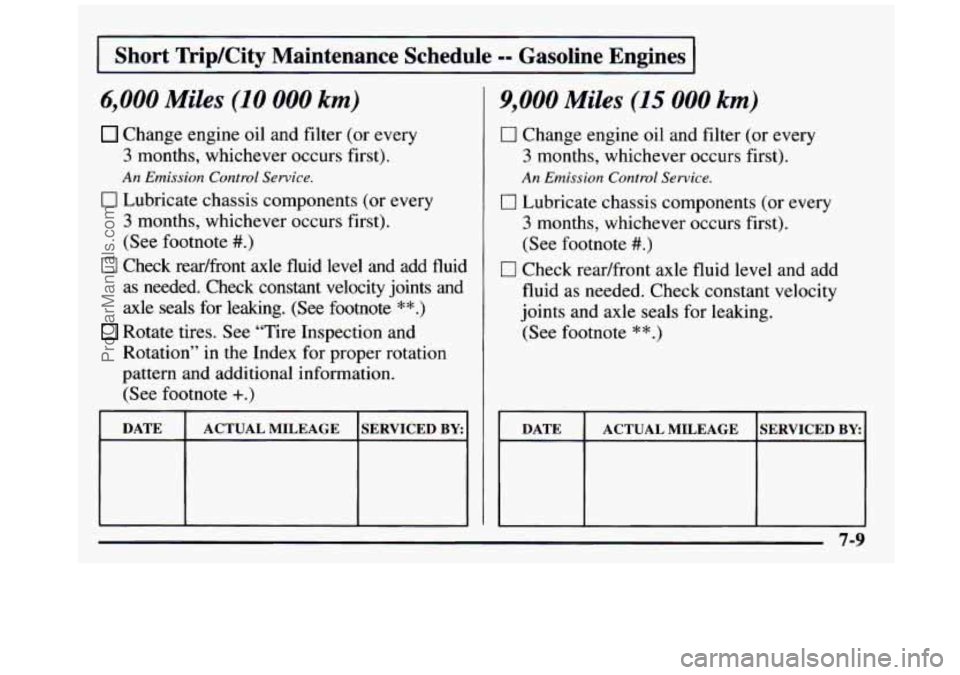
6,000 Miles (10 000 km)
Change engine oil and filter (or every
3 months, whichever occurs first).
An Emission Control Service.
0 Lubricate chassis components (or every
3 months, whichever occurs first).
(See footnote
#.)
0 Check readfront axle fluid level and add fluid
as needed. Check constant velocity joints and
axle seals for leaking. (See footnote
**.)
Rotate tires. See “Tire Inspection and
Rotation” in the Index for proper rotation
pattern and additional information.
(See footnote
+.)
9,000 Miles (15 000 km)
0 Change engine oil and filter (or every
3 months, whichever occurs first).
An Emission Control Service.
0 Lubricate chassis components (or every
3 months, whichever occurs first).
(See footnote
#.)
0 Check readfront axle fluid level and add
fluid as needed. Check constant velocity
joints and axle seals for leaking.
(See footnote
**.)
DATE SERVICED BY: ACTUAL MILEAGE
7-9
ProCarManuals.com
Page 364 of 436
Short TripKity Maintenance Schedule -- Gasoline Engines
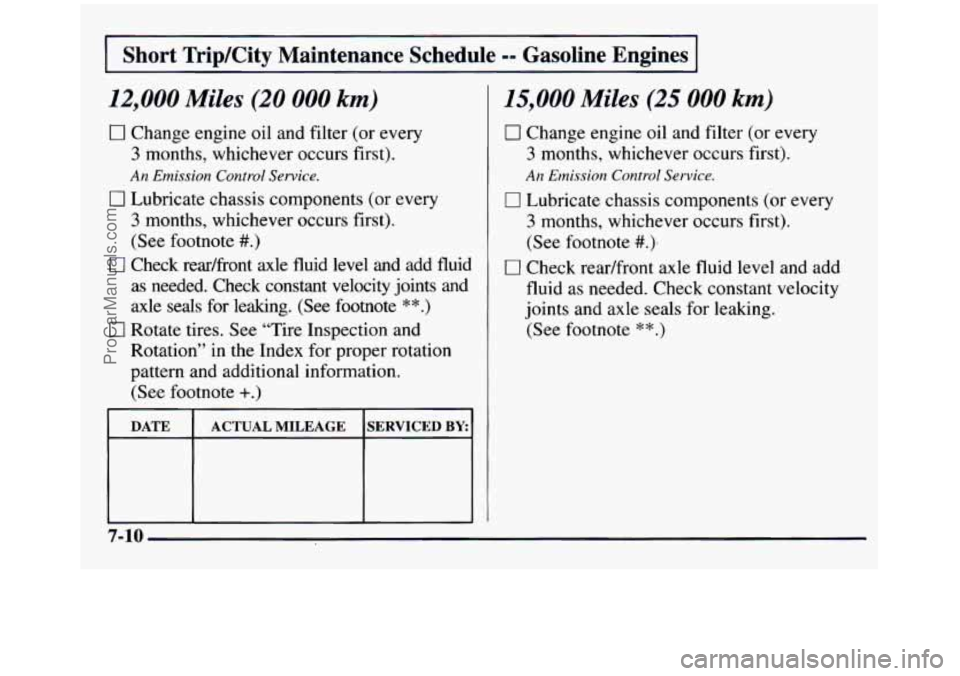
12,000 Miles (20 000 km)
0 Change engine oil and filter (or every
3 months, whichever occurs first).
An Emission Control Service.
0 Lubricate chassis components (or every
3 months, whichever occurs first).
(See footnote
#.)
0 Check readfront axle fluid level and add fluid
as needed. Check constant velocity joints
and
axle seals for leaking. (See footnote **.)
0 Rotate tires. See “Tire Inspection and
Rotation”
in the Index for proper rotation
pattern and additional information.
(See footnote
+.)
15,000 Miles (25 000 km)
0 Change engine oil and filter (or every
3 months, whichever occurs first).
An Emission Control Service.
0 Lubricate chassis components (or every
3 months, whichever occurs first).
(See footnote
#.).
0 Check readfront axle fluid level and add
fluid
as needed. Check constant velocity
joints and axle seals for leaking.
(See footnote
**.)
7-10
ProCarManuals.com