Page 278 of 377
![FORD F250 1997 Owners Manual 279
*
[MC13800(FM)01/96]
4. Let the engine coolant drain into a suitable
container. Disconnect the lower radiator hose
at the radiator connector and drain any
remaining engine coolant into a container](/manual-img/11/57800/w960_57800-277.png "FORD F250 1997 Owners Manual 279
*
[MC13800(FM)01/96]
4. Let the engine coolant drain into a suitable
container. Disconnect the lower radiator hose
at the radiator connector and drain any
remaining engine coolant into a container")
279
*
[MC13800(FM)01/96]
4. Let the engine coolant drain into a suitable
container. Disconnect the lower radiator hose
at the radiator connector and drain any
remaining engine coolant into a container.
*
[MC13850(FM)01/96]
5. Reconnect the lower radiator hose and close
the radiator drain cock.
[MC13900(FM)04/96]
Proper procedures for flushing the cooling
system can be found in theTruck Service Manual.
[MC13950(FM)01/96]
Engine coolant refill procedure
*
[MC14000(FM)01/96]
After you have drained the engine cooling
system:
*
[MC14050(FM)01/96]
1. Fill the radiator with a 50/50 mixture of the
specified engine coolant concentrate and
water. Allow several minutes for trapped air
to escape (bubble out) and for engine coolant
to flow through the radiator.
*
[MC14100(FM)01/96]
2. Replace the radiator cap to its fully installed
position, then back off to the first stop. This
will prevent high pressure from building up
in the cooling system during this part of the
fill procedure.
*
[MC14150(FM)01/96]
3. Start and idle the engine until the thermostat
opens and the radiator upper hose becomes
warm.
*
[MC14200(FM)01/96]
4. Shut off the engine and allow the engine to
cool. Cover the radiator cap with a thick
cloth and cautiously remove it. Step back
while the pressure releases.
*
[MC14250(FM)01/96]
5. Finally, check the radiator and add more
engine coolant if needed, following the
procedures noted above. Reinstall the
radiator cap securely, when finished.
*
[MC14300(FM)01/96]
6. If more engine coolant is necessary, fill the
overflow reservoir to the appropriate level
marked on the bottle.
File:11ltmcf.ex
Update:Tue May 28 08:52:04 1996
ProCarManuals.com
Page 279 of 377
![FORD F250 1997 Owners Manual 280
%*
[MC18300(FM)01/96]
Power Steering Fluid
*
[MC18350(FM)01/96]
Check the level of the power steering fluid at
least twice a year (i.e., every Spring and Fall).
*
[MC18400(FM)01/96]
To check the l](/manual-img/11/57800/w960_57800-278.png "FORD F250 1997 Owners Manual 280
%*
[MC18300(FM)01/96]
Power Steering Fluid
*
[MC18350(FM)01/96]
Check the level of the power steering fluid at
least twice a year (i.e., every Spring and Fall).
*
[MC18400(FM)01/96]
To check the l")
280
%*
[MC18300(FM)01/96]
Power Steering Fluid
*
[MC18350(FM)01/96]
Check the level of the power steering fluid at
least twice a year (i.e., every Spring and Fall).
*
[MC18400(FM)01/96]
To check the level of your power steering fluid:
*
[MC18450(FM)04/96]
1. Start the engine and let it run until the
power steering fluid reaches normal
operating temperature. The power steering
fluid will be at the right temperature when
the engine coolant temperature gauge in the
instrument cluster is near the center of the
NORMAL operating temperature range.
*
[MC18500(FM)01/96]
2. While the engine idles, turn the steering
wheel back and forth several times. Make
sure that the cap assembly is installed at this
time.
*
[MC18550(F )01/96]
3. Turn the engine off.
%*
[MC18650(FM)01/96]
4. Check the fluid level on the dipstick (which
is highlighted in yellow in your vehicle). The
fluid level should be between the arrows in
the FULL HOT range, which is marked on
the side of the dipstick, opposite the side
marked FULL COLD. Do not add fluid if the
level is within the FULL HOT range.
*
[MC18700(FM)01/96]
one third page art:0021016-B
Power steering dipstick
File:11ltmcf.ex
Update:Tue May 28 08:52:04 1996
ProCarManuals.com
Page 280 of 377
![FORD F250 1997 Owners Manual 281
*
[MC18800(F )01/96]
quarter page art:0020386-B
Power steering reservoir
*
[MC19050(FM)01/96]
5. If the power steering fluid is low, add fluid
in small amounts, continuously checking the
level, un](/manual-img/11/57800/w960_57800-279.png "FORD F250 1997 Owners Manual 281
*
[MC18800(F )01/96]
quarter page art:0020386-B
Power steering reservoir
*
[MC19050(FM)01/96]
5. If the power steering fluid is low, add fluid
in small amounts, continuously checking the
level, un")
281
*
[MC18800(F )01/96]
quarter page art:0020386-B
Power steering reservoir
*
[MC19050(FM)01/96]
5. If the power steering fluid is low, add fluid
in small amounts, continuously checking the
level, until you reach the FULL HOT range.
Do not overfill.
*
[MC19060(FM)03/96]
6. When you are finished, put the dipstick back
in and make sure that it fits snugly.
*
[MC19070(FM)03/96]
If you check the power steering fluid when it is
cold, make sure that the fluid reaches the FULL
COLD range on the dipstick. The reading will
only be accurate if the fluid temperature is
approximately 50 to85ÊF (10 to 30ÊC).
[MC19100(F )05/96]
Use only MERCONHAutomatic Transmission
Fluid.
*
[MC19250(FM)01/96]
If the power steering fluid is low, do not drive
your vehicle for a long period of time before
adding fluid. This can damage the power
steering pump.
*
[MC19400(FM)01/96]
NOTE: Do not turn the steering wheel of your
vehicle with the engine off. It could
force power steering fluid out from the
reservoir cap or in extreme cases, it
could unseat the cap.
File:11ltmcf.ex
Update:Tue May 28 08:52:04 1996
ProCarManuals.com
Page 282 of 377
![FORD F250 1997 Owners Manual 283 %
*
[MC21850(FM)01/96]
Checking the Automatic Transmission
Fluid
[MC21875(FM)01/96]
Transmission fluid should be checked at least
twice a year.
*
[MC21900(FM)01/96]
It is preferable to check the t](/manual-img/11/57800/w960_57800-281.png "FORD F250 1997 Owners Manual 283 %
*
[MC21850(FM)01/96]
Checking the Automatic Transmission
Fluid
[MC21875(FM)01/96]
Transmission fluid should be checked at least
twice a year.
*
[MC21900(FM)01/96]
It is preferable to check the t")
283 %
*
[MC21850(FM)01/96]
Checking the Automatic Transmission
Fluid
[MC21875(FM)01/96]
Transmission fluid should be checked at least
twice a year.
*
[MC21900(FM)01/96]
It is preferable to check the transmission fluid
level at normal operating temperature
150ÊF-170ÊF (66ÊC-77ÊC),after approximately 20
miles (30 km) of driving. However, if necessary,
you can check the fluid level without having to
drive 20 miles (30 km) to obtain a normal
operating temperature if outside temperatures
are above50ÊF (10ÊC).
*
[MC21950(FM)01/96]
NOTE: If the vehicle has been operated for an
extended period at high speeds or in
city traffic during hot weather, or
pulling a trailer, the vehicle should be
turned off for about 30 minutes to
allow the fluid to cool before checking.
*
[MC22000(FM)05/96]
With the vehicle on a level surface, start the
engine and move the transmission gearshift
through all of the gear ranges allowing sufficient
time for each position to engage. Securely latch
the transmission gearshift in the P (Park)
position, fully set the parking brake and leave
the engine running.
[MC22050(F )04/96]
NOTE: Vehicles equipped with the 4x4 option
must have the 4x4 shift selector in any
position other than neutral.
*
[MC22100(FM)01/96]
RWARNING
Your vehicle should not be driven if the
fluid level is below the bottom hole on
the dipstick and outside temperatures are
above50ÊF (10ÊC).
File:11ltmcf.ex
Update:Tue May 28 08:52:04 1996
ProCarManuals.com
Page 294 of 377
![FORD F250 1997 Owners Manual 295
*
[MC31200(FM)01/96]
NOTE: If you replace your fuel cap with an
aftermarket fuel filler cap, the customer
warranty may be void for any damage
to the fuel tank and/or fuel system.
*
[MC31300(FM)01/](/manual-img/11/57800/w960_57800-293.png "FORD F250 1997 Owners Manual 295
*
[MC31200(FM)01/96]
NOTE: If you replace your fuel cap with an
aftermarket fuel filler cap, the customer
warranty may be void for any damage
to the fuel tank and/or fuel system.
*
[MC31300(FM)01/")
295
*
[MC31200(FM)01/96]
NOTE: If you replace your fuel cap with an
aftermarket fuel filler cap, the customer
warranty may be void for any damage
to the fuel tank and/or fuel system.
*
[MC31300(FM)01/96]
RWARNING
The fuel system may be under pressure. If
the fuel cap is venting vapor or if you
hear a hissing sound, wait until it stops
before completely removing the cap.
*
[MC31400(F )01/96]
A venting fuel tank is not an abnormal
condition. It may be caused by:
*
[MC31500(F )01/96]
q
Too volatile a fuel for the weather conditions.
The service stations sometimes sell winter
grade fuel in the summer.
*
[MC31600(F )01/96]
q
Pulling a heavy load on hot days, or at high
altitudes.
*
[MC31700(F )01/96]
q
Extended periods of idling with the engine
RPM increased above the normal idle range.
*
[MC31800(F )01/96]
q
Parking vehicle in full sunlight for extended
periods on extremely hot days.
%*
[MC32000(FM)01/96]
Choosing the Right Fuel
[MC32100(F )04/96]
NOTE: Read the7.3L Diesel Engine Owner
Guide Supplementfor information
regarding correct fuel requirements for
your diesel-powered vehicle.
*
[MC32200(FM)03/96]
Use only UNLEADED FUEL. Using leaded fuel
is prohibited by federal law and could damage
your vehicle. The damage may not be covered
by your warranty.
*
[MC32250(FM)04/96]
Your vehicle was not designed to use fuel
containing manganese-based additives such as
MMT. Additionally, vehicles certified to
California emission standards (indicated on the
File:11ltmcf.ex
Update:Tue May 28 08:52:04 1996
ProCarManuals.com
Page 295 of 377
296underhood Vehicle Emissions Control
Information label) are designed to operate on
California reformulated gasolines. If California
reformulated gasoline is not available when you
refuel, your vehicle can be operated on
non-California fuels. However, even though your
engine will perform adequately on other
gasolines, the performance of the emission
control devices and systems may be adversely
affected. Repair of damage caused by using a
fuel that your vehicle was not designed for may
not be covered by your warranty.
%*
[MC32400(FM)04/96]
Octane recommendation
*
[MC32500(FM)03/96]
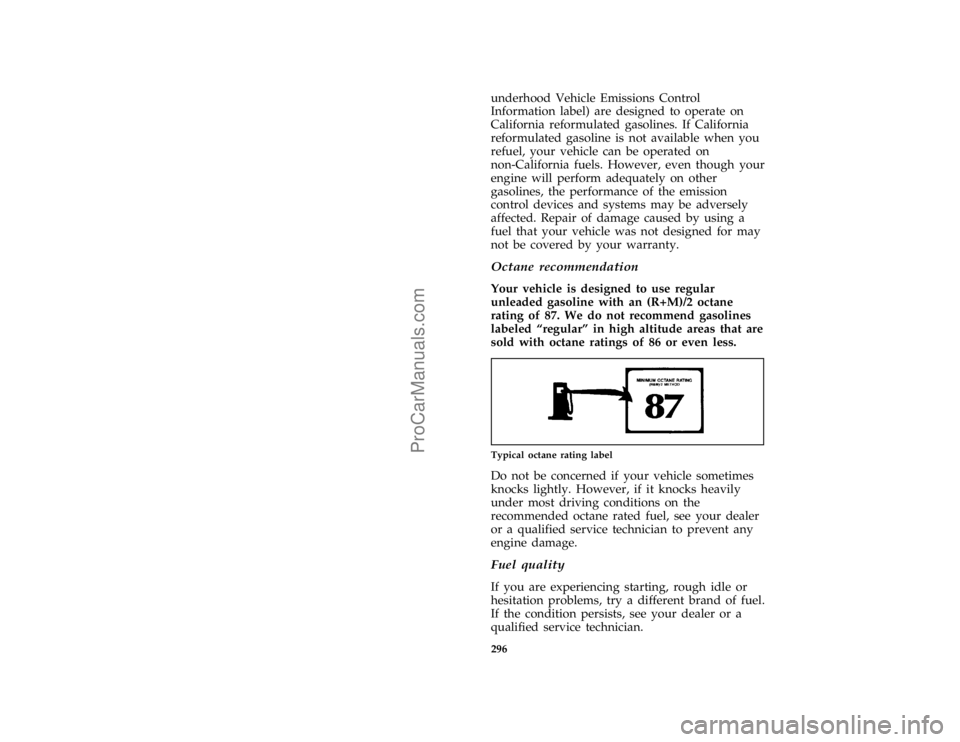
Your vehicle is designed to use regular
unleaded gasoline with an (R+M)/2 octane
rating of 87. We do not recommend gasolines
labeled ªregularº in high altitude areas that are
sold with octane ratings of 86 or even less.
*
[MC32600(FM)01/96]
one inch art:0060001-C
Typical octane rating label
%*
[MC32800(FM)03/96]
Do not be concerned if your vehicle sometimes
knocks lightly. However, if it knocks heavily
under most driving conditions on the
recommended octane rated fuel, see your dealer
or a qualified service technician to prevent any
engine damage.
%*
[MC32900(FM)04/96]
Fuel quality
*
[MC33000(FM)03/96]
If you are experiencing starting, rough idle or
hesitation problems, try a different brand of fuel.
If the condition persists, see your dealer or a
qualified service technician.
File:11ltmcf.ex
Update:Tue May 28 08:52:04 1996
ProCarManuals.com
Page 299 of 377
![FORD F250 1997 Owners Manual 300 %
*
[MC36100(FM)01/96]
Running Out of Fuel
*
[MC36200(FM)01/96]
If your vehicle runs out of fuel, try to stop on
level ground away from traffic. Add at least two
gallons (8 liters) of fuel to star](/manual-img/11/57800/w960_57800-298.png "FORD F250 1997 Owners Manual 300 %
*
[MC36100(FM)01/96]
Running Out of Fuel
*
[MC36200(FM)01/96]
If your vehicle runs out of fuel, try to stop on
level ground away from traffic. Add at least two
gallons (8 liters) of fuel to star")
300 %
*
[MC36100(FM)01/96]
Running Out of Fuel
*
[MC36200(FM)01/96]
If your vehicle runs out of fuel, try to stop on
level ground away from traffic. Add at least two
gallons (8 liters) of fuel to start your vehicle
again. If your vehicle is not on level ground,
you may need as much as five gallons (20 liters)
of fuel to start it.
*
[MC36300(FM)01/96]
You may need to crank the engine several times
before the fuel system starts to pump fuel from
the tank to the engine.
%*
[MC36400(FM)03/96]
Fuel Economy
*
[MC36500(FM)01/96]
Fuel economy is an estimate of the efficiency of
your vehicle and can be calculated as Miles Per
Gallon (MPG) or Liters Per 100 Kilometers
(L/100K).
*
[MC36600(FM)01/96]
Do not calculate fuel economy during your
vehicle's break-in period. This would not be an
accurate estimate of how much fuel your vehicle
will normally use.
*
[MC36700(FM)01/96]
To calculate fuel economy:
*
[MC36800(FM)01/96]
1. Fill the tank completely and record the
initial odometer reading.
*
[MC36900(FM)01/96]
2. Every time you buy fuel record the
amount (in gallons or liters) purchased.
*
[MC37000(FM)01/96]
3. After at least three to five tankfuls, fill the
fuel tank and record the final odometer
reading.
*
[MC37100(FM)01/96]
4. Use these equations to calculate your fuel
economy.
*
[MC37200(FM)01/96]
q
English: MPG = (total miles)/(gallons used).
*
[MC37300(FM)01/96]
q
Metric: L/100K = (liters used) x 100/(total
kilometers)
File:11ltmcf.ex
Update:Tue May 28 08:52:04 1996
ProCarManuals.com
Page 300 of 377
![FORD F250 1997 Owners Manual 301 %
*
[MC37400(F )01/96]
Comparisons With Environmental
Protection Agency (EPA) and Transport
Canada (TC) Fuel Economy Estimates
[MC37600(F )04/96]
NOTE: There are no EPA fuel economy
estimates for](/manual-img/11/57800/w960_57800-299.png "FORD F250 1997 Owners Manual 301 %
*
[MC37400(F )01/96]
Comparisons With Environmental
Protection Agency (EPA) and Transport
Canada (TC) Fuel Economy Estimates
[MC37600(F )04/96]
NOTE: There are no EPA fuel economy
estimates for")
301 %
*
[MC37400(F )01/96]
Comparisons With Environmental
Protection Agency (EPA) and Transport
Canada (TC) Fuel Economy Estimates
[MC37600(F )04/96]
NOTE: There are no EPA fuel economy
estimates for vehicles over 8500 lbs.
(3,855 kg) GVW.
%*
[MC37700(FM)01/96]
Improving Fuel Economy
*
[MC37800(FM)01/96]
Fuel economy is affected by a number of
variables which can reduce efficiency. You can
improve fuel economy by understanding these
variables and minimizing their effect.
*
[MC37900(FM)01/96]
The following decrease fuel economy:
*
[MC38000(FM)01/96]
q
Lack of regular, scheduled maintenance
*
[MC38100(FM)01/96]
q
Driving with your foot on the brake
*
[MC38200(FM)01/96]
q
Sudden stops
*
[MC38300(FM)01/96]
q
Excessive speed
*
[MC38400(FM)01/96]
q
Extended engine idling
*
[MC38500(FM)01/96]
q
Heavy loads
*
[MC38600(FM)01/96]
q
Underinflated tires
*
[MC38700(FM)01/96]
q
Extended use of the A/C, defroster, rear
window defroster and other accessories
*
[MC38900(F )01/96]
q
Aftermarket add-ons such as bike, ski or
luggage racks, bug deflectors, etc.
File:11ltmcf.ex
Update:Tue May 28 08:52:04 1996
ProCarManuals.com