Page 110 of 219
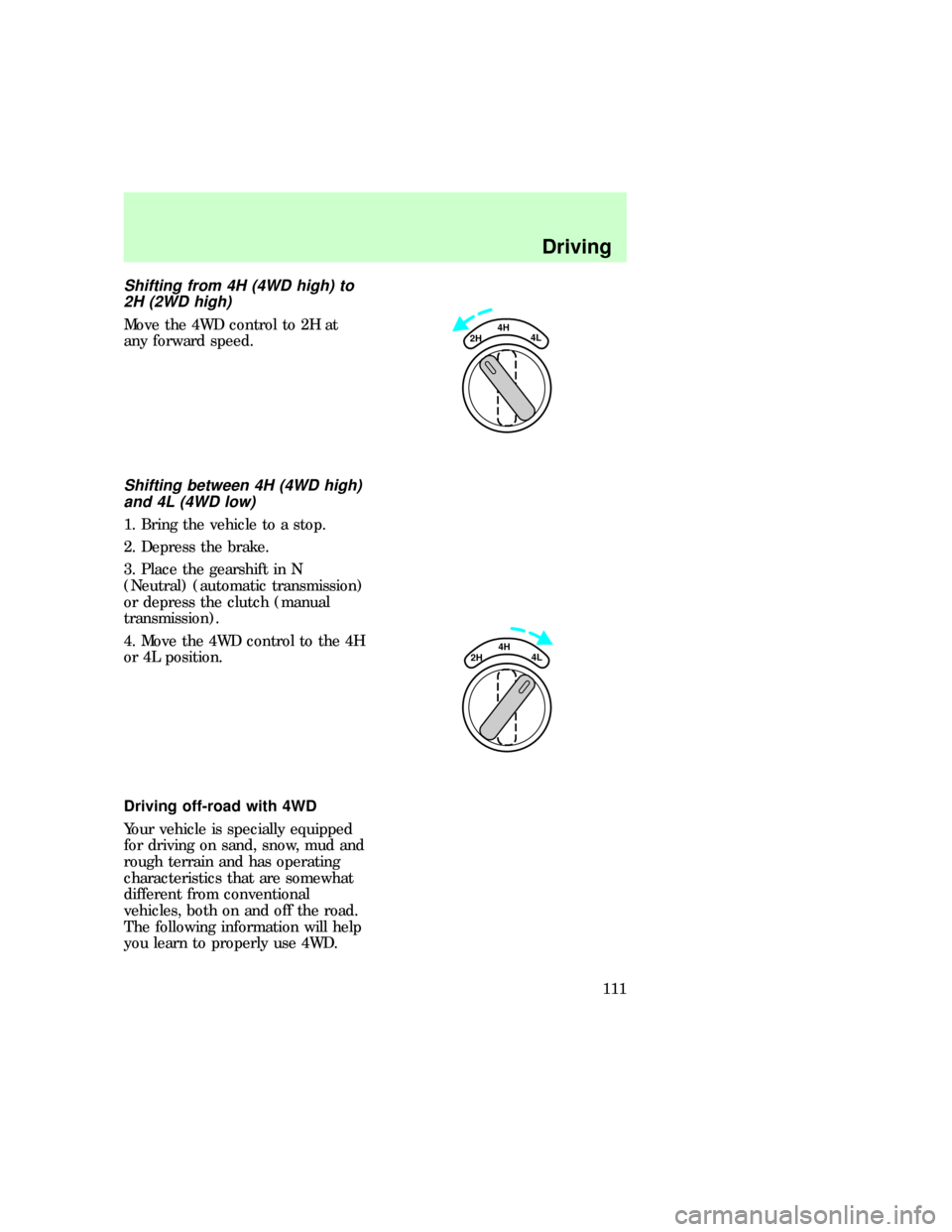
Shifting from 4H (4WD high) to
2H (2WD high)
Move the 4WD control to 2H at
any forward speed.
Shifting between 4H (4WD high)
and 4L (4WD low)
1. Bring the vehicle to a stop.
2. Depress the brake.
3. Place the gearshift in N
(Neutral) (automatic transmission)
or depress the clutch (manual
transmission).
4. Move the 4WD control to the 4H
or 4L position.
Driving off-road with 4WD
Your vehicle is specially equipped
for driving on sand, snow, mud and
rough terrain and has operating
characteristics that are somewhat
different from conventional
vehicles, both on and off the road.
The following information will help
you learn to properly use 4WD.
2H4H
4L
2H4H
4L
f12_ct_4h_4l
f12_driving_offroad
Driving
111
Page 111 of 219
When using 4WD, maintain
steering wheel control at all times,
especially in rough terrain. Since
sudden changes in terrain can
result in abrupt steering wheel
motion, make sure you grip the
steering wheel from the outside.
Do not grip the spokes.
Drive cautiously to avoid vehicle
damage from concealed objects
such as rocks and stumps.
You should either know the terrain
or examine maps of the area
before driving. Map out your route
before driving in the area. For
more information on driving
off-road, read the ªFour Wheelingº
supplement in your owner's
portfolio.
If your vehicle gets stuck
If the vehicle is stuck, shift the
transmission in a steady motion
between forward and reverse
gears. Allow the transmission to
engage, then press lightly on the
accelerator. DO NOT rock the
vehicle for more than a few
minutes. The transmission and
tires may be damaged or the
engine can overheat.
Do not spin the wheels at
over 35 mph (55 km/h).
The tires may fail and injure a
passenger or bystander.
Sand
When driving over sand, try to
keep all four wheels on the most
f12_driving_sand
Driving
112
Page 113 of 219

that could damage drive
components.
If the transmission and transfer
case are submerged in water, their
fluids should be checked and
changed, if necessary.
If the rear axle is submerged in
water, the rear axle lubricant
should be checked and changed, if
necessary. The rear axle is filled
with a synthetic lubricant and does
not normally require a lubricant
change for the life of the vehicle.
Rear axle lubricant quantities
should not need to be checked
unless a leak is suspected.
Driving on hill or slope terrain
When driving on a hill, avoid
driving crosswise or turning on
steep slopes. You could lose
traction and slip sideways. Drive
straight up, straight down or avoid
the hill completely. Know the
conditions on the other side of a
hill before driving over the crest.
When climbing a steep hill, start in
a lower gear rather than
downshifting to a lower gear from
a higher gear once the ascent has
started. This reduces strain on the
engine and the possibility of
stalling.
f12_driving_hill
Driving
114
Page 114 of 219

When descending a steep hill,
avoid sudden braking. Rapid
pumping of the brake pedal will
help slow the vehicle and still
maintain steering control.
When speed control is on and you
are driving uphill, your vehicle
speed may drop considerably,
especially if you are carrying a
heavy load.
If vehicle speed drops more than
15±25 km/h (8±14 mph), the speed
control will cancel automatically.
Resume speed with accelerator
pedal.
If speed control cancels after
climbing the hill, reset speed by
pressing and holding the SET
ACCEL button (to resume speeds
over 50 km/h (30 mph).
Automatic transmission may shift
frequently while driving up steep
grades. Eliminate frequent shifting
by shifting out of
D(Overdrive)
into D (Drive).
Driving on snow and ice
A 4WD vehicle has advantages
over 2WD vehicles in snow and ice
but can skid like any other vehicle.
Avoid sudden applications of
power and quick changes of
direction on snow and ice. Apply
the accelerator slowly and steadily
when starting from a full stop.
When braking, apply the brakes as
you normally would. In order to
allow the anti-lock brake system
(ABS) to operate properly, keep
f12_driving_snow_ice
Driving
115
Page 118 of 219

maximum trailer weight your
vehicle can tow and must fall
below the maximum shown under
maximum trailer weight on the
chart.
Trailer towing table (F-150 4x2 automatic transmission)
Engine Rear axle
ratioMaximum
GCWR kg (lb)Maximum
trailer weight
kg (lb)Maximum
frontal area
of trailer
m
2(ft2)
Regular Cab F-150
4.2L 3.08 4,077 (9,000) 2,177 (4,800) 5.52 (60)
4.2L 3.55 4,530 (10,000) 2,582 (5,800) 5.52 (60)
4.6L 3.08 4,530 (10,000) 2,582 (5,700) 5.52 (60)
4.6L 3.55 5,209 (11,500) 3,261 (7,200) 5.52 (60)
5.4L 3.08 4,983 (11,000) 2,948 (6,500) 5.52 (60)
5.4L 3.55 5,753 (12,700) 3,268 (8,000) 5.52 (60)
SuperCab F-150
4.2L 3.08 4,077 (9,000) 2,086 (4,600) 5.52 (60)
4.2L 3.08 4,530 (10,000) 2,540 (5,600) 5.52 (60)
4.6L 3.55 4,530 (10,000) 2,491 (5,500) 5.52 (60)
4.6L 3.55 5,209 (11,500) 3,171 (7,000) 5.52 (60)
5.4L 3.08 4,983 (11,000) 2,857 (6,300) 5.52 (60)
5.4L 3.55 5,753 (12,700) 3,628 (8,000) 5.52 (60)
Trailer towing table (F-150 4x2 manual transmission)
Engine Rear axle
ratioMaximum
GCWR kg (lb)Maximum
trailer weight
kg (lb)Maximum
frontal area
of trailer
m
2(ft2)
Regular Cab F-150
4.2L 3.08 2,944 (6,500) 1,041 (2,300) 5.52 (60)
4.2L 3.55 3,533 (7,800) 1,630 (3,600) 5.52 (60)
4.6L 3.08 2,944 (6,500) 997 (2,200) 5.52 (60)
Driving
119
Page 119 of 219

Trailer towing table (F-150 4x2 manual transmission)
4.6L 3.55 3,533 (7,800) 1,587 (3,500) 5.52 (60)
SuperCab F-150
4.2L 3.08 2,944 (6,500) 951 (2,100) 5.52 (60)
4.2L 3.55 3,533 (7,800) 1,540 (3,400) 5.52 (60)
4.6L 3.08 2,944 (6,500) 907 (2,000) 5.52 (60)
4.6L 3.55 3,533 (7,800) 1496 (3,300) 5.52 (60)
Trailer tow table (F-150 4x4 automatic transmission)
Engine Rear axle
ratioMaximum
GCWR kg (lb)Maximum
trailer weight
kg (lb)Maximum
frontal area
of trailer
m
2(ft2)
Regular Cab F-150
4.2L 3.08 4,077 (9,000) 1,995 (4,400) 5.52 (60)
4.2L 3.55 4,530 (10,000) 2,449 (5,400) 5.52 (60)
4.6L 3.08 4,530 (10,000) 2,404 (5,300) 5.52 (60)
4.6L 3.55 5,209 (11,500) 3,084 (6,800) 5.52 (60)
5.4L 3.08 4,983 (11,000) 2,721 (6,000) 5.52 (60)
5.4L 3.55 5,753 (12,700) 3,492 (7,700) 5.52 (60)
SuperCab F-150
4.6L 3.08 4,530 (10,000) 2,313 (5,100) 5.52 (60)
4.6L 3.55 5,209 (11,500) 2,993 (6,600) 5.52 (60)
5.4L 3.08 4,983 (11,000) 2,721 (6,000) 5.52 (60)
5.4L 3.55 5,753 (12,700) 3,492 (7,700) 5.52 (60)
Trailer towing table (F-150 4x4 manual transmission)
Engine Rear axle
ratioMaximum
GCWR kg (lb)Maximum
trailer weight
kg (lb)Maximum
frontal area
of trailer
m
2(ft2)
Regular Cab F-150
4.2L 3.08 2,944 (6,500) 861 (1,900) 5.52 (60)
Driving
120
Page 120 of 219

Trailer towing table (F-150 4x4 manual transmission)
4.2L 3.55 3,533 (7,800) 1,451 (3,200) 5.52 (60)
4.6L 3.08 2,944 (6,500) 816 (1,800) 5.52 (60)
4.6L 3.55 3,533 (7,800) 1,406 (3,100) 5.52 (60)
SuperCab F-150
4.6L 3.08 2,944 (6,500) 771 (1,700) 5.52 (60)
4.6L 3.55 3,533 (7,800) 1,360 (3,000) 5.52 (60)
Trailer towing table (F-250 4x2 automatic transmission)
Engine Rear axle
ratioMaximum
GCWR kg (lb)Maximum
trailer weight
kg (lb)Maximum
frontal area
of trailer
m
2(ft2)
Regular Cab F-250
4.6L 3.31 4,756 (10,500) 2,630 (5,800) 5.52 (60)
4.6L 3.73 5,436 (12,000) 3,311 (7,300) 5.52 (60)
5.4L 3.31 5,436 (12,000) 3,265 (7,200) 5.52 (60)
5.4L 3.73 6,115 (13,500) 3,946 (8,600) 5.52 (60)
SuperCab F-250
4.6L 3.31 4,756 (10,500) 2,585 (5,700) 5.52 (60)
4.6L 3.73 5,436 (12,000) 3,265 (7,200) 5.52 (60)
5.4L 3.31 5,436 (12,000) 3,220 (7,100) 5.52 (60)
5.4L 3.73 6,115 (13,500) 3,900 (8,600) 5.52 (60)
Trailer towing table (F-250 4x2 manual transmission)
Engine Rear axle
ratioMaximum
GCWR kg (lb)Maximum
trailer weight
kg (lb)Maximum
frontal area
of trailer
m
2(ft2)
Regular Cab F-250
4.6L 3.31 3,261 (7,200) 1,179 (2,600) 5.52 (60)
4.6L 3.73 3,533 (7,800) 1,451 (3,200) 5.52 (60)
SuperCab F-250
Driving
121
Page 121 of 219
Trailer towing table (F-250 4x2 manual transmission)
4.6L 3.31 3,261 (7,200) 1,133 (2,500) 5.52 (60)
4.6L 3.73 3,533 (7,800) 1,406 (3,100) 5.52 (60)
Trailer towing table (F-250 4x4 automatic transmission)
Engine Rear axle
ratioMaximum
GCWR kg (lb)Maximum
trailer weight
kg (lb)Maximum
frontal area of
trailer m
2(ft2)
Regular Cab F-250
4.6L 3.31 4,756 (10,500) 2,449
(5,400)5.52 (60)
4.6L 3.73 5,436 (12,000) 3,129
(6,900)5.52 (60)
5.4L 3.31 5,436 (12,000) 3,084
(6,800)5.52 (60)
5.4L 3.73 6,115 (13,500) 3,764
(8,300)5.52 (60)
SuperCab F-250
4.6L 3.31 4,756 (10,500) 2,449
(5,400)5.52 (60)
4.6L 3.73 5,436 (12,000) 3,129
(6,900)5.52 (60)
5.4L 3.31 5,436 (12,000) 3,084
(6,800)5.52 (60)
5.4L 3.73 6,115 (13,500) 3,764
(8,300)5.52 (60)
Trailer towing table (F-250 4x4 manual transmission)
Engine Rear axle
ratioMaximum
GCWR kg (lb)Maximum
trailer weight
kg (lb)Maximum
frontal area of
trailer m
2(ft2)
Regular Cab F-250
4.6L 3.31 3,261 (7,200) 952 (2,100) 5.52 (60)
Driving
122