Page 78 of 219
Keep the passenger air bag
turned on unless there is a
rear-facing infant seat installed in
the front seat. When the
passenger air bag switch is
turned off, the passenger air bag
will not inflate in a collision.
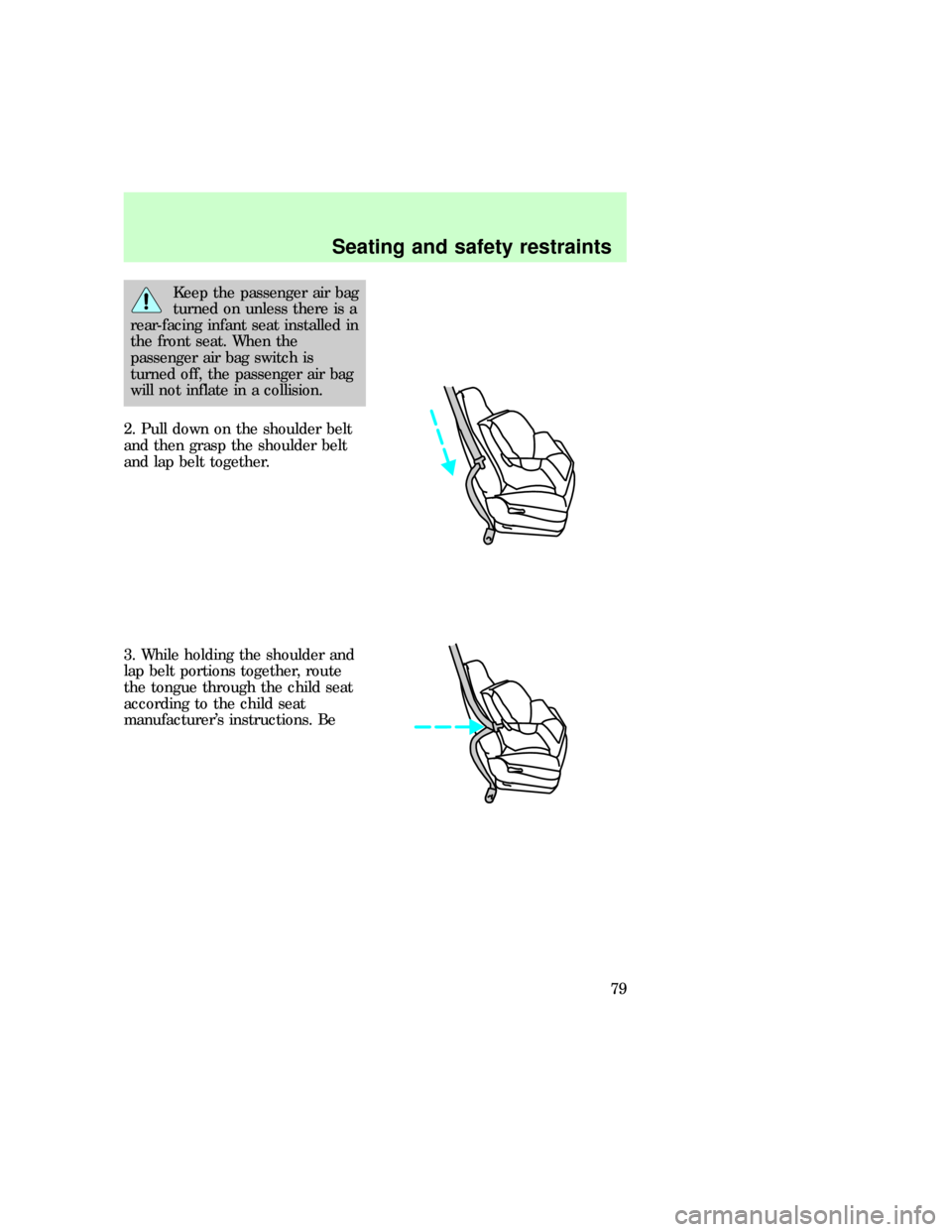
2. Pull down on the shoulder belt
and then grasp the shoulder belt
and lap belt together.
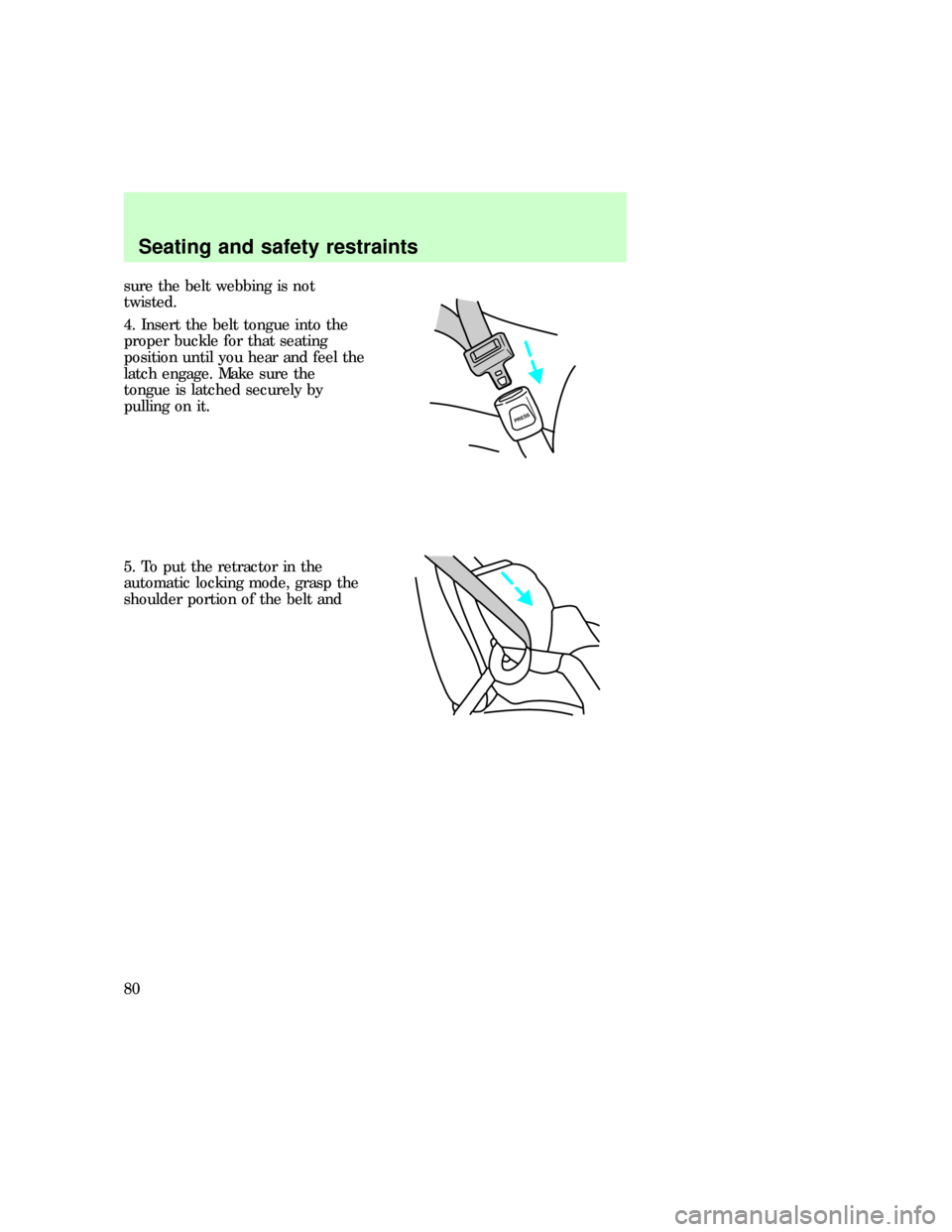
3. While holding the shoulder and
lap belt portions together, route
the tongue through the child seat
according to the child seat
manufacturer's instructions. Be
Seating and safety restraints
79
Page 79 of 219
sure the belt webbing is not
twisted.
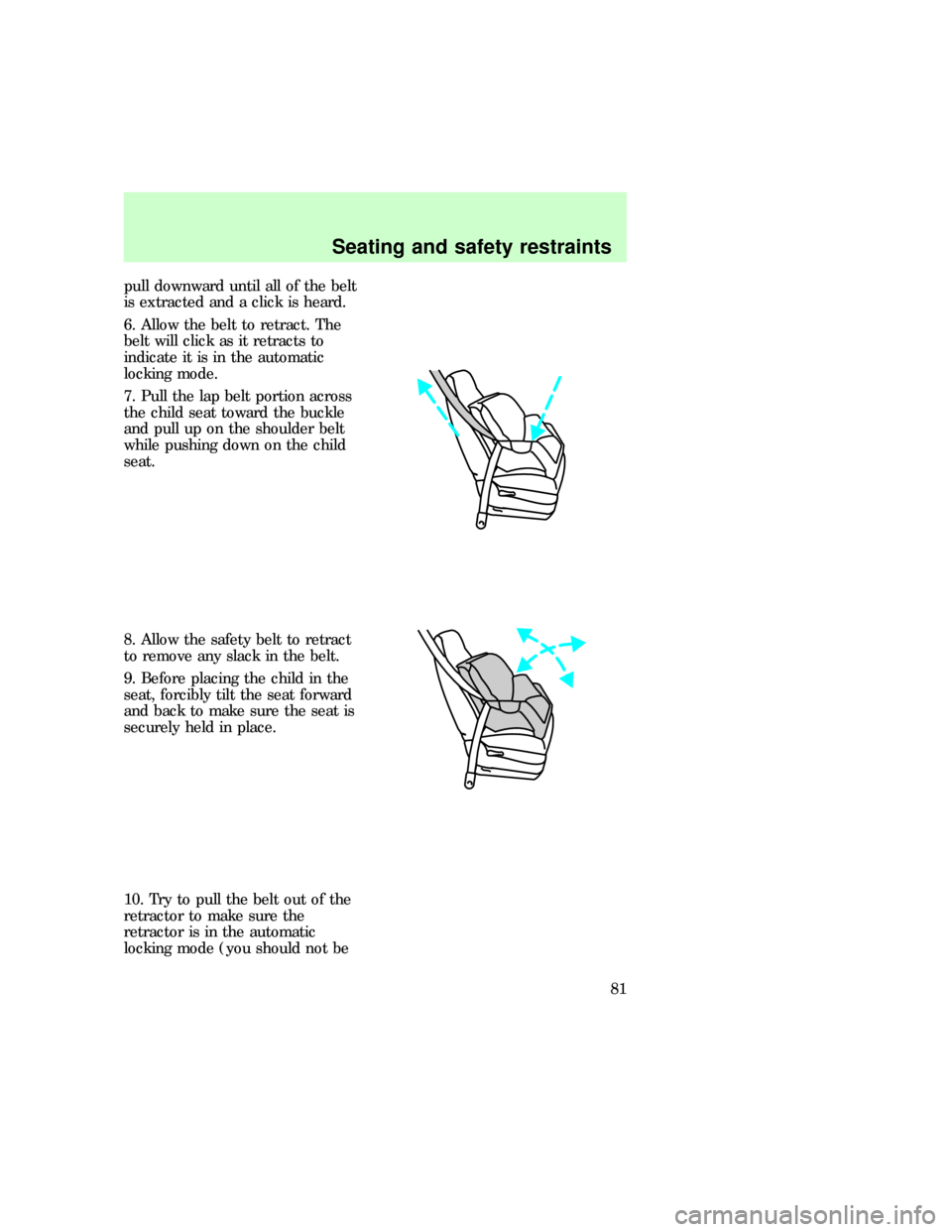
4. Insert the belt tongue into the
proper buckle for that seating
position until you hear and feel the
latch engage. Make sure the
tongue is latched securely by
pulling on it.
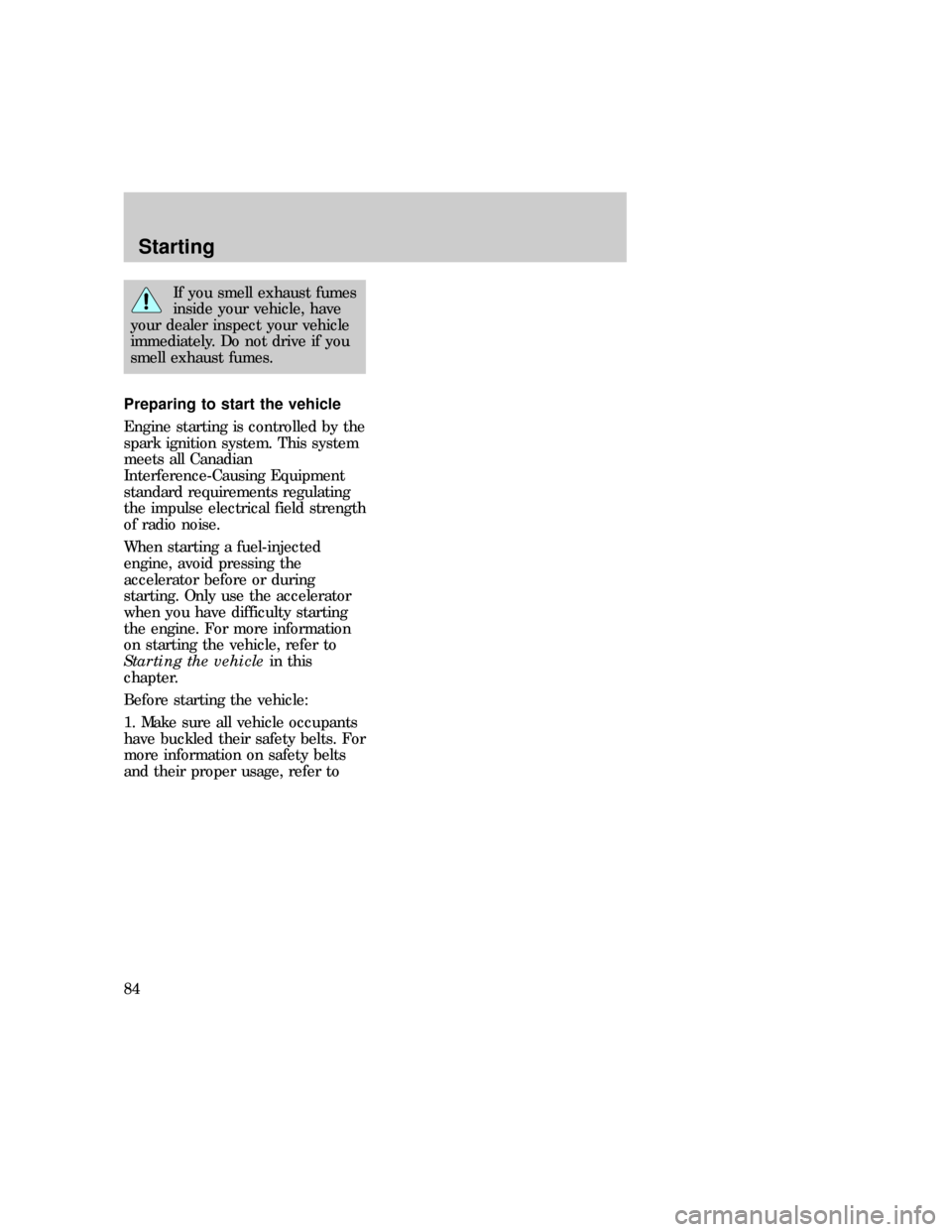
5. To put the retractor in the
automatic locking mode, grasp the
shoulder portion of the belt and
PRESS
Seating and safety restraints
80
Page 80 of 219
pull downward until all of the belt
is extracted and a click is heard.
6. Allow the belt to retract. The
belt will click as it retracts to
indicate it is in the automatic
locking mode.
7. Pull the lap belt portion across
the child seat toward the buckle
and pull up on the shoulder belt
while pushing down on the child
seat.
8. Allow the safety belt to retract
to remove any slack in the belt.
9. Before placing the child in the
seat, forcibly tilt the seat forward
and back to make sure the seat is
securely held in place.
10. Try to pull the belt out of the
retractor to make sure the
retractor is in the automatic
locking mode (you should not be
Seating and safety restraints
81
Page 81 of 219

able to pull more belt out). If the
retractor is not locked, unbuckle
the belt and repeat steps two
through nine.
Check to make sure the child seat is
properly secured before each use.
Using a tether strap
Ford recommends using child
safety seats with a top tether
strap. Contact the manufacturer of
your safety seat for information
about ordering a tether strap if one
is not provided to you. Contact
your Ford dealer for a free tether
strap if one is not provided to you.
Contact your Ford dealer for a free
tether anchor kit (613D74) so you
can attach a tether anchor bracket
to the back of the seat cushion. If
you have a SuperCab, attach the
bracket to the inside of the back
panel of your vehicle. Carefully
follow the instructions provided
with the kit.
If you have a SuperCab, Ford
recommends you attach tether
safety seats in a rear seating
position (if possible) with the
tether strap attached to the tether
anchor bracket as shown in the
instructions provided with the
tether anchor kit.
If the tethered seat is installed in
the front seat, put the tether strap
over the seatback and attach it to
the anchor bracket installed on the
rear edge of the seat cushion as
explained in the tether strap
instructions.
f12_tether_straps
Seating and safety restraints
82
Page 83 of 219
If you smell exhaust fumes
inside your vehicle, have
your dealer inspect your vehicle
immediately. Do not drive if you
smell exhaust fumes.
Preparing to start the vehicle
Engine starting is controlled by the
spark ignition system. This system
meets all Canadian
Interference-Causing Equipment
standard requirements regulating
the impulse electrical field strength
of radio noise.
When starting a fuel-injected
engine, avoid pressing the
accelerator before or during
starting. Only use the accelerator
when you have difficulty starting
the engine. For more information
on starting the vehicle, refer to
Starting the vehiclein this
chapter.
Before starting the vehicle:
1. Make sure all vehicle occupants
have buckled their safety belts. For
more information on safety belts
and their proper usage, refer to
com_preparing_start.01
Starting
84
Page 86 of 219
3. Turn the key to the ON position
(without turning the key to
START).
Make sure the following lights
illuminate briefly. If a light fails to
illuminate, have the vehicle
serviced.
²If the driver's safety belt is
fastened, the
light does not
illuminate.
!MPH 1050
3070
4080
120
140
18 0
40
20
0
10090 60
8060100
20 km/h
0010
000005CH
EF
DOOR
AJARLOW
FUEL
MPH
CHECK
ENGINEABS
L H18
8
BRAKE
!
LOW
FUEL
ABS
BRAKE
3
MPH 1050
3070
4080
120
140
18 0
40
20
0
10090 60
8060100
20 km/h
0010
0000052
4
5
6 01LH
CH
EF
818RPMx1000CHECK
ENGINE
Starting
87
Page 115 of 219
steady pressure on the brake
pedal.
Allow more stopping distance and
drive slower than usual. Consider
using one of the lower gears.
VEHICLE LOADING
It is extremely dangerous
to ride in a cargo area,
inside or outside of a vehicle. In
a collision, people riding in these
areas are more likely to be
seriously injured or killed. Do not
allow people to ride in any area
of your vehicle that is not
equipped with seats and safety
belts. Be sure everyone in your
vehicle is in a seat and using a
safety belt properly.
Before loading a vehicle, familiarize
yourself with the following terms:
²Base Curb Weight:Weight of
the vehicle including any
standard equipment, fluids,
lubricants, etc. It does not
include passengers or
aftermarket equipment.
²Payload:Combined maximum
allowable weight of cargo,
passengers and optional
equipment. The payload equals
gross vehicle weight rating
(GVWR) minus base curb
weight.
²Gross vehicle weight (GVW):
Base curb weight plus the
payload weight (including
passengers, cargo and optional
f12_heavy_load
Driving
116
Page 131 of 219
Careless or high speed driving
while plowing snow which results
in vehicle decelerations equivalent
to or greater than the air bag
deployment impact speeds listed
above can deploy the air bag. Such
driving also increases the risk of
accidents.
All occupants of the
vehicle, including the
driver, should always wear their
safety belts.
Never remove or defeat the
ªtripping mechanismsº designed
into the snow removal equipment
by its manufacturer. Doing so may
cause damage to the vehicle and
the snow removal equipment as
well as possible air bag
deployment.
Do not attempt to service,
repair, or modify the Air
Bag Supplemental Restraint
System or its fuses. See your
Ford or Lincoln-Mercury dealer.
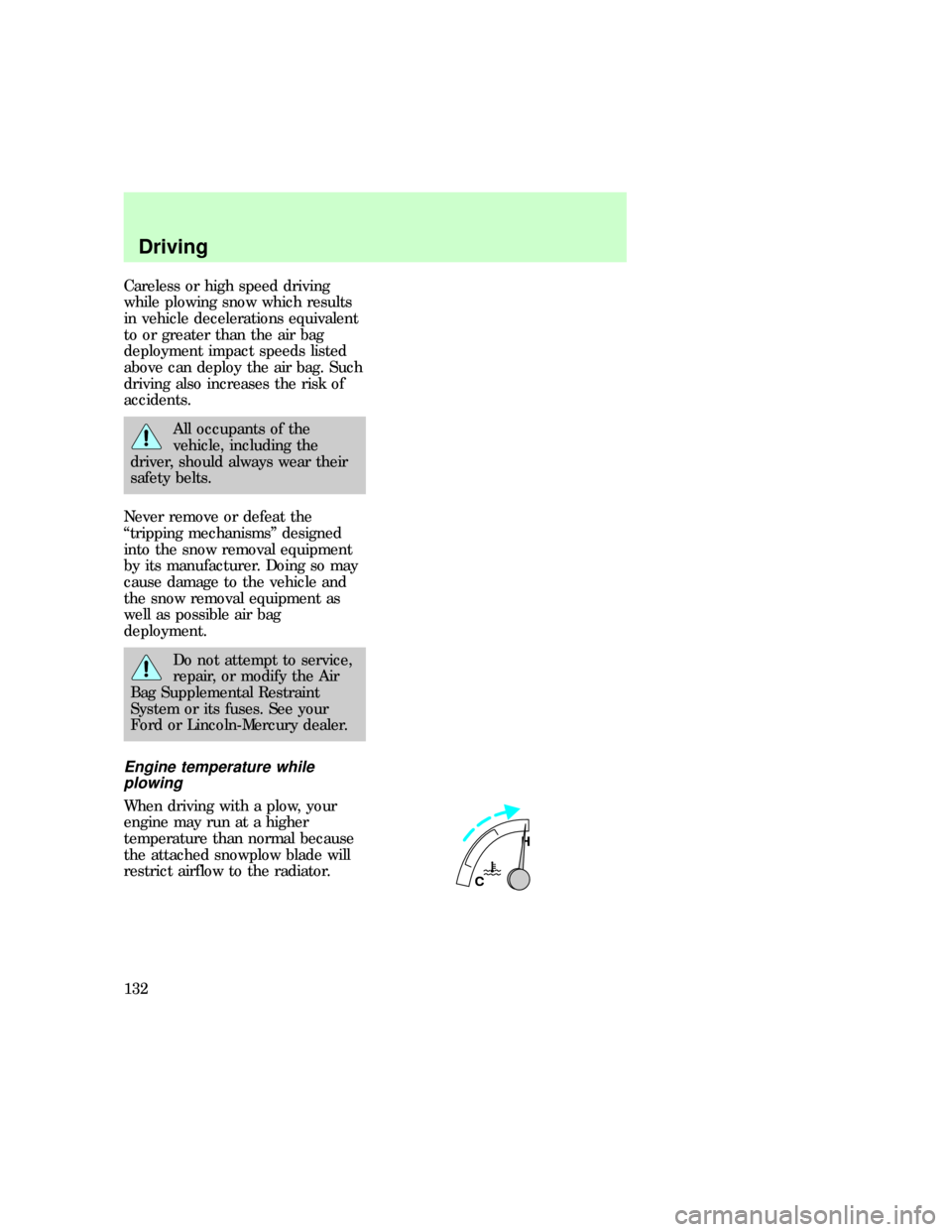
Engine temperature while
plowing
When driving with a plow, your
engine may run at a higher
temperature than normal because
the attached snowplow blade will
restrict airflow to the radiator.
CHCH
f12_driving_wplow
Driving
132