Page 112 of 219
solid area of the trail. Do not
reduce the tire pressures but shift
to a lower gear and drive steadily
through the terrain. Apply the
accelerator slowly and avoid
spinning the wheels.
Mud and water
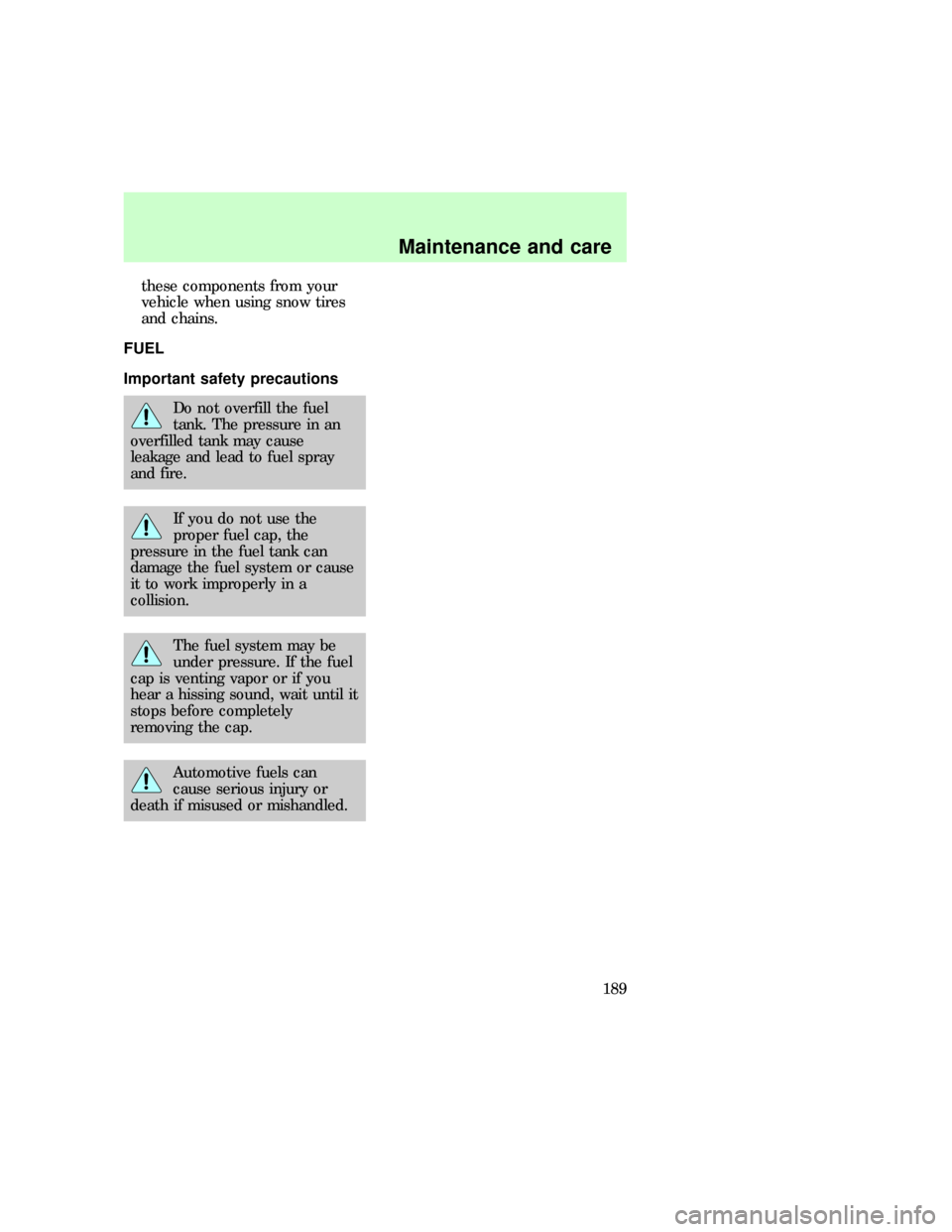
If you must drive through high
water, drive slowly. Traction or
brake capability may be limited.
When driving through water,
determine the depth; avoid water
higher than the bottom of the hubs
(if possible) and proceed slowly. If
the ignition system gets wet, the
vehicle may stall.
Once through water, always try the
brakes. Wet brakes do not stop the
vehicle as effectively as dry brakes.
Drying can be improved by moving
your vehicle slowly while applying
light pressure on the brake pedal.
After driving through mud, clean
off residue stuck to rotating
driveshafts and tires. Excess mud
stuck on tires and rotating
driveshafts causes an imbalance
f12_driving_mud_water
Driving
113
Page 183 of 219

controlled conditions on a
specified indoor laboratory test
wheel. Sustained high temperature
can cause the material of the tire
to degenerate and reduce tire life,
and excessive temperature can
lead to sudden tire failure. The
grade C corresponds to a level of
performance which all passenger
car tires must meet under the
Federal Motor Vehicle Safety
Standard No. 109. Grades B and A
represent higher levels of
performance on the laboratory test
wheel than the minimum required
by law.
The temperature grade for
this tire is established for a
tire that is properly inflated and
not overloaded. Excessive speed,
underinflation, or excessive
loading, either separately or in
combination, can cause heat
buildup and possible tire failure.
Servicing the tires
Checking the tire pressure
Check the tire pressure at least
once a month or after rotating
tires and inflate tires as necessary.
Tire pressure is most accurate
when tires are cold (after vehicle
has been parked for at least one
f12_servicing_tires
Maintenance and care
184
Page 184 of 219
hour or driven less than 5 km [3
miles]).
The cold pressure amount is listed
on the Safety Compliance
Certification Label located on the
inside driver door latch pillar.
Improperly inflated tires
can affect vehicle handling
and can fail suddenly, possibly
resulting in loss of vehicle
control.
Rotating the tires
Rotate your tires at regular
intervals to ensure even wear.
Refer to the following diagrams for
rotation cycles. Rotation intervals
are listed in the ªService Guide.º
Your wheels and tires are
match-mounted for improved ride.
Before you begin a tire repair,
mark the wheel and tire to ensure
f12_rotating_tires
Maintenance and care
185
Page 186 of 219

When replacing full size
tires, never mix radial,
bias-belted, or bias-type tires.
Use only the tire sizes that are
listed on the tire pressure decal.
Make sure that all tires are the
same size, speed rating, and
load-carrying capacity. Use only
the tire combinations
recommended on the decal. If
you do not follow these
precautions, your vehicle may
not drive properly and safely.
Make sure that all
replacement tires are of
the same size, type, load-carrying
capacity and tread design (e.g.,
ªAll Terrainº, etc.), as originally
offered by Ford.
Do not replace your tires
with ªhigh performanceª
tires or larger size tires.
Failure to follow these
precautions may adversely
affect the handling of the vehicle
and make it easier to lose control
and roll over.
Identifying tire types
Refer to the Safety Compliance
Certification Label to determine
the specific size tire and wheel
Ford Motor Company recommends
for use on this vehicle.
f12_iden_tire_types
f12_snow_tires
Maintenance and care
187
Page 188 of 219
these components from your
vehicle when using snow tires
and chains.
FUEL
Important safety precautions
Do not overfill the fuel
tank. The pressure in an
overfilled tank may cause
leakage and lead to fuel spray
and fire.
If you do not use the
proper fuel cap, the
pressure in the fuel tank can
damage the fuel system or cause
it to work improperly in a
collision.
The fuel system may be
under pressure. If the fuel
cap is venting vapor or if you
hear a hissing sound, wait until it
stops before completely
removing the cap.
Automotive fuels can
cause serious injury or
death if misused or mishandled.
f12_fuel_info
com_important_precautions.06
Maintenance and care
189
![FORD F150 1997 10.G Owners Manual hour or driven less than 5 km [3
miles]).
The cold pressure amount is listed
on the Safety Compliance
Certification Label located on the
inside driver door latch pillar.
Improperly inflated tires
can](/manual-img/11/5016/w960_5016-183.png "FORD F150 1997 10.G Owners Manual hour or driven less than 5 km [3
miles]).
The cold pressure amount is listed
on the Safety Compliance
Certification Label located on the
inside driver door latch pillar.
Improperly inflated tires
can")