Page 191 of 236
Always dispose of automotive
batteries in a responsible manner.
Follow your community's local
standards for disposal. Call your
local recycling center to find out
more about recycling automotive
batteries.
Battery saver control feature
Your vehicle is equipped with a
battery saver control feature
designed to prevent your battery
from accidental wear down due to
doors left ajar. For information on
the system and its function, refer
to theControls and features
chapter.
AIR CLEANER FILTER
MAINTENANCE
Refer to the ªService Guideº for
the appropriate intervals for
changing the air cleaner filter.
Do not start your engine
with the air cleaner
removed and do not remove it
while the engine is running.
uno_saver_battery_feature
uno_air_filter_maint
uno_changing_air_filter
Maintenance and care
192
Page 194 of 236
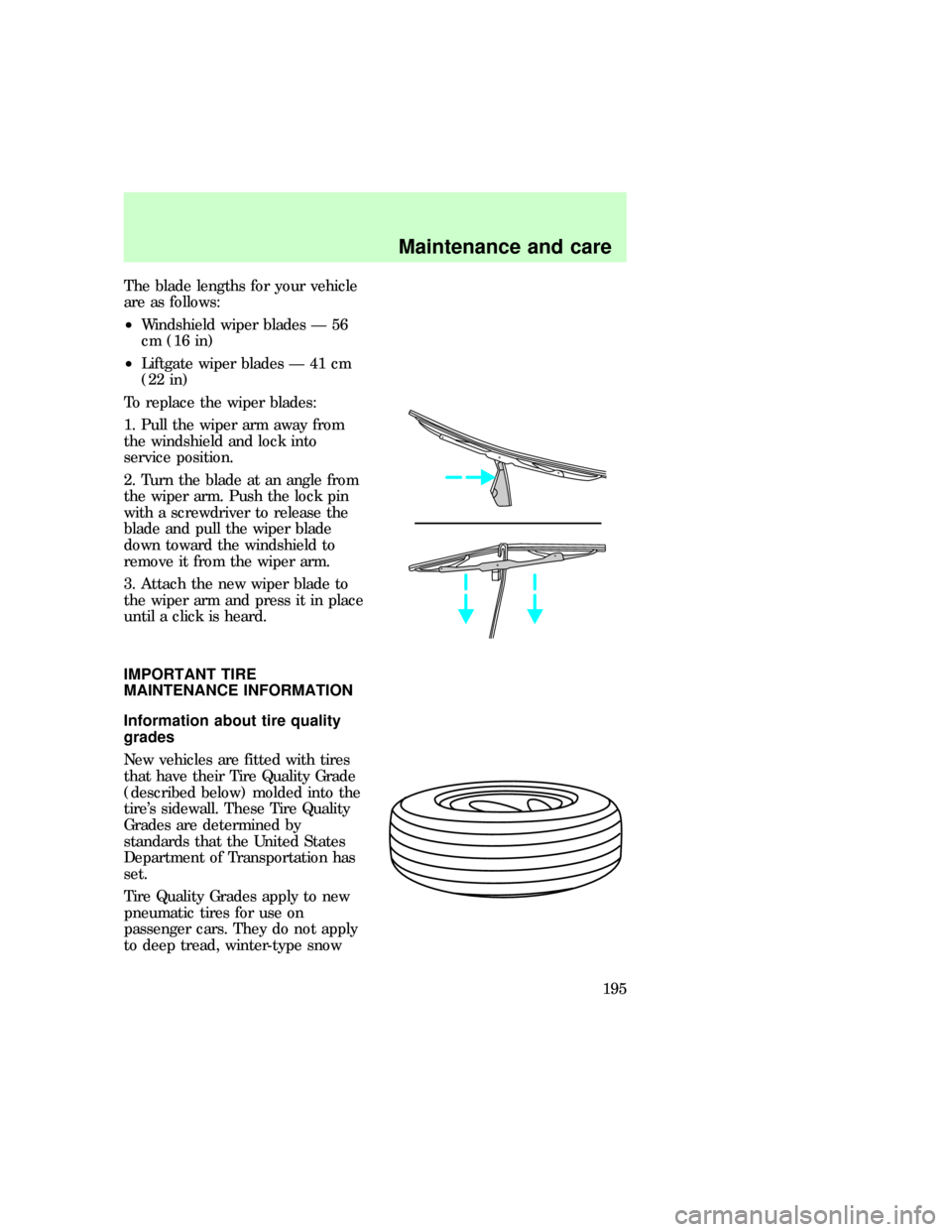
The blade lengths for your vehicle
are as follows:
²Windshield wiper blades Ð 56
cm (16 in)
²Liftgate wiper blades Ð 41 cm
(22 in)
To replace the wiper blades:
1. Pull the wiper arm away from
the windshield and lock into
service position.
2. Turn the blade at an angle from
the wiper arm. Push the lock pin
with a screwdriver to release the
blade and pull the wiper blade
down toward the windshield to
remove it from the wiper arm.
3. Attach the new wiper blade to
the wiper arm and press it in place
until a click is heard.
IMPORTANT TIRE
MAINTENANCE INFORMATION
Information about tire quality
grades
New vehicles are fitted with tires
that have their Tire Quality Grade
(described below) molded into the
tire's sidewall. These Tire Quality
Grades are determined by
standards that the United States
Department of Transportation has
set.
Tire Quality Grades apply to new
pneumatic tires for use on
passenger cars. They do not apply
to deep tread, winter-type snow
uno_title_tires
com_about_tire_grades.01
Maintenance and care
195
Page 195 of 236

tires, space-saver or temporary use
spare tires, tires with nominal rim
diameters of 10 to 12 inches or
limited production tires as defined
in Title 49 Code of Federal
Regulations Part 575.104(c)(2).
U.S. Department of
Transportation-Tire quality
grades:The U.S. Department of
Transportation requires Ford to
give you the following information
about tire grades exactly as the
government has written it.
Treadwear
The treadwear grade is a
comparative rating based on the
wear rate of the tire when tested
under controlled conditions on a
specified government test course.
For example, a tire grade 150
would wear one and one-half (1
1/2) times as well on the
government course as a tire grade
100. The relative performance of
tires depends upon the actual
conditions of their use, however,
and may depart significantly from
the norm due to variations in
driving habits, service practices,
and differences in road
characteristics and climate.
Traction A B C
The traction grades, from highest
to lowest are A, B, and C, and they
represent the tire's ability to stop
on wet pavement as measured
under test surfaces of asphalt and
concrete. A tire marked C may
have poor traction performance.
com_treadwear.01
com_traction_abc.01
Maintenance and care
196
Page 197 of 236
necessary. To check the tire
pressure, insert the tire pressure
gauge into the valve stem.
The cold pressure amount is listed
on the Safety Compliance
Certification label.
Improperly inflated tires
can affect vehicle handling
and can fail suddenly, possibly
resulting in loss of vehicle
control.
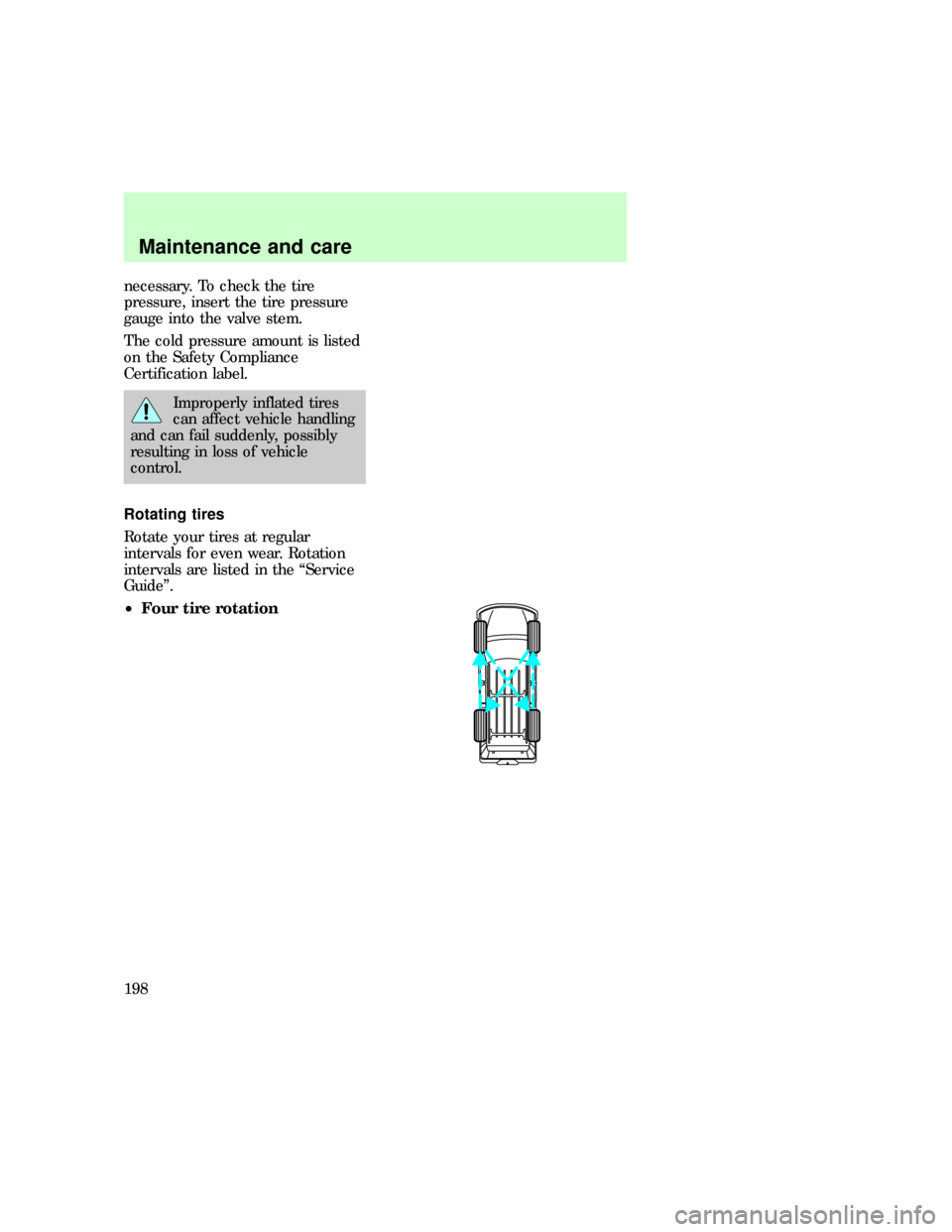
Rotating tires
Rotate your tires at regular
intervals for even wear. Rotation
intervals are listed in the ªService
Guideº.
²Four tire rotation
uno_rotating_tires
Maintenance and care
198
Page 199 of 236
Make sure that all
replacement tires are of
the same size, type, load-carrying
capacity and tread design (e.g.,
ªAll Terrainº, etc.), as originally
offered by Ford.
Do not replace your tires
with ªhigh performanceª
tires or larger size tires.
Failure to follow these
precautions may adversely
affect the handling of the vehicle
and make it easier to lose control
and roll over.
Refer to the Safety Compliance
Certification label to determine the
specific size tire and wheel Ford
Motor Company recommends for
use on this vehicle.
When purchasing replacement tires
for your vehicle, consult your
dealer or qualified service
technician to ensure that the
correct tire types are used.
uno_snow_tires
Maintenance and care
200
Page 200 of 236
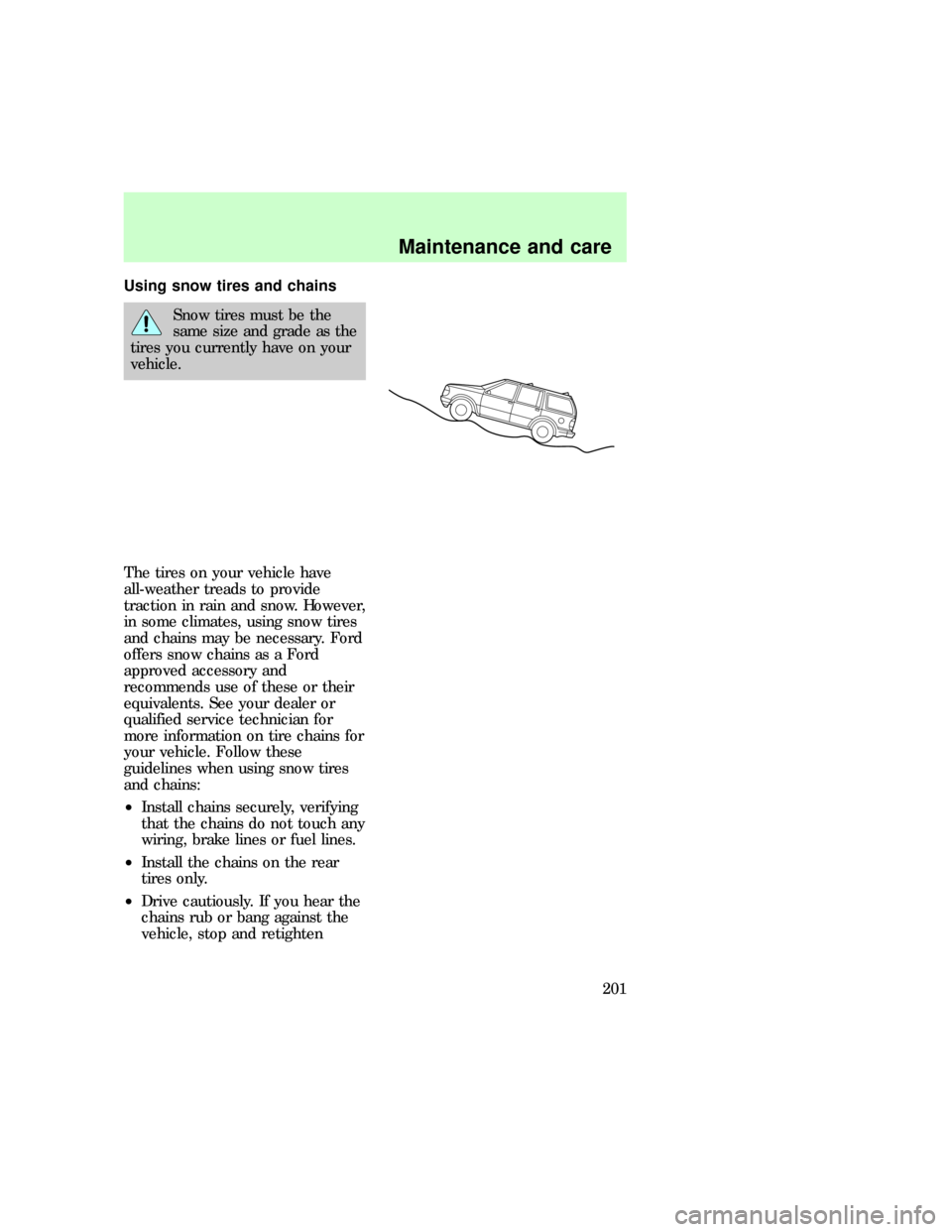
Using snow tires and chains
Snow tires must be the
same size and grade as the
tires you currently have on your
vehicle.
The tires on your vehicle have
all-weather treads to provide
traction in rain and snow. However,
in some climates, using snow tires
and chains may be necessary. Ford
offers snow chains as a Ford
approved accessory and
recommends use of these or their
equivalents. See your dealer or
qualified service technician for
more information on tire chains for
your vehicle. Follow these
guidelines when using snow tires
and chains:
²Install chains securely, verifying
that the chains do not touch any
wiring, brake lines or fuel lines.
²Install the chains on the rear
tires only.
²Drive cautiously. If you hear the
chains rub or bang against the
vehicle, stop and retighten
Maintenance and care
201
Page 203 of 236
forms of disulfiram for the
treatment of alcoholism.
Breathing gasoline vapors or
skin contact could cause an
adverse reaction. Consult a
physician immediately.
Cleaner air
Ford approves the use of gasolines
to improve air quality, including
reformulated gasolines, that
contain oxygenates such as a
maximum of 10% ethanol or 15%
MTBE. There should be no more
than 5% methanol with cosolvents
and additives to protect the fuel
system.
Octane recommendations
Your vehicle is designed to use
regular gasoline with an (R+M)/2
octane rating of 87. We do not
recommend gasolines labeled as
ªregularº in high altitude areas that
are sold with octane ratings of 86
or even less.
Do not be concerned if your
vehicle sometimes knocks lightly.
However, if it knocks heavily under
most driving conditions on the
recommended octane fuel, see
your dealer or a qualified service
technician to prevent any engine
damage.
87
com_cleaner_air.01
com_octane_recommendations.01
com_fuel_quality.01
Maintenance and care
204
Page 204 of 236

Fuel quality
If you are experiencing starting,
rough idle or hesitation problems
try a different brand of fuel. If the
condition persists, see your dealer
or a qualified service technician.
The American Automobile
Manufacturers Association (AAMA)
issued a gasoline specification to
provide information on high quality
fuels that optimize the
performance of your vehicle. We
recommend the use of gasolines
that meet the AAMA specification
if they are available.
It should not be necessary to add
any aftermarket products to your
fuel tank if you continue to use a
high-quality fuel.
Choosing the right fuel
Use only UNLEADED FUEL. The
use of leaded fuel is prohibited by
law and could damage your
vehicle. The damage may not be
covered by your warranty.
Your vehicle was not designed to
use fuel containing
manganese-based additives such as
MMT. Additionally, vehicles
certified to California emission
standards (indicated on the
underhood Vehicle Emissions
Control Information label) are
designed to operate on California
reformulated gasolines. If
California reformulated gasoline is
not available when you refuel, your
vehicle can be operated on
non-California fuels. However, even
com_choosing_fuel.01
Maintenance and care
205