Page 159 of 236
tire and replace it with a full-size
tire as soon as possible.
It is not recommended that the
vehicle be operated in 4WD HIGH
or LOW modes with a temporary
spare. If 4WD HIGH or LOW
operation is necessary, do not
operate above speeds of 16 km/h
(10 mph) or for distances above 80
km (50 miles).
When driving with a temporary
spare,do not:
²exceed 80 km/h (50 mph) under
any circumstances.
²load your vehicle so that it
exceeds the maximum load
rating listed on the tire decal.
²tow a trailer.
²use tire chains on this tire.
²try to repair the temporary
spare or remove it from its
wheel.
²use the wheel for any other type
of vehicle.
²drive through an automatic car
wash.
JUMP STARTING YOUR
VEHICLE
The gases around the
battery can explode if
exposed to flames, sparks, or lit
cigarettes. An explosion could
result in injury or vehicle
damage.
com_jump-starting.01
Roadside emergencies
160
Page 161 of 236
![FORD EXPLORER 1997 2.G Owners Manual Do not connect the end of
the second cable to the
negative ([-]) terminal of the
battery to be jumped. A spark
may cause an explosion of the
gases that surround the battery.
Jump starting
1. Start the](/manual-img/11/4954/w960_4954-160.png "FORD EXPLORER 1997 2.G Owners Manual Do not connect the end of
the second cable to the
negative ([-]) terminal of the
battery to be jumped. A spark
may cause an explosion of the
gases that surround the battery.
Jump starting
1. Start the")
Do not connect the end of
the second cable to the
negative ([-]) terminal of the
battery to be jumped. A spark
may cause an explosion of the
gases that surround the battery.
Jump starting
1. Start the booster vehicle and
run the engine at moderately
increased speed.
2. Start the engine of the vehicle
with the discharged battery.
3. Once the engine has been
started, run both vehicles for a
further three minutes before
disconnecting the cable leads.
Removing the jumper cables
1. Remove the jumper cables in
reverse order. Take the cable off
the metallic surface (1) first,
followed by the cable on the
negative (-) booster battery
terminal (2).
2. Remove the cable from the
positive (+) terminal of the booster
battery (3) and then the
discharged battery (4).
3. After the disabled vehicle has
been started, allow it to idle for a
while so the engine can ªrelearnº
its idle conditions.
+–
+–
2
3
4
1
uno_jump_starting
com_removing_cables.01
uno_wrecker_towing
Roadside emergencies
162
Page 162 of 236
WRECKER TOWING
Ford recommends that your
vehicle be towed with wheel lift
and dollies or flatbed equipment.
Do not tow with slingbelt
equipment. Ford Motor Company
has not developed or approved a
T-hook or slingbelt towing
procedure.
For vehicles equipped with control
trac, the ignition must be in the
OFF position when towing.
When calling for a tow truck, tell
the operator what kind of vehicle
you have. A towing manual is
available for Ford Motor Company
Roadside emergencies
163
Page 163 of 236
for all authorized tow truck
operators. Have your tow truck
driver refer to this manual for
proper hook-up and towing
procedures.
Neutral tow kit accessory
Neutral tow feature is an option
which can be activated at any
dealership that has a Service Bay
Diagnostic System (SBDS). When
activated the feature may be
enabled by following the
instruction located on the visor or
the headliner.
The feature is available on vehicles
with Control Trac and automatic
transmission only. It is not
available on vehicles with
All-Wheel Drive.
There are no wrecker or
recreational vehicle towing
restrictions on method or distance
if the above feature is activated
and enabled.
See your dealer for more
information.
uno_tow-kit
Roadside emergencies
164
Page 175 of 236

kilometers (mileage) and time
requirements, whichever occurs
first:
²Normal Schedule ± 8,000 km
(5,000 miles) or six months.
²Severe Duty Schedule ± 5,000
km (3,000 miles) or three
months. Severe duty operation
would include extensive idling,
trailer towing, driving in severe
dust and police, taxi or delivery
service.
Ford production and aftermarket
(Motorcraft) oil filters are designed
for added engine protection and
long life. If a replacement oil filter
is used that does not meet Ford
material and design specifications,
startup engine noises or knock
may be experienced.
It is recommended you use the
appropriate Motorcraft oil filter (or
another brand meeting Ford
specifications) for your engine
application.
DRIVELINE UNIVERSAL JOINT
AND SLIP YOKE
The universal joints standard with
your vehicle do not require
lubrication. If the original
equipment universal joints are
replaced with universal joints
equipped with grease fittings,
lubrication will be necessary at the
intervals shown in the ªService
Guideº supplement.
com_universal_joint.01
com_checking-adding_fluid.01
Maintenance and care
176
Page 194 of 236
The blade lengths for your vehicle
are as follows:
²Windshield wiper blades Ð 56
cm (16 in)
²Liftgate wiper blades Ð 41 cm
(22 in)
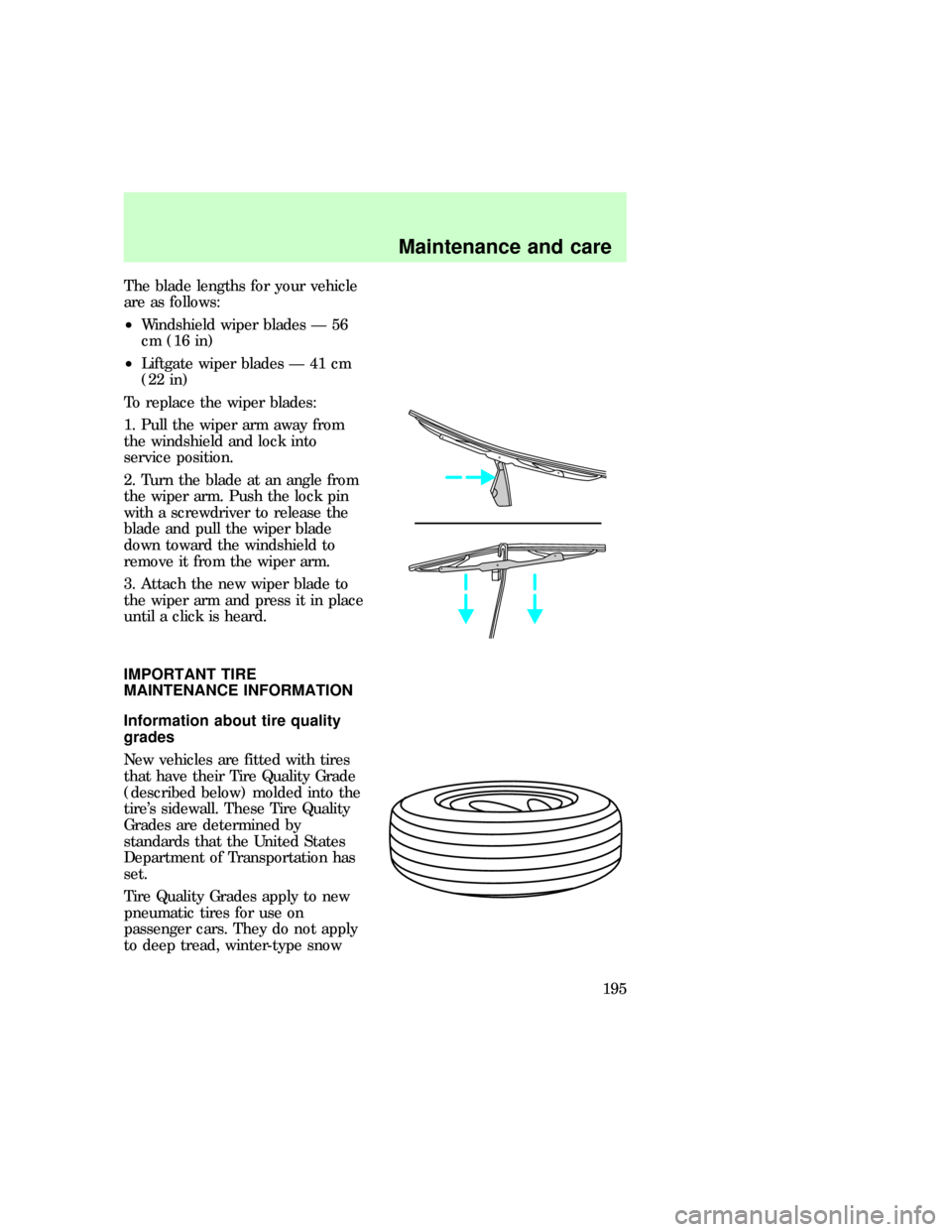
To replace the wiper blades:
1. Pull the wiper arm away from
the windshield and lock into
service position.
2. Turn the blade at an angle from
the wiper arm. Push the lock pin
with a screwdriver to release the
blade and pull the wiper blade
down toward the windshield to
remove it from the wiper arm.
3. Attach the new wiper blade to
the wiper arm and press it in place
until a click is heard.
IMPORTANT TIRE
MAINTENANCE INFORMATION
Information about tire quality
grades
New vehicles are fitted with tires
that have their Tire Quality Grade
(described below) molded into the
tire's sidewall. These Tire Quality
Grades are determined by
standards that the United States
Department of Transportation has
set.
Tire Quality Grades apply to new
pneumatic tires for use on
passenger cars. They do not apply
to deep tread, winter-type snow
uno_title_tires
com_about_tire_grades.01
Maintenance and care
195
Page 217 of 236
²Never wash or rinse the engine
while it is running; water in the
running engine may cause
internal damage.
Cleaning plastic exterior parts
Use a vinyl cleaner for routine
cleaning of plastic. Clean with a tar
remover if necessary. Do not clean
plastic parts with thinners,
solvents or petroleum-based
cleaners.
Cleaning the exterior lamps
Wash the exterior lamps with the
same detergent you used to wash
the exterior of your vehicle. Use
glass cleaner or tar remover if
necessary.
To avoid scratching the lamps, do
not use a dry paper towel,
chemical solvents or abrasive
cleaners to clean the lamps.
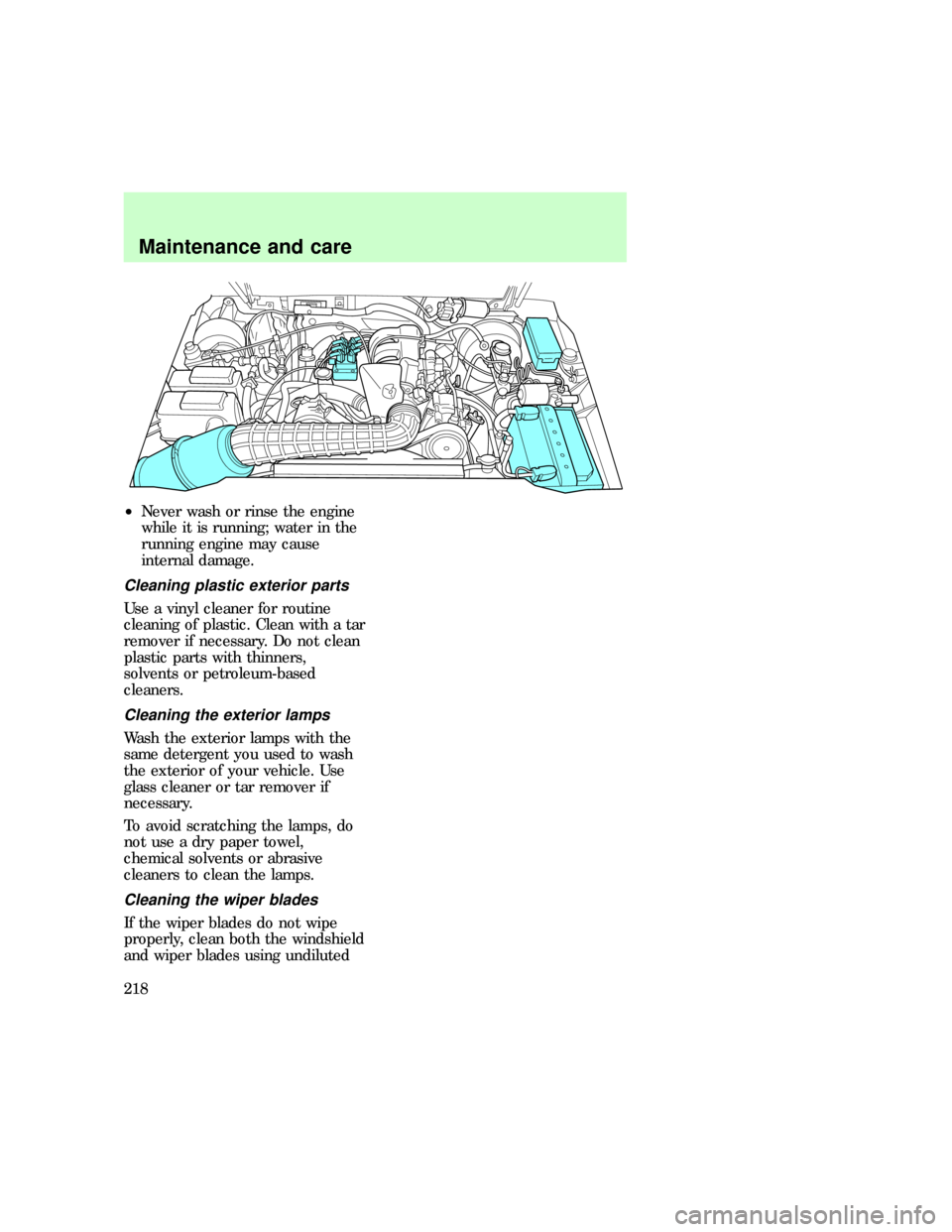
Cleaning the wiper blades
If the wiper blades do not wipe
properly, clean both the windshield
and wiper blades using undiluted
com_plastic_exterior.01
uno_exterior_lamps
uno_wiper_cleaning
Maintenance and care
218
Page 232 of 236

Air bag supplemental restraint
system
and child safety seats ..............90
description ................................89
disposal ......................................94
indicator light ...........................93
passenger air bag .....................91
Air cleaner filter .......................192
replacing ..................................193
Air conditioning
manual heating and air
conditioning
system ...................28,29,30,31,32
Air suspension ...........................119
All wheel drive (AWD) .............134
Anti-theft system ........................65
arming the system ....................66
disarming a triggered system ..68
disarming an untriggered
system .......................................68
warning light .............................67
Autolamp system (see
Headlamps) .................................49
Automatic dimming mirror ...47,48
Battery .......................................188
battery saver ...........................192
servicing ....................188,189,190
Brakes
adjustment ..............................117
anti-lock ...................................117
fluid, checking and adding ....177
parking ....................................118
Break-in period .............................2
Built-in child seat .......102,107,108
Bulbs,
replacing ........208,210,211,212,213
specifications ..........................213
Capacities for refilling fluids ....225
Cargo area shade ........................64
Childproof locks ..........................55
Cleaning your vehicle ...............215
built-in child seat ...................220engine compartment ..............216
fabric ........................................219
instrument panel ....................219
plastic parts ............................218
safety belts ..............................220
tail lamps .................................218
washing ....................................215
waxing .....................................215
wheels ......................................216
Climate control system ..............28
automatic temperature
control ...................32,33,34,35,36
defrosting .............................59,60
Clutch
fluid ..........................................177
Compass, electronic ....................50
calibration .................................51
set zone adjustment .................51
Console, description ..............58,61
Control trac 4WD system .........128
Controls ..................................58,59
Coolant (see Engine coolant)
proper solution .......................181
Daytime running light system ...26
Differential fluid ........................187
Driveline universal joint and
slip yoke .............................176,187
Driving under special
conditions ..................................130
high water ...............................131
slippery roads ..................132,133
towing a trailer .......................144
Emission control system ..........206
Engine .................................228,231
service points ............170,171,172
Engine block heater .................116
Engine coolant
checking and adding .......180,183
checking hoses .......................184
disposal ....................................182
refill capacities ........................182
Index
233