Page 144 of 224
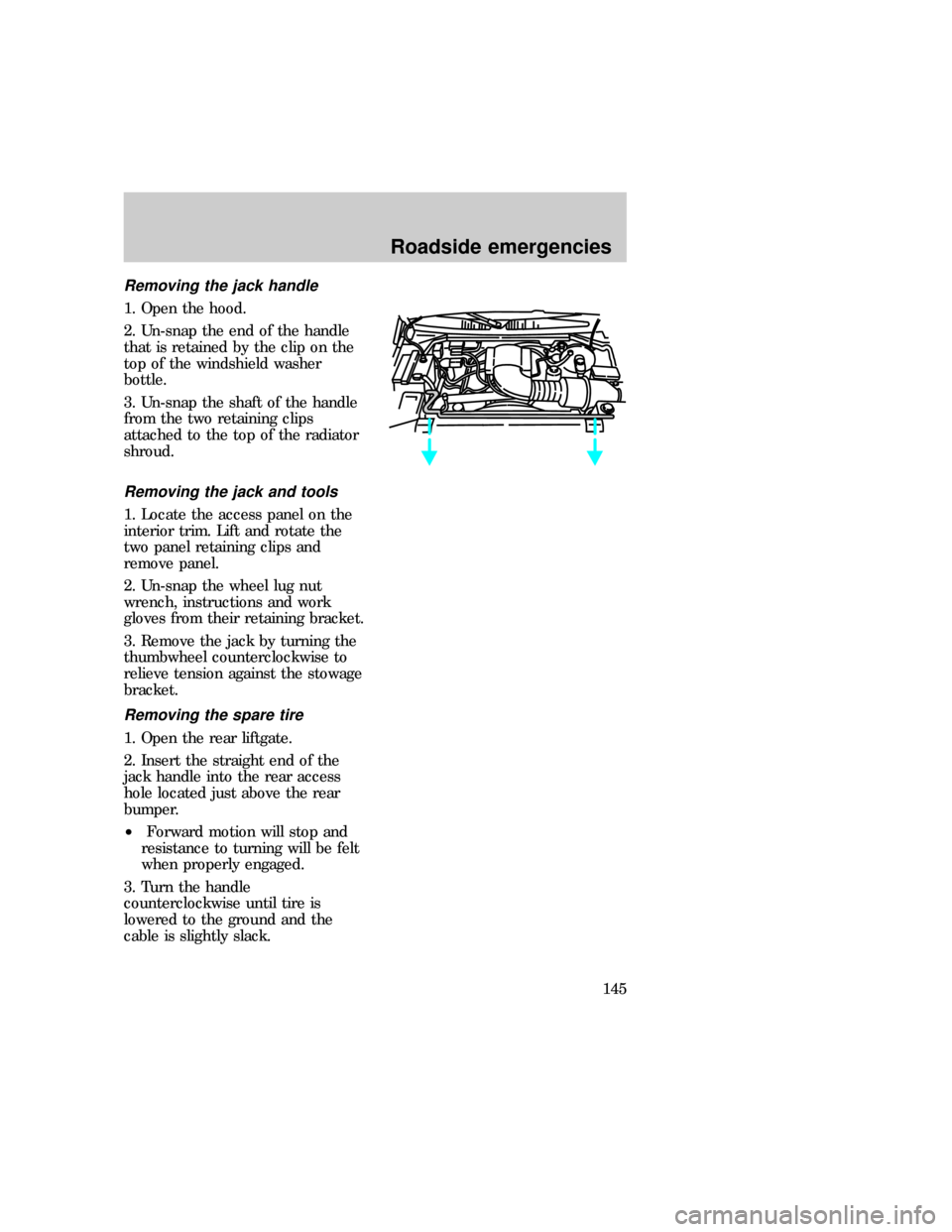
Removing the jack handle
1. Open the hood.
2. Un-snap the end of the handle
that is retained by the clip on the
top of the windshield washer
bottle.
3. Un-snap the shaft of the handle
from the two retaining clips
attached to the top of the radiator
shroud.
Removing the jack and tools
1. Locate the access panel on the
interior trim. Lift and rotate the
two panel retaining clips and
remove panel.
2. Un-snap the wheel lug nut
wrench, instructions and work
gloves from their retaining bracket.
3. Remove the jack by turning the
thumbwheel counterclockwise to
relieve tension against the stowage
bracket.
Removing the spare tire
1. Open the rear liftgate.
2. Insert the straight end of the
jack handle into the rear access
hole located just above the rear
bumper.
²Forward motion will stop and
resistance to turning will be felt
when properly engaged.
3. Turn the handle
counterclockwise until tire is
lowered to the ground and the
cable is slightly slack.
exd_removing_jack_handle
exd_removing_tools
exd_removing_spare
Roadside emergencies
145
Page 154 of 224

Precautions when servicing
your vehicle
Be especially careful when
inspecting or servicing your
vehicle. Here are some general
precautions for your safety:
²Do not work on a hot engine.
²If you must work with the
engine running, avoid wearing
loose clothing or jewelry that
could get caught in moving
parts. Take precautions with
long hair.
²Do not work on a vehicle with
the engine running in an
enclosed space, unless you are
sure you have enough
ventilation.
²Keep all lit cigarettes, open
flames and other lit material
away from the battery and all
fuel related parts.
If you disconnect the battery, the
engine must ªrelearnº its idle
conditions before your vehicle will
drive properly, as explained in
Batteryin this chapter.
Service recommendations
To help you service your vehicle:
²We highlight do-it-yourself items
in the engine compartment for
easy location.
²As possible, we design parts that
can be replaced without tools.
com_precautions_servicing.02
com_service_recommendations.01
Maintenance and care
155
Page 169 of 224
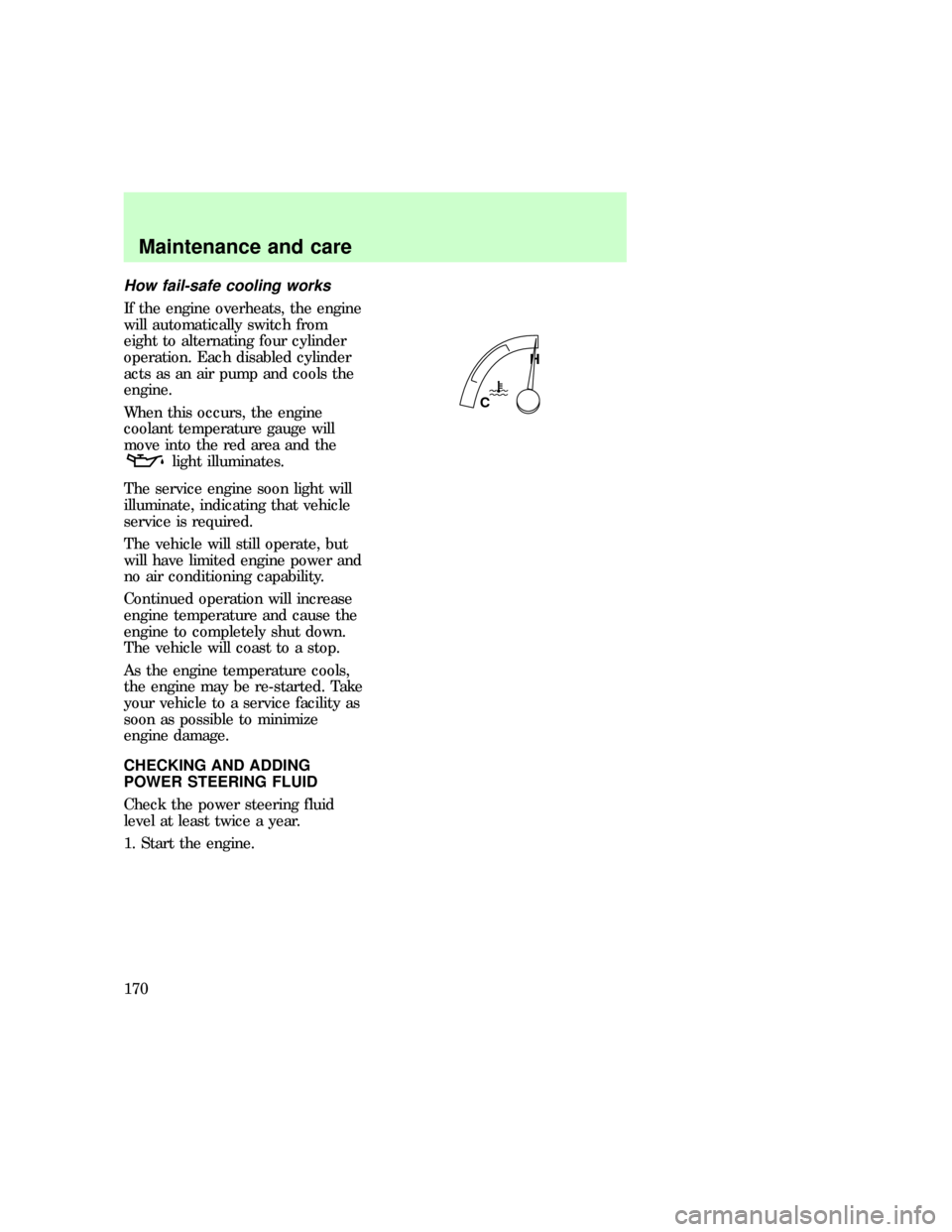
How fail-safe cooling works
If the engine overheats, the engine
will automatically switch from
eight to alternating four cylinder
operation. Each disabled cylinder
acts as an air pump and cools the
engine.
When this occurs, the engine
coolant temperature gauge will
move into the red area and the
light illuminates.
The service engine soon light will
illuminate, indicating that vehicle
service is required.
The vehicle will still operate, but
will have limited engine power and
no air conditioning capability.
Continued operation will increase
engine temperature and cause the
engine to completely shut down.
The vehicle will coast to a stop.
As the engine temperature cools,
the engine may be re-started. Take
your vehicle to a service facility as
soon as possible to minimize
engine damage.
CHECKING AND ADDING
POWER STEERING FLUID
Check the power steering fluid
level at least twice a year.
1. Start the engine.
CH
exd_power_steering
Maintenance and care
170
Page 190 of 224
vehicle can be operated on
non-California fuels. However, even
though your engine will perform
adequately on other gasolines, the
performance of the emission
control devices and systems may
be adversely affected. Repair of
damage caused by using a fuel that
your vehicle was not designed for
may not be covered by your
warranty.
Octane recommendations
Your vehicle is designed to use
regular gasoline with an (R+M)/2
octane rating of 87. We do not
recommend gasolines labeled as
ªregularº in high altitude areas that
are sold with octane ratings of 86
or even less.
Do not be concerned if your
vehicle sometimes knocks lightly.
However, if it knocks heavily under
most driving conditions on the
recommended octane fuel, see
your dealer or a qualified service
technician to prevent any engine
damage.
Fuel quality
If you are experiencing starting,
rough idle or hesitation problems
try a different brand of fuel. If the
condition persists, see your dealer
or a qualified service technician.
The American Automobile
Manufacturers Association (AAMA)
87
com_octane_recommendations.01
com_fuel_quality.01
Maintenance and care
191
Page 192 of 224
![FORD EXPEDITION 1997 1.G Owners Manual ²The help reduce early nozzle
shut offs and fuel spillage, park
your vehicle so that the fuel
filler door is level.
²Avoid excessively fast fuel
dispensing rates (over 38 L [10
gallons] per minute).](/manual-img/11/4905/w960_4905-191.png "FORD EXPEDITION 1997 1.G Owners Manual ²The help reduce early nozzle
shut offs and fuel spillage, park
your vehicle so that the fuel
filler door is level.
²Avoid excessively fast fuel
dispensing rates (over 38 L [10
gallons] per minute).")
²The help reduce early nozzle
shut offs and fuel spillage, park
your vehicle so that the fuel
filler door is level.
²Avoid excessively fast fuel
dispensing rates (over 38 L [10
gallons] per minute).
²If you spill any fuel on the body
of your vehicle, clean it off
immediately. The fuel may dull
or soften the paint if it is not
washed off promptly.
3. To replace the fuel cap, align
the tabs on the cap with the
notches on the filler pipe. Turn it
clockwise until it stops.
4. Push the fuel door closed.
If the check engine warning light
illuminates and remains illuminated
while the engine is started, the
fuel cap may not be properly
seated. Turn off the engine,
remove the fuel cap and replace it.
being sure to align the cap
properly.
If the fuel cap is lost, replace it
with an authorized Motorcraft or
equivalent part.
Calculating fuel economy
To accurately calculate your
vehicle's fuel economy:
1. Fill the tank completely and
record the initial odometer
reading.
2. Each time you fill the tank,
record the amount of fuel added
(in liters or gallons).
com_calculating_economy.01
Maintenance and care
193
Page 194 of 224
²Do not turn off the ignition
while your vehicle is in motion.
²Have maintenance performed
according to intervals in the
ªService Guideº.
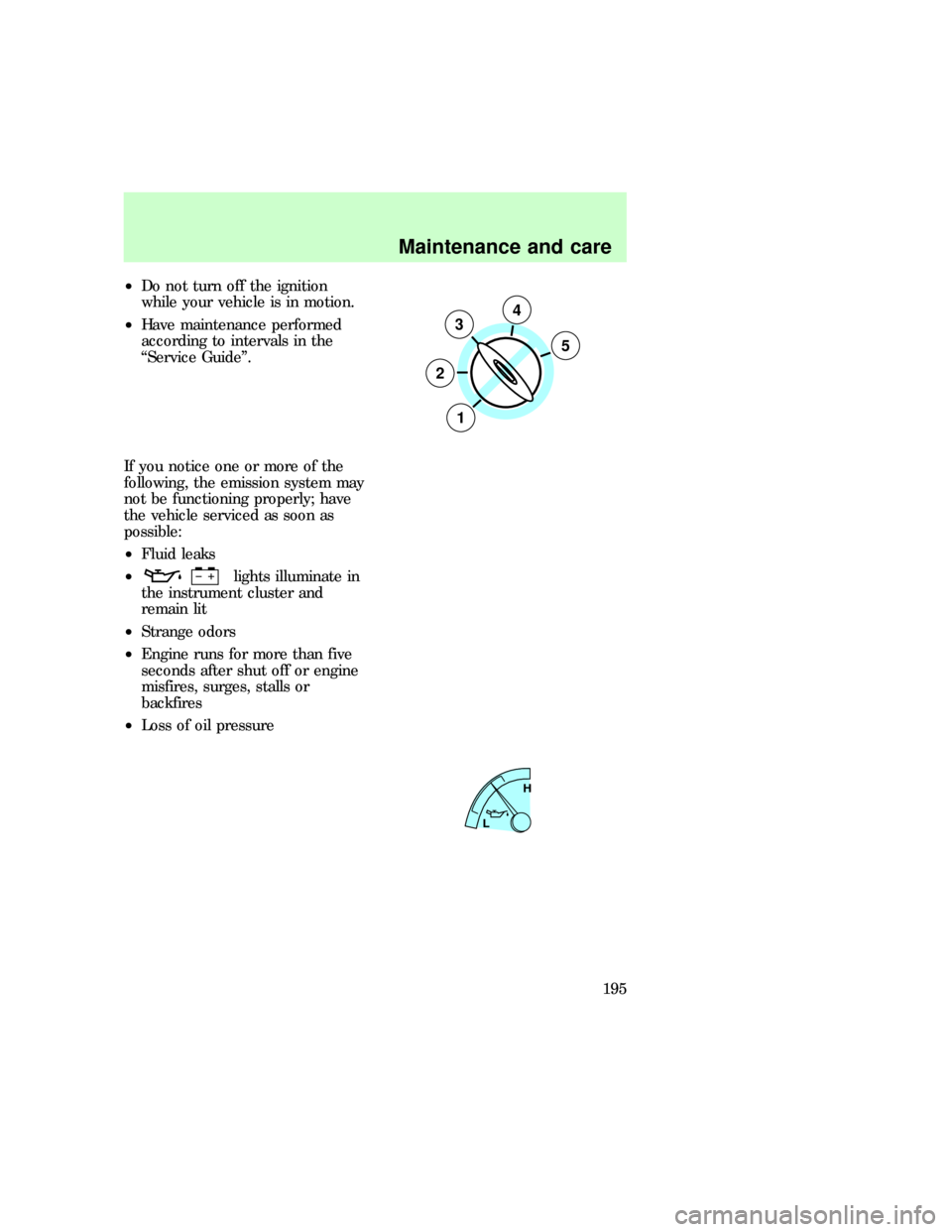
If you notice one or more of the
following, the emission system may
not be functioning properly; have
the vehicle serviced as soon as
possible:
²Fluid leaks
²
lights illuminate in
the instrument cluster and
remain lit
²Strange odors
²Engine runs for more than five
seconds after shut off or engine
misfires, surges, stalls or
backfires
²Loss of oil pressure
34
5
2
1
LHLH
exd_emissions_info
Maintenance and care
195
Page 204 of 224
4. Replace the connector by
placing it back into the assembly
and turning it
1¤4turn clockwise.
REPLACING THE INTERIOR
BULBS
Check the operation of the
following interior bulbs frequently:
²interior overhead lamp
²map lamp
²courtesy and cargo lamps
²hazard flasher
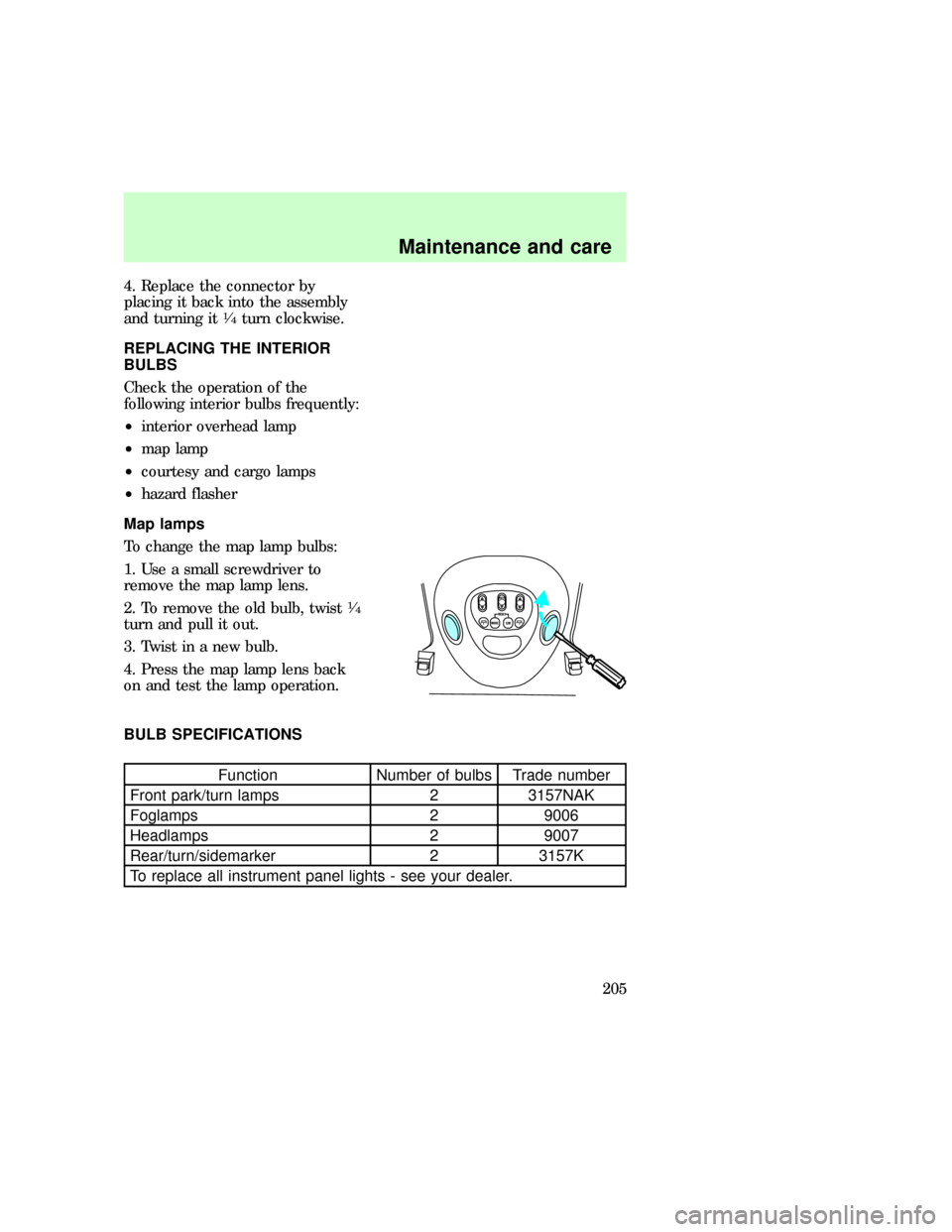
Map lamps
To change the map lamp bulbs:
1. Use a small screwdriver to
remove the map lamp lens.
2. To remove the old bulb, twist
1¤4
turn and pull it out.
3. Twist in a new bulb.
4. Press the map lamp lens back
on and test the lamp operation.
BULB SPECIFICATIONS
Function Number of bulbs Trade number
Front park/turn lamps 2 3157NAK
Foglamps 2 9006
Headlamps 2 9007
Rear/turn/sidemarker 2 3157K
To replace all instrument panel lights - see your dealer.
exd_interior_bulbs
exd_changing_maplamps
exd_bulb_specs_chart
Maintenance and care
205
Page 205 of 224
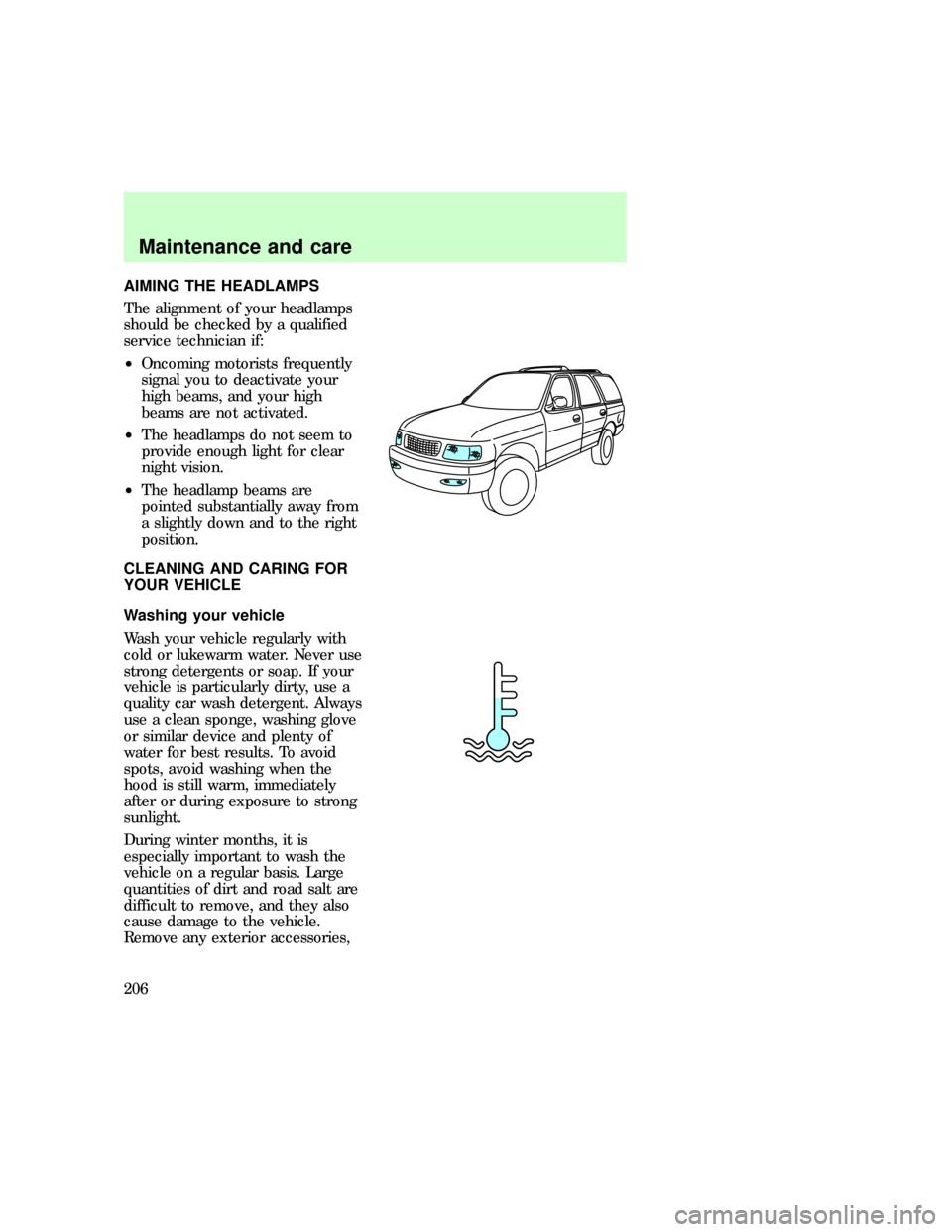
AIMING THE HEADLAMPS
The alignment of your headlamps
should be checked by a qualified
service technician if:
²Oncoming motorists frequently
signal you to deactivate your
high beams, and your high
beams are not activated.
²The headlamps do not seem to
provide enough light for clear
night vision.
²The headlamp beams are
pointed substantially away from
a slightly down and to the right
position.
CLEANING AND CARING FOR
YOUR VEHICLE
Washing your vehicle
Wash your vehicle regularly with
cold or lukewarm water. Never use
strong detergents or soap. If your
vehicle is particularly dirty, use a
quality car wash detergent. Always
use a clean sponge, washing glove
or similar device and plenty of
water for best results. To avoid
spots, avoid washing when the
hood is still warm, immediately
after or during exposure to strong
sunlight.
During winter months, it is
especially important to wash the
vehicle on a regular basis. Large
quantities of dirt and road salt are
difficult to remove, and they also
cause damage to the vehicle.
Remove any exterior accessories,exd_headlamp_aiming
exd_cleaning_info
com_washing_vehicle.01
Maintenance and care
206