Page 190 of 224
vehicle can be operated on
non-California fuels. However, even
though your engine will perform
adequately on other gasolines, the
performance of the emission
control devices and systems may
be adversely affected. Repair of
damage caused by using a fuel that
your vehicle was not designed for
may not be covered by your
warranty.
Octane recommendations
Your vehicle is designed to use
regular gasoline with an (R+M)/2
octane rating of 87. We do not
recommend gasolines labeled as
ªregularº in high altitude areas that
are sold with octane ratings of 86
or even less.
Do not be concerned if your
vehicle sometimes knocks lightly.
However, if it knocks heavily under
most driving conditions on the
recommended octane fuel, see
your dealer or a qualified service
technician to prevent any engine
damage.
Fuel quality
If you are experiencing starting,
rough idle or hesitation problems
try a different brand of fuel. If the
condition persists, see your dealer
or a qualified service technician.
The American Automobile
Manufacturers Association (AAMA)
87
com_octane_recommendations.01
com_fuel_quality.01
Maintenance and care
191
Page 191 of 224
issued a gasoline specification to
provide information on high quality
fuels that optimize the
performance of your vehicle. We
recommend the use of gasolines
that meet the AAMA specification
if they are available.
It should not be necessary to add
any aftermarket products to your
fuel tank if you continue to use a
high-quality fuel.
Cleaner air
Ford approves the use of gasolines
to improve air quality, including
reformulated gasolines, that
contain oxygenates such as a
maximum of 10% ethanol or 15%
MTBE. There should be no more
than 5% methanol with cosolvents
and additives to protect the fuel
system.
Filling the fuel tank
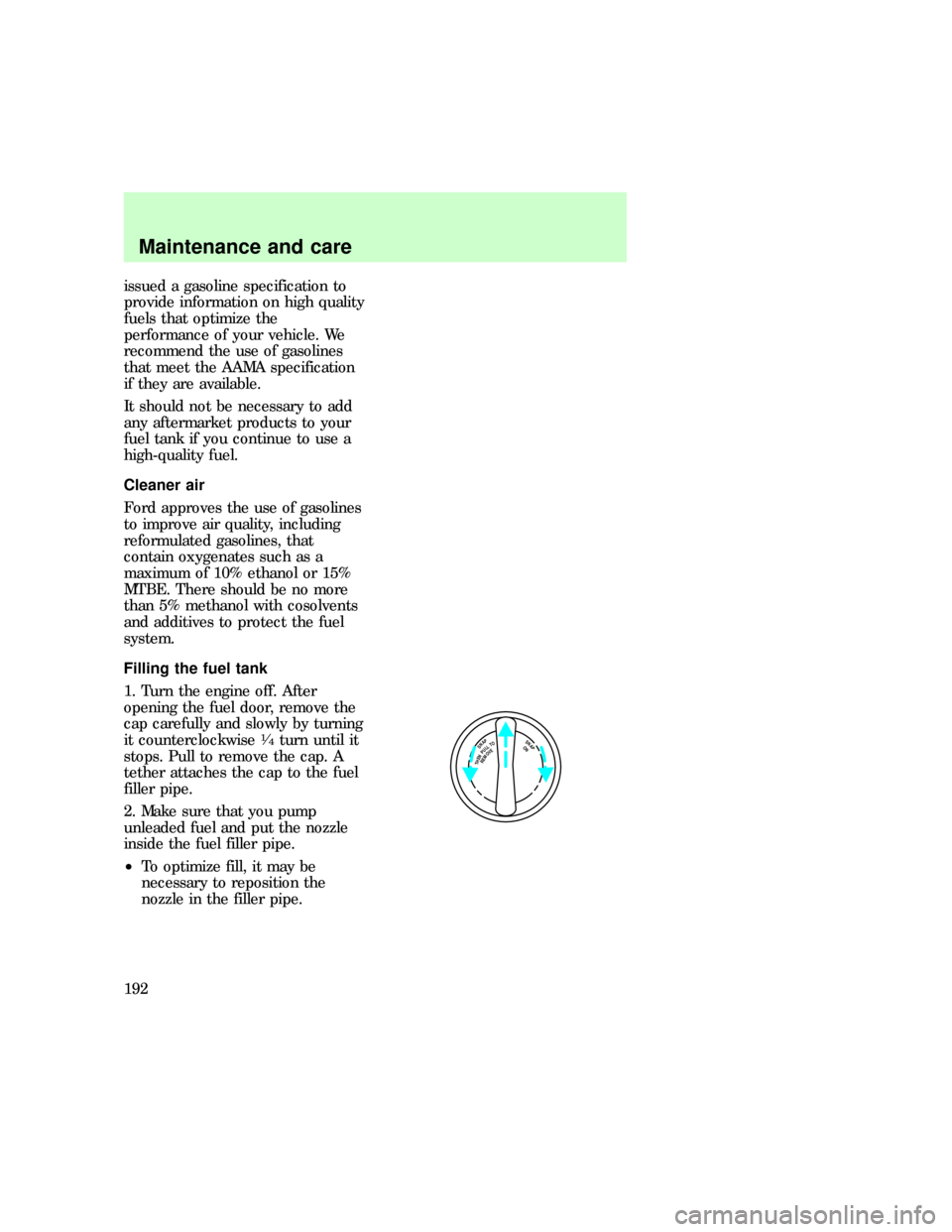
1. Turn the engine off. After
opening the fuel door, remove the
cap carefully and slowly by turning
it counterclockwise
1¤4turn until it
stops. Pull to remove the cap. A
tether attaches the cap to the fuel
filler pipe.
2. Make sure that you pump
unleaded fuel and put the nozzle
inside the fuel filler pipe.
²To optimize fill, it may be
necessary to reposition the
nozzle in the filler pipe.SNAP
THENPULLTO
REMOVESNAPON
com_cleaner_air.01
exd_fuel_cap
Maintenance and care
192
Page 192 of 224
![FORD EXPEDITION 1997 1.G Owners Manual ²The help reduce early nozzle
shut offs and fuel spillage, park
your vehicle so that the fuel
filler door is level.
²Avoid excessively fast fuel
dispensing rates (over 38 L [10
gallons] per minute).](/manual-img/11/4905/w960_4905-191.png "FORD EXPEDITION 1997 1.G Owners Manual ²The help reduce early nozzle
shut offs and fuel spillage, park
your vehicle so that the fuel
filler door is level.
²Avoid excessively fast fuel
dispensing rates (over 38 L [10
gallons] per minute).")
²The help reduce early nozzle
shut offs and fuel spillage, park
your vehicle so that the fuel
filler door is level.
²Avoid excessively fast fuel
dispensing rates (over 38 L [10
gallons] per minute).
²If you spill any fuel on the body
of your vehicle, clean it off
immediately. The fuel may dull
or soften the paint if it is not
washed off promptly.
3. To replace the fuel cap, align
the tabs on the cap with the
notches on the filler pipe. Turn it
clockwise until it stops.
4. Push the fuel door closed.
If the check engine warning light
illuminates and remains illuminated
while the engine is started, the
fuel cap may not be properly
seated. Turn off the engine,
remove the fuel cap and replace it.
being sure to align the cap
properly.
If the fuel cap is lost, replace it
with an authorized Motorcraft or
equivalent part.
Calculating fuel economy
To accurately calculate your
vehicle's fuel economy:
1. Fill the tank completely and
record the initial odometer
reading.
2. Each time you fill the tank,
record the amount of fuel added
(in liters or gallons).
com_calculating_economy.01
Maintenance and care
193
Page 193 of 224
3. After at least three to five fuel
tank fill-ups, fill the fuel tank and
record the current mileage
reading.
4. Use one of the following
equations to calculate fuel
economy.
Liters used x 1004Total
kilometers traveled
Total miles traveled4Total
gallons used
Keep a record for at least one
month. This will provide an
accurate estimate of the vehicle's
fuel economy.
WHAT YOU SHOULD KNOW
ABOUT THE EMISSION
CONTROL SYSTEM
For more information on your
vehicle's emission control system,
refer to the Vehicle Emission
Control Information Decal located
on the inside, left of the engine
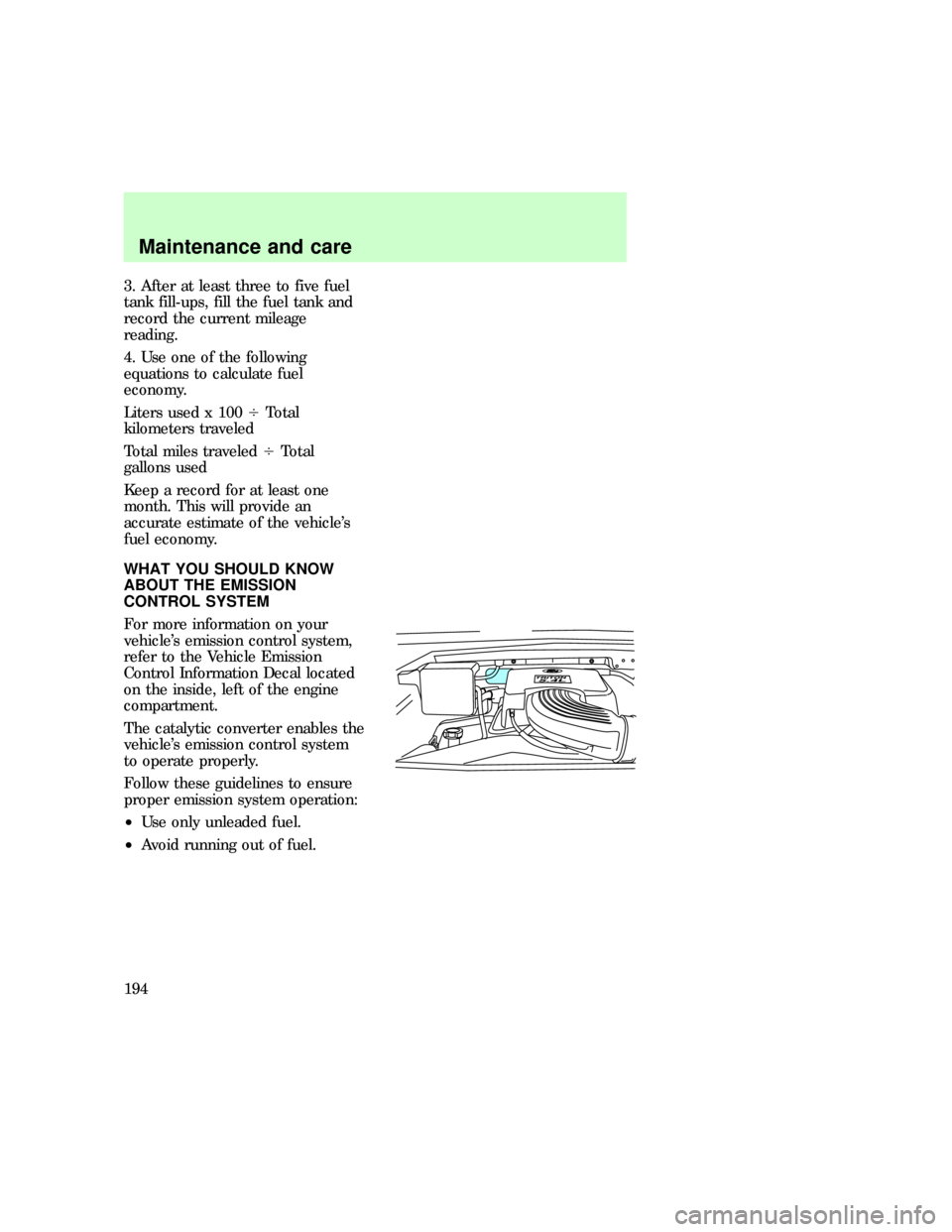
compartment.
The catalytic converter enables the
vehicle's emission control system
to operate properly.
Follow these guidelines to ensure
proper emission system operation:
²Use only unleaded fuel.
²Avoid running out of fuel.
exd_emission-control
Maintenance and care
194
Page 195 of 224
Important emission control
information
By law, anyone who manufacturers,
repairs, services, leases, trades
vehicles or supervises a fleet of
vehicles is not permitted to
intentionally remove an emission
control device or prevent it from
working. Do not make any
unauthorized changes to the
vehicle or engine. Changes that
cause more unburned fuel to reach
the exhaust system can increase
the temperature of the engine or
exhaust system.
When your vehicle is serviced,
never use a metal exhaust
collector. The use of a metal
collector may melt or deform
plastic parts.
Do not park, idle, or drive
your vehicle in dry grass
or other dry ground cover. The
emission system heats up the
engine compartment and exhaust
system, which can start a fire.
Preparing your vehicle for
inspection/maintenance (I/M)
testing
In some localities it may be a legal
requirement to pass an I/M test of
the on-board diagnostic (OBD II)
system. If your vehicle's powertrain
system or battery has just been
serviced, the OBD II system is
reset to a condition unready for
I/M testing. To ready the OBD II
system for I/M testing, the law
exd_im_testing
Maintenance and care
196
Page 207 of 224
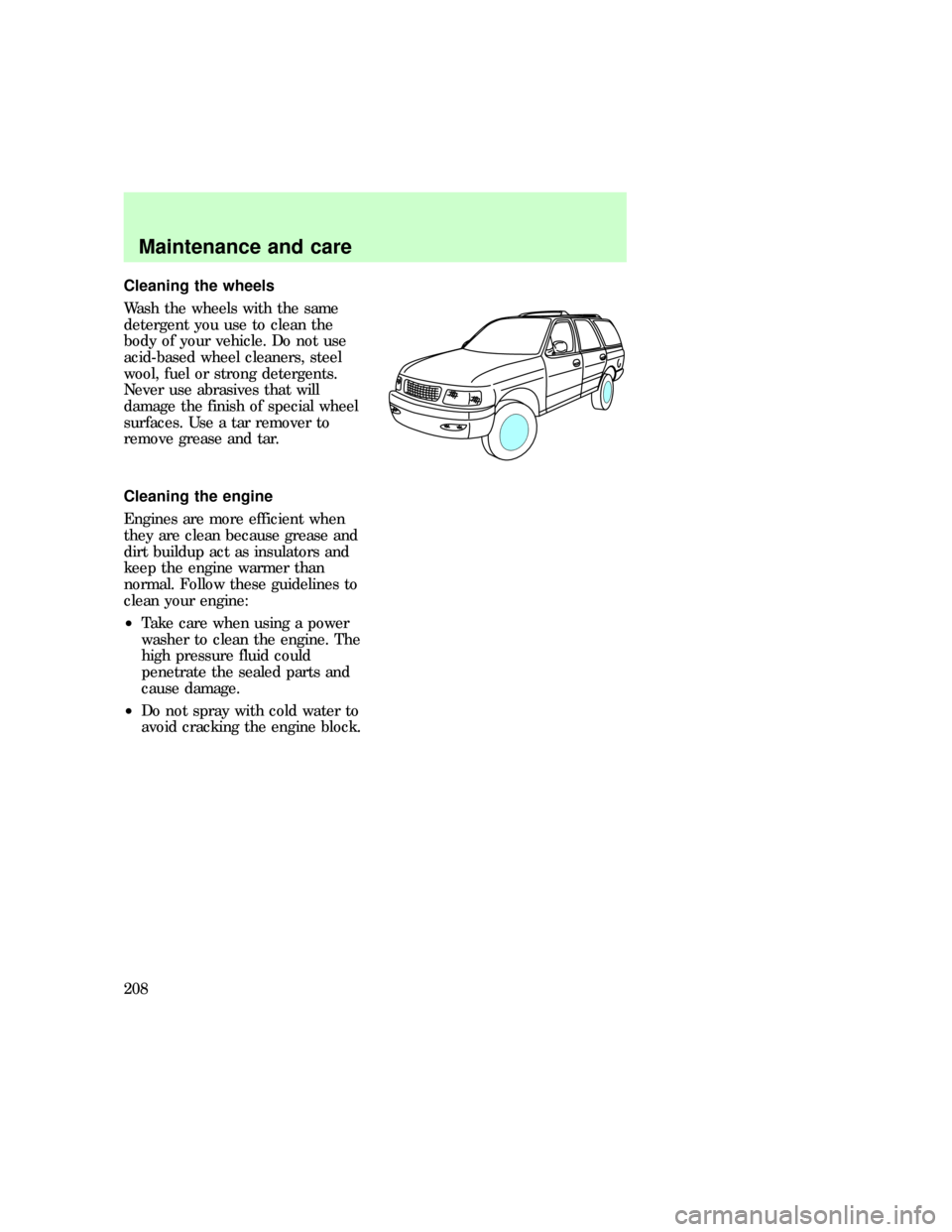
Cleaning the wheels
Wash the wheels with the same
detergent you use to clean the
body of your vehicle. Do not use
acid-based wheel cleaners, steel
wool, fuel or strong detergents.
Never use abrasives that will
damage the finish of special wheel
surfaces. Use a tar remover to
remove grease and tar.
Cleaning the engine
Engines are more efficient when
they are clean because grease and
dirt buildup act as insulators and
keep the engine warmer than
normal. Follow these guidelines to
clean your engine:
²Take care when using a power
washer to clean the engine. The
high pressure fluid could
penetrate the sealed parts and
cause damage.
²Do not spray with cold water to
avoid cracking the engine block.
com_engine_cleaning.01
Maintenance and care
208
Page 209 of 224
Cleaning the exterior lamps
Wash the exterior lamps with the
same detergent you used to wash
the exterior of your vehicle. Use
glass cleaner or tar remover if
necessary.
To avoid scratching the lamps, do
not use a dry paper towel,
chemical solvents or abrasive
cleaners to clean the lamps.
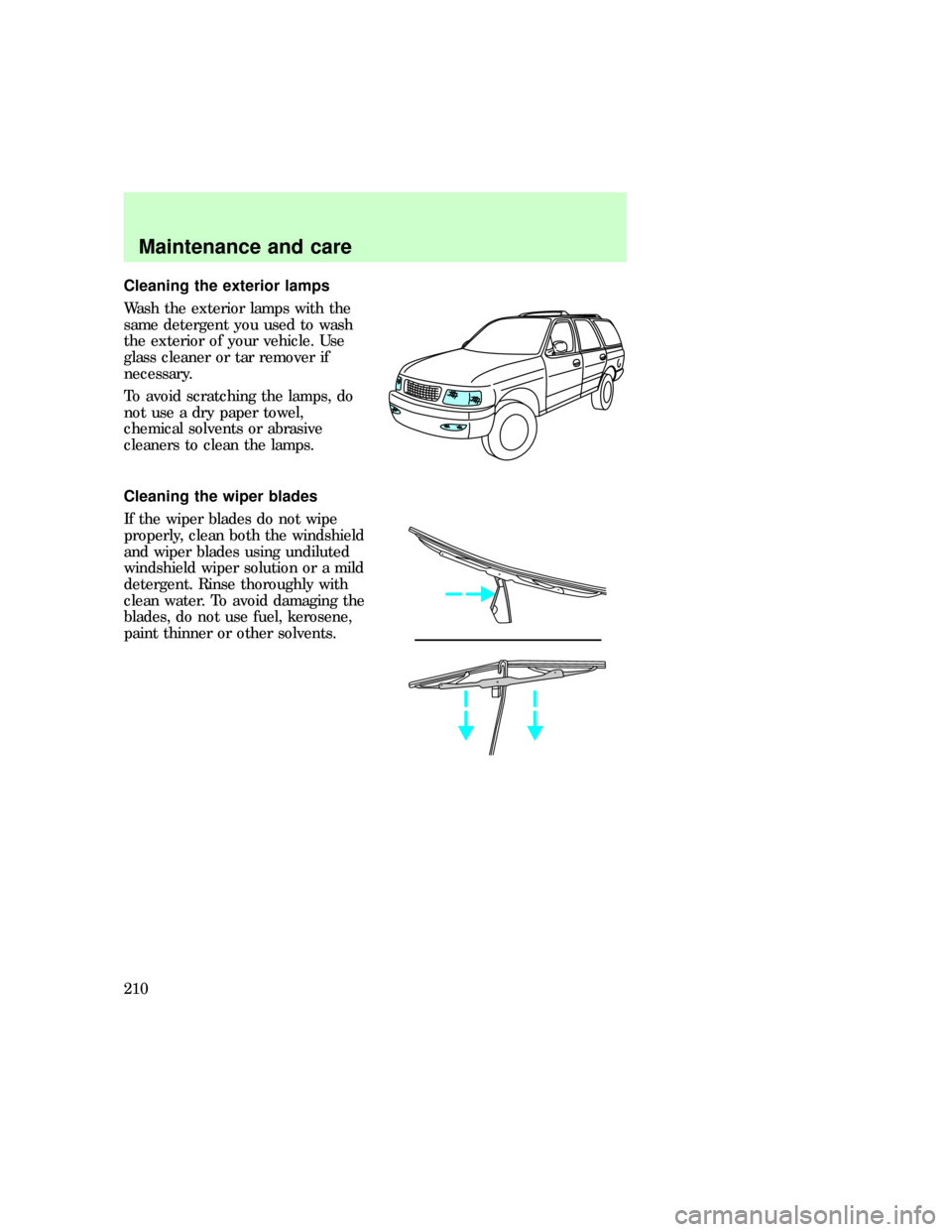
Cleaning the wiper blades
If the wiper blades do not wipe
properly, clean both the windshield
and wiper blades using undiluted
windshield wiper solution or a mild
detergent. Rinse thoroughly with
clean water. To avoid damaging the
blades, do not use fuel, kerosene,
paint thinner or other solvents.
com_wiper_cleaning.01
com_instru-panel_cleaning.01
Maintenance and care
210
Page 212 of 224
MOTORCRAFT PART NUMBERS
Component 4.6 L engine 5.4 L engine
Air filter FA-1632 FA-1632
Battery
- standard
- optionalBXT-59
BXT-65-750BXT-59
BXT-65-750
Fuel filter FG-872 FG-872
Oil filter FL-820-S FL-820-S
PCV valve EV-98 EV-233
Spark plug* - platinum AWSF-32PP AWSF-22F
* Replacement double platinum spark plug9EE9will replace9E9and
9EG9and9P9will replace9P9and9PG9suffixed plugs. Refer to the
Engine datachart for spark plug gap specifications.
CAPACITIES
Your vehicle's fuel capacity
The fuel capacity of your vehicle is:
Vehicle Fuel capacity
4x2 (standard suspension) 98 L (26 gallons)
4x2 (with air suspension) 114 L (30 gallon)
4x4 (if equipped) 114 L (30 gallons)
²Always use high quality fuel
containing detergent and other
additives. Using inferior fuel
could result in engine damage.
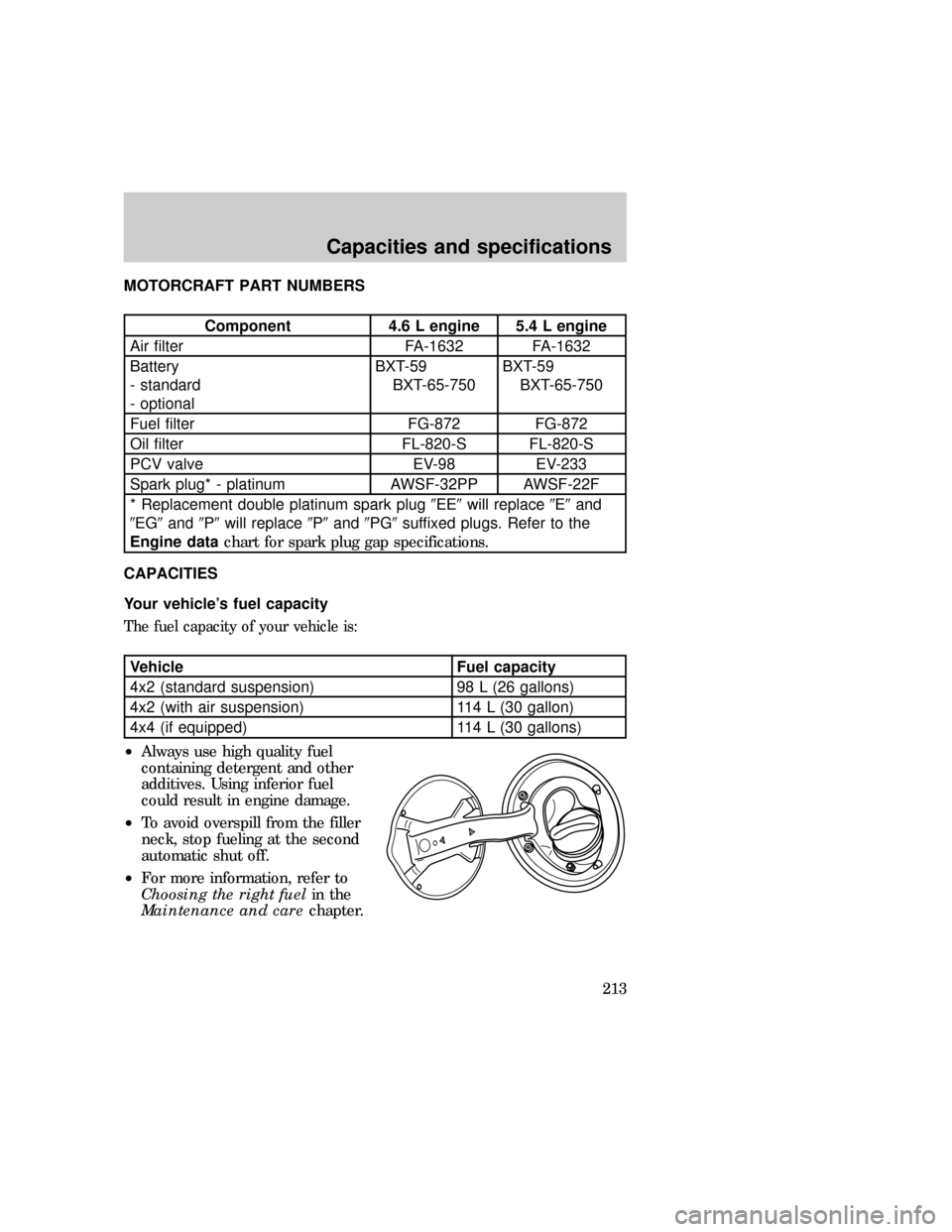
²To avoid overspill from the filler
neck, stop fueling at the second
automatic shut off.
²For more information, refer to
Choosing the right fuelin the
Maintenance and carechapter.
exd_motorcraft_parts_numbers
exd_fuel_capacity
exd_refill_capacities
Capacities and specifications
213