Page 137 of 224
Slot number Fuse
amperage
ratingCircuits protected
13 30 amp Auxiliary blower
14 60 amp Four wheel anti-lock brake system
(4WABS)
15 50 amp Air suspension compressor
16 40 amp Trailer tow battery charge, engine
minifuse box fuse #2, engine minifuse
box fuse #4
17 30 amp Four-wheel drive (4WD) transfer case
motor and clutch
18 30 amp Driver power seat
19 20 amp Fuel pump
20 50 amp Junction box ignition switched feed
21 50 amp Junction box ignition switched feed
22 50 amp Junction box battery feed
23 40 amp Front blower
24 30 amp Powertrain control module power
25 30 C.B. Windows
26 - not used
27 40 amp Heated backlite and mirrors
28 30 amp Trailer tow electric brake
29 30 amp Hybrid fan, moon roof, flip windows
Slot number Description
1 - not used
2 - PCM diode
Slot number Description
1 - Windshield wipers high/low speed
2 - Windshield wipers run/park
3 - Front washer pump relay
4 - Fuel pump relay
Roadside emergencies
138
Page 154 of 224

Precautions when servicing
your vehicle
Be especially careful when
inspecting or servicing your
vehicle. Here are some general
precautions for your safety:
²Do not work on a hot engine.
²If you must work with the
engine running, avoid wearing
loose clothing or jewelry that
could get caught in moving
parts. Take precautions with
long hair.
²Do not work on a vehicle with
the engine running in an
enclosed space, unless you are
sure you have enough
ventilation.
²Keep all lit cigarettes, open
flames and other lit material
away from the battery and all
fuel related parts.
If you disconnect the battery, the
engine must ªrelearnº its idle
conditions before your vehicle will
drive properly, as explained in
Batteryin this chapter.
Service recommendations
To help you service your vehicle:
²We highlight do-it-yourself items
in the engine compartment for
easy location.
²As possible, we design parts that
can be replaced without tools.
com_precautions_servicing.02
com_service_recommendations.01
Maintenance and care
155
Page 155 of 224
²We provide you with a ªService
Guideº which makes tracking
routine service for your vehicle
easy.
If your vehicle requires
professional service, your
dealership can provide necessary
parts and service. Check your
ªWarranty Information Bookletº to
find out which parts and services
are covered.
Use only recommended fuels,
lubricants, fluids and service parts
conforming to specifications.
Motorcraft parts are designed and
built to provide the best
performance in your vehicle.
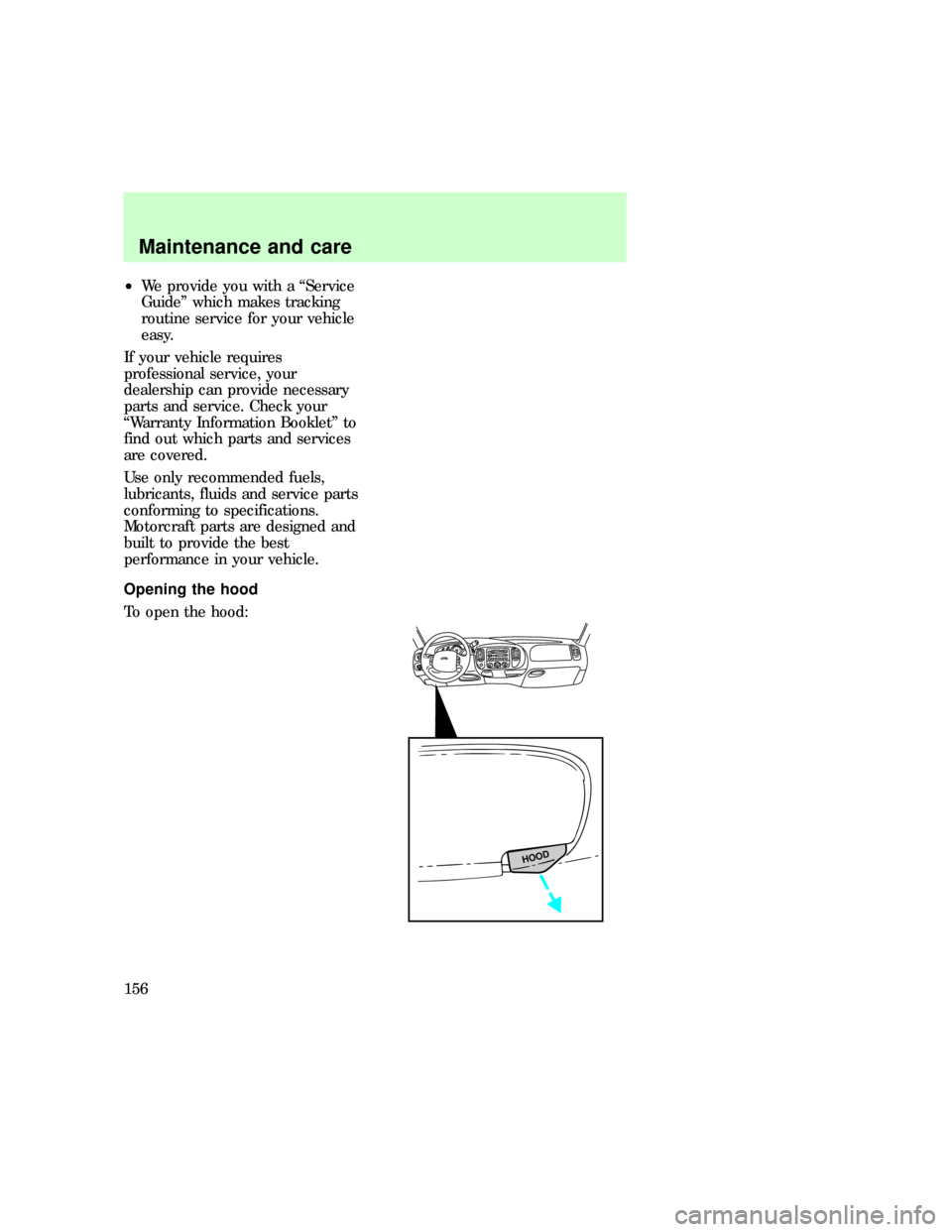
Opening the hood
To open the hood:
HOOD
exd_hood_opening
Maintenance and care
156
Page 158 of 224
3. Engine oil dipstick (For more
information on the engine oil
dipstick location and maintenance,
refer toChecking and adding
engine oilin this chapter.)
4. Brake fluid reservoir
5. Engine compartment fuse panel
6. Engine coolant reservoir
7. Air cleaner filter
8. Power steering fluid reservoir
9. Engine oil filler cap
10. Washer fluid reservoir
CHECKING AND ADDING
ENGINE OIL
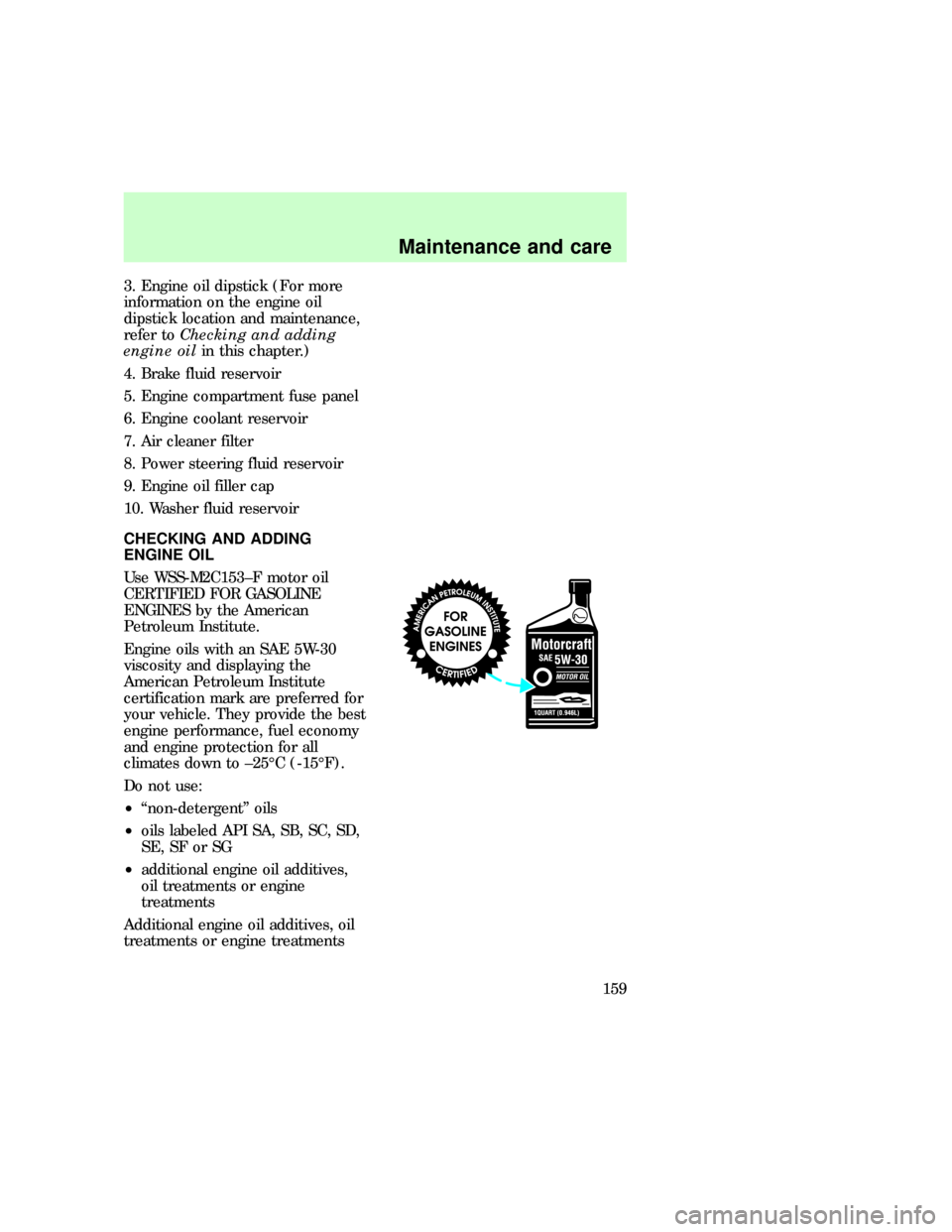
Use WSS-M2C153±F motor oil
CERTIFIED FOR GASOLINE
ENGINES by the American
Petroleum Institute.
Engine oils with an SAE 5W-30
viscosity and displaying the
American Petroleum Institute
certification mark are preferred for
your vehicle. They provide the best
engine performance, fuel economy
and engine protection for all
climates down to ±25ÉC (-15ÉF).
Do not use:
²ªnon-detergentº oils
²oils labeled API SA, SB, SC, SD,
SE, SF or SG
²additional engine oil additives,
oil treatments or engine
treatments
Additional engine oil additives, oil
treatments or engine treatments
com_check-add_oil.01
Maintenance and care
159
Page 159 of 224
are never needed and could, under
certain conditions, lead to engine
damage which is not covered by
your Ford warranty.
Synthetic engine oils which are
CERTIFIED and of the preferred
viscosity may be used in your
engine. The engine oil and oil filter
must still be changed according to
the ªService Guideº.
Checking the engine oil
Check the engine oil each time you
fuel your vehicle.
To check the oil:
1. Make sure the vehicle is on level
ground. If the engine is running,
turn the engine off and wait a few
minutes for the oil to drain into
the oil pan.
2. Set the parking brake and
ensure the gearshift is securely
latched in P.
3. Open the hood. Protect yourself
from engine heat.
exd_checking_engine_oil
Maintenance and care
160
Page 187 of 224
²Install cables securely, verifying
that the cables do not touch any
wiring, brake lines or fuel lines.
²Drive cautiously. If you hear the
cables rub or bang against the
vehicle, stop and retighten
them. If this does not work,
remove the cables to prevent
vehicle damage.
²Avoid overloading your vehicle.
²Remove the tire cables when
they are no longer needed.
²Do not use cables on dry roads.
²The suspension insulation and
bumpers will help prevent
vehicle damage. Do not remove
these components from the
vehicle when using snow tires
and traction devices.
²Do not exceed 48 km/h (30
mph) with tire cables on your
vehicle.
Consult your dealer for information
on other Ford approved methods
of traction control.
FUEL INFORMATION
The ignition key must be turned to
3 (Off) or 1 (Acc) during refueling
to obtain accurate fuel gauge
ratings.
exd_fuel_info
exd_important_precautions
Maintenance and care
188
Page 188 of 224
Important safety precautions
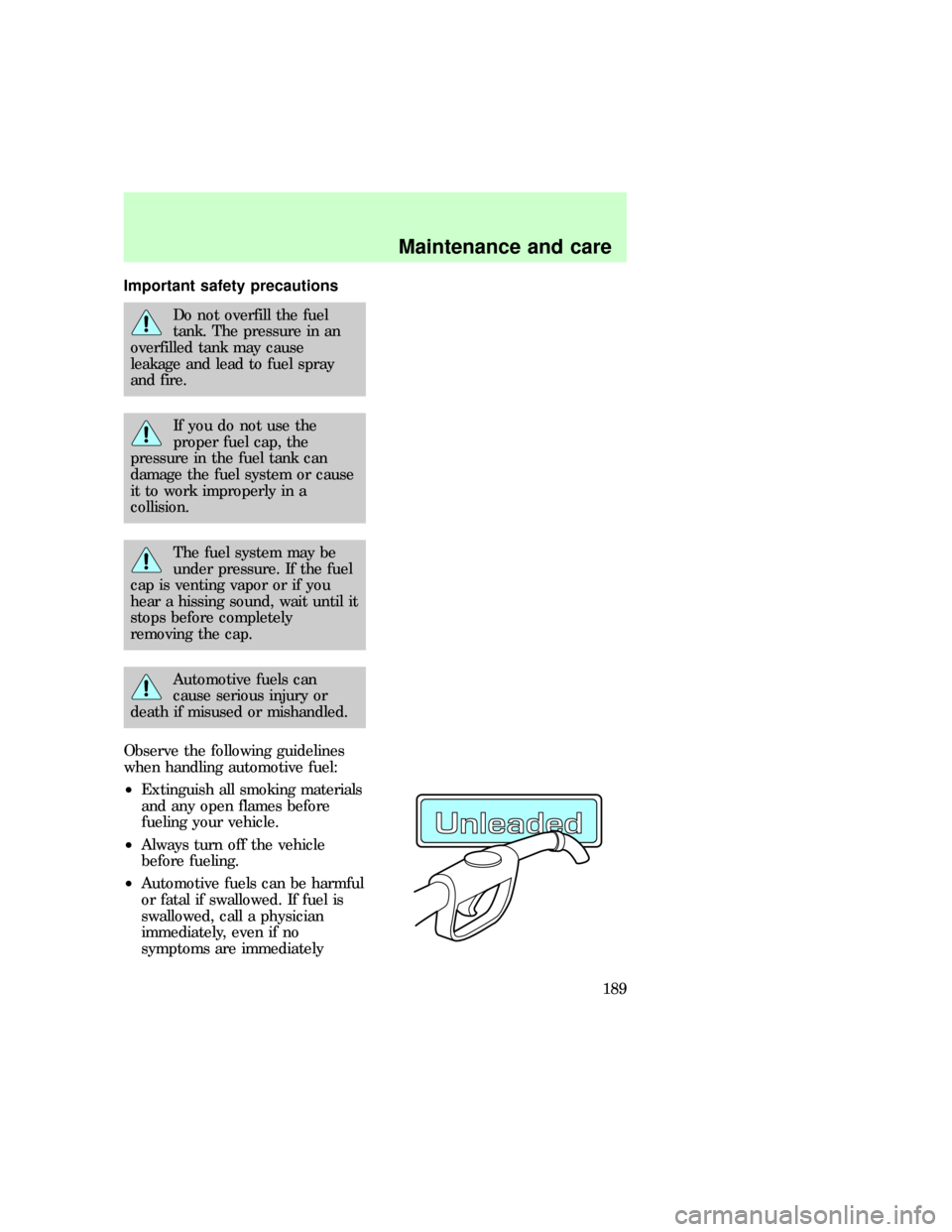
Do not overfill the fuel
tank. The pressure in an
overfilled tank may cause
leakage and lead to fuel spray
and fire.
If you do not use the
proper fuel cap, the
pressure in the fuel tank can
damage the fuel system or cause
it to work improperly in a
collision.
The fuel system may be
under pressure. If the fuel
cap is venting vapor or if you
hear a hissing sound, wait until it
stops before completely
removing the cap.
Automotive fuels can
cause serious injury or
death if misused or mishandled.
Observe the following guidelines
when handling automotive fuel:
²Extinguish all smoking materials
and any open flames before
fueling your vehicle.
²Always turn off the vehicle
before fueling.
²Automotive fuels can be harmful
or fatal if swallowed. If fuel is
swallowed, call a physician
immediately, even if no
symptoms are immediately
Maintenance and care
189
Page 189 of 224

apparent. The toxic affects of
fuel may not be visible for
hours.
²Fuels can also be harmful if
absorbed through the skin. If
fuel is splashed on the skin,
promptly remove contaminated
clothing and wash skin
thoroughly with soap and water.
²If fuel is splashed in the eyes,
remove contact lenses, flush
with water for 15 minutes and
seek medical attention.
²Be particularly careful if you are
taking ªAntabuseº or other
forms of disulfiram for the
treatment of alcoholism.
Breathing gasoline vapors or
skin contact could cause an
adverse reaction. Consult a
physician immediately.
Choosing the right fuel
Use only UNLEADED FUEL. The
use of leaded fuel is prohibited by
law and could damage your
vehicle. The damage may not be
covered by your warranty.
Your vehicle was not designed to
use fuel containing
manganese-based additives such as
MMT. Additionally, vehicles
certified to California emission
standards (indicated on the
underhood Vehicle Emissions
Control Information label) are
designed to operate on California
reformulated gasolines. If
California reformulated gasoline is
not available when you refuel, your
com_choosing_fuel.01
Maintenance and care
190