Page 129 of 224
²Weigh your vehicle as you
customarily operate the vehicle
without cargo.
²Subtract the total weight of
passengers, driver and
aftermarket equipment and the
obtained weight (in the step
above) from the GCWR to
determine the trailer weight
your vehicloe can tow.
Trailer weight range
The trailer weight range is the
specified range by weight that the
trailer must fall within. The range
is between zero and the maximum
trailer weight rating found in this
chapter.
Using trailer brakes
Use electric brakes or manual,
automatic or surge type hydraulic
brakes that meet Federal and local
regulations. Install and adjust
brakes according to the
manufacturer's instructions.
Do not connect a trailer's
hydraulic brake system
directly to your vehicle's brake
system. Your vehicle may not
have enough braking power and
your chances of having a
collision greatly increase.
Using safety chains
Always connect the trailer's safety
chains to the vehicle. To connect
the chains, cross the chains under
the trailer tongue and attach to the
exd_weight_range
exd_brakes_trailer
exd_safety_chains
Driving
130
Page 131 of 224
should the vehicle weight ratings
per axle or combination truck and
trailer exceed the weight ratings
listed on the Safety Compliance
Certification label located on the
driver's side door.
When connecting a trailer hitch:
1. Turn off the air suspension
switch.
2. Connect the trailer.
3. Turn the air suspension back on.
Adjusting an equalizing
hitch so the rear bumper
of the vehicle is lower or higher
than it was unloaded will defeat
the function of the load
equalizing hitch and may cause
unpredictable handling.
Driving while towing a trailer
Speed control (if equipped) may
not work properly while towing on
long, steep grades.
Driving with an automatic
transmission:
²use D, 1 or 2 rather than
Dwhile towing up or down
steep hills
²anticipate stops and brake
gradually.
Towing behind another vehicle
Your vehicle can not be flat towed
with all wheels on the ground.
No neutral tow kit is available for
your vehicle.
exd_driving_trailer
exd_towing_another_vehicle
exd_servicing_while_towing
Driving
132
Page 137 of 224
Slot number Fuse
amperage
ratingCircuits protected
13 30 amp Auxiliary blower
14 60 amp Four wheel anti-lock brake system
(4WABS)
15 50 amp Air suspension compressor
16 40 amp Trailer tow battery charge, engine
minifuse box fuse #2, engine minifuse
box fuse #4
17 30 amp Four-wheel drive (4WD) transfer case
motor and clutch
18 30 amp Driver power seat
19 20 amp Fuel pump
20 50 amp Junction box ignition switched feed
21 50 amp Junction box ignition switched feed
22 50 amp Junction box battery feed
23 40 amp Front blower
24 30 amp Powertrain control module power
25 30 C.B. Windows
26 - not used
27 40 amp Heated backlite and mirrors
28 30 amp Trailer tow electric brake
29 30 amp Hybrid fan, moon roof, flip windows
Slot number Description
1 - not used
2 - PCM diode
Slot number Description
1 - Windshield wipers high/low speed
2 - Windshield wipers run/park
3 - Front washer pump relay
4 - Fuel pump relay
Roadside emergencies
138
Page 141 of 224
Slot number Amperage Description
6 5 amp Generic electronic module
(GEM), shift interlock, air
suspension module,
heated backlite (HBL)
relay, steering sensor, trip
computer, compass
7 5 amp Console blower, auxiliary
blower relay coil
8 5 amp GEM, radio, RAP module
9 - Not used
10 - Not used
11 30 amp Front wiper motor, washer
motor
12 5 amp OBDII scan tool connector
13 15 amp Brake on/off switch, brake
pressure switch
14 15 amp Interior lamps, delayed
accessory relay, rear wiper
relays
15 5 amp GEM, passive anti-theft
system (PATS) module
16 20 amp High beam headlamps,
high beam indicator
17 10 amp Heated mirrors, heated
mirror switch
18 5 amp Instrument and switch
illumination
19 10 amp Airbag diagnostic monitor,
instrument cluster
20 5 amp GEM, air suspension
module
21 15 amp Starter relay, junction box
fuse #20
Roadside emergencies
142
Page 143 of 224

CHANGING THE TIRES
If you get a flat tire while driving,
do not apply the brake heavily.
Instead, gradually decrease your
speed. Hold the steering wheel
firmly and slowly move to a safe
place on the side of the road:
²Park on a level spot.
²Turn off the ignition.
²Set the parking brake.
²Activate the hazard flashers.
Spare tire information
Your vehicle is equipped with a
spare tire that may be used as a
spare or as a regular tire. The
spare is identical to the other tires
on your vehicle, although the
wheel cover may not match.
Location of the spare tire and
tools
The spare tire and tools for your
vehicle are stowed in the following
locations:
Tool Location
Spare tire Under the vehicle, just in front of the rear
bumper.
Jack, wheel nut
wrench, instructions,
work glovesBehind the access panel located on the right
rear quarter panel interior trim.
Jack handle On the top of the raditator support at the front
of the engine compartment.
exd_flat-tires_changing
exd_spare_location
exd_location_spare_tools
Roadside emergencies
144
Page 145 of 224
4. Remove the end of the cable
from the wheel and slide the spare
out from under the vehicle.
To re-install the spare tire or tools,
reverse the removal procedure.
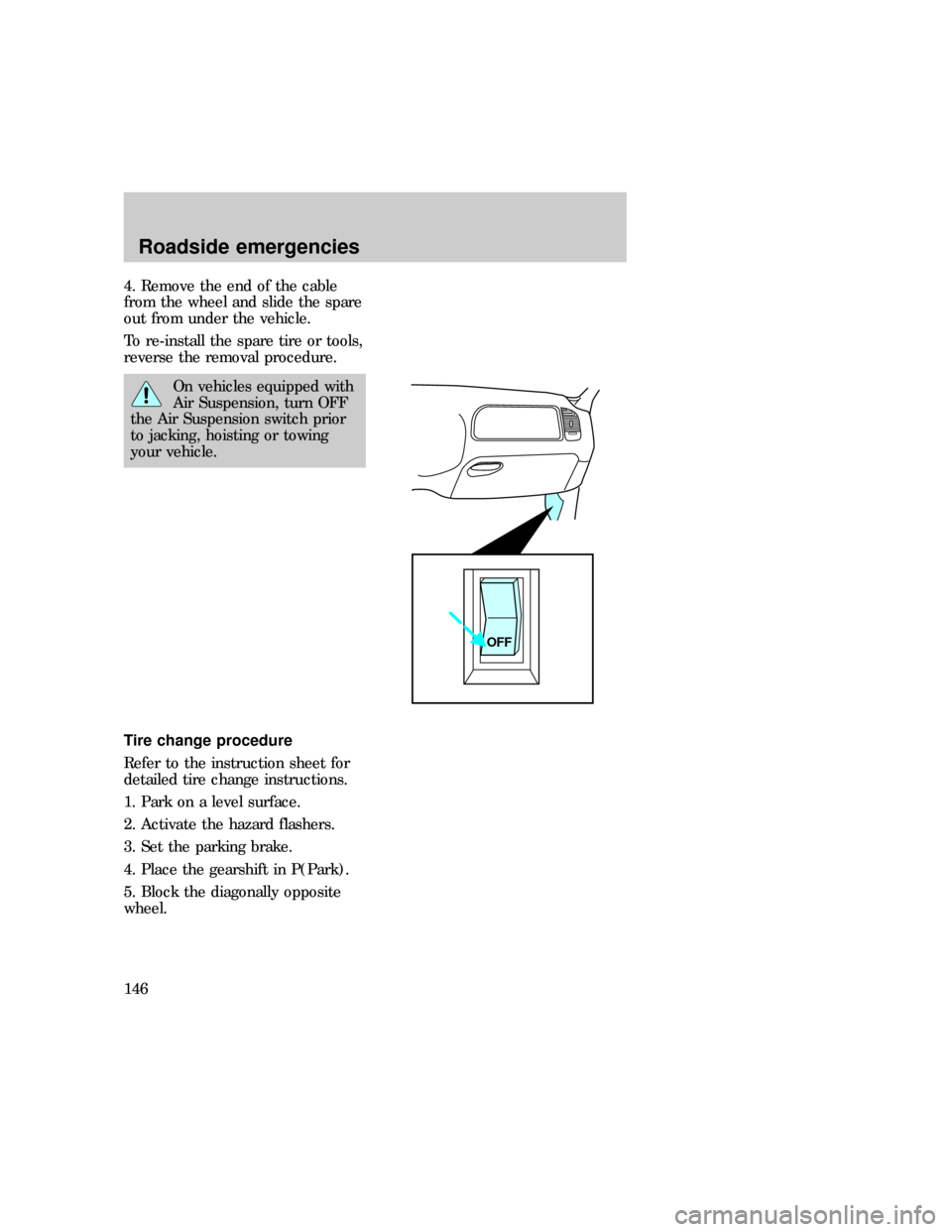
On vehicles equipped with
Air Suspension, turn OFF
the Air Suspension switch prior
to jacking, hoisting or towing
your vehicle.
Tire change procedure
Refer to the instruction sheet for
detailed tire change instructions.
1. Park on a level surface.
2. Activate the hazard flashers.
3. Set the parking brake.
4. Place the gearshift in P(Park).
5. Block the diagonally opposite
wheel.
OFF
exd_change_proc
exd_removing_flat
Roadside emergencies
146
Page 146 of 224
Removing flat tire and installing
spare
6. Use the tip of the lug wrench to
remove any wheel trim. Insert the
tapered end of the lug wrench
behind the wheel covers or
hubcaps and twist off.
7. Loosen the wheel nuts with the
lug wrench. Do not remove the lug
nuts until the tire has been raised
off the ground.
8. Insert the jack handle into the
jack and use the handle to slide
the jack under the vehicle.
9. Position the jack according to
the following guides and turn the
jack handle clockwise until the
wheel is completely off the ground.
²When one of the back wheels is
off the ground, the transmission
alone will not prevent the
vehicle from moving or slipping
off the jack, even if the vehicle
is in P (Park). To prevent the
vehicle from moving when you
change the tire, be sure that the
parking brake is set and the
diagonally opposite wheel is
blocked. If the vehicle slips off
the jack, someone could be
seriously injured.
Roadside emergencies
147
Page 156 of 224
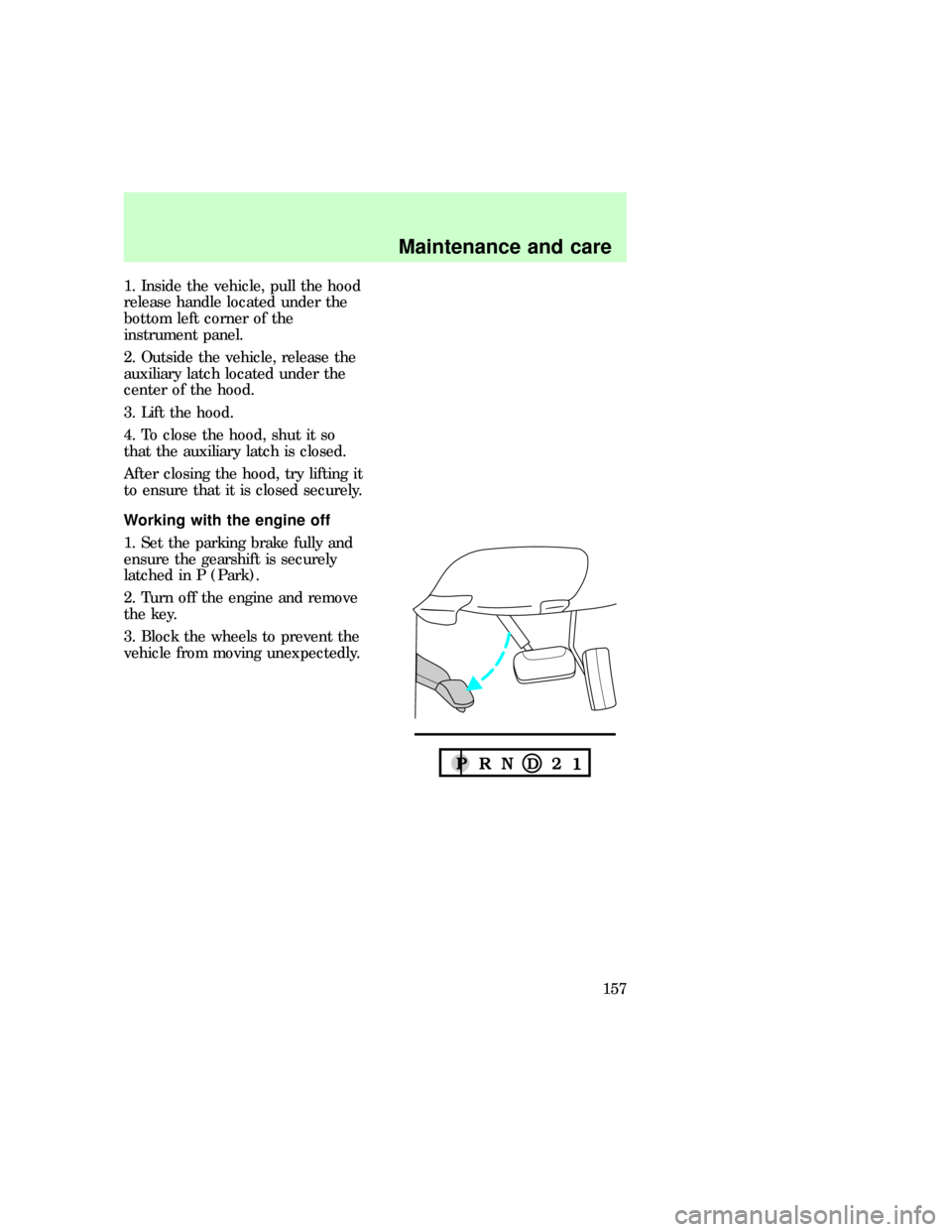
1. Inside the vehicle, pull the hood
release handle located under the
bottom left corner of the
instrument panel.
2. Outside the vehicle, release the
auxiliary latch located under the
center of the hood.
3. Lift the hood.
4. To close the hood, shut it so
that the auxiliary latch is closed.
After closing the hood, try lifting it
to ensure that it is closed securely.
Working with the engine off
1. Set the parking brake fully and
ensure the gearshift is securely
latched in P (Park).
2. Turn off the engine and remove
the key.
3. Block the wheels to prevent the
vehicle from moving unexpectedly.
exd_working_off
exd_working_on
Maintenance and care
157