Page 107 of 224
Braking with ABS
On vehicles with ABS, the wheels
will not lock and slide when you
press down hard on the brake
pedal. The ABS automatically
releases and reapplies the front
and rear brakes independently
whenever the wheels start to lock.
When this happens, you will feel
the brake pedal pulse. This pulse
may be unfamiliar feeling, but it is
a normal indication that the ABS is
working as designed.
Do not ªpumpº the brake pedal of
vehicles with ABS.
exd_parking_brake
Driving
108
Page 108 of 224
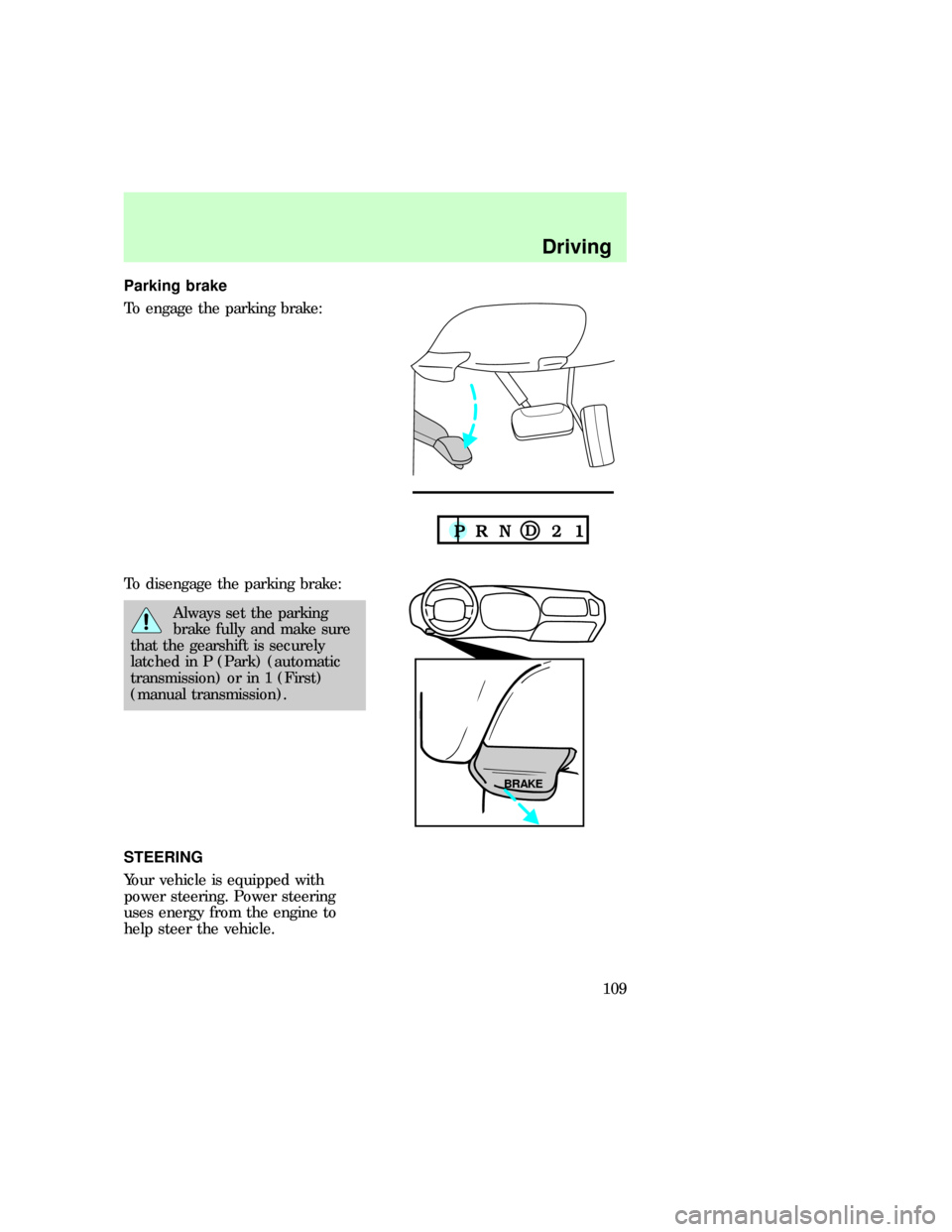
Parking brake
To engage the parking brake:
To disengage the parking brake:
Always set the parking
brake fully and make sure
that the gearshift is securely
latched in P (Park) (automatic
transmission) or in 1 (First)
(manual transmission).
STEERING
Your vehicle is equipped with
power steering. Power steering
uses energy from the engine to
help steer the vehicle.
BRAKE
exd_steering
Driving
109
Page 113 of 224
If the light is displayed while
driving and the air suspension
system service switch is not turned
off, safely pull off the road at your
earliest convenience. Turn the
ignition switch from 4(On) to 3
(Off) and 4(On) again. If the
warning light reappears, turn the
air suspension switch off and have
the vehicle serviced by your dealer
or qualified service technician.
If the vehicle is loaded beyond the
recommended maximum payload,
the CHECK SUSP light may
illuminate. To correct this
condition, remove or redistribute
the payload according to the
recommended requirements and
follow the procedure outlined
above.
TRANSMISSION OPERATION
Automatic transmission
operation
Hold the brake pedal down
while you move the
gearshift lever from position to
position. If you do not hold the
brake pedal down, your vehicle
may move unexpectedly and
injure someone.
exd_transmission
exd_automatic
Driving
114
Page 114 of 224
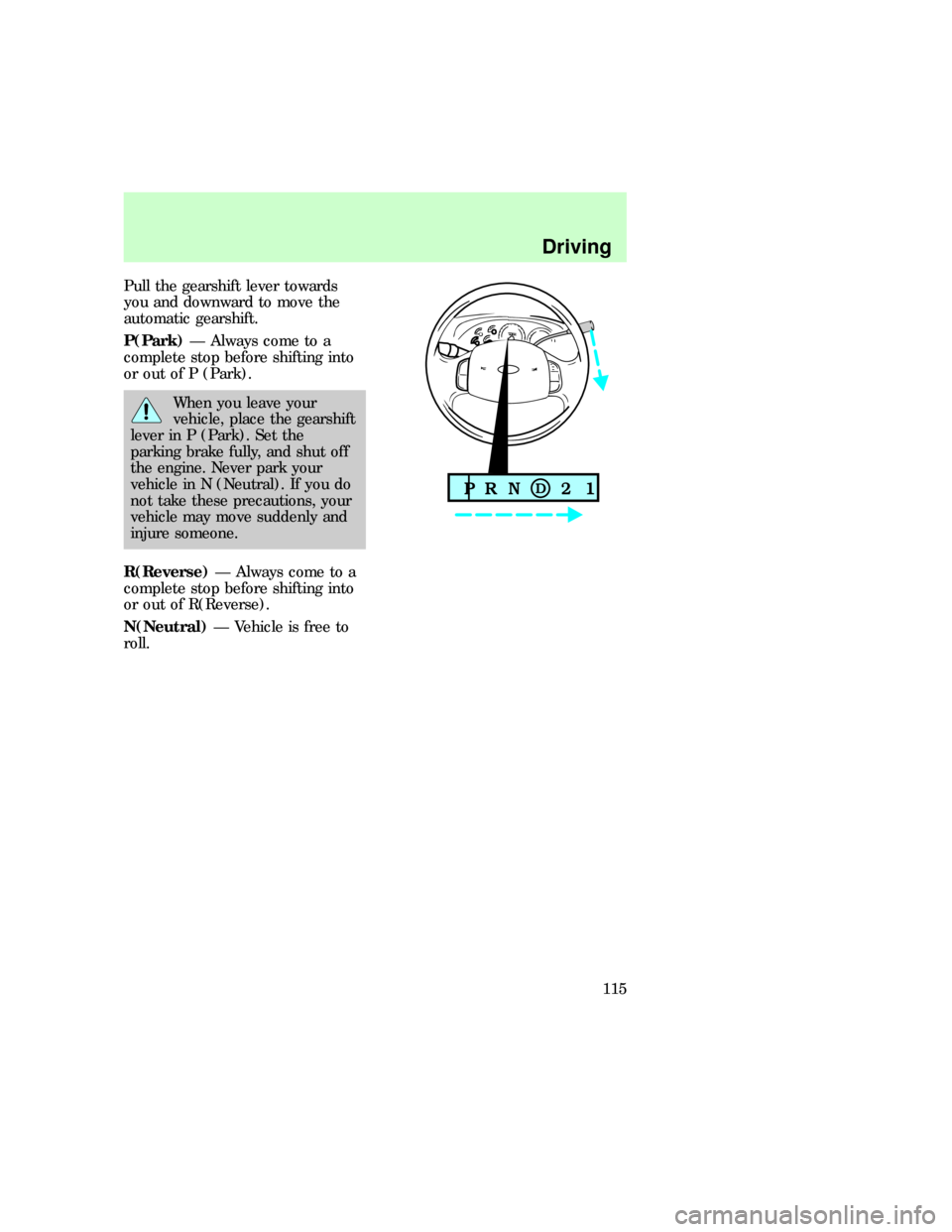
Pull the gearshift lever towards
you and downward to move the
automatic gearshift.
P(Park)Ð Always come to a
complete stop before shifting into
or out of P (Park).
When you leave your
vehicle, place the gearshift
lever in P (Park). Set the
parking brake fully, and shut off
the engine. Never park your
vehicle in N (Neutral). If you do
not take these precautions, your
vehicle may move suddenly and
injure someone.
R(Reverse)Ð Always come to a
complete stop before shifting into
or out of R(Reverse).
N(Neutral)Ð Vehicle is free to
roll.
Driving
115
Page 116 of 224
2(Second)Ð Use 2(Second) to
start-up on slippery roads or to
provide additional engine braking
on downgrades. Transmission
operates in first and second gears.
1(Low)Ð Use 1(Low) to provide
maximum engine braking on steep
downgrades. Upshifts can be made
by shifting to 2(Second) or to
D(Overdrive). Selecting 1(Low)
at higher speeds causes a shift to
2(Second), and will shift to 1(Low)
after vehicle decelerates to the
proper speed.
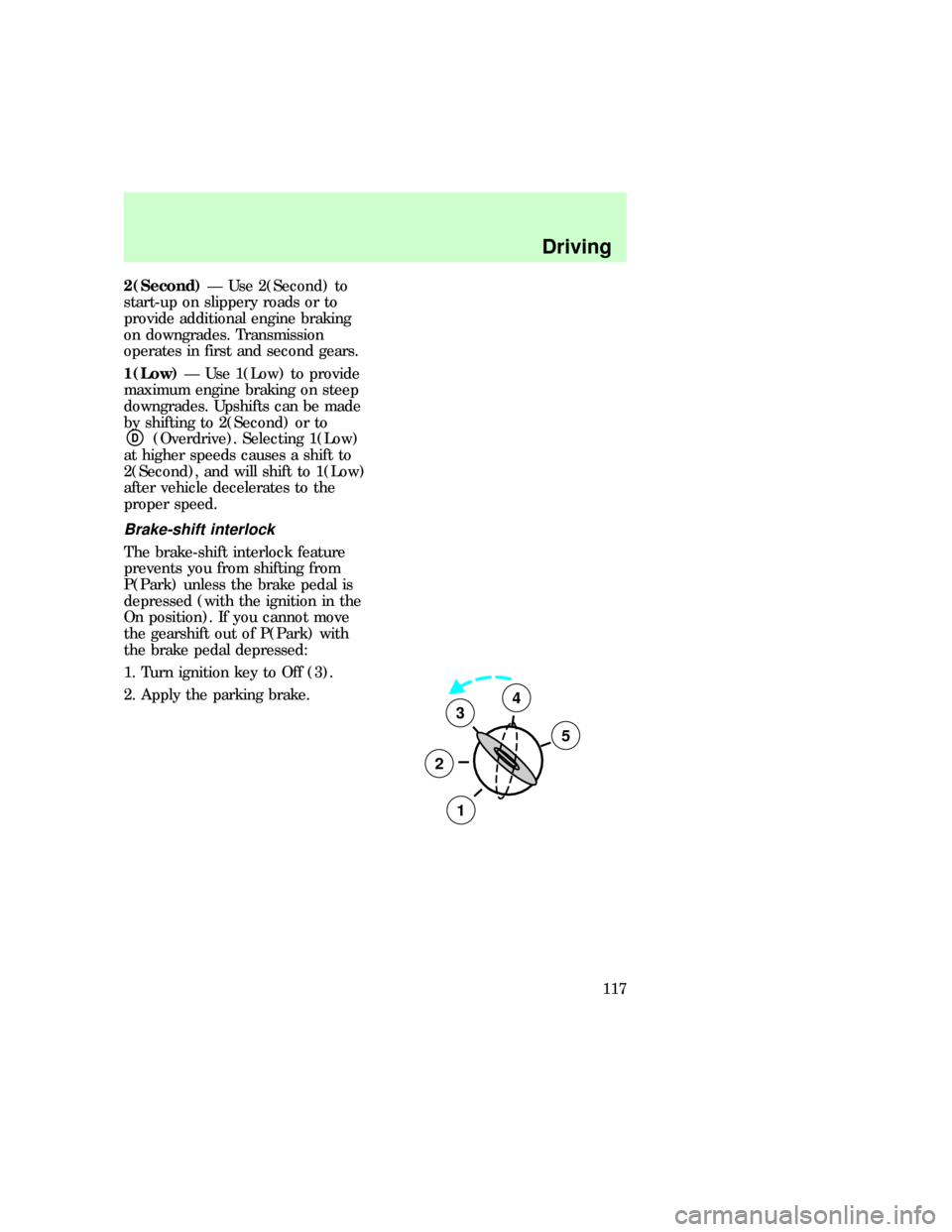
Brake-shift interlock
The brake-shift interlock feature
prevents you from shifting from
P(Park) unless the brake pedal is
depressed (with the ignition in the
On position). If you cannot move
the gearshift out of P(Park) with
the brake pedal depressed:
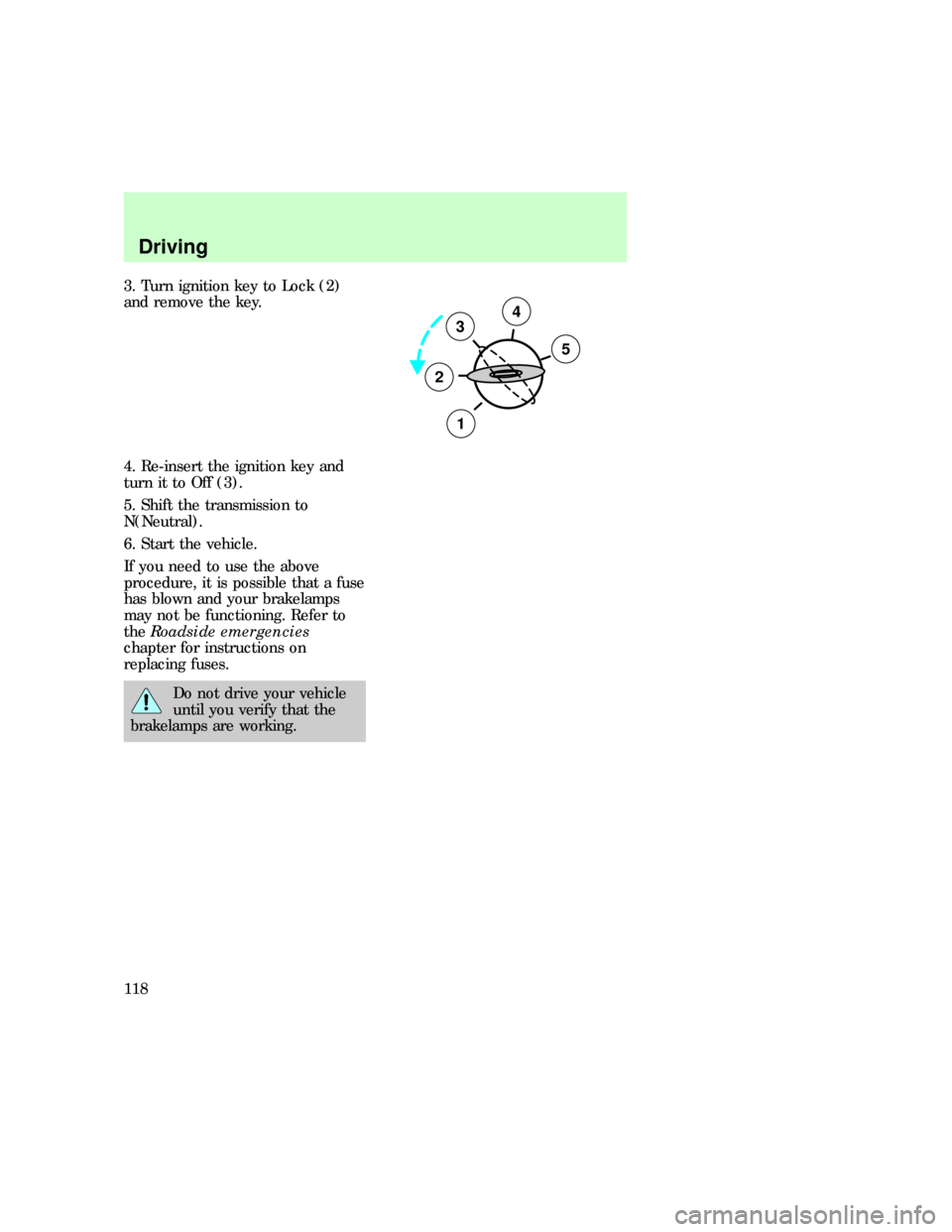
1. Turn ignition key to Off (3).
2. Apply the parking brake.
3
2
1
5
4
exd_brake_shift_interlock
Driving
117
Page 117 of 224
3. Turn ignition key to Lock (2)
and remove the key.
4. Re-insert the ignition key and
turn it to Off (3).
5. Shift the transmission to
N(Neutral).
6. Start the vehicle.
If you need to use the above
procedure, it is possible that a fuse
has blown and your brakelamps
may not be functioning. Refer to
theRoadside emergencies
chapter for instructions on
replacing fuses.
Do not drive your vehicle
until you verify that the
brakelamps are working.
3
2
1
5
4
exd_4wd_operation
Driving
118
Page 120 of 224
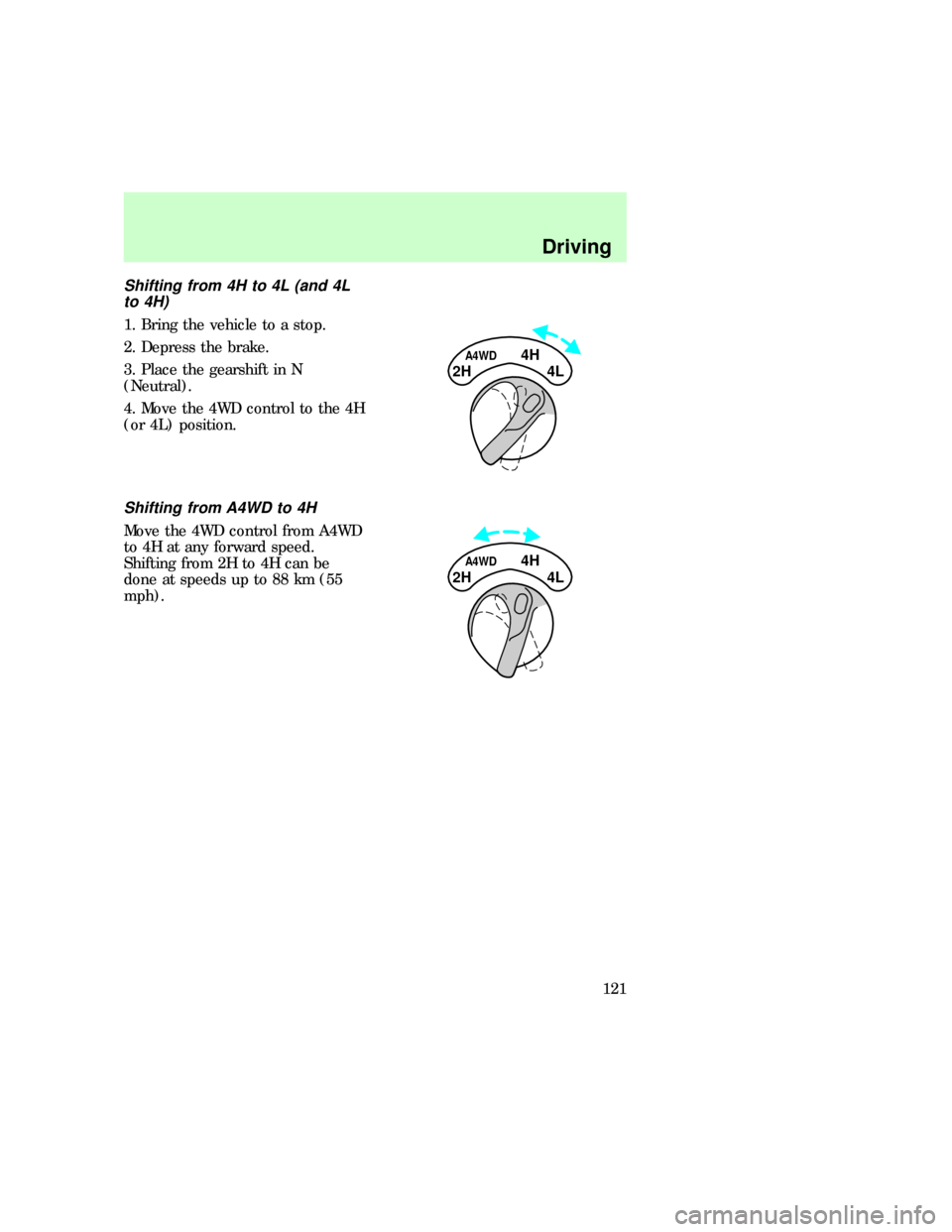
Shifting from 4H to 4L (and 4L
to 4H)
1. Bring the vehicle to a stop.
2. Depress the brake.
3. Place the gearshift in N
(Neutral).
4. Move the 4WD control to the 4H
(or 4L) position.
Shifting from A4WD to 4H
Move the 4WD control from A4WD
to 4H at any forward speed.
Shifting from 2H to 4H can be
done at speeds up to 88 km (55
mph).
2H 4L
A4WD4H
2H 4L
A4WD4H
exd_a4wd_to_4h
exd_driving_off_road
Driving
121
Page 126 of 224
TRAILER TOWING
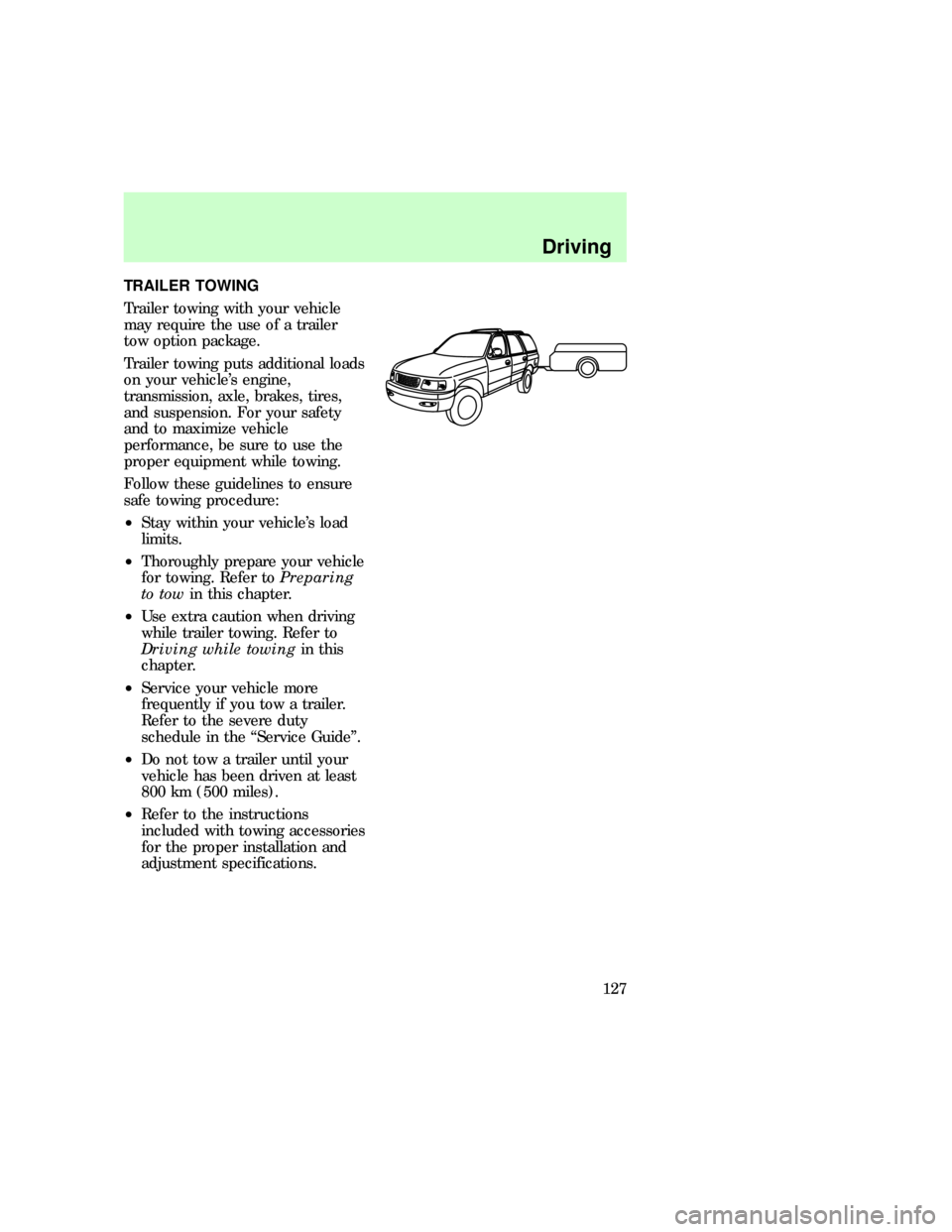
Trailer towing with your vehicle
may require the use of a trailer
tow option package.
Trailer towing puts additional loads
on your vehicle's engine,
transmission, axle, brakes, tires,
and suspension. For your safety
and to maximize vehicle
performance, be sure to use the
proper equipment while towing.
Follow these guidelines to ensure
safe towing procedure:
²Stay within your vehicle's load
limits.
²Thoroughly prepare your vehicle
for towing. Refer toPreparing
to towin this chapter.
²Use extra caution when driving
while trailer towing. Refer to
Driving while towingin this
chapter.
²Service your vehicle more
frequently if you tow a trailer.
Refer to the severe duty
schedule in the ªService Guideº.
²Do not tow a trailer until your
vehicle has been driven at least
800 km (500 miles).
²Refer to the instructions
included with towing accessories
for the proper installation and
adjustment specifications.
Driving
127