Page 119 of 191
Installation of an English
thread nut on a metric
stud (or vice-versa) will not
properly secure the wheel to the
hub. Damaged studs may result
in wheel separation and possible
injury.
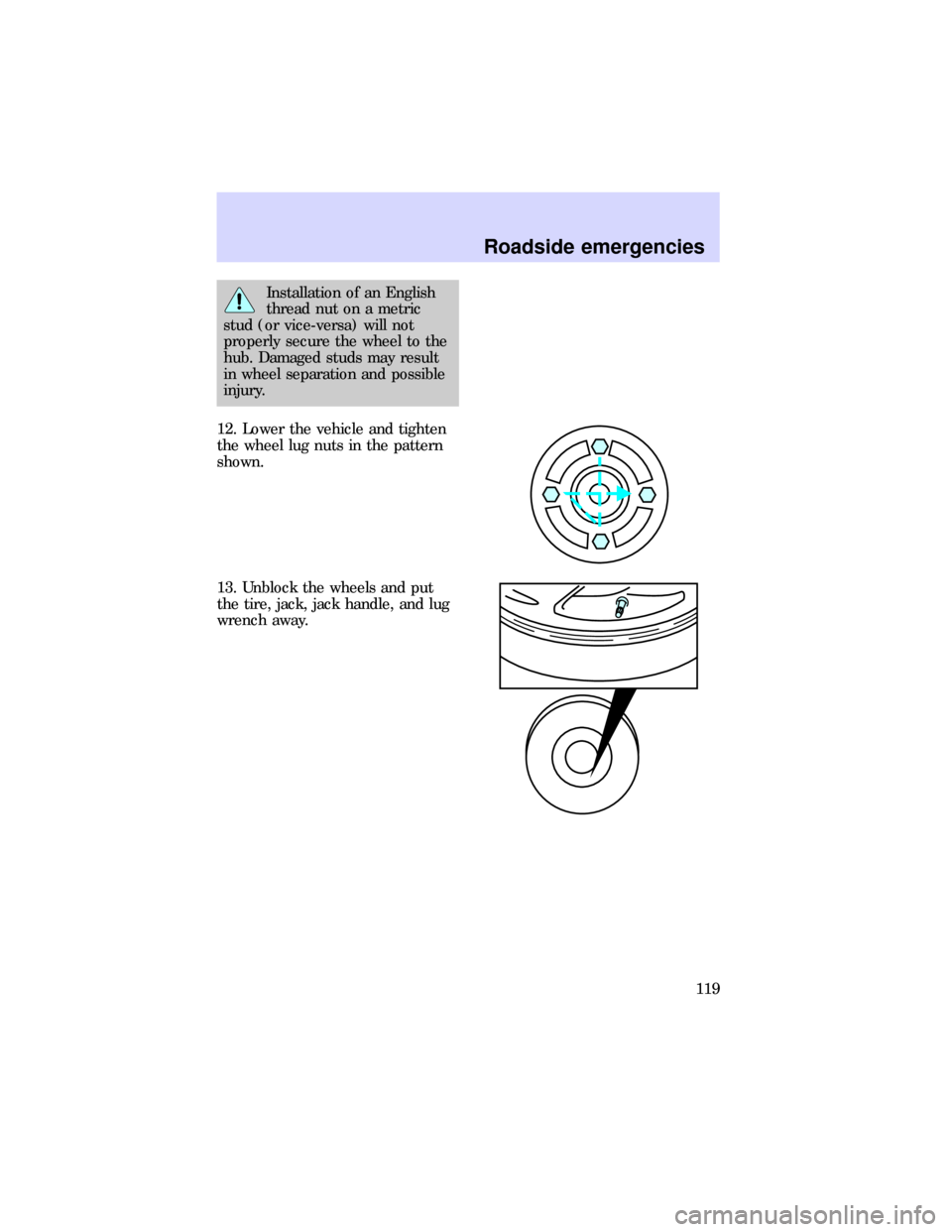
12. Lower the vehicle and tighten
the wheel lug nuts in the pattern
shown.
13. Unblock the wheels and put
the tire, jack, jack handle, and lug
wrench away.
Roadside emergencies
119
Page 121 of 191
system; a 24-volt power supply
will cause vehicle damage
²park the vehicles close to each
other, but do not allow the two
vehicles to touch.
²check to make sure neither
battery is disconnected
²remove any excessive corrosion
from the battery terminals
²turn on the heater fan in each
vehicle to prevent damage from
voltage surges
To jump start the vehicle:
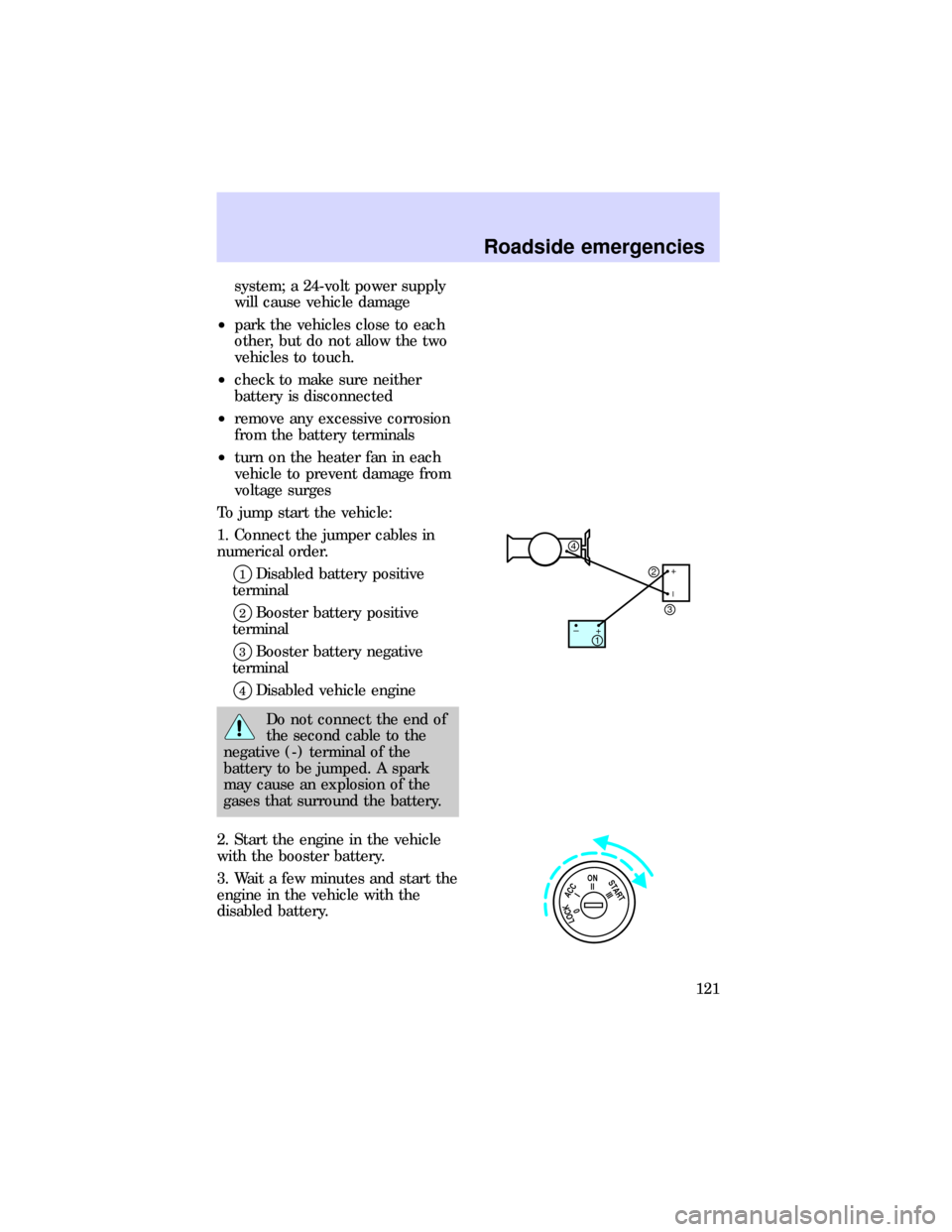
1. Connect the jumper cables in
numerical order.
V1Disabled battery positive
terminal
V2Booster battery positive
terminal
V3Booster battery negative
terminal
V4Disabled vehicle engine
Do not connect the end of
the second cable to the
negative (-) terminal of the
battery to be jumped. A spark
may cause an explosion of the
gases that surround the battery.
2. Start the engine in the vehicle
with the booster battery.
3. Wait a few minutes and start the
engine in the vehicle with the
disabled battery.
+ –
4
2
3
1
+ –
ON
II
ACC
I
LOCK
0
START
III
Roadside emergencies
121
Page 126 of 191
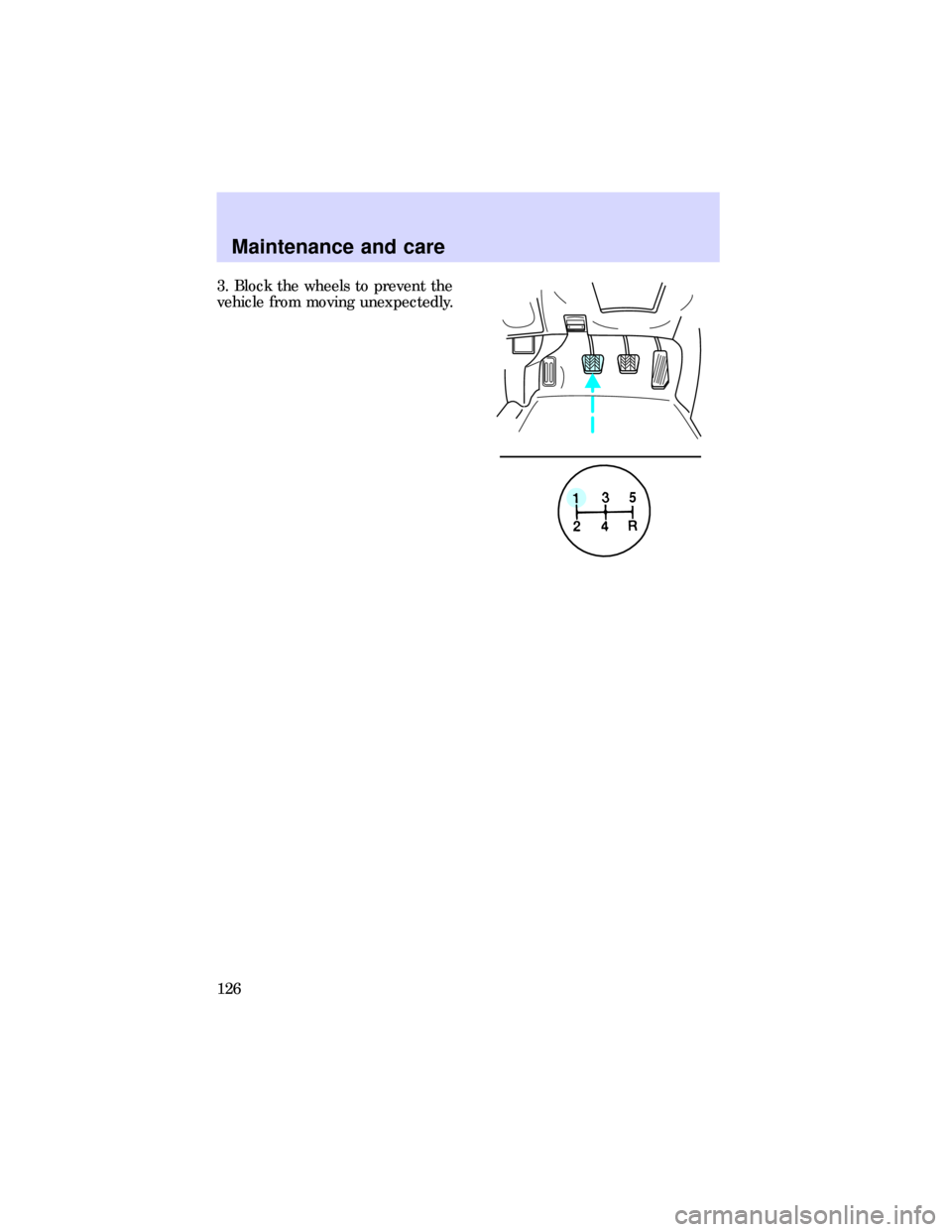
3. Block the wheels to prevent the
vehicle from moving unexpectedly.
5
Maintenance and care
126
Page 128 of 191
3. Block the wheels to prevent the
vehicle from moving unexpectedly.
4. If work must be done with the
engine running, avoid wearing
loose clothing or jewelry that could
get caught in moving parts. Take
appropriate precautions with long
hair.
Opening the hood
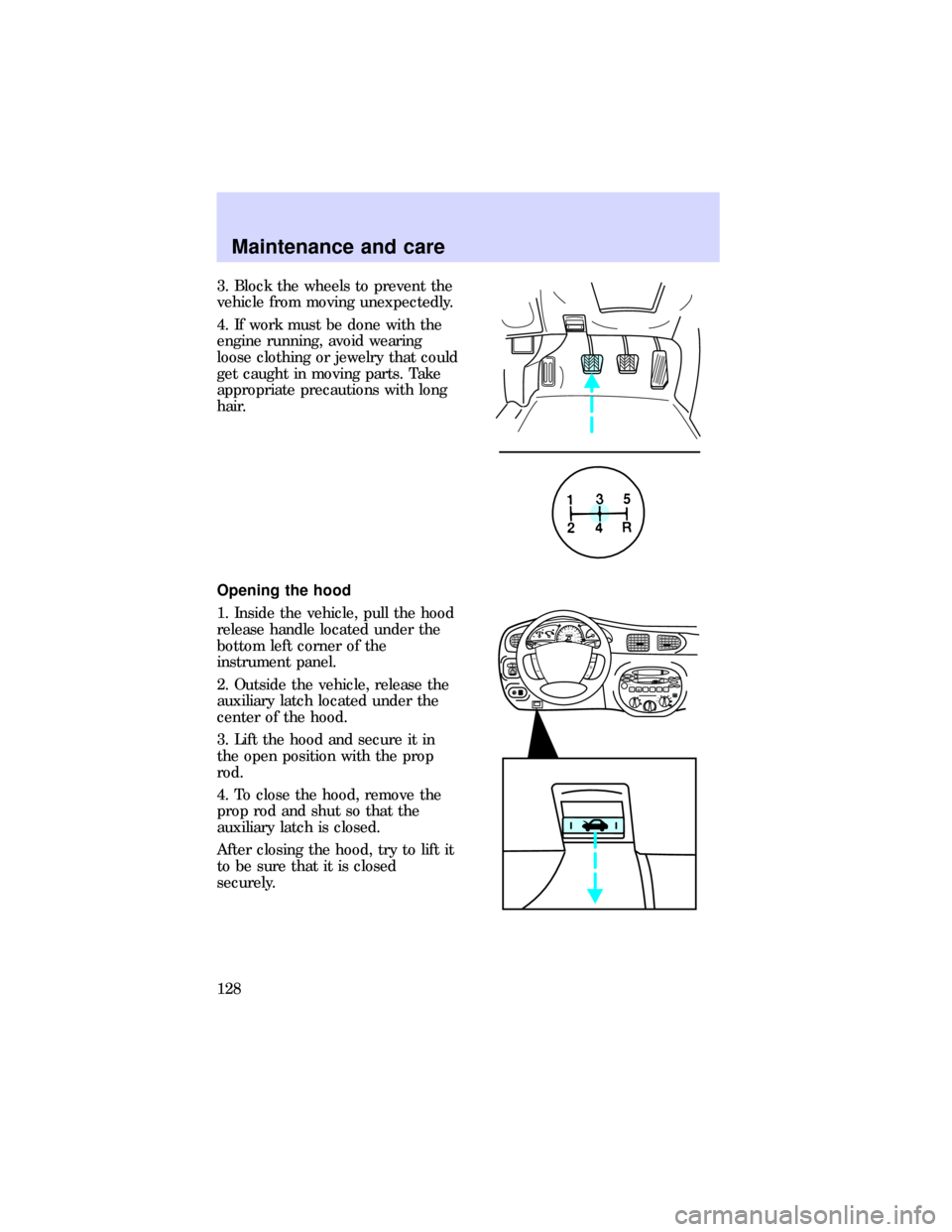
1. Inside the vehicle, pull the hood
release handle located under the
bottom left corner of the
instrument panel.
2. Outside the vehicle, release the
auxiliary latch located under the
center of the hood.
3. Lift the hood and secure it in
the open position with the prop
rod.
4. To close the hood, remove the
prop rod and shut so that the
auxiliary latch is closed.
After closing the hood, try to lift it
to be sure that it is closed
securely.
5
HI LOOFF*A/C*MAX
A/C
TUNE
DISCS
SEEK
TUNE
SCAN
EJ REW FF
BAL BASSTREBFADE TAPE
CD AM
FM
–+1
SIDE 1-22
345
COMP1
SIDE 1-2VOL–
PUSH ON
LMIRRORR
0000000002030405060
70
80
90
10 0
11 020 40608010 0
12 0
16 0
18 0 140FUEL FILLCHEF1/22
13RPM x 1000
RESET
SET
ACC
SET XXXX XXXOFF2INT
1 OFF MIST
Maintenance and care
128
Page 137 of 191

2. When the engine is cool, wrap
a thick cloth around the cap and
turn it slowly, counterclockwise
to the first stop.
3. Step back while the pressure
releases.
4. When you are sure that all the
pressure has been released, use
the cloth to press the cap down,
turn it counterclockwise, and
remove it.
Use Ford Premium Engine Coolant
E2FZ-19549-AA (in Canada,
Motorcraft CXC-8-B) or an
equivalent premium engine coolant
that meets Ford Specification
ESE-M97B44-A. Ford Premium
Engine Coolant is an optimized
formula that will protect all metals
and rubber elastomers used in
Ford cooling systems for 4 years or
50,000 miles (80,000 km).
Do not use alcohol or methanol
antifreeze or any engine coolants
mixed with alcohol or methanol
antifreeze. Do not use
supplemental coolant additives in
your vehicle. These additives may
harm your engine cooling system.
The use of an improper coolant
may void the warranty of your
vehicle's engine cooling system.
Recycled Engine Coolant
Ford Motor Company recommends
that Ford and Lincoln-Mercury
dealers use recycled engine
coolant produced by
Ford-approved processes. Not all
coolant recycling processes
Maintenance and care
137
Page 139 of 191
CHECKING AND ADDING
POWER STEERING FLUID
Check the power steering fluid at
least twice a year by completing
the following steps:
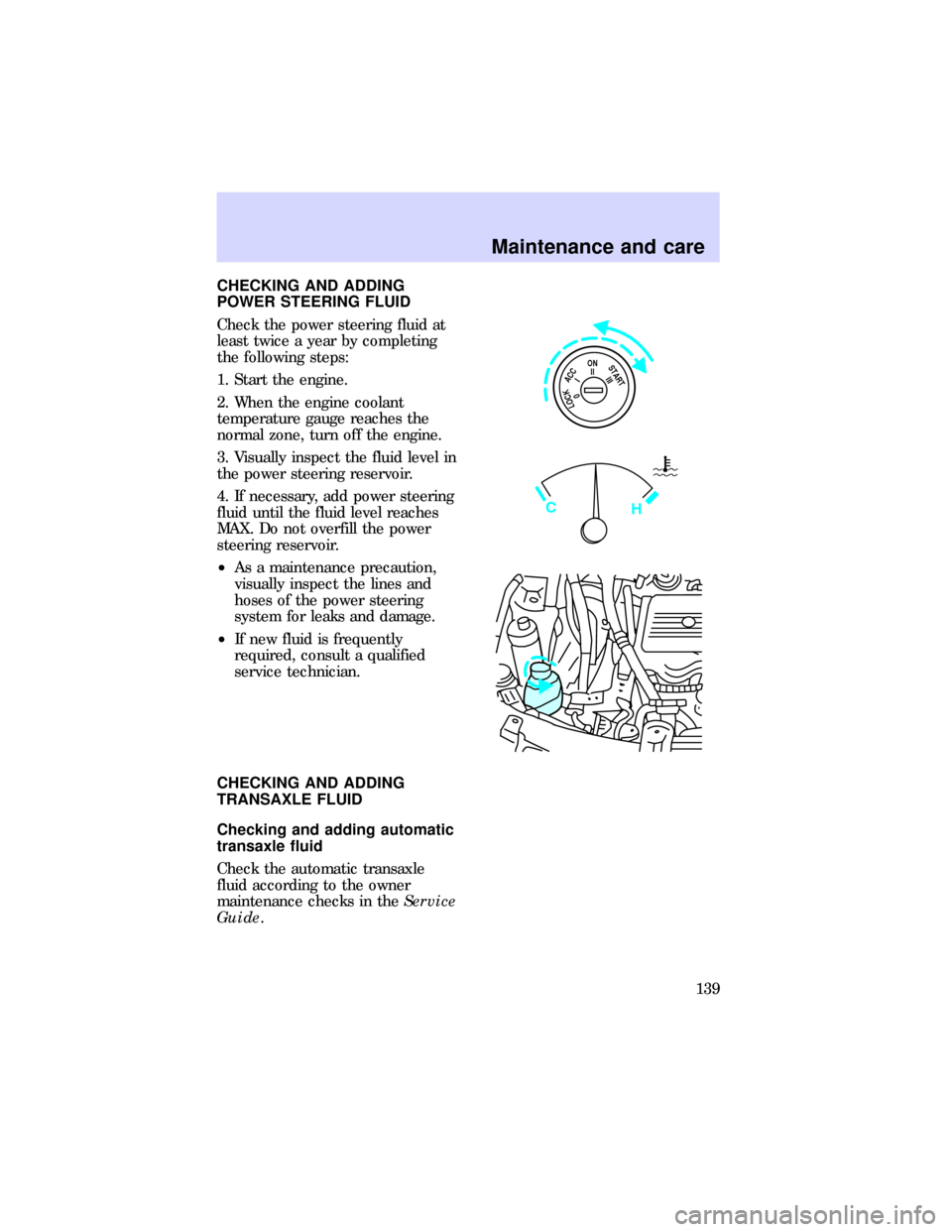
1. Start the engine.
2. When the engine coolant
temperature gauge reaches the
normal zone, turn off the engine.
3. Visually inspect the fluid level in
the power steering reservoir.
4. If necessary, add power steering
fluid until the fluid level reaches
MAX. Do not overfill the power
steering reservoir.
²As a maintenance precaution,
visually inspect the lines and
hoses of the power steering
system for leaks and damage.
²If new fluid is frequently
required, consult a qualified
service technician.
CHECKING AND ADDING
TRANSAXLE FLUID
Checking and adding automatic
transaxle fluid
Check the automatic transaxle
fluid according to the owner
maintenance checks in theService
Guide.
ON
II
ACC
I
LOCK
0
START
III
C
H
Maintenance and care
139
Page 140 of 191
It is best to check the transaxle
fluid level at the normal operating
temperature, after approximately
35 km (20 miles) of driving. If the
transaxle fluid level must be
checked under different
circumstances, make sure the
outside temperature is above 10 ÉC
(50 ÉF) to obtain an accurate fluid
level check.
Checking the automatic
transaxle fluid
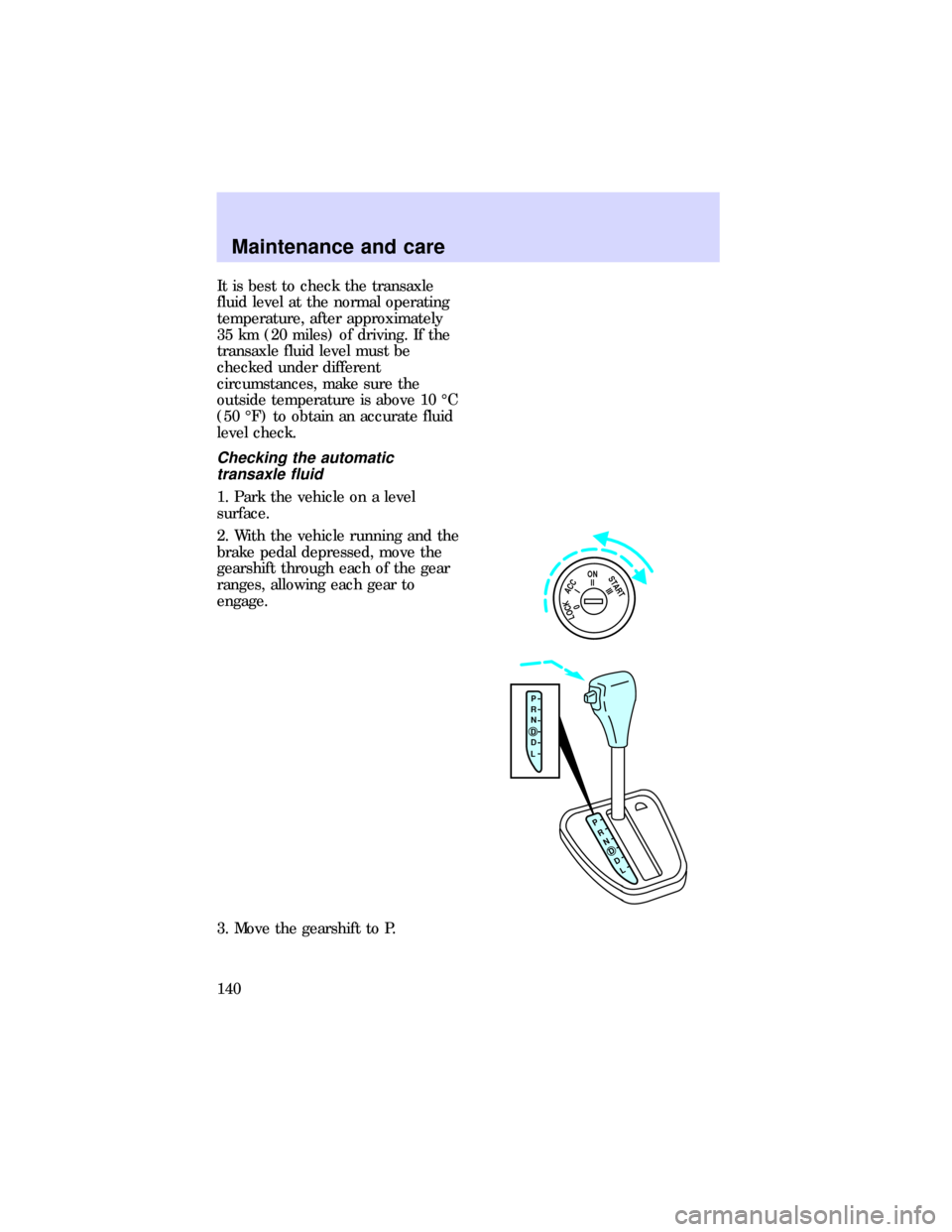
1. Park the vehicle on a level
surface.
2. With the vehicle running and the
brake pedal depressed, move the
gearshift through each of the gear
ranges, allowing each gear to
engage.
3. Move the gearshift to P.
P
R
N
D
D
L
R
N
D
D
LP
ON
II
ACC
I
LOCK
0
START
III
Maintenance and care
140
Page 145 of 191
of your vehicle may be adversely
affected until the idle is
eventually relearned.
²If the battery has been
disconnected or a new battery
has been installed, the clock and
preset radio stations must be
reset once the battery is
reconnected.
²Always dispose of used
automotive batteries in a
responsible manner. Follow your
community's standards for
disposal. Call your local
recycling center to find out
more about recycling automotive
batteries.
CHECKING AND CHANGING
YOUR AIR FILTER
If the vehicle is operated in very
dusty or sandy areas, replace the
filter more often than the
recommended intervals.
Do not drive without an air
filter; this could result in
excessive engine wear.
Maintenance and care
145