Page 70 of 191
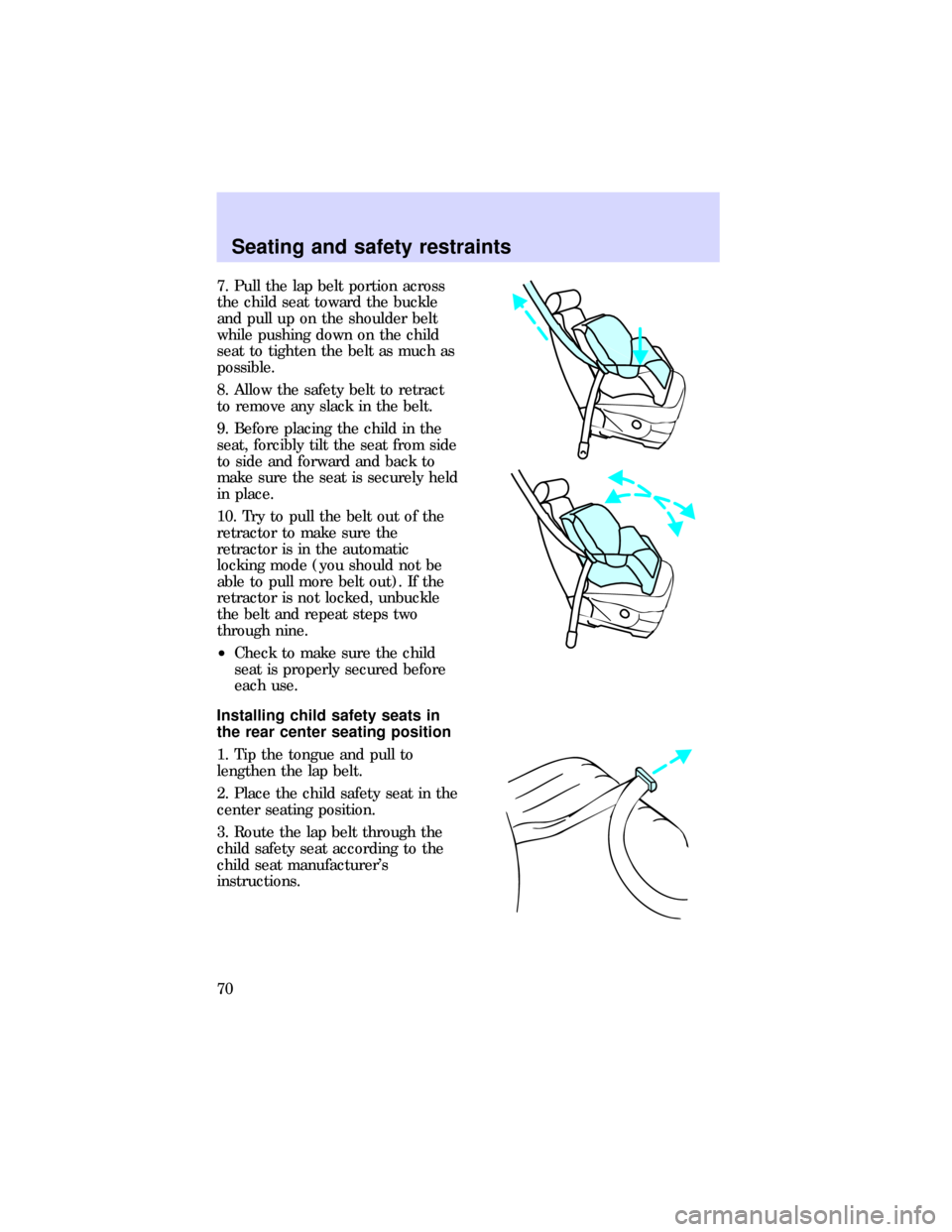
7. Pull the lap belt portion across
the child seat toward the buckle
and pull up on the shoulder belt
while pushing down on the child
seat to tighten the belt as much as
possible.
8. Allow the safety belt to retract
to remove any slack in the belt.
9. Before placing the child in the
seat, forcibly tilt the seat from side
to side and forward and back to
make sure the seat is securely held
in place.
10. Try to pull the belt out of the
retractor to make sure the
retractor is in the automatic
locking mode (you should not be
able to pull more belt out). If the
retractor is not locked, unbuckle
the belt and repeat steps two
through nine.
²Check to make sure the child
seat is properly secured before
each use.
Installing child safety seats in
the rear center seating position
1. Tip the tongue and pull to
lengthen the lap belt.
2. Place the child safety seat in the
center seating position.
3. Route the lap belt through the
child safety seat according to the
child seat manufacturer's
instructions.
Seating and safety restraints
70
Page 75 of 191
Regularly inspect the lap and
shoulder belt system of your child
seat. If there is any damage to the
system or if it is not functioning
properly, see your dealer.
Placing your child in the built-in
child seat
Failure to follow all of the
instructions on the use of
this child restraint system can
result in your child striking the
vehicle's interior during a sudden
stop or crash.
Never use the built-in
child seat as a booster
cushion with the adult safety
belts. A child using the adult
belts could slide forward and out
from under the safety belts.
The rear seatback must be
fully locked before
operating the child restraint
system.
Seating and safety restraints
75
Page 76 of 191
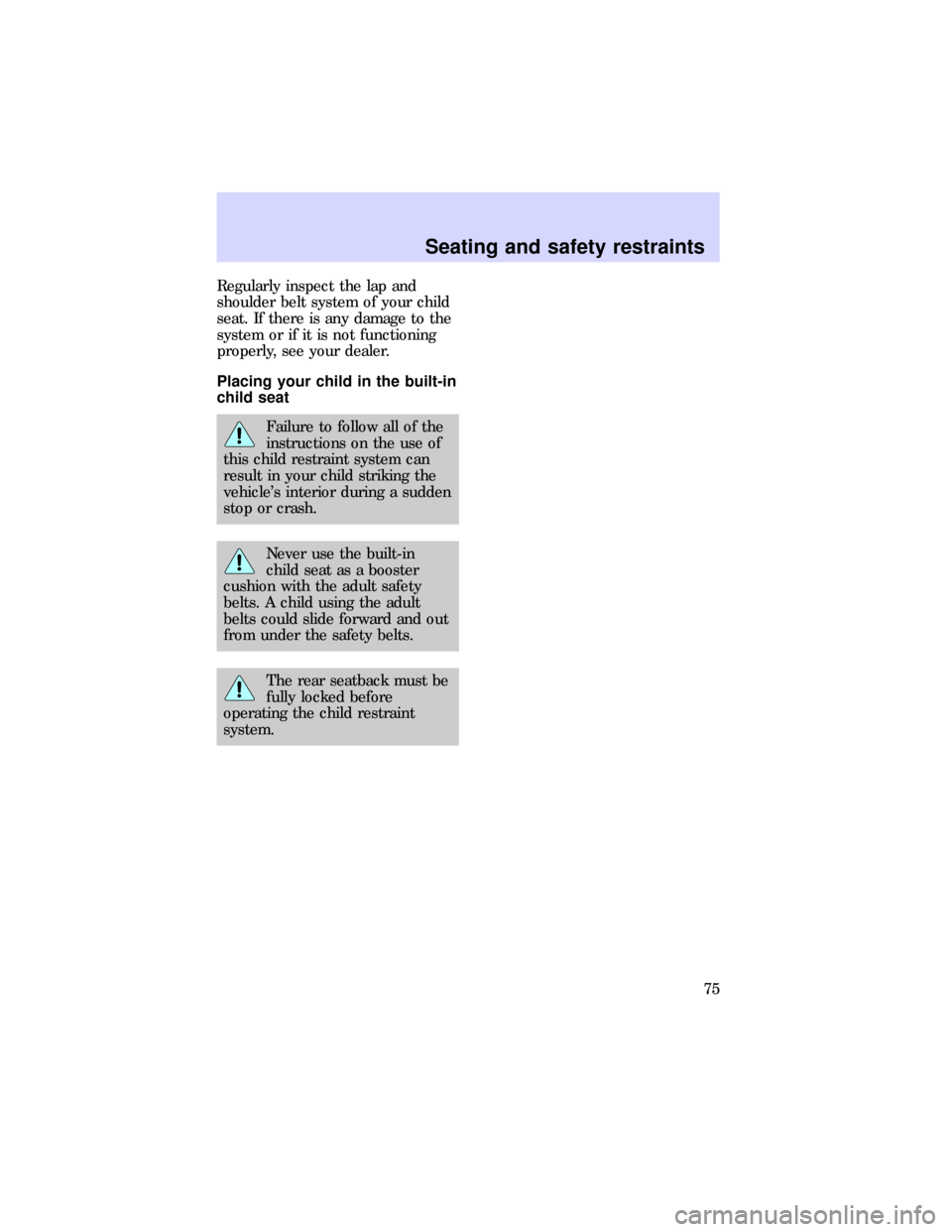
Ensure that the latch release
buttons are in the full up (locked)
position.
When the latch release buttons are
in full up (locked) position and the
built-in child seat is open, the rear
seatback cannot be unlocked or
folded down.
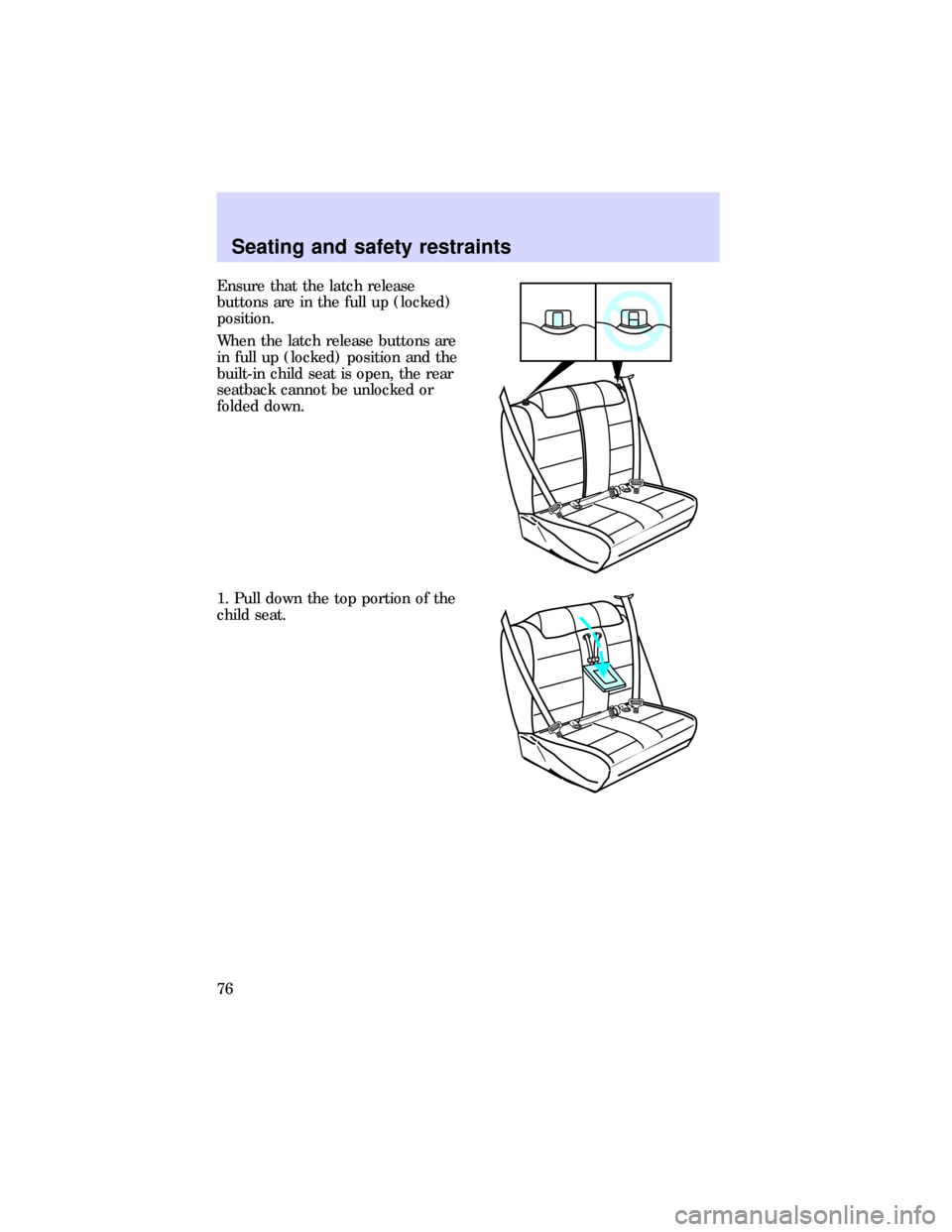
1. Pull down the top portion of the
child seat.
Seating and safety restraints
76
Page 80 of 191
If both tongues do not
latch in the buckle, do not
use the child seat. See your
dealer for repairs.
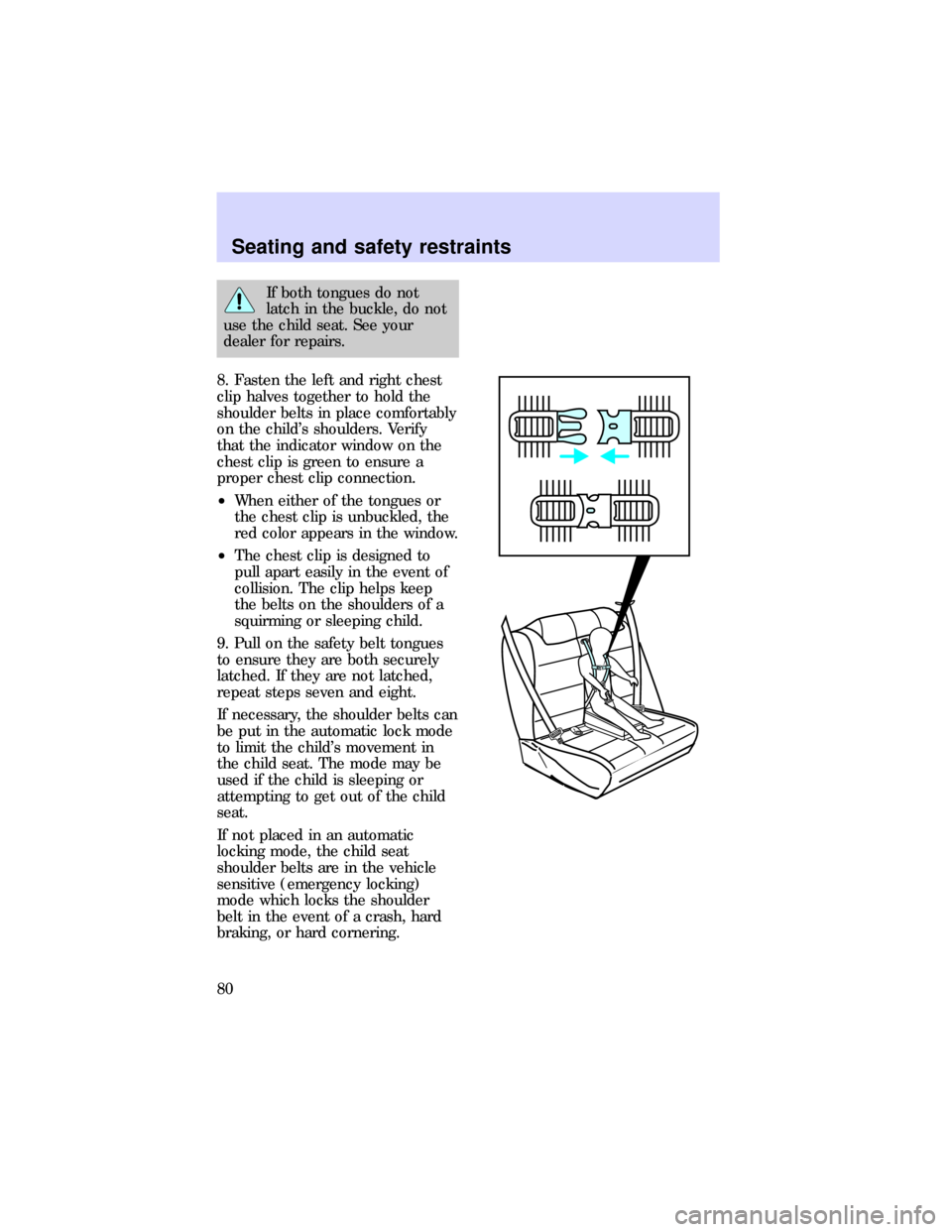
8. Fasten the left and right chest
clip halves together to hold the
shoulder belts in place comfortably
on the child's shoulders. Verify
that the indicator window on the
chest clip is green to ensure a
proper chest clip connection.
²When either of the tongues or
the chest clip is unbuckled, the
red color appears in the window.
²The chest clip is designed to
pull apart easily in the event of
collision. The clip helps keep
the belts on the shoulders of a
squirming or sleeping child.
9. Pull on the safety belt tongues
to ensure they are both securely
latched. If they are not latched,
repeat steps seven and eight.
If necessary, the shoulder belts can
be put in the automatic lock mode
to limit the child's movement in
the child seat. The mode may be
used if the child is sleeping or
attempting to get out of the child
seat.
If not placed in an automatic
locking mode, the child seat
shoulder belts are in the vehicle
sensitive (emergency locking)
mode which locks the shoulder
belt in the event of a crash, hard
braking, or hard cornering.
Seating and safety restraints
80
Page 81 of 191
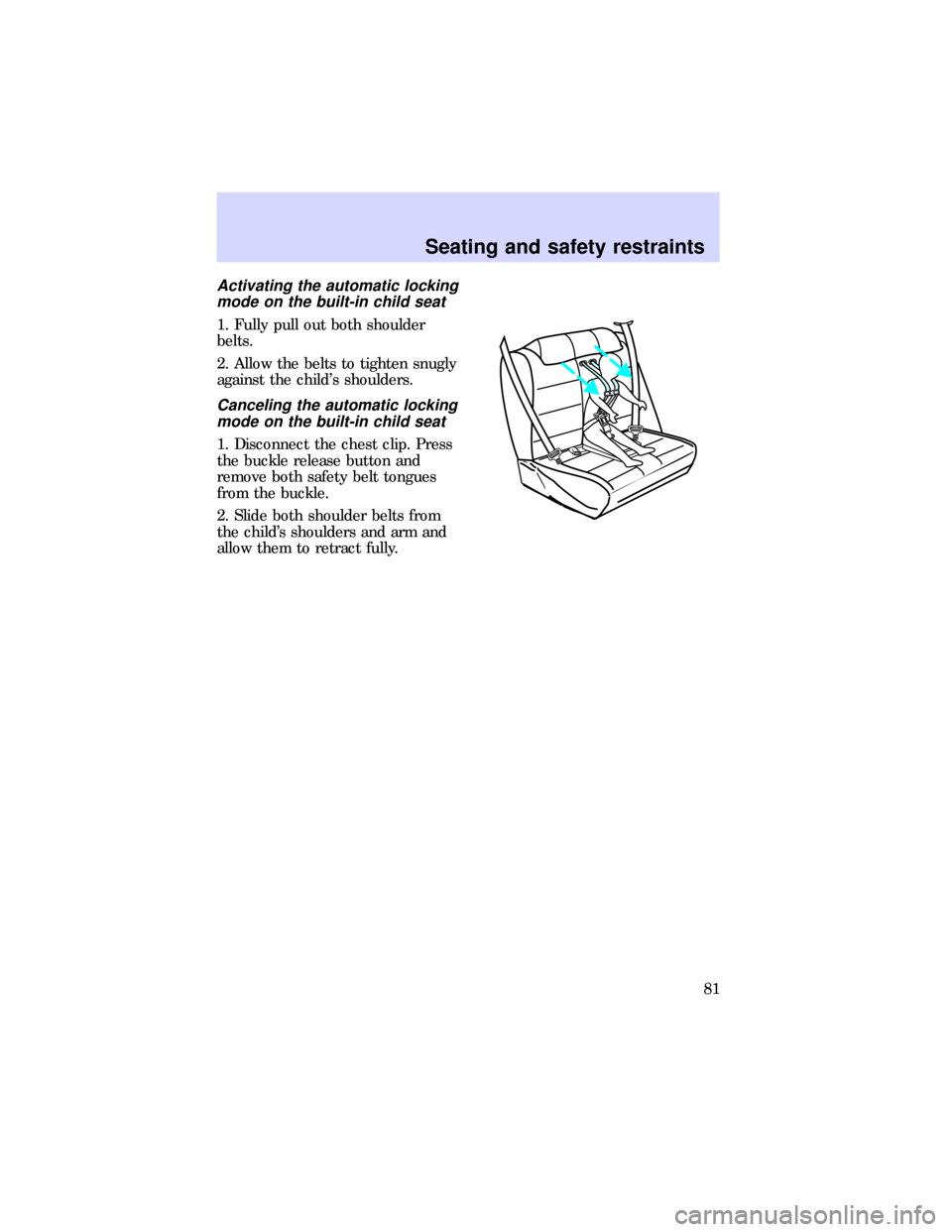
Activating the automatic locking
mode on the built-in child seat
1. Fully pull out both shoulder
belts.
2. Allow the belts to tighten snugly
against the child's shoulders.
Canceling the automatic locking
mode on the built-in child seat
1. Disconnect the chest clip. Press
the buckle release button and
remove both safety belt tongues
from the buckle.
2. Slide both shoulder belts from
the child's shoulders and arm and
allow them to retract fully.
Seating and safety restraints
81
Page 84 of 191
Inspecting the built-in child seat
after a collision
All built-in child restraints,
including seats, buckles,
retractors, seat latches,
interlocks, and attaching
hardware should be inspected by
a qualified Dealer technician
after any collision. If the child
seat was in use during a
collision, Ford recommends
replacing it. However, if the
collision was minor and a
qualified technician finds that
the child restraints do not show
damage and continue to operate
properly, they do not need to be
replaced. Built-in child seats not
in use during a collision should
also be inspected and replaced if
either damage or improper
operation is noted.
For information on cleaning your
built-in child seat, refer to
Cleaning the built-in child seat
in theMaintenance and care
section.
Seating and safety restraints
84
Page 88 of 191
4. Turn the key to the ON position
(without turning the key to
START). Make sure the following
lights illuminate briefly. If a light
fails to illuminate, have the vehicle
serviced.
If the driver's safety belt is
fastened, the
light does not
illuminate.
STARTING THE VEHICLE
After completing the steps under
Preparing to start the vehicle:
1. Turn the key to START and
release.Do notpress the
accelerator.
²The key will return to the ON
position.
2. After idling for a few seconds,
apply the brake and release the
parking brake.
ON
II
ACC
I
LOCK
0
START
III
MP
km/10 203040520 4060
80
SERVICE
ENGINE
SOON
LOW
FUELABS
0
80
90
10 0
12 011 012 0
16 0
18 0 140
200
CHECK
COOLANTTHEFT
ON
II
ACC
I
LOCK
0
START
III
Starting
88
Page 89 of 191

Special conditions when
starting
Starting a cold engine
At temperatures -12ÉC (10ÉF) and
below, do not hold the key in the
START position longer than 15
seconds. If the engine does not
start on the first attempt:
1. Turn the ignition key to LOCK
and wait approximately ten
seconds.
2. Try starting the engine again.
At temperatures above -12ÉC
(10ÉF), do not hold the key in the
START position longer than five
seconds. If the engine does not
start on the first attempt:
1. Turn the ignition key to LOCK
and wait approximately five
seconds.
2. Try starting the engine again.
Starting a warm engine
Do not hold the key in the START
position longer than five seconds.
If the engine does not start on the
first attempt:
1. Turn the ignition key to LOCK
and wait a few seconds until the
starter stops.
2. Try starting the engine again.
Starting the engine after two
failed attempts
If the engine does not start after
two attempts:
1. Turn the key to LOCK and wait
about two minutes.
Starting
89