Page 124 of 191

SERVICE RECOMMENDATIONS
Whenever possible, Ford has
designed parts that do not require
servicing. However when servicing
is required, Ford's goal is to make
servicing your vehicle as easy as
possible. To help you:
²We highlight do-it-yourself items
in the engine compartment for
easy location.
²Often, parts (such as the
headlamp bulbs) may be
replaced without tools.
²We provide you with aService
Guidethat makes tracking
routine service of your vehicle
easy.
If your vehicle requires
professional servicing, your
dealership can provide the
necessary parts and service. Check
theWarranty Information Guide
to find out what parts and services
are covered. Use only
recommended fuels, lubricants,
fluids, and service parts
conforming to Ford specifications.
Motorcraft parts are designed and
built to provide the best
performance in your vehicle.
Precautions for servicing your
vehicle
Be particularly careful when
inspecting or servicing your
vehicle. Here are some general
precautions for your safety:
Maintenance and care
124
Page 125 of 191
²Never get under a vehicle that is
supported only by a jack. If you
must work under a vehicle, use
safety stands.
²Keep all lit cigarettes and other
smoking materials away from
the battery and all fuel-related
parts.
Working with the engine off
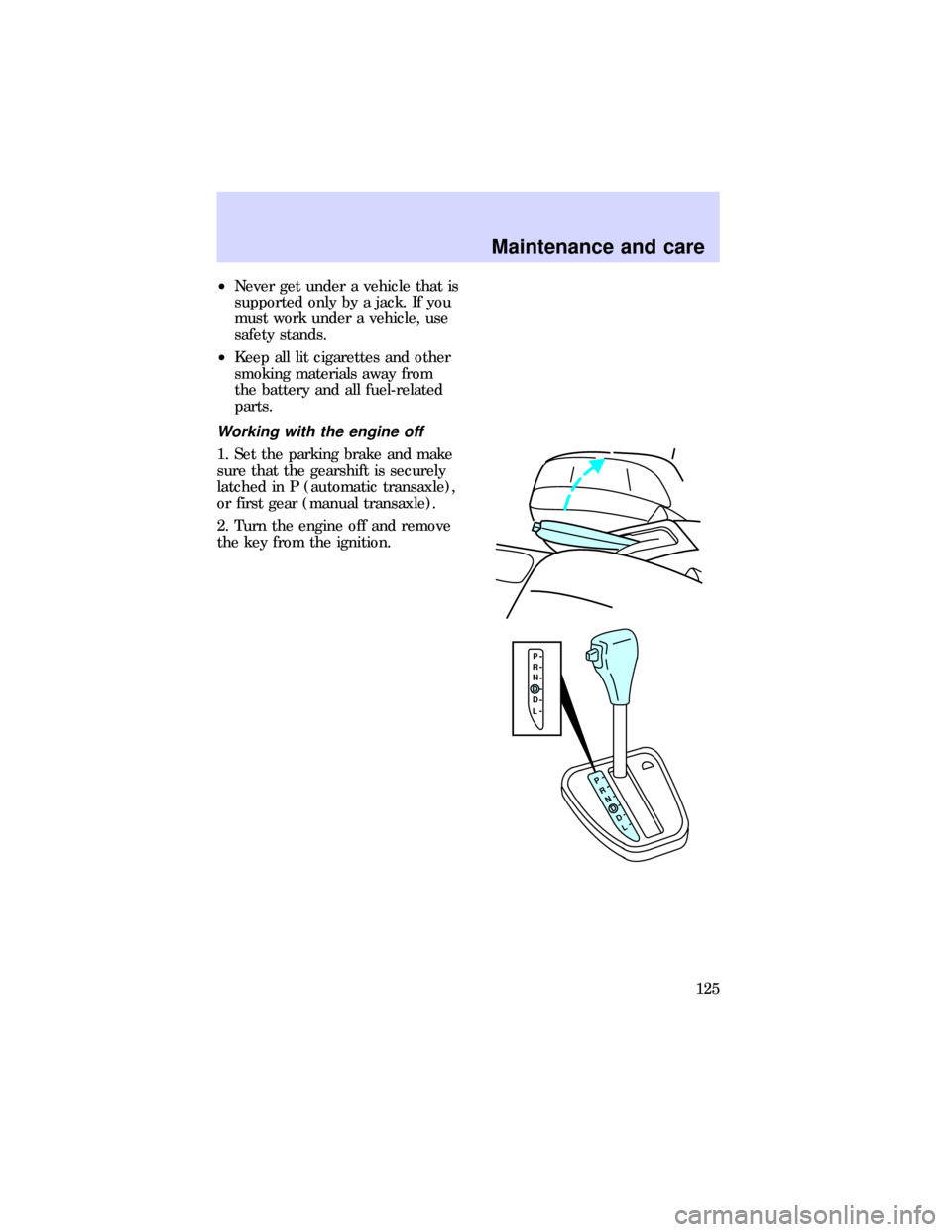
1. Set the parking brake and make
sure that the gearshift is securely
latched in P (automatic transaxle),
or first gear (manual transaxle).
2. Turn the engine off and remove
the key from the ignition.
P
R
N
D
D
L
R
N
D
D
LP
Maintenance and care
125
Page 128 of 191
3. Block the wheels to prevent the
vehicle from moving unexpectedly.
4. If work must be done with the
engine running, avoid wearing
loose clothing or jewelry that could
get caught in moving parts. Take
appropriate precautions with long
hair.
Opening the hood
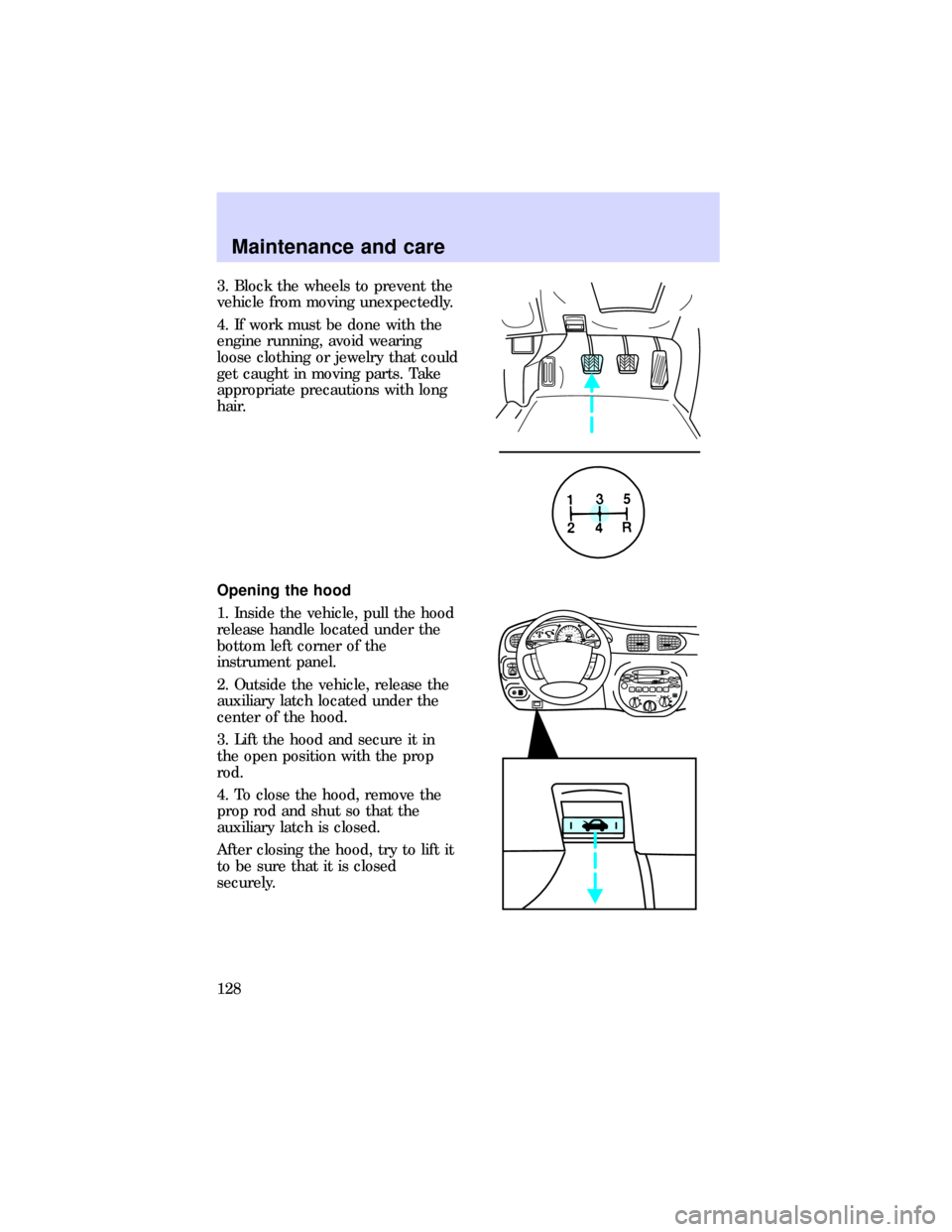
1. Inside the vehicle, pull the hood
release handle located under the
bottom left corner of the
instrument panel.
2. Outside the vehicle, release the
auxiliary latch located under the
center of the hood.
3. Lift the hood and secure it in
the open position with the prop
rod.
4. To close the hood, remove the
prop rod and shut so that the
auxiliary latch is closed.
After closing the hood, try to lift it
to be sure that it is closed
securely.
5
HI LOOFF*A/C*MAX
A/C
TUNE
DISCS
SEEK
TUNE
SCAN
EJ REW FF
BAL BASSTREBFADE TAPE
CD AM
FM
–+1
SIDE 1-22
345
COMP1
SIDE 1-2VOL–
PUSH ON
LMIRRORR
0000000002030405060
70
80
90
10 0
11 020 40608010 0
12 0
16 0
18 0 140FUEL FILLCHEF1/22
13RPM x 1000
RESET
SET
ACC
SET XXXX XXXOFF2INT
1 OFF MIST
Maintenance and care
128
Page 130 of 191
CHECKING AND ADDING
ENGINE OIL
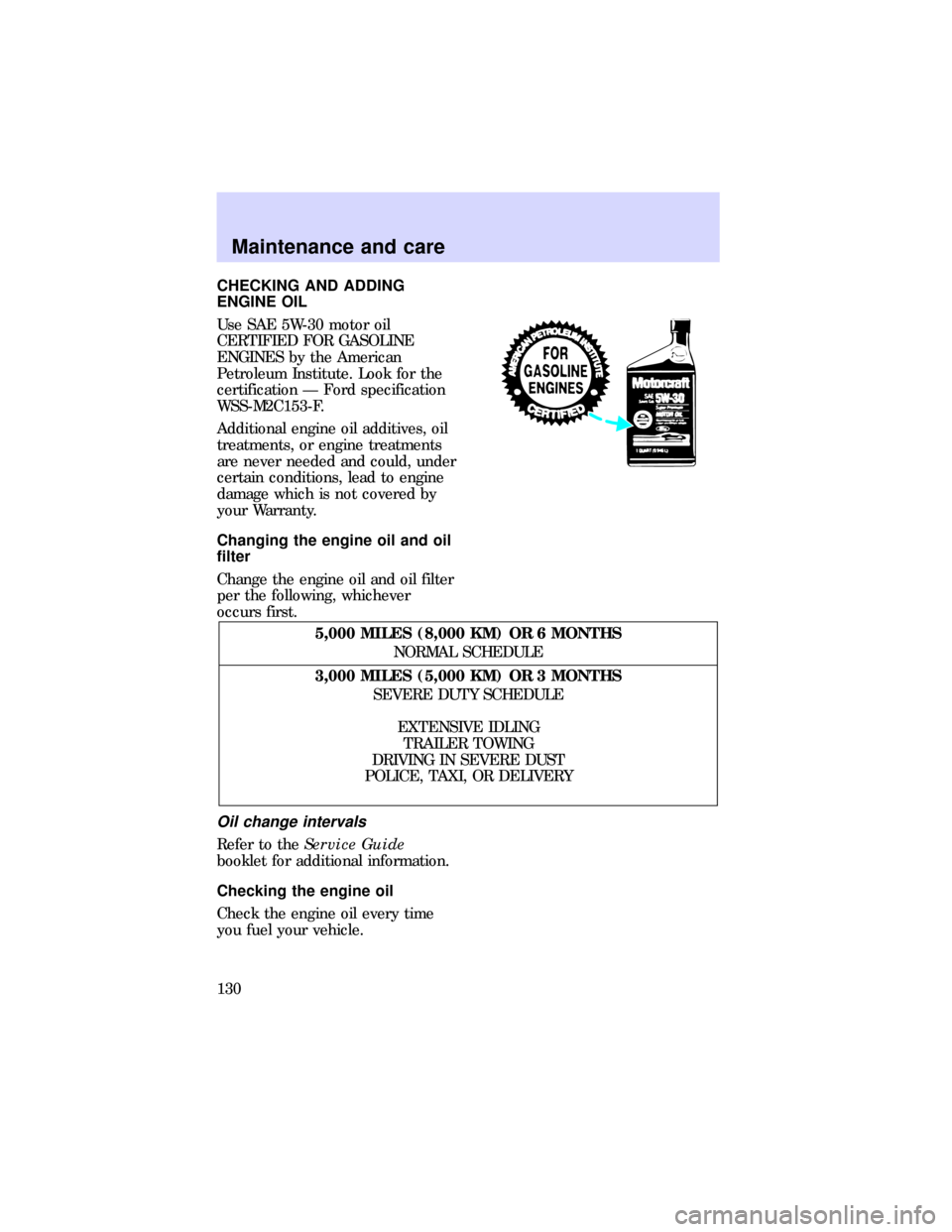
Use SAE 5W-30 motor oil
CERTIFIED FOR GASOLINE
ENGINES by the American
Petroleum Institute. Look for the
certification Ð Ford specification
WSS-M2C153-F.
Additional engine oil additives, oil
treatments, or engine treatments
are never needed and could, under
certain conditions, lead to engine
damage which is not covered by
your Warranty.
Changing the engine oil and oil
filter
Change the engine oil and oil filter
per the following, whichever
occurs first.
5,000 MILES (8,000 KM) OR 6 MONTHS
NORMAL SCHEDULE
3,000 MILES (5,000 KM) OR 3 MONTHS
SEVERE DUTY SCHEDULE
EXTENSIVE IDLING
TRAILER TOWING
DRIVING IN SEVERE DUST
POLICE, TAXI, OR DELIVERY
Oil change intervals
Refer to theService Guide
booklet for additional information.
Checking the engine oil
Check the engine oil every time
you fuel your vehicle.
Maintenance and care
130
Page 153 of 191
²Install chains securely, verifying
that the chains do not touch any
wiring, brake lines, or fuel lines.
²Install tire chains on front tires
only.
²Drive cautiously. If you hear the
chains rub or bang against your
vehicle, stop and retighten the
chains. If this does not work,
remove the chains to prevent
damage to your vehicle.
²When possible, avoid
overloading your vehicle.
²Remove the tire chains when
they are no longer needed. Do
not use tire chains on dry roads.
²The suspension insulation and
bumpers will help prevent
vehicle damage. Do not remove
these components from your
vehicle when using snow tires
and chains.
WHAT YOU SHOULD KNOW
ABOUT AUTOMOTIVE FUEL
Automotive fuels can
cause serious injury or
death if misused or mishandled.
Observe the following guidelines
when handling automotive fuel:
²Extinguish all smoking material
and any open flames before
fueling your vehicle.
²Automotive fuels can be harmful
or fatal if swallowed. If fuel is
swallowed, call a physician
immediately, even if no
Maintenance and care
153
Page 154 of 191
symptoms are apparent. The
toxic effects of fuels may not be
evident for many hours.
²Fuels can also be harmful if
absorbed through the skin. If
fuel is splashed on the skin,
promptly remove contaminated
clothing and wash skin
thoroughly with soap and water.
²If fuel is splashed in the eyes,
remove contact lenses, flush
eyes with water for fifteen
minutes, and seek immediate
medical attention.
²Be particularly careful if you are
taking Antabuse or other forms
of disulfiram for the treatment
of alcoholism. Breathing gasoline
vapors or skin contact with fuel
could cause an adverse reaction.
Consult a physician immediately.
If you replace your fuel cap with
an aftermarket fuel filter cap, the
customer warranty may be void if
any damage to the fuel tank and/or
fuel system occurs.
Do not overfill the fuel
tank. The pressure in an
overfilled tank may cause
leakage and lead to fuel spray
and fire.
If you do not use a proper
fuel cap, the pressure in
the fuel tank can damage the
fuel system or cause it to work
improperly in a collision.
Maintenance and care
154
Page 155 of 191
If the fuel cap is venting
vapor or you hear a hissing
sound, wait until it stops before
completely removing the cap.
CHOOSING THE RIGHT FUEL
Use only UNLEADED FUEL. The
use of leaded fuel is prohibited by
law and could damage your
vehicle. The damage may not be
covered by your warranty.
Your vehicle was not designed to
use fuel containing
manganese-based additives such as
MMT. Additionally, vehicles
certified to California emission
standards (indicated on the
underhood Vehicle Emissions
Control Information label) are
designed to operate on California
reformulated gasolines. If
California reformulated gasoline is
not available when you refuel, your
vehicle can be operated on
non-California fuels. However, even
though your engine will perform
adequately on other gasolines, the
performance of the emission
control devices and systems may
be adversely affected. Repair of
damage caused by using a fuel that
your vehicle was not designed for
may not be covered by your
warranty.
87
Maintenance and care
155
Page 156 of 191

Octane Recommendation
Your vehicle is designed to use regular gasoline with an (R+M)/2
octane rating of 87. We do not recommend gasolines labeled as
``regular'' in high altitude areas that are sold with octane ratings
of 86 or even less.
Do not be concerned if your
vehicle sometimes knocks lightly.
However, if it knocks heavily under
most driving conditions on the
recommended octane fuel, see
your dealer or a qualified service
technician to prevent any engine
damage.
Fuel Quality
If you are experiencing starting,
rough idle or hesitation problems,
try a different brand of fuel. If the
condition persists, see your dealer
or a qualified service technician.
The American Automobile
Manufacturers Association (AAMA)
issued a gasoline specification to
provide information on high quality
fuels that optimize the
performance of your vehicle. We
recommend the use of gasolines
that meet the AAMA specification
if they are available.
It should not be necessary to add
any aftermarket products to your
fuel tank if you continue to use a
high-quality fuel.
Cleaner Air
Ford approves the use of gasolines
to improve air quality, including
reformulated gasolines, that
contain oxygenates such as a
Maintenance and care
156