Page 157 of 191
maximum of 10% ethanol or 15%
MTBE. There should be no more
than 5% methanol with cosolvents
and additives to protect the fuel
system.
WHAT YOU SHOULD KNOW
ABOUT THE EMISSION
CONTROL SYSTEM
For more information on your
vehicle's emission control system,
see the Vehicle Emission Control
Information Decal located on the
inside left side of the engine
compartment.
The catalytic converter enables the
vehicle's emission control system
to operate properly.
Follow these guidelines to ensure
proper emission system operation:
²Use only unleaded fuel.
²Avoid running out of fuel.
²Do not turn off the ignition
while your vehicle is in motion.
²Have maintenance performed
according to the intervals in the
Service Guide.
If you notice one or more of the
following, the emission system may
not be working properly; have the
vehicle serviced as soon as
possible:
²fluid leaks
²
,,, lights
illuminate in the instrument
cluster and remain lit
²strange odors
Maintenance and care
157
Page 158 of 191
²engine runs more than five
seconds after shut off or engine
misfires, surges, stalls, or
backfires
²loss of oil pressure
Important emission control
information
By law, anyone who manufactures,
repairs, services, sells, leases, or
trades vehicles, or who supervises
a fleet of vehicles is not permitted
to intentionally remove an
emission control device or prevent
it from working. Do not make any
unauthorized changes to the
vehicle or engine. Changes that
cause more unburned fuel to reach
the exhaust system can increase
the temperature of the engine or
exhaust system.
When your vehicle is serviced,
never use a metal exhaust
collector. The use of a metal
collector may melt or deform
plastic parts.
Do not park, idle, or drive
your vehicle in dry grass
or other dry ground cover. The
emission system heats up the
engine compartment and exhaust
system, which can start a fire.
Preparing your vehicle for
inspection / maintenance (I/M)
testing
In some localities it may become a
legal requirement to pass an I/M
test of the on-board diagnostic
Maintenance and care
158
Page 176 of 191

After washing your vehicle, apply
the brakes several times to dry
them.
Repairing paint chips
Minor scratches or paint damage
from road chippings may be
camouflaged with Ford exterior
lacquer touch-up paint,
AL81-XXXX-B or
ALBZ-19500-XXXXA. XXXX
indicates the code, meeting Ford
specification ESR-M2P100-C.
Follow the application instructions
on the product. Be sure to remove
aggressive particles such as bird
droppings, tree resins, insect
remains, tar spots, and road salt,
that may damage your paint.
Cleaning the wheels
Wash the wheels with the same
detergent used to clean the body
of your vehicle. Do not use acid
based wool cleaners, steel wool,
fuel, or strong detergents. Never
use abrasives that will damage the
finish of special wheel surfaces.
Use a tar and road oil remover to
remove grease and tar.
Cleaning plastic parts
Some of the vehicle's trim parts
are plastic. Clean with a tar and
road oil remover if necessary. Use
a vinyl cleaner for routine cleaning.
Do not clean plastic parts with
thinners, solvents, or petroleum
based cleaners.
Maintenance and care
176
Page 177 of 191

Cleaning the instrument panel
Any cleaner or polish that
increases the gloss of the upper
portion of the instrument panel
should be avoided. The dull finish
in this area is to help protect the
driver from windshield reflection.
Cleaning the exterior lamps
Do not use dry paper towels,
chemical solvents, or abrasive
cleaners to clean the lamps; these
products may cause scratches or
crack the lamps.
Cleaning the engine
A clean engine is more efficient
than a dirty one because a buildup
of grease and dirt acts as an
insulator and keeps the engine
warmer than normal. Follow these
guidelines to clean your engine:
²Take care when using a power
washer to clean the engine. The
high pressure fluid could
penetrate sealed parts and
cause damage.
²In order to avoid cracking the
engine block or fuel injection
pump, do not spray these
components with cold water.
²The alternator and air intake
must be covered to prevent
water damage when cleaning the
engine.
²Never wash or rinse the engine
while it is running; water in a
running engine may cause
internal damage.
Maintenance and care
177
Page 178 of 191
Cleaning the wiper blades
If the blades do not wipe properly,
clean both the windshield and the
wiper blades using undiluted
windshield washer solution or a
mild detergent. Rinse thoroughly
with clean water. Do not use fuel,
kerosene, paint thinner, or other
solvents to clean the wiper blades;
these fluids will damage the
blades.
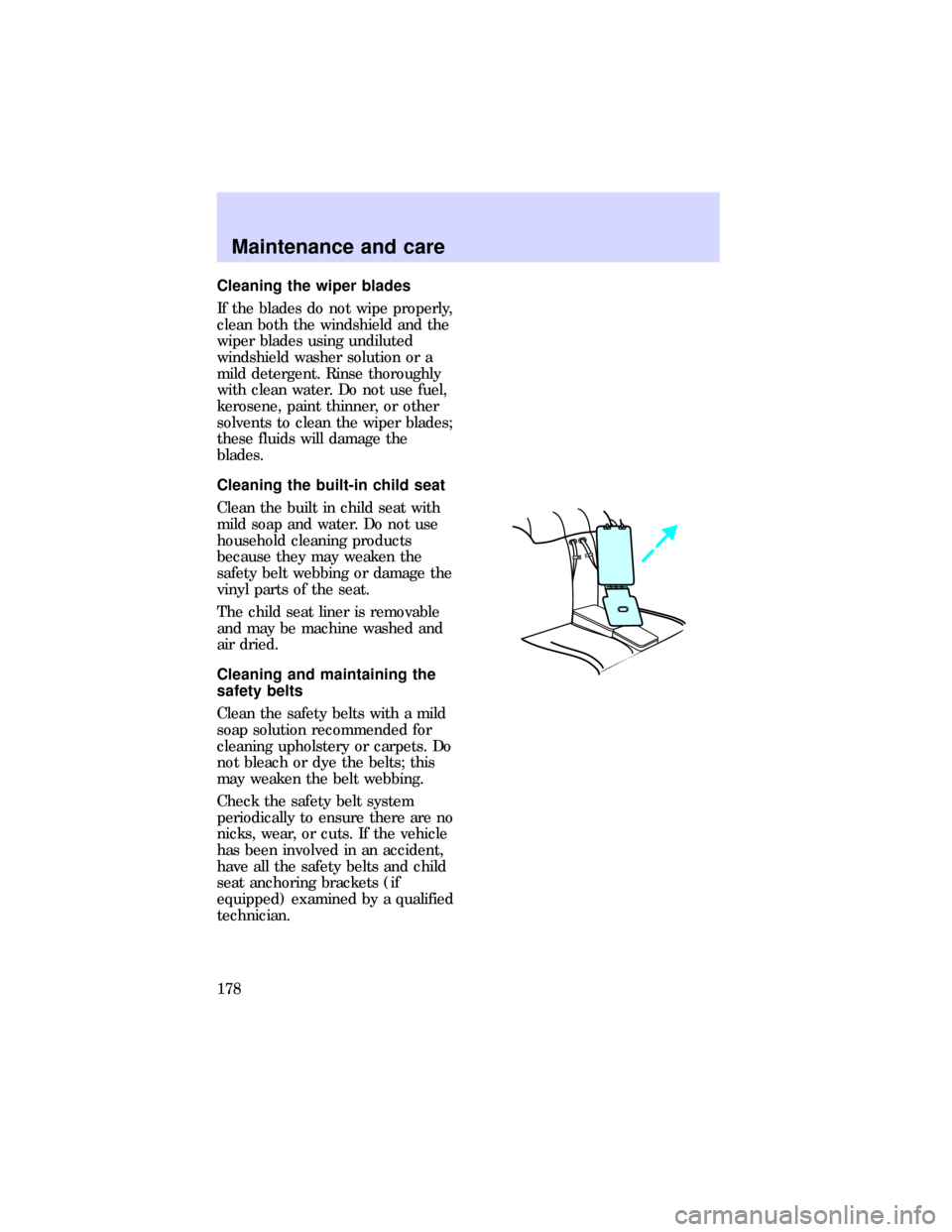
Cleaning the built-in child seat
Clean the built in child seat with
mild soap and water. Do not use
household cleaning products
because they may weaken the
safety belt webbing or damage the
vinyl parts of the seat.
The child seat liner is removable
and may be machine washed and
air dried.
Cleaning and maintaining the
safety belts
Clean the safety belts with a mild
soap solution recommended for
cleaning upholstery or carpets. Do
not bleach or dye the belts; this
may weaken the belt webbing.
Check the safety belt system
periodically to ensure there are no
nicks, wear, or cuts. If the vehicle
has been involved in an accident,
have all the safety belts and child
seat anchoring brackets (if
equipped) examined by a qualified
technician.
Maintenance and care
178
Page 179 of 191
MOTORCRAFT PART NUMBERS
Component Ford part number Ð 2.0 liter
SPI engine
Air filter F7CX-9601-AA
Battery BX-58C
Fuel filter FG-862
Oil filter FL400-A
PCV valve EV-229
Spark plug* AGSF-34-E
* Refer to the Vehicle Emission
Control Information (VECI) decal,
located on the underside of the
hood, for gap specifications.
REFILL CAPACITIES
Your vehicle's fuel capacity
The fuel capacity for your vehicle
is 48.0 L (12.7 gallons).
²To avoid overspill from the filler
neck, stop fueling at the second
automatic shut off.
²For more information on fueling
your vehicle, refer toChoosing
the right fuelin the
Maintenance and carechapter.
Capacities and specifications
179
Page 182 of 191
ENGINE DATA
Engine 2.0 liter; 121 CID; 4 cylinder (in-line);
compression ratio 9.2:1; single overhead cam;
split port induction (SPI)
Horsepower 110 at 5,000 rpm
Torque 169 Nm (125 lb ft at 3,750 rpm)
Required fuel grade 87 (R+M)/2
Firing order /
Injection timing1-3-4-2
Spark plug gap 1.3 to 1.4 mm / 0.052 to 0.056
Ignition system DIS
Valve clearances cold
inlet exhaust0: Maintenance free 0: Maintenance free
VEHICLE DIMENSIONS
Dimensions Ð cm
(inches)Sedan Wagon
V1Overall length 443.25 cm (174.5 in) 439.1 cm (172.9 in)
V2Overall width
(excluding exterior
mirrors)168.00 cm (66.2 in) 170 cm (67 in)
V3Maximum height 135.00 cm (53.2 in) 136.9 cm (53.9 in)
V4Wheelbase 250.00 cm (98.4 in) 250 cm (98.4 in)
V5Track Front
Rear143.5 cm (56.5 in),
143.5 cm (56.5 in)143.5 cm (56.5 in),
143.5 cm (56.5 in)
Capacities and specifications
182
Page 188 of 191

Engine oil ..................................130
check oil warning light ...............9
checking and adding ..............130
Exhaust fumes ............................91
Fan ...............................................18
Flashing the lights ......................27
Floor mats ...................................39
Foglamps ..............................27,163
Fuel
capacity ...................................179
improving fuel economy ........106
low fuel warning light ................7
safety information relating to
automotive fuels .....................153
Fuel pump shut-off switch ..43,107
starting after a collision ...........43
Fuse panels
engine compartment ..............113
instrument panel ....................111
Fuses ..........................................109
charts ................................111,113
checking and replacing ..........109
circuit breakers .......................110
Gauges, Electronic ......................12
Gauges, Mechanical ....................12
engine coolant temperature
gauge .........................................13
fuel gauge ..................................13
odometer ...................................14
speedometer .............................13
trip odometer ............................14
Gearshift .................................36,97
GVWR (Gross Vehicle Weight
Rating) .......................................101
definition .................................101
Hazard flashers ....................29,107
Head restraints ...........................54
Headlamps
daytime running lights .............26
replacing bulbs .......................162
turning on and off ....................26High beams
indicator light .............................9
operation ...................................27
High-mount brakelamp
replacing the bulb ..................164
Hood ..........................................128
prop rod ..................................128
release lever ............................128
working under the hood ........124
Idle
relearning ................................144
Ignition
positions of the ignition ...........25
Inspection/maintenance (I/M)
testing ........................................158
Instrument cluster
sport .........................................6,7
standard ......................................6
Instrument panel ........................15
lighting up panel and interior 6,15
location of components ...........4,5
Interval wipers ............................30
Jump-starting your vehicle ......120
attaching cables ......................121
disconnecting cables ..............122
Lamps ........................................160
bulb replacement
specifications chart ................172
daytime running light system ..26
dome lamps .............................170
fog lamps ............................27,163
headlamps ..........................26,162
high beams ................................27
high-mount brakelamp ...........164
illuminated entry system .........33
interior lamps ....................31,170
map lamps ..........................31,171
replacing bulbs .......................160
tail lamps ..........................167,168
License plate lamps ..................165
Liftgate .................................40,164
warning light .............................10
Index
188