Page 23 of 192
STEERING COLUMN
CONTROLS
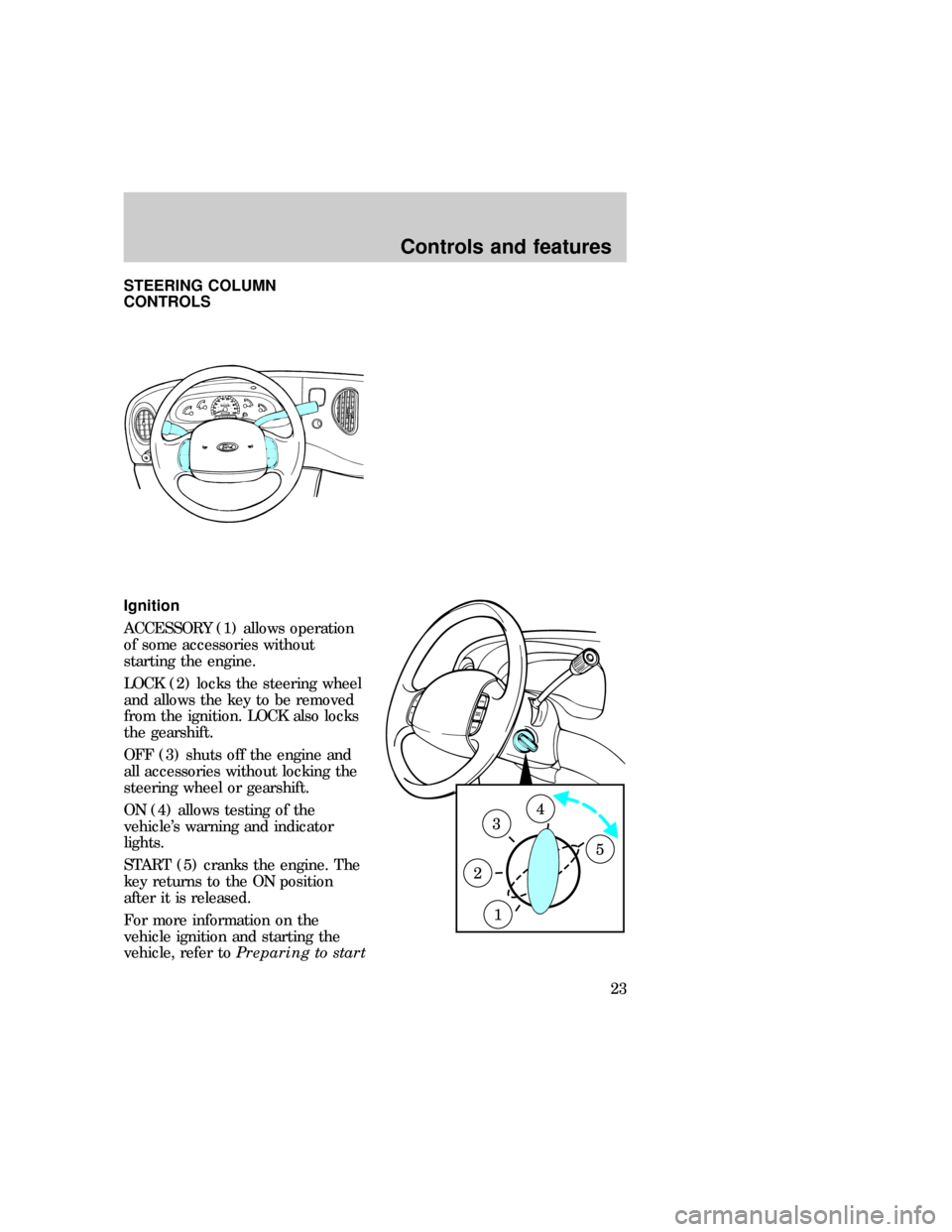
Ignition
ACCESSORY (1) allows operation
of some accessories without
starting the engine.
LOCK (2) locks the steering wheel
and allows the key to be removed
from the ignition. LOCK also locks
the gearshift.
OFF (3) shuts off the engine and
all accessories without locking the
steering wheel or gearshift.
ON (4) allows testing of the
vehicle's warning and indicator
lights.
START (5) cranks the engine. The
key returns to the ON position
after it is released.
For more information on the
vehicle ignition and starting the
vehicle, refer toPreparing to start
RES
SET
ACCEL
COASTON
OFF
xxx
xxxxxx
xxxx
x
4
5
3
2
1
eco_ignition_position
Controls and features
23
Page 26 of 192
Transmission control indicator
light (TCIL)
The TCIL (the word ªOFFº)
located on the gearshift lever
indicates the status of the
transmission.
The TCIL may flash steady if a
malfunction is detected. If this
occurs have your transmission
serviced by your Ford dealer as
soon as possible or damage may
occur.
Tilt steering
Pull the control to adjust the
steering column angle. Push the
control back up to lock the
steering wheel into position.
Never adjust the steering
wheel when the vehicle is
moving.
OVERDRIVE OFF
eco_tilt-steering
eco_hazard_flasher
Controls and features
26
Page 53 of 192
All occupants of the
vehicle, including the
driver, should always wear their
safety belts, failure to do so may
increase the risk of personal
injury in the event of a collision.
The right front passenger
air bag is not designed to
restrain occupants in the center
front seating position.
Do not place objects or
mount equipment on or
near the dashboard area,
steering wheel or in front of the
passenger that may come in
contact with a deploying air bag.
Failure to follow this instruction
may increase the risk of personal
injury in the event of a collision.
Do not attempt to service,
repair, or modify the Air
Bag Supplemental Restraint
System or its fuses. See your
Ford or Lincoln-Mercury dealer.
If you are close to an
inflating air bag, it could
seriously injure you. Sit against
the seatback and position your
seat such that it is as far back
from the steering wheel as
possible but still allows you to
properly control the vehicle.
eco_children
Seating and safety restraints
53
Page 80 of 192

BRAKES
Your brakes are self-adjusting.
Refer to the ªService Guideº for
maintenance scheduling.
Anti-lock brake system (ABS) (if
equipped)
The ABS operates by detecting the
onset of wheel lock up during
brake applications and
compensating for this tendency.
The front wheels are prevented
from locking even when the brakes
are firmly applied. The
accompanying illustration depicts
the advantage of an ABS equipped
vehicle (on bottom) to a non-ABS
equipped vehicle (on top) during
hard braking.
Using ABS
²In an emergency, apply full force
on the brake. The ABS will be
activated immediately, thus
allowing you to retain full
steering control of your vehicle
and, providing there is sufficient
space, will enable you to avoid
obstacles and bring the vehicle
to a quiet stop.
²We recommend that you
familiarize yourself with this
braking technique. However,
avoid taking any unnecessary
risks.
Parking brake
The parking brake should be used
whenever you park your vehicle. It
is not designed to stop a moving
com_brakes.01
com_abs.01
com_using_abs.01
eco_parking_brake
Driving
80
Page 82 of 192
Releasing parking brake
²Push parking brake pedal down
firmly, then release.
If the parking brake is fully
released, but the Brake
System light remains on, have
the brakes checked immediately.
They may not be working
properly.
STEERING YOUR VEHICLE
If the amount of effort needed to
steer your vehicle changes at a
constant speed, have the vehicle
power steering system checked.
Never hold the steering wheel to
the extreme left or right for more
than five seconds if the engine is
running. This can damage the
power steering pump.
After any severe impact or
collision involving the front end,
observe the steering wheel
alignment. If the spoke of the
eco_steeing_vehicle
Driving
82
Page 83 of 192
steering wheel seem to be in a
different position while going
straight down the road, have the
suspension and steering checked
for possible damage.
AUTOMATIC TRANSMISSION
OPERATION
Hold the brake pedal down
while you move the
gearshift lever from position to
position. If you do not hold the
brake pedal down, your vehicle
may move unexpectedly and
injure someone.
Pull the gearshift lever towards
you and downward to move the
automatic gearshift.
P (Park)Ð Always come to a
complete stop before shifting into
or out of P (Park).
When you leave your
vehicle, place the gearshift
lever in P (Park). Set the
parking brake fully, and shut off
the engine. Never park your
vehicle in N (Neutral). If you do
not take these precautions, your
vehicle may move suddenly and
injure someone.
R (Reverse)Ð Always come to a
complete stop before shifting into
or out of R (Reverse).
P RN 21D
P RN 21D
eco_automatic_trans
Driving
83
Page 93 of 192
Trailer Towing Table
GCWR (Gross Combined Weight Rating)/Trailer Weights
EngineRear axle
ratioMaximum
GCWR kg
(lb)Trailer weight
range kg (lb)
(0-Maximum)Maximum
Frontal Area Of
Trailer Ft
2
6.8L 3.736,804
(15,000)3,901
(8,600)60
6.8L 4.108,392
(18,500)4,536
(10,000)60
E-350 RV Cutaway (single rear wheel)
7.3L
(Diesel)4.109,072
(20,000)4,717
(10,400)60
E-350 RV Cutaway (dual rear wheel)
5.4L 4.105,897
(13,000)1,134
(2,500)60
6.8L 4.108,392
(18,500)3,629
(8,000)60
7.3L
(Diesel)4.109,072
(20,000)4,309
(9,500)60
E-350 Commercial Cutaway (single rear wheel)
7.3L
(Diesel)4.109,072
(20,000)4,717
(10,400)60
E-350 Commercial Cutaway (dual rear wheel)
5.4L 4.105,897
(13,000)1,225
(2,700)60
6.8L 4.108,392
(18,500)3,720
(8,200)60
7.3L
(Diesel)4.109,072
(20,000)4,400
(9,700)60
E-Super Duty
6.8L 4.639,072
(20,000)4,536
(10,000)60
7.3L
(Diesel)4.639,072
(20,000)4,536
(10,000)60
Driving
93
Page 94 of 192

Trailer Towing Table
GCWR (Gross Combined Weight Rating)/Trailer Weights
EngineRear axle
ratioMaximum
GCWR kg
(lb)Trailer weight
range kg (lb)
(0-Maximum)Maximum
Frontal Area Of
Trailer Ft
2
E-250/350 Stripped Chassis (single rear wheel)
5.4L 4.105,897
(13,000)1,542
(3,400)60
6.8L 3.736,804
(15,000)2,540
(5,600)60
E-250/350 Stripped Chassis (dual rear wheel)
5.4L 4.105,897
(13,000)1,361
(3,000)60
6.8L 4.108,392
(18,500)3,856
(8,500)60
For high altitude operation, reduce GCWR by 2% per 300 meters
(1,000 ft) elevation.
To determine the maximum trailer weight designed for you particular
vehicle as equipped, follow the section Calculating the load your
vehicle can tow/carryearlier in this chapter.
TRAILER TOWING
Your vehicle may tow a class I, II
or III trailer provided the
maximum trailer weight is less
than or equal to the maximum
trailer weight listed for your engine
and rear axle ratio on the above
charts.
Your vehicle's load capacity is
designated by weight, not by
volume, so you cannot necessarily
use all available space when
loading a vehicle.
Distribute the load so that only 10
to 15% of the total is on the
tongue. Tie down the load so that
eco_trailer
Driving
94