Page 97 of 192

hilly country or on hot days.
Speed control may shut off if you
are towing on very long, steep
grades.
When towing a trailer
If towing a trailer and your vehicle
is not equipped with the Ford
trailer tow package, an auxiliary
transmission fluid cooler is
recommended.
²Use D (Drive) rather than
D(Overdrive) while towing up
or down steep hills. This will
eliminate excessive downshifting
and upshifting for optimum fuel
economy and transmission
cooling.
²Anticipate stops and brake
gradually.
²Allow more room for stopping
with a trailer attached.
²Practice turning, stopping and
backing in an area before
starting on a trip to get the feel
of the vehicle/trailer
combination.
²When turning, drive slightly
beyond the normal turning point
so the trailer wheels will clear
curbs and other obstacles.
²When stopped in traffic for long
periods of time in hot weather,
place the gearshift in P (Park)
to increase idle speed. This aids
engine cooling and air
conditioner efficiency.
²Vehicles with trailers should not
be parked on a grade. If you
eco_when_towing
Driving
97
Page 98 of 192
must park on a grade, place
wheel chocks under the trailer's
wheels.
²After you have travelled about
80 km (50 miles), thoroughly
check your hitch, electrical
connections and trailer wheel
lug nuts.
Launching or retrieving a boat
When backing down a ramp during
boat launching or retrieval,
²Do not allow the static water
level to rise above the bottom
edge of the rear bumper and
²Do not allow waves to break
higher than 15 cm (six inches)
above the bottom edge of the
rear bumper.
Exceeding these limits may allow
water to enter critical vehicle
components, adversely affecting
driveability, emissions and
reliability.
Servicing when towing
If you tow a trailer for long
distances, your vehicle will require
more frequent service intervals.
Follow the severe duty
maintenance schedule outlined in
the ªService Guide.º
com_launch-retrieving_boat.01
eco_service_when_towing
com_fuel_consumption.01
Driving
98
Page 113 of 192
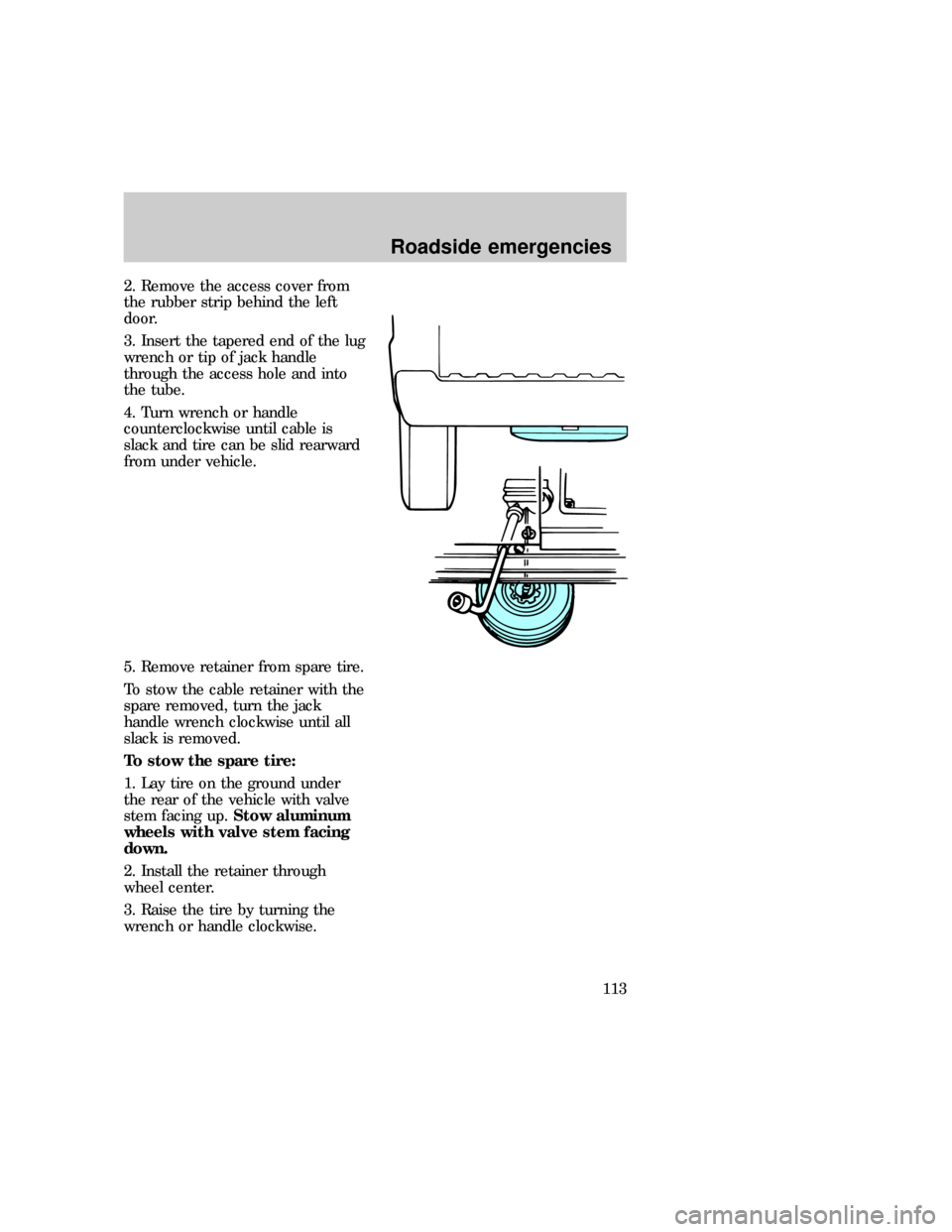
2. Remove the access cover from
the rubber strip behind the left
door.
3. Insert the tapered end of the lug
wrench or tip of jack handle
through the access hole and into
the tube.
4. Turn wrench or handle
counterclockwise until cable is
slack and tire can be slid rearward
from under vehicle.
5. Remove retainer from spare tire.
To stow the cable retainer with the
spare removed, turn the jack
handle wrench clockwise until all
slack is removed.
To stow the spare tire:
1. Lay tire on the ground under
the rear of the vehicle with valve
stem facing up.Stow aluminum
wheels with valve stem facing
down.
2. Install the retainer through
wheel center.
3. Raise the tire by turning the
wrench or handle clockwise.
Roadside emergencies
113
Page 114 of 192
Continue until the lift mechanism
ªclicks.º
4. Check that the tire is tightly
seated under the vehicle by
pushing against tire. Retighten as
necessary.
5. Replace the access cover,
anti-theft bracket and thumb
screw. Use finger pressure only to
secure the thumb screw.
Make sure the spare tire
and jacking equipment are
stowed and secured in the
proper storage location.
Never run the engine with
one wheel off the ground.
Preparing to change the tire
1. Make sure your vehicle will not
move or roll.
²Put the gearshift in P (Park)
DPRN 21
eco_preparing_tire_change
Roadside emergencies
114
Page 115 of 192
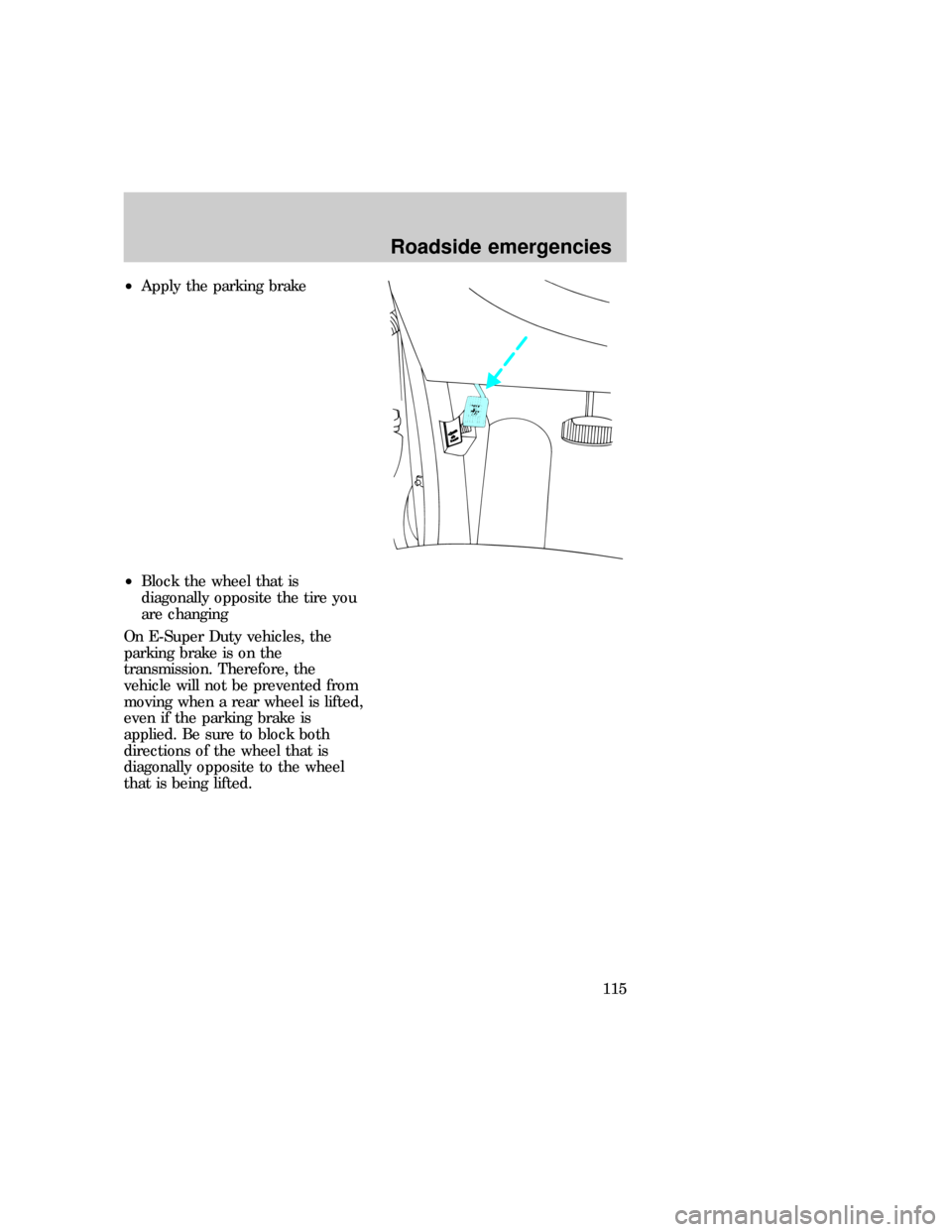
²Apply the parking brake
²Block the wheel that is
diagonally opposite the tire you
are changing
On E-Super Duty vehicles, the
parking brake is on the
transmission. Therefore, the
vehicle will not be prevented from
moving when a rear wheel is lifted,
even if the parking brake is
applied. Be sure to block both
directions of the wheel that is
diagonally opposite to the wheel
that is being lifted.
Roadside emergencies
115
Page 116 of 192
If the vehicle slips off the
jack, you or someone else
could be seriously injured.
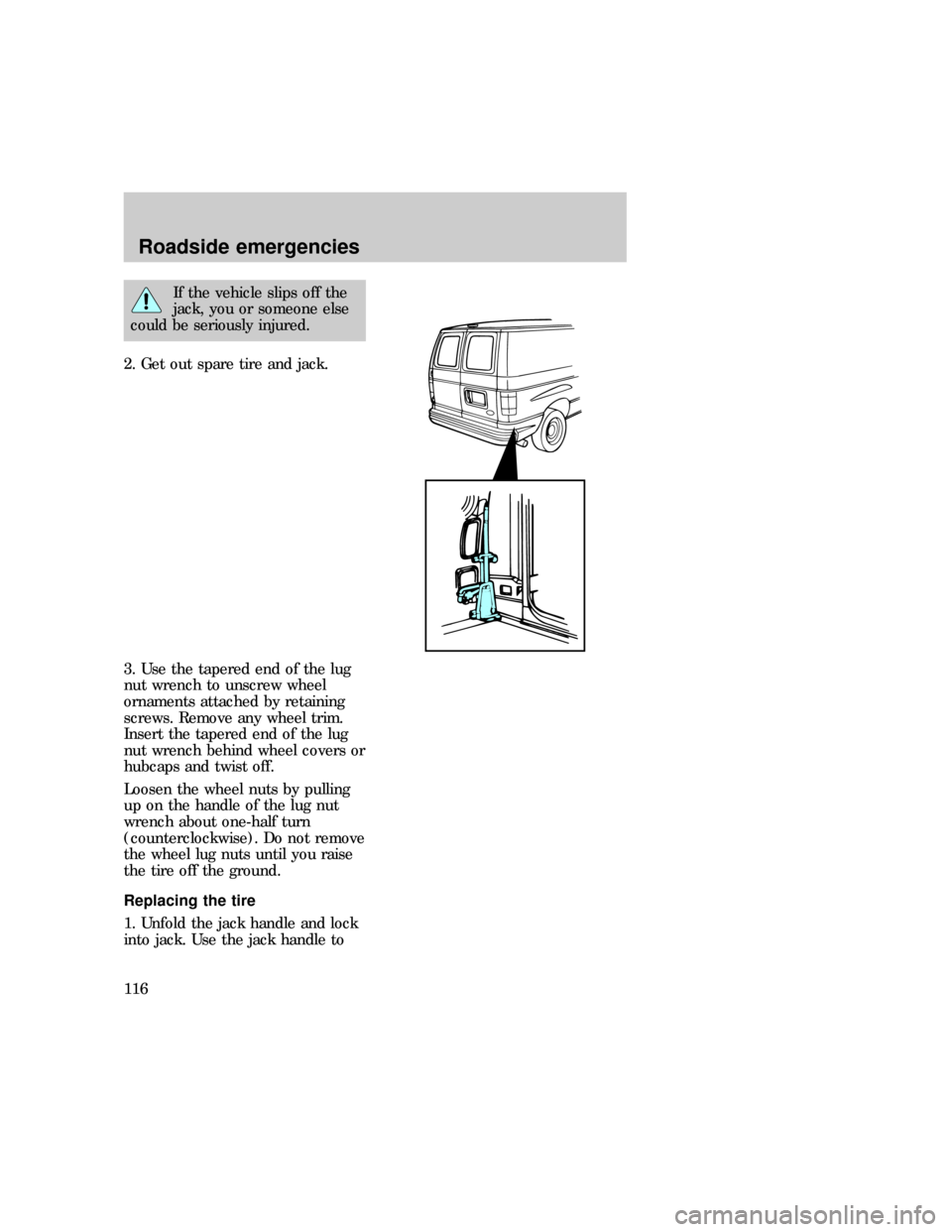
2. Get out spare tire and jack.
3. Use the tapered end of the lug
nut wrench to unscrew wheel
ornaments attached by retaining
screws. Remove any wheel trim.
Insert the tapered end of the lug
nut wrench behind wheel covers or
hubcaps and twist off.
Loosen the wheel nuts by pulling
up on the handle of the lug nut
wrench about one-half turn
(counterclockwise). Do not remove
the wheel lug nuts until you raise
the tire off the ground.
Replacing the tire
1. Unfold the jack handle and lock
into jack. Use the jack handle to
eco_changing-tire
Roadside emergencies
116
Page 117 of 192
slide the jack under the vehicle.
To lessen the risk of
personal injury, do not put
any part of your body under the
vehicle while changing a tire. Do
not start the engine when your
vehicle is on the jack. The jack is
only meant for changing the tire.
2. Position the jack to raise the
front or rear wheel.
Never use the differential housing
as a lift point.
Rear axle jacking points:
²All models except E-Super Duty
²E-Super Duty
Roadside emergencies
117
Page 118 of 192
Front axle jacking points:
²All models
3. Turn the jack handle clockwise
until the wheel is completely off
the ground.
4. Remove the lug nuts with the
lug nut wrench.
5. Replace the flat tire with the
spare tire.
If your vehicle has dual rear
wheels, there are locating pins on
the hubs and wheels with
corresponding holes. When you
install the wheel make sure that
the pins are aligned with the
proper holes.
If your vehicle has single rear
wheels, thread the lug nuts on the
studs with the beveled face toward
the wheel.
If your vehicle has dual rear
wheels, thread the two element
swiveling lug nut on the studs with
the flange facing toward the wheel.
6. Use the lug nut wrench to screw
the lug nut snugly against the
wheel.
Roadside emergencies
118