Page 226 of 402
Downloaded from www.Manualslib.com manuals search engine Getting under a vehicle when it is jacked up is
dangerous. If the vehicle slips off the jack, you
could be badly injured or killed. Never get under
a vehicle when
it is supported only by a jack.
I
1 NOTICE:
Raising your vehicle with the jack improperly
positioned
can damage the vehicle and even make
the vehicle
fall. To help avoid personal injury
and vehicle
damage, be sure to fit the jack
18t head into the proper location before raising
your vehicle.
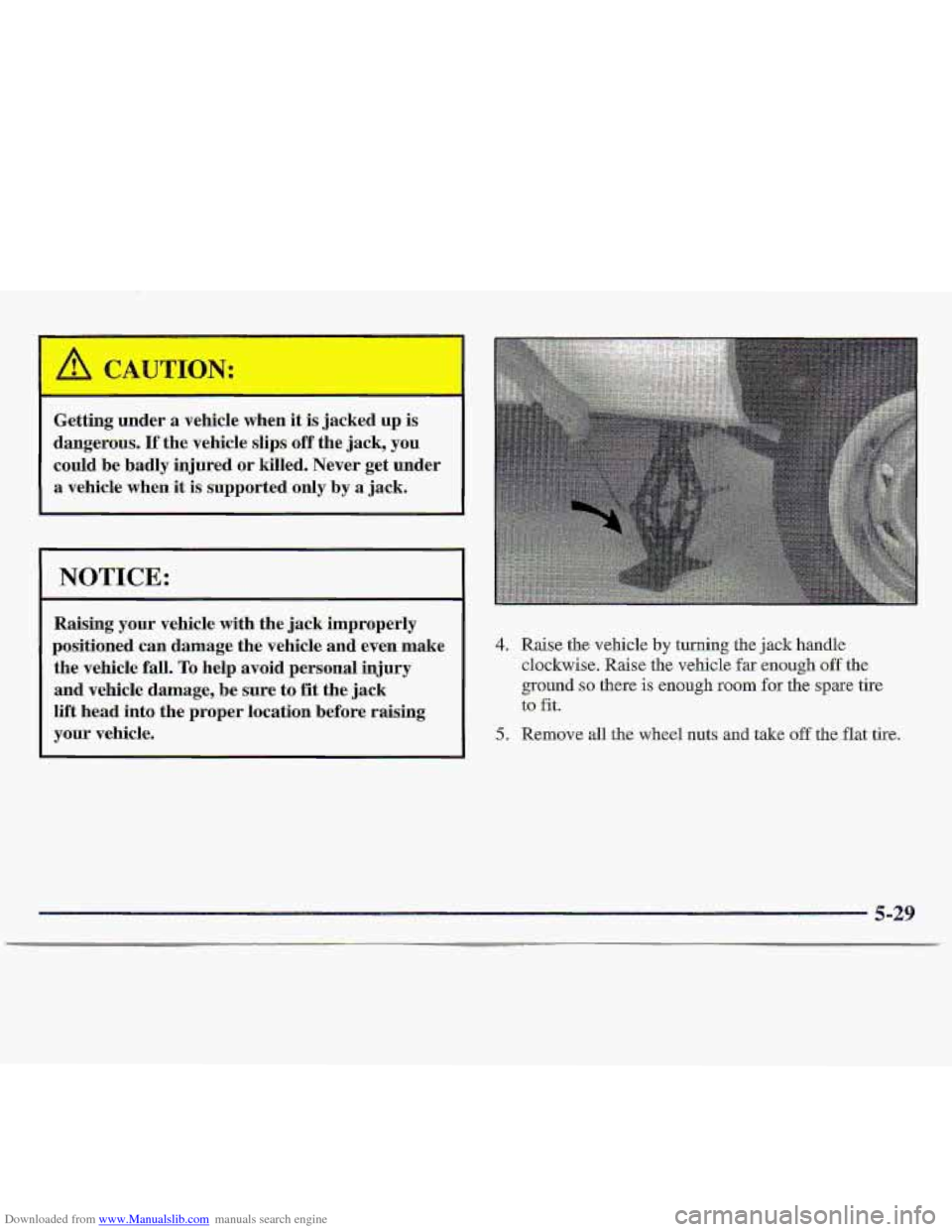
4. Raise the vehicle by turning the jack handle
clockwise. Raise the vehicle far enough off the
ground so there is enough room for the spare tire
to fit.
5. Remove all the wheel nuts and take off the flat-tire;
Page 228 of 402
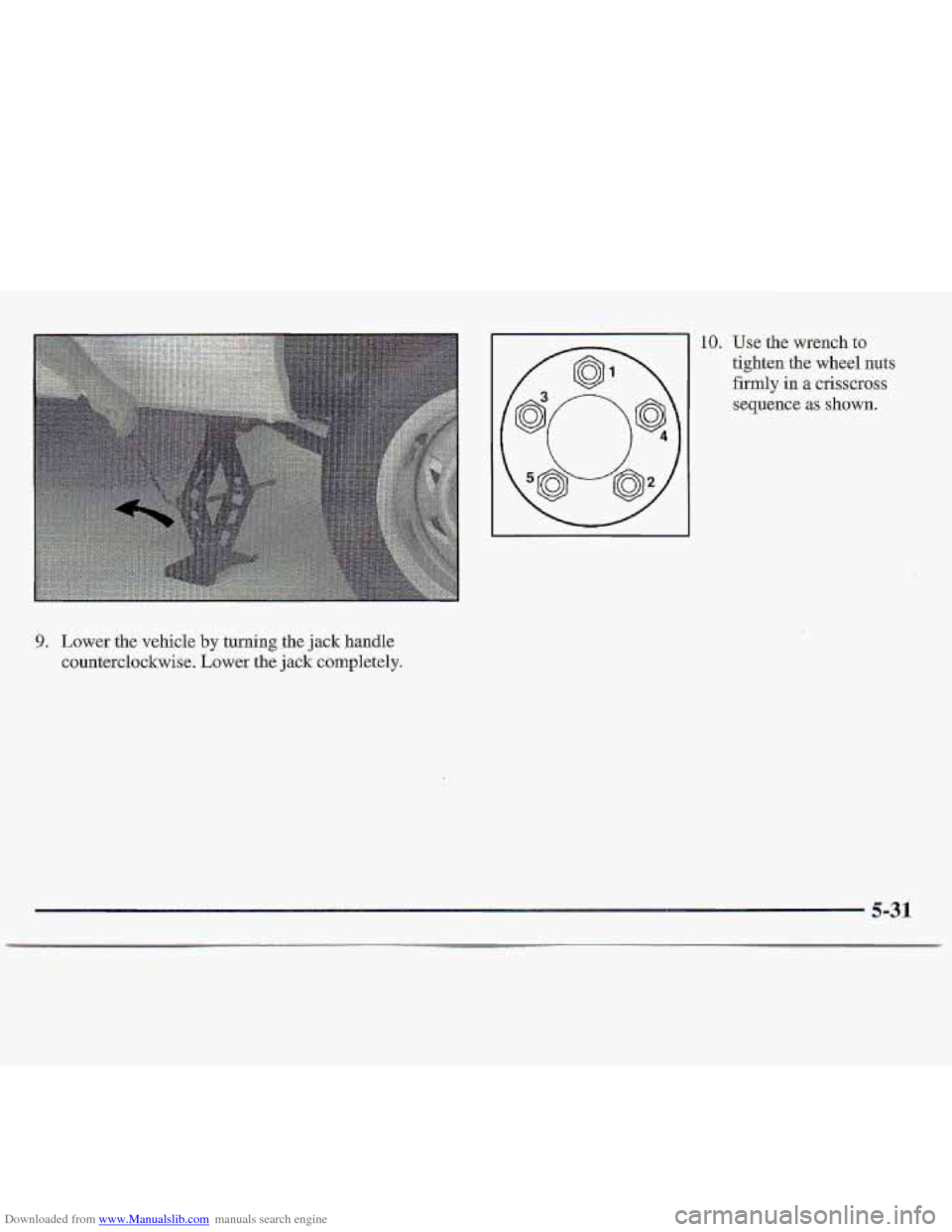
Downloaded from www.Manualslib.com manuals search engine 9. Lower the vehicle by turning the jack handle
counterclockwise. Lower the
jack completely.
10. Use the wrench.to
tighten the wheel nuts
firmly in a crisscross
sequence as
shown.
5-31
Page 242 of 402
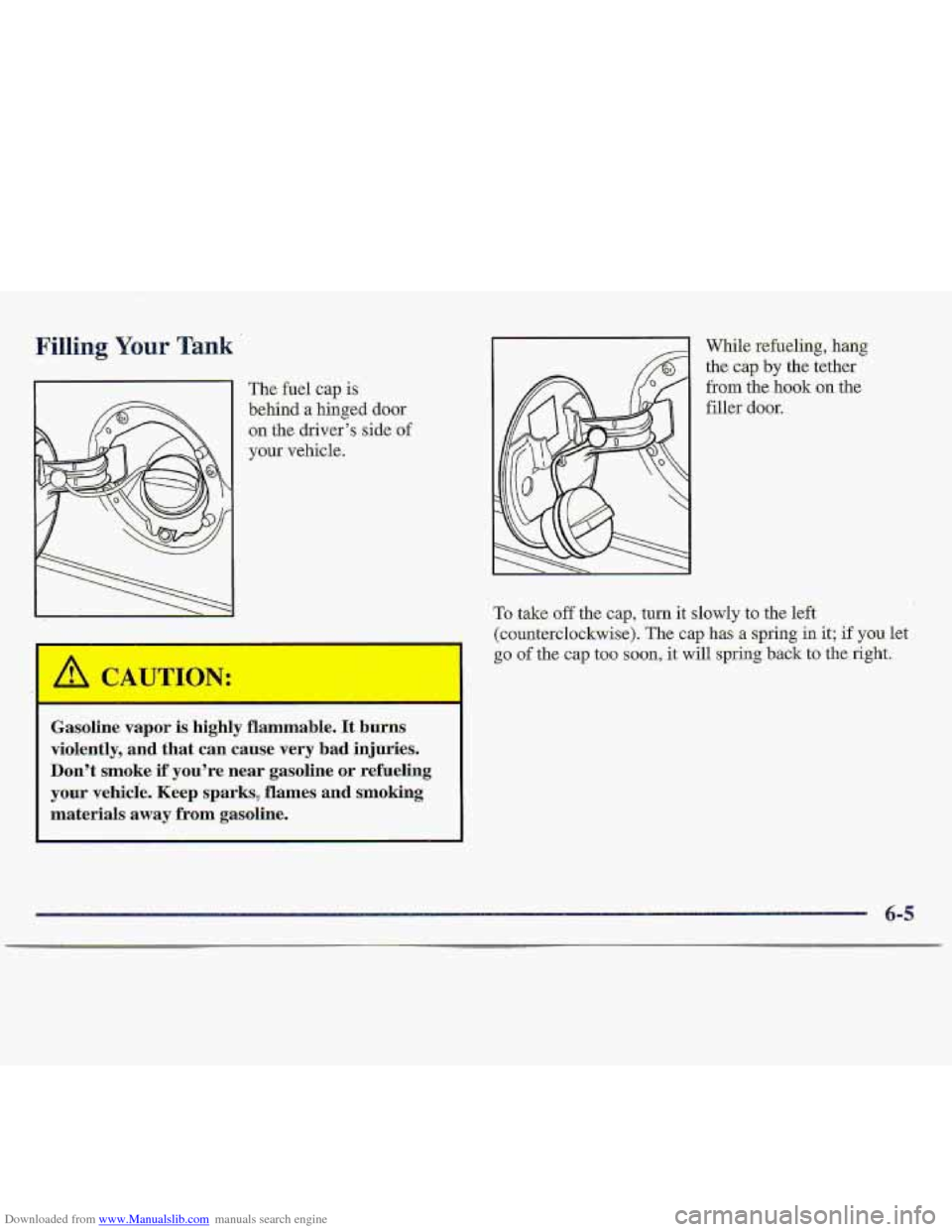
Downloaded from www.Manualslib.com manuals search engine behind .a hiLged door
on the driver’s side of
your vehicle. While refueling, hang
the cap by the tether
from the hook’on the
filler door.
4- soline ne vapor is highly flammable. It bums
violently, and that can cause very bad injuries.
Don’t smoke if you’re near gasoline
or refueling
your vehicle. Keep sparks, flames and
smoking
materials away from gasoline.
To take off the cap, turn it slowly to the left
(counterclockwise). The cap
has a spring in it; if you let
go of the cap too soon, it will spring back to the right.
Page 243 of 402
Downloaded from www.Manualslib.com manuals search engine som-ething ignites it; y0.u could. be badly burned.
Gasoline
can spray out on you if you open the
fuel fiIler cap too quickly. This spray can happen
if your tank is nearly full, and is more likely in
hot weather. Open the fuel fiier cap slowly and
wait for;ang ‘ShW’ noise to stop. Then unscte-w
the cap all the way.
Be- careful .not to spill gasolina. C1e.m gasoline from
painted
surfaces-as- SOO~ as possible. Se-e “Clean-ing the
Out; e
o lam Vehicle” in- the Index.
When y0.u put the cap back on, twn it to the right
(clockwise) until you hear a cli.cking sound. Make sure
you -fully install the cap. The-dia.gn
determine if the E~1.d cap has b-e-e,n left off DX .impr.~pesly
installed,
This would-allow fud to evaporate into the
atmos.phere.
See “Malfunction Indicator Lamp” in
the Index,
NOTICE:
If y0.u need .a new cap, be sure to get the right
type. Your dealer ean get. one for you. If you $-et
the wrong type, itmay not fit properly. This-may
cause your rnalfunctiori indicator lamp to
li.ght
and your fuel tank and emissions. system may be
damaged. S;ee “Malfunction Indicator Lamp” in
the
Index.
Checking Things Under the Ho
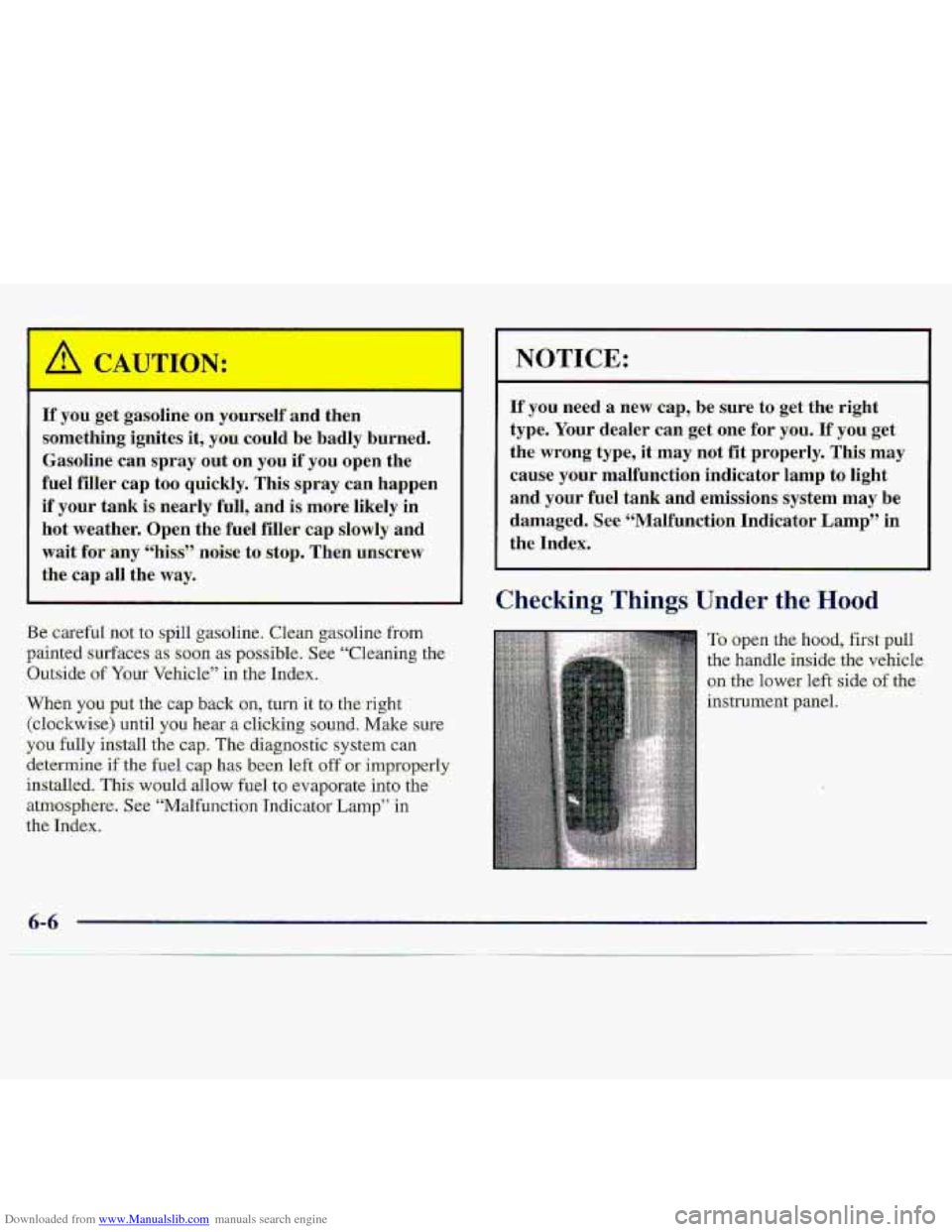
To open the hood, first pull
the handle- inside the vehicle
on the lower left side of the
instrument panel.
Page 251 of 402
Downloaded from www.Manualslib.com manuals search engine a
0
-0
Most trip3 .are less. than 5 to 10 miles (8 to Xi km).
This is particularly impgrtant when outsid.:
tempemratures me below Freezing;
Most trips include.-extensive idling (such .as fiequenr
driving .in stopand-go traffic).
YQU operate- yo.^ vehicle in dusty areas or
You frkquently tow a'traila.
The vehicle is .used for delivtyy ,service, police, taxi
or other cornexcia1 application.
a€f-roid fraquen-tly. Driving
undef these conditions
causes eagineail to
break down sooner. If' a.ny one of these is true for your
vehicle,
-then you need to .change, your oil and filter
every 3,060..mil~s (3' 000 km] or 3 .months - whichever
0cc:U.rs first.
If none of them is true, use the lopg triplhighway
maintenance schedule. Change. the bil-and filter every
'7.,500 miles (1.2.5.00 km) or 1.2 months -- whicheve-r
u.cc.urs first. Driving a vehicle with 3 fully warmqd
engine under highway coridifians causeis engine oil- to
break dawn dower.
Rem-ote Oil Filter (Four=Whe:el Drive)
The access ,dcmx fm the ;re:mote:oil filter is in-the steering
linkage shiqld as-sbrnbly hated under the. r.adiator
support. Twist the screw to unlock or lack the dom.
Make sure 8 you open the door, it is securely closed.
when
you are finished.
Page 256 of 402
Downloaded from www.Manualslib.com manuals search engine Then, without shutting off the engine, follow these steps:
3.
4.
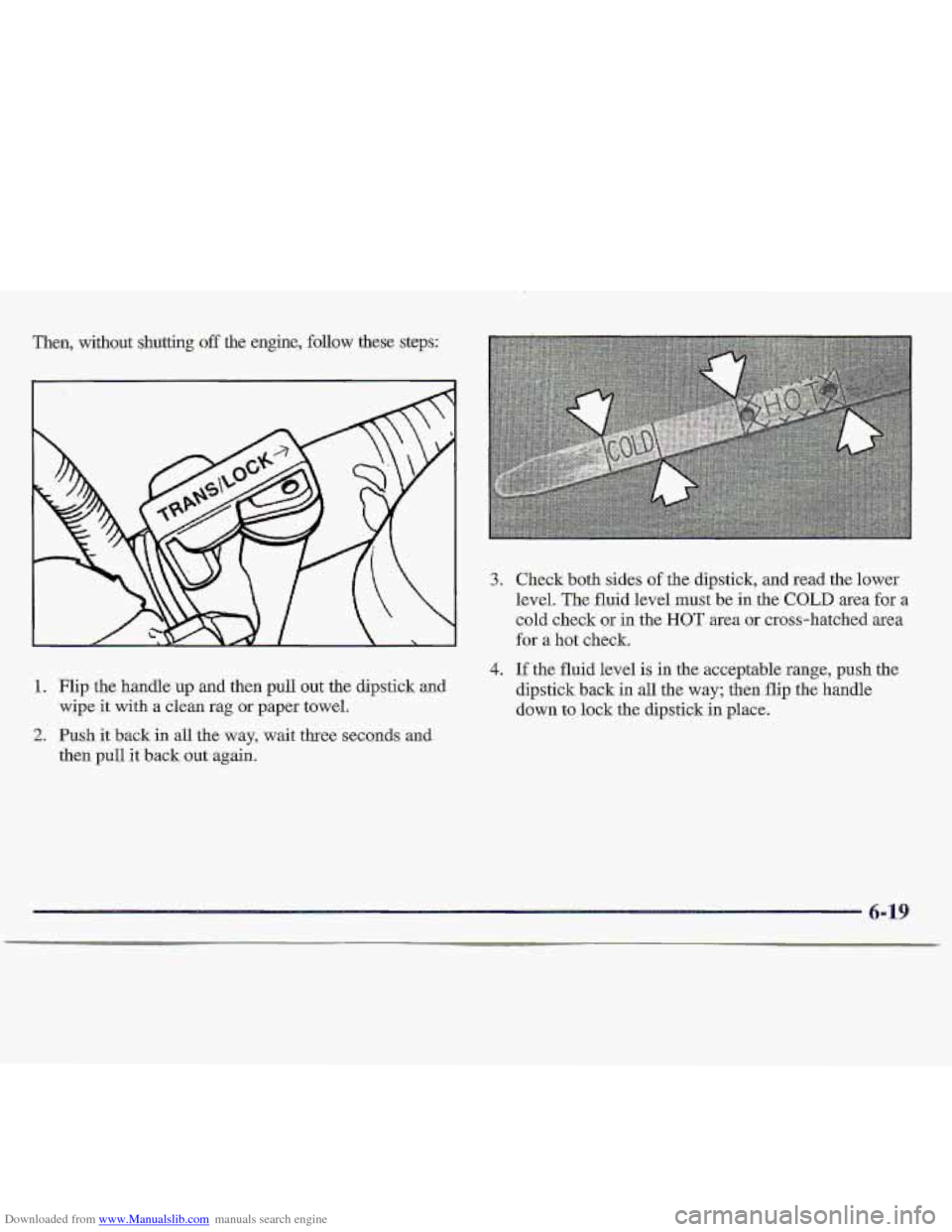
1. Flip the handle up and then pull out the dipstick and
2. Push it back in all the way, wait three seconds and
wipe
it with
a clean rag or paper towel.
then pull it back out again, Check both sides
of the dipstick, and read
the lower
level.
The fluid level must.be in the COLD area €or a
cold check or in the ROT area or.cross-hatched area
for a hot check.
If the fluid level is in the acceptable range, push the
dipstick
back in all the way; then flip the handle
down
to .lock thedipstick. in place.
Page 257 of 402
Downloaded from www.Manualslib.com manuals search engine HOW to Add Fluid Manual TransmisSion Fluid
Referto- the. M-aintenance Schedule t~ dtztermirie. what
kind of- tram~ssion fluid to. me. See “Recommended
Fluids and Lubricants:” in. the Index.
Add fluid only after checking tktrmsmission fluid HOT.
(A COLD check is used .only as a reference.) If the fluid
levd is low, add Only enough of the proper flvid. to bring
the le,vel up t.0 the HOT area fora hat check. It doesdt
take much fluid, ,generally less than Qne pint (0.5 L).
Don t ove.$ll.
NOTICE:
We recommend you use only fluid labeled
DEXRON@-III, because. fluid with that label is
made especidy
for-. your automatic transmission.
.Damage caused.
by fluid other than DEXRON-111
is not covered by y.our new vehicle warranty.
After srddiag fluid-, recheck the fluid Ievel as
When the-correct fluid level Ls obtained, .push the
described under “How to Check.”
dipstick back
in all the way; then flip the handle
down
to lock the dipstick in place.
A good time to have it checked is when-the engine
oil is changed. However, the fluid in your manual
transmission doesn’t require charging..
How to Check
Because this operation can be a little difficult, you
may choose to have this done at.you-r GM dealership
Service Department.
‘If YOU do it yourself, be sure. to follow all the
instructions here, or
you could ge.t a false reading,
NOTICE:
Too much or too little-fluid can damage your
transmission.
Too much can mean that same: u1
the fluid could come; out and fall on hot engine.
parts
or exhaust system p-arts, starting a fire. Be
sure
to get an accurate reading if you check your
tranqmission fluid.
Page 275 of 402
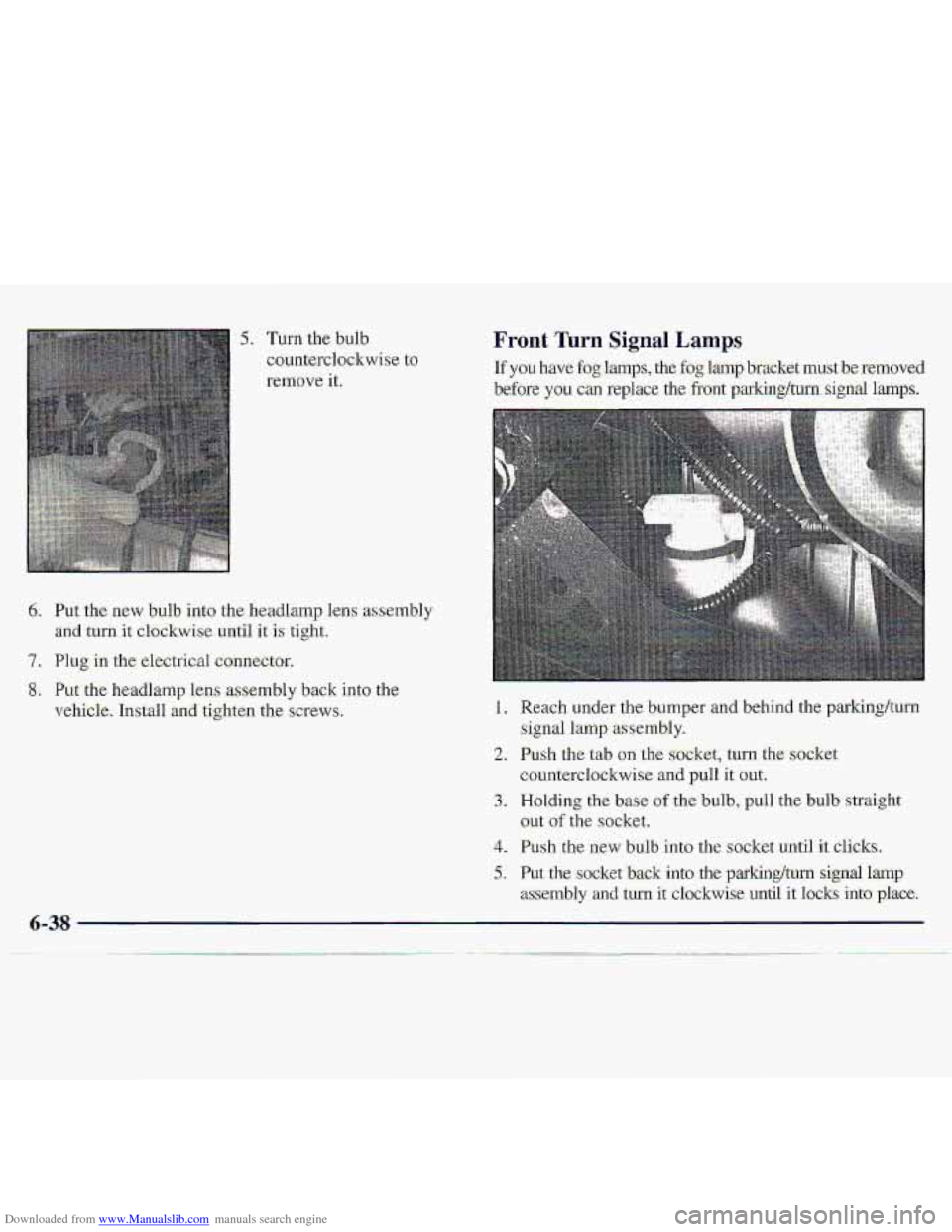
Downloaded from www.Manualslib.com manuals search engine 5. Turn the. bulb
countercl.ockrwise
to
remove it.
6. .Put-the new bulb into theheadlamp lens ass-ernbiy
7. PhLg in the e1ectric.al connector.
and turn it clockwise until it is tight.
8. P.ut the headlamp 1-ens assembly back into t.he
ve:hicle. Insrall and tighten the screws.
Front Turn Signal Lamps
If you. have fog.lamps, the fog lalizp bracket rnusE.De &H6v'ed
before you can rep1ac.e the front parking/!turn signal limps.
1, Rea.ch under the bumper and behind the parkin,g/turn
2. Push the tab on the socket, turn the socket
3. Holding the base of the bulb, pull the bulb straight
signal lamp
assembly.
counterclockwise and pull
it out,
out
of the socket.
4. Push the new bu1b.int.o the socket until it clicks.
5. Put the socket-back into lhe parkinghrn signal lamp
assembly and turn it clockwise until it locks into place.