Page 132 of 402
Downloaded from www.Manualslib.com manuals search engine Disabling the Theft-Deterrent Feat-ure
Enter yoor secret-code as follows; pause no mor'e than
15 seconds between steps:
1. Turn the ignition to ACCESSORY or RUN.
2. Turn the. radio off.
3. Piess the 1 and 4 buttons together. Hold them aown
4. Press MNand 000 will appear cm the display.
5. PPess MNagain tu make the last two digits agree
.until
SEC shows--ox~ the display.
with your
Code.
6. Press I3.R to make the €irst one or two di@ zgree
with;yGur codei
7. Press AM-FM af1e.r yau have confirmed that the
code matches
the secret code you have written down.
The display will show ---j indicating that the radio is
no longer secured.
If the wde.. entered is .incorre.ct, SEC will appear on the
display.
The rad.io will remain secured until the correct
code is
entered.
-When battery power is removed and later app1ie:d to a
J secure.d radio, the radia won't. turn sind LOC will
appearon the-display.
To:unlock a secured radio, see "Unlrxking the
Theft-Det-errent Feature After a Power Loss" earlier i.n
this section.
ff" Stereo
FM. ste.ere.0 will give. you the best sound. B.ut FM signals
will reach only about 10 to 40 miles (16. to 65 km). Tall
buildings or:hills
can inte?fere with FM signals, causing.
the
sound to: dome and. go.
AM
The range for most AM stations is greater than fm FM,
especially at n.ight. The longer rangc, however, can
c&e stxioris to intwfeit-with each other. AM can pick
up noise from things like storms and pawer lines. Try
reducing
the treble-@ reduce this noise- if you ever get it.
Tips About Your Au,dio System
Hearing -damage from loud noise is almos1 undet.ectabk
until
it is too late, Your hearing. can .adapt to higher
volumes
of sound. Sound that seems normal c8n be loud
and harmful to your hearing. Take. precautions by
adjusting-the volume cuntrol, on your radio to a safe
sound lwei before your hearing adapts to it.
3-19
Page 144 of 402
Downloaded from www.Manualslib.com manuals search engine Anti-Lock Brakes (ABS)
Your vehicle has anti-lock bmk& (ABS). ABS is an
advanced .electronic braking systeni that will help
prevent a braking skid.
When you start your engine and begin to drive away,
your-anti-lok
brake system will check. itself. Yau may
hear
a rnsrnentary motor or clicking-noise, w-file this ‘test
is going on. This is normal.
If your-engine ever stqs while you’se driving, brake
normally
but do;n’:t pul~ip your brakes. Ifyou do, th-e
,p%ed-al may get hard-er-to puGh .down. If -your.engi-ne
‘stops, you will-s~tal have some power assist. B:ut
you will a-se it when you brake; Once the power.asskt is
used up, it may take long-er to stop afid thelljrake pedal
will
.be .harder to zrush.
ANTI - LOCK
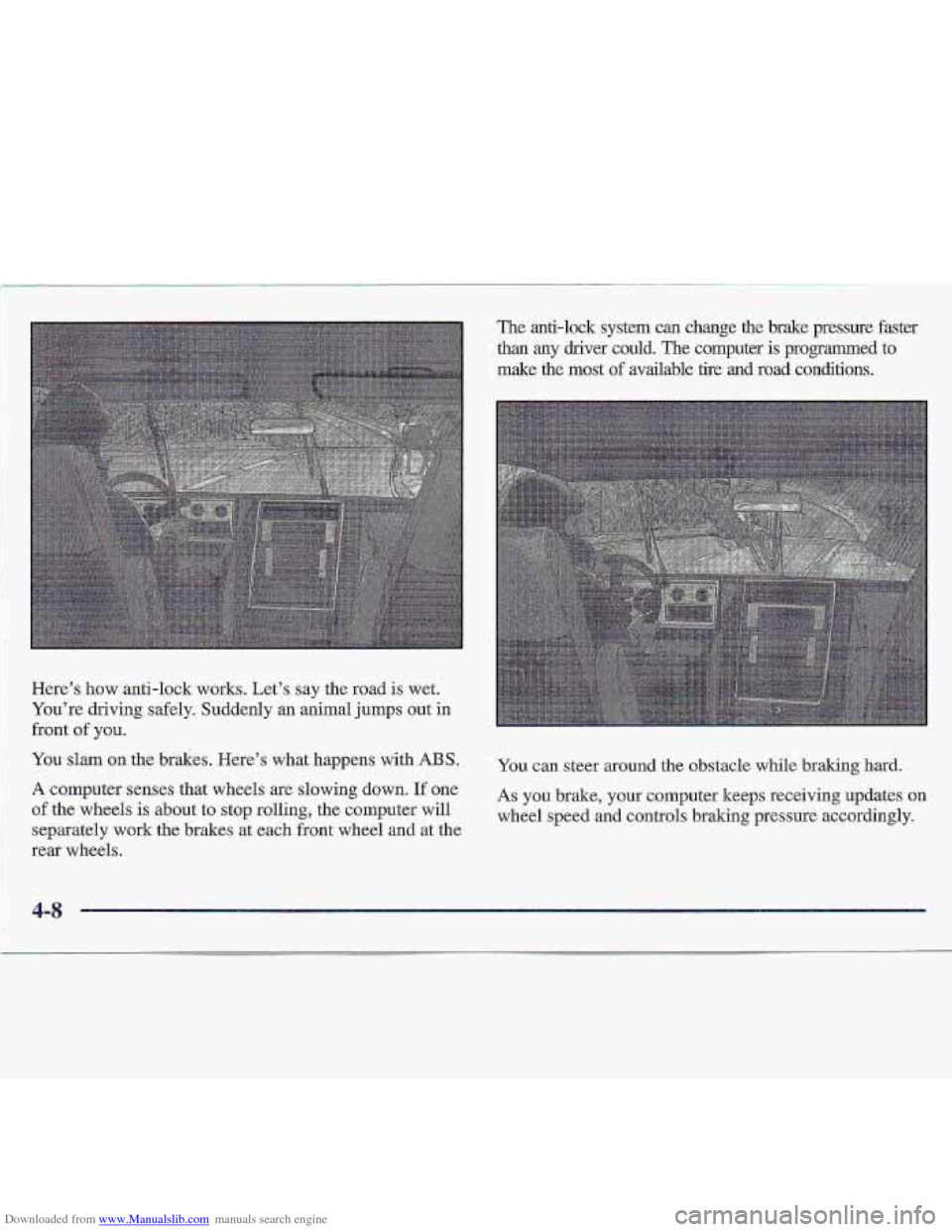
If there’s a problem with the.
anti-lock brake system, -this
war‘i&g.Iight will stay an.
See. “Anti-Lo& Brake
System
Warning Light” in
th.e Index.
4-7
Page 145 of 402
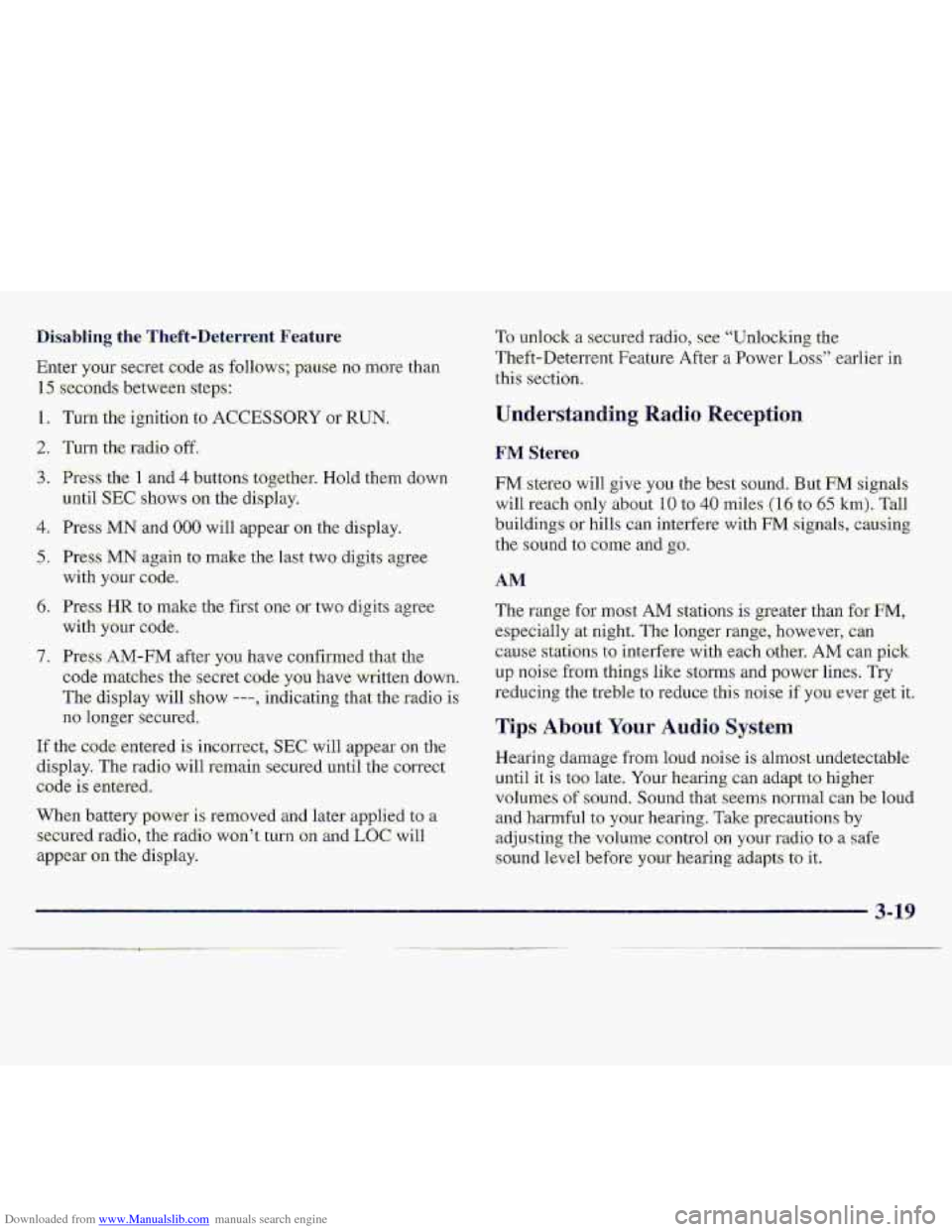
Downloaded from www.Manualslib.com manuals search engine Here’s how anti-lock works. Let’s. say the road is wet.
You’re driving safely; Suddenly-an animal jumps out
in
front of you.
1 You slam on the brakes, Here’s what happens with ABS.
A computer senses that wheels are slowing down. If one
of the wheels is about to stop rolling, the computer will
separately work the brakes at each front wheel and at the
~ rear wheels.
The anti-lock system em change the brake p~essure faster
than any driver could. ?%e computer is programmed to
make the most of available tire and road tronditions.
You cansteer around the obstacle while braking hard.
As you brake, your computer keeps receiving updates- on
wheel speed and controls braking pressure accordingly.
Page 146 of 402
Downloaded from www.Manualslib.com manuals search engine Remember: Anti-lock dsesn’t change tbc- -time y.ou :need
:to get yo.ur fo~t up to .the brake ped,ai or always decrease
stopping
diskan&. If.you get-to6 cl~,se to thcvehicle in
front of YOU; you won’t have time to apply your brzikes
If.th:at vehicle suddelily .slows or siop-s. Always i-eave
e.nough mom up ahead to si.op, even though you have
anti-lockrbpkes.
U.s,ing.Anti.-LthA
Don’t pump the’bisakes. Just hdd the brake pedzl down
and let anti-lock wark..fox you. You ‘may feel the brake.$
vibrate., or you-may notice som-e noise, but this is-
::normal. Ofi vehicles Mth-four-wheel drive, your
;anti-lockbrakes work at all times- -- whether ,you are in
two-wheel driveor fuur-wheel:&.ive.
Braking in Emergencies,
With m-ti-lock, you can steer and brake at thc same
.time-. In many emergencies., st.eering can kip, you more
than even the very $est braking.
Power Steering
If you lose p~wer steeringatssist because the e.ngine
stop;s or the system is not fiw.dt?orriag, you can ste.er .but
it will take much more effort.
Steering Tips
It’s important to take c.urv.es at a reasonable sp-eed.
A lot of the “drivet lo‘st ci3ntml”‘accidents meritionedl ~li
the slews happen on curves. Here’-s why
Page 148 of 402
Downloaded from www.Manualslib.com manuals search engine An eri~rgency like this requires t10 ,attintion .arid a
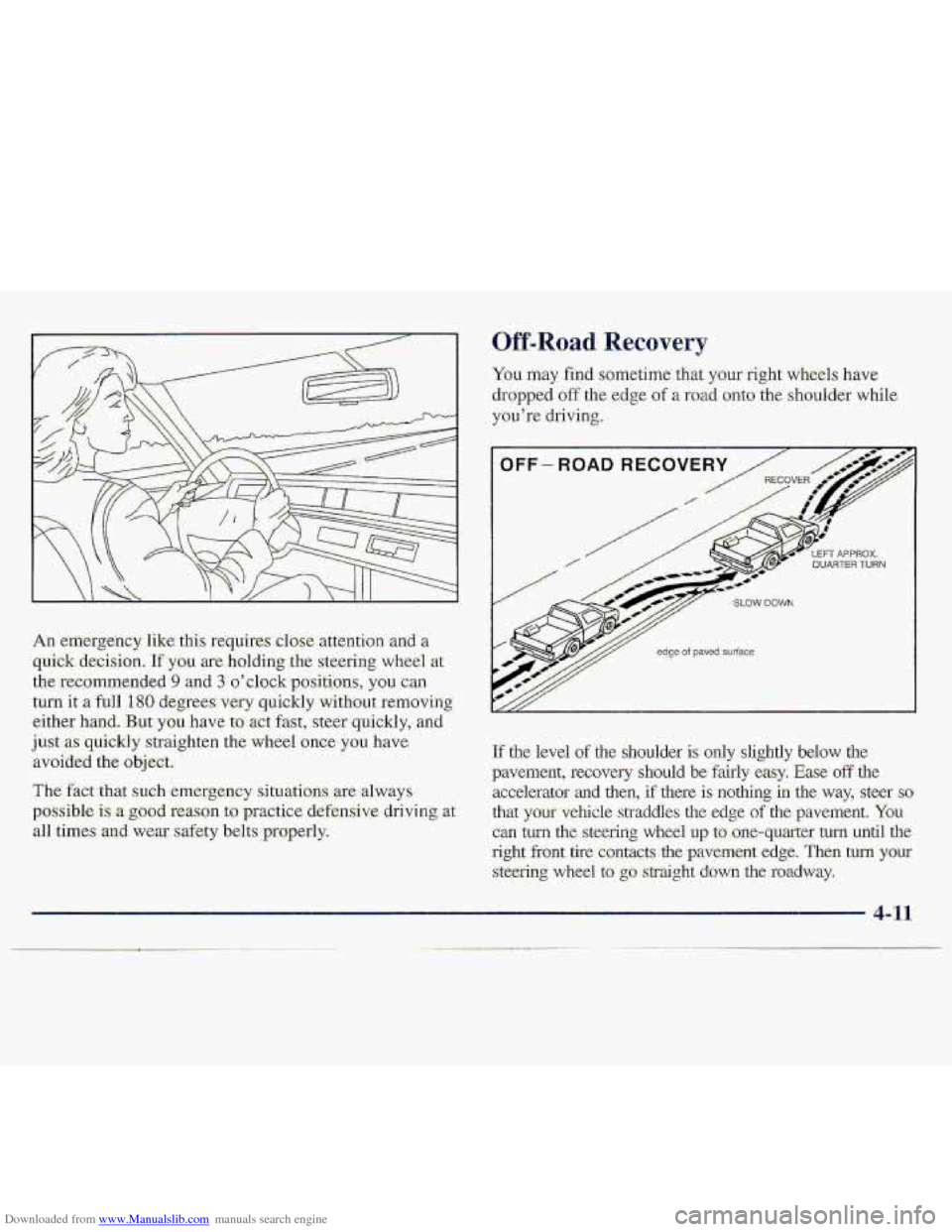
quick decision. 1fy.0~1 are. holding the steering wheel at
the rec,omme,nded-9 and
3 o’elock-..positims, you can
turn it a full 180 de,grees. very quickly without removing
eith.er
hand. But you have tomt hst, ste,er quickly, and.
just as quickly straighten the wheel once you have
avoided the object..
The fact that such emergency situations ..me always
possible
is a-goD.d reason to pmctice. defensive driving at
all times and wexr safety b.elts properly.
Off-Road Recovery
You may find soriletime that your right wheels have
dropped off the. edge of a road onto the shoulder while
y~i’re
driving.
Tf the level of .the shoulder is only slightly below the
pavemefit, recovery should be fairly easy. Ease off tlie
accelerator
and then, if there is nothing in the way7 steer so.
that your-vehicle straddies the edge of the pavement. You-
cm turn the st.eering wheel up taone-quarter turn until the
right front tire contacts -the pavement edge. Then turn your
steering wheel to’ go straight dawn the roadway,
Page 151 of 402
Downloaded from www.Manualslib.com manuals search engine A cornering skid and an acceleratioa skid .are best
hand1e.d by easing your foot off the accelerator pedal.
Driving Guidelines.
Off-IC0a.d Driving with Your
Four-Wheel-Drive Vehicle..
This off-road guide is for vehicles that have
.four-wheel drive.
Also, see “Anti-Lock Brakes” in the Index;
If your vehicle doesn’t have :four-wheel drive, you
shouldn’t drive off-road unl.es.s-you”re on a letel,
solid surface.
Off-road driving can be great fun. But it does have
some definite hazards. The greatest of these is the
terrain itself,
“Off-roading” means
.you’ ve left .the great North
American road system behind. Traffic. lanes arerft
marked. Curves aren.’t.Ij;znked. There are no road -sigm.
Surfaces can be slip-pery, rouqh, uphill or &~wnMl. In
-short, you’ve gone. ri.ght ba to nature.
off-road driving involves soni new skills. Aad tbat.’s-
why it’s very important that you read this guide. You’ll
find many driving tips and suggestions. These will help
make your off-rbad driving safer and more enjoyable.
4-14
Page 153 of 402
Downloaded from www.Manualslib.com manuals search engine Errvironmental Concerns
O€f-road driving .can provide wholesome and satisfying
recreation.
However, it also raises- enviranmental
c:dricernS. GM recognizes these concerns and urges
every off-roader to follow these- bask rules for
protecting the environment:
0
0
a
Traveling, to Remote Areas
It-makes sense to: plan yow-.trip, cspechlly when-going
‘to a remote area; Know- the terraiwand plan your ~uute.
You are much less likely to get bad surpris-es. Get
accurate maps bf trails and terrain. Try to learn of my
blocked or closed roads,
It’s
a1s.o a good idea to travel withat 1eas.r: one o,rner
vehicle. If ‘something happens to one of thern,.i€ie-.ather
can
help quickly.
Does your
vehide have a winch?. I-f sa, be sure to read
the winch instructions.
1n.a remote area, a winch can be
handy-if you get: stuck. But you’ll want to how how to
use it pmperly.
Getting .Familiar with Off-Road Driving
It’s a good i.dea to practice in !an area that’s safe and
.cI.~se?o home before you go info :the wilderness..
Off-road
driving;.cloes require some new and-dlnffixent
.driving. skills. Here’s what-we mean.
Tune you^ senses t~ different kinds of-signals. Your
eyes, for example, need to co.nstantly sweep the terrain
for unexpected. obstacles. -Yuur ears need to listen for
unasual tire .or e:ngine sounds. With youwu-rns, hands,
kt and body, you’il need -to respoad to vibrations -and
vehicle bounce.
4-16
Page 177 of 402
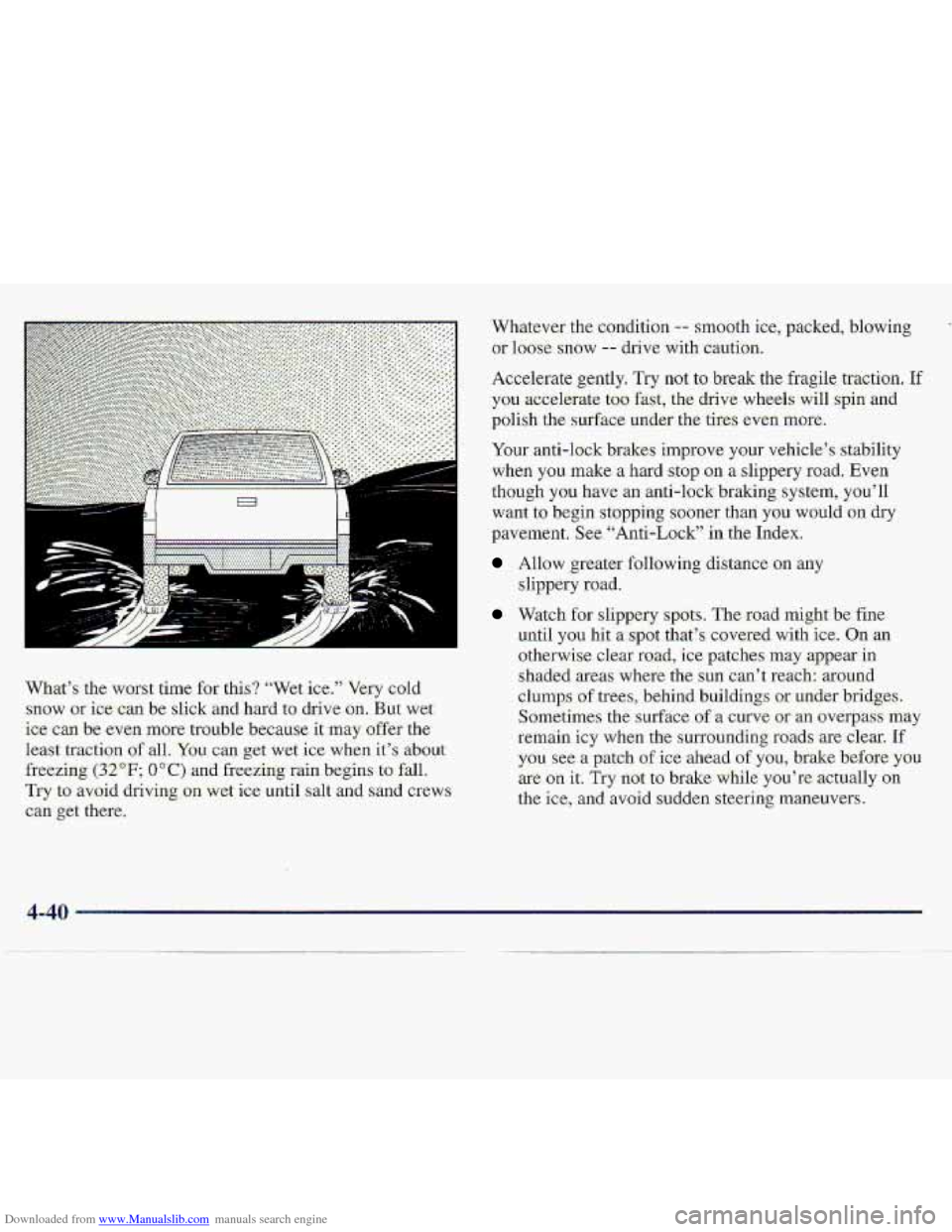
Downloaded from www.Manualslib.com manuals search engine Wh8t’s:the worst time for this? “Wet-.ice.” Very cold
snow or-ice-can be slick and hard to drive on. But wet
ice c.m- be even m-ore. trouble be-cause -it ‘may .offer the
1-east iraction
of all. You can get wet ice when it’s about
fxce.zag C32”F; 0°C) .and fieeziag rain begins tQ fall.
Try to avoid driving .on wet ice untG salt and sand crews
can get there.
Whatever:the G-ondition -- smooth ice, packe.d, blowing
or loose: snow -- drive with Cautibn.
Accelerate gently. Try
not to break the fragile. traction. If
you accelerate t6o fait, the dr5v-e whee1.s will spin-and
polish the -surface under the tires even more..
Your anti-lock brakes improve your vehicle’s stability
when you,make-
a hard stop on a slippery road. Even
tho.ugh you have an anti-lock brxking system, you’ll’
want to begin
stopping sooner tha-n you would on dry
pavement. S,ee: “Anti-Lo-ck” in the Index.
Allow greater following distance :on any
slippery road.
Watch for dippery spots. The road might be fine
until you hit a,spat.th&s covered. with ice. Qn an
.otherwise clear road,: ice -patches may app-ear in
shaded areas where the
sun mn’t reach/ arou-nd
clump>s of. trees, :behind buikdings under bridges.
Sometiines the:surface of a curve air an overpa% may
remain icy when the surrounding raxds are clear. If
you see a-patch &ice ahead of YOLI-, brake:before you
axe on it, Try notto brake while you’=re .actually on
.the ice, .and avoid sadden st_e.Gring maneuvers.