Page 200 of 402
Downloaded from www.Manualslib.com manuals search engine Jump S t-arting.
If your battery has run clown, you m.ay want to use
another vehic1.e and some jumper cables to start your
vehicle,
But p1eas.e use the-folluwing steps to do
it safely.
NOTICE:
Ignoring these steps could result in costly damage
to your vehicle that wouldnlt
b.e covered by
your ww-ranty.
Do not try to Start your vehicle by pushing or
pulling it. This could damage your vehicle, even if
you have. a m-mual transdssion. And if you have I
an automatic transmis;sion, it: won’t start that way.
Batteries can hurt you. They can be dangerous
because:
They contain.acid that can burn you.
They contain gas that can explode or ignite.
They corit&iu enough electricity to
If you don’t follow- these -steps exactly,-’some or all
of-these things-
can hurt you.
burn you.
1. Check the other ve-hicle. 1.t must.have a 12-volt
battery with a neg,ative ground system.
I NOTICE:
I€ the other system isn’t a l2-volt .systein with .a
negative ground, both vehicles, can role d-amaged.: I
Page 202 of 402
Downloaded from www.Manualslib.com manuals search engine 4. Open the hoods and locate the batteries. Find
the positive
(+) and negative (-) terminals on
each battery.
Using a match near .a battery can cause battery
gas to explode. People have been hurt doing this,
and some have been blinded. Use a flashiight
if
you need more light.
Be sure the battery has enough water.
You don’t
need to add water
to the Delco Freedom@ battery
installed
in every new GM vehicle. But if a
battery has filler caps, be sure the right amount
of fluid is there. .If it is‘low, add water to take care
of that fist, If you don’t, explosive gas could
be present.
Battery
fluid contains acid that can burn you.
Don’t get it on you. If you accidentally get it in
your eyes or on your skin, flush the place with
water and get medical help immediately.
5. Check that the jumper cables don’t have loose or
missing insulation.
If they do, you could. get a shock.
The-vehicles could be damaged too.
Before you connect the cables, here are some- basic
things
you should know. Positive (+> will ga
to positive (+) and negative (-) will go to a
metal engine
part. Don’t connect positive (+) to
negative
(-) or you’ll get a short that would damage
the battery and maybe other parts too.
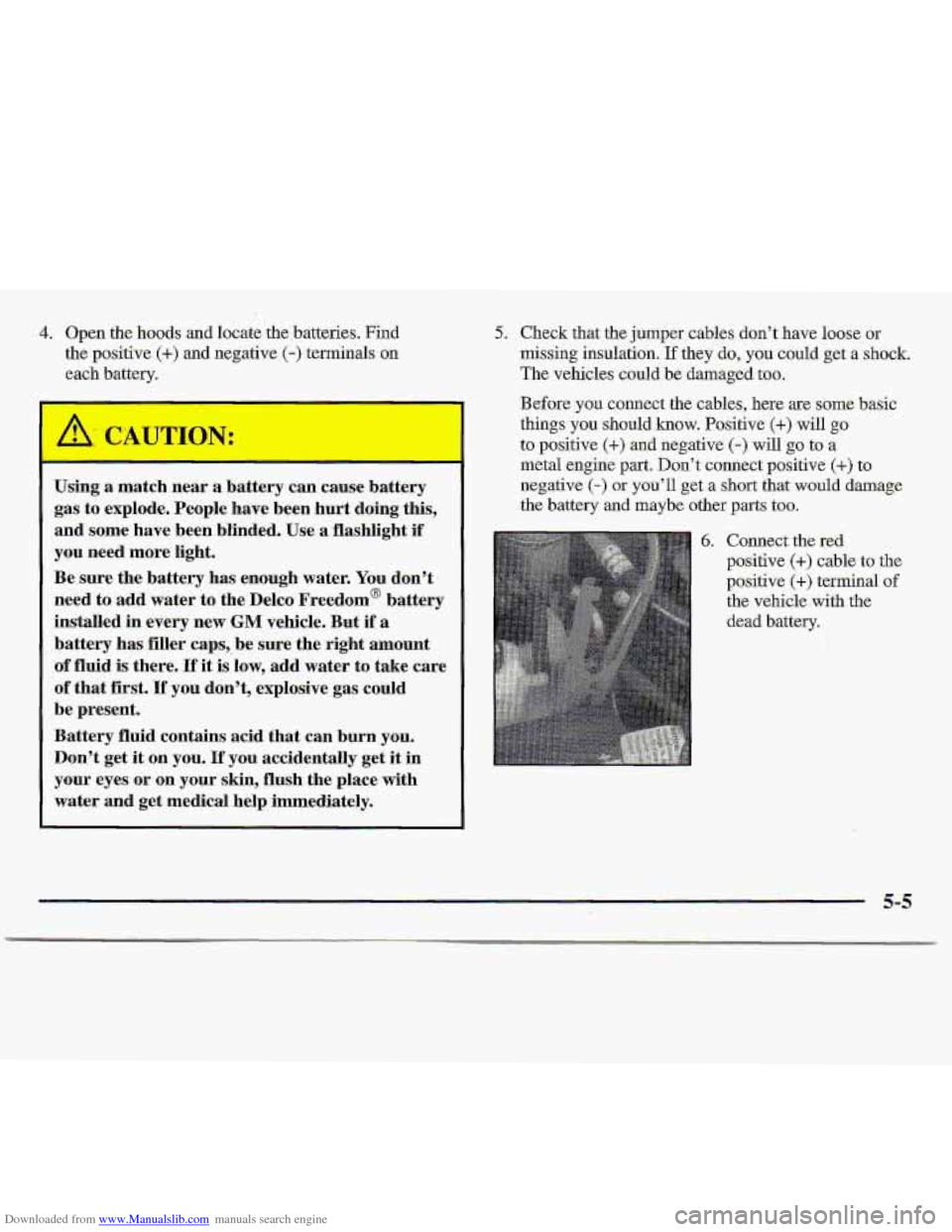
6. Connect the red
positive
(+) cable to the
positive
(+) terminal of
the vehicle with the
dead btittery.
Page 232 of 402
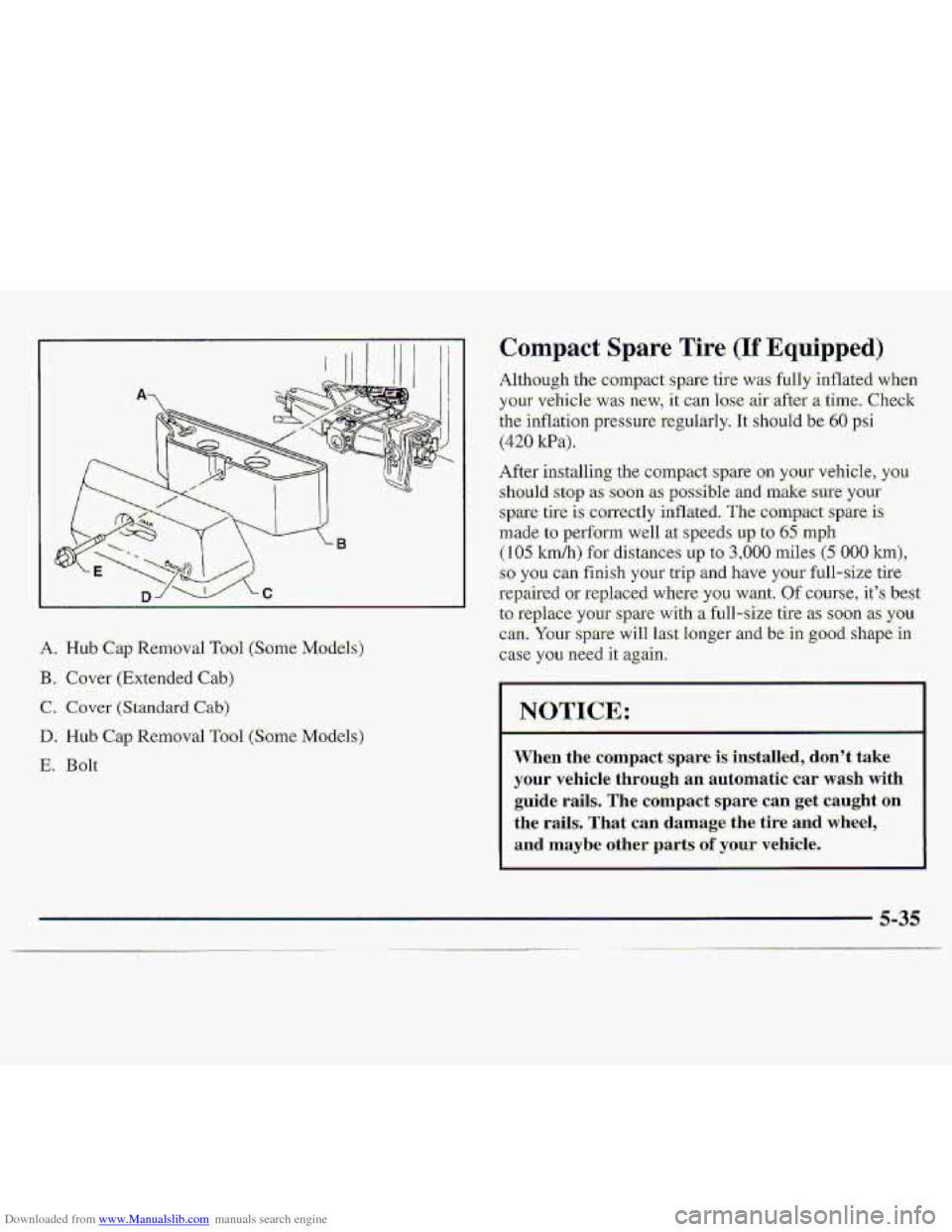
Downloaded from www.Manualslib.com manuals search engine A, Hub Cap Removal Tool (Some Mmiels)
E. Cover (Extended Cab)
%. Cover (Stand,ard Cab)
D. Hub Cap Removal Tool (Some Models)
E. Bdt
Compact Spare Tire (If Equippe.d)
Although the compact spare-tire was fully inflated when
your vehicle w.as new, it can lose air after a time. Check
the. inflation pressure regularly. It should be 60 psi
(420 kPa).
After installing the compact spare on your vehicle, you
should stop as 'soon as possible and 'm.ake-. sure your
spare tire
is cor-rec.tly inflated. The compact spare is
made to perform well at speeds up to 65 :mph
(I 05 krn/h) for distances up to 3,000 miles (5.000 km),
so you can finish your trip and have your full-size tire
repaired or replaceid where.you
want. Of course, it's best
to replace y0.w spare with a full-size tire as soon as you
can. Your spare will last longer and be: in .good shape in
case you-need it again.
I NOTICE: I
When the compact 'spare: is installed, don't ta.ke
your vehicle through
an automatic car wash with
guide rails, The compact spare can get caught on
the rails; That can damage the tire and wheel,
-and maybe other-parts of your vehicle.
Page 238 of 402
Downloaded from www.Manualslib.com manuals search engine Section 6 Service and. Appearance Care
Here:you will find inf6frriatisn about 'the care of your vehicle. This section begins with Service and fuel information,,
and then it.shows how to check important fluid and lubriean~.Ievz=ls.. There is a1s.o technical informatkm &;gut your
vehicle, and a pmt devoteft to itsappearance c.are.
Fuel
Fuels in Foreign Countrks
Filling
Your Tank
Checking Things Ugdgr lhs Hood
Engine Oil
Air Cleaner
Autam-atic Trans-missi-on Fluid.
Manual Transmission Fluid..
Hy.draulk Clutch
Rear Axle
Four-wheel Drive
Engine' Coolant
Radiator Pressare- Cap
'Thermg-sgat
P6we.r. Steering Fluid
..
6-29
6-3.1
6- 3-5.
6 -3 5
-6-42
6-44
-6-53
6-53
6-57
6-6.1
6-62
'6-63
6-67
6-68
&'70
Windshield. Washer Fluid
Brakes
Battery
Bulb Replacement
Windshield;
Wiper Blade Rephement
Tires
Appearance Care
Cleaning the Inside of Your Vehicle
Cleaning the Outside
of Your Vehicle
Appearance Care Materids Chat
Vehicle Identification Number (VIN)
Electrical Sptem
Replacement Bulbs
Capacities -and Specificztions
Air Conditioning Refrigerants
6" 1
Page 241 of 402
Downloaded from www.Manualslib.com manuals search engine I NOTICE:. I
Your vehixle was xiat desigaed. for fk%I that
contains me-thand. 'Don't use it. It can Corrode
metal parts in your- fuel-system and also, damage
phstie and rubb-er parts. -That damage wouldn't
be covered under your warranty.
' . .~ % i in Foreign ,Countries
If-you pian on driving-in another country outside the
United.,
States or Canada, .the proper fuel may be hard to
find. Neveruse leaded gasoline or any other fuel not
recommended
in the previous. text on fuel. Costly repairs.
caused by use of improper file1 w-oddn't be c.overed:'by
your warranty.
TQ check un fuel availability, ask an auto club, or
contact a major oil company that does bt s in the
country.where
you'I1 be driving.
You can also write us &the following addressfor
advice. Just tell us where. you're going and give your
Vehicle Identification Number (VIN).
General Molars International Product Center
190.8 Colonel Sam Drive
Oshawa, Ontario LlH SP7
*
Page 243 of 402
Downloaded from www.Manualslib.com manuals search engine som-ething ignites it; y0.u could. be badly burned.
Gasoline
can spray out on you if you open the
fuel fiIler cap too quickly. This spray can happen
if your tank is nearly full, and is more likely in
hot weather. Open the fuel fiier cap slowly and
wait for;ang ‘ShW’ noise to stop. Then unscte-w
the cap all the way.
Be- careful .not to spill gasolina. C1e.m gasoline from
painted
surfaces-as- SOO~ as possible. Se-e “Clean-ing the
Out; e
o lam Vehicle” in- the Index.
When y0.u put the cap back on, twn it to the right
(clockwise) until you hear a cli.cking sound. Make sure
you -fully install the cap. The-dia.gn
determine if the E~1.d cap has b-e-e,n left off DX .impr.~pesly
installed,
This would-allow fud to evaporate into the
atmos.phere.
See “Malfunction Indicator Lamp” in
the Index,
NOTICE:
If y0.u need .a new cap, be sure to get the right
type. Your dealer ean get. one for you. If you $-et
the wrong type, itmay not fit properly. This-may
cause your rnalfunctiori indicator lamp to
li.ght
and your fuel tank and emissions. system may be
damaged. S;ee “Malfunction Indicator Lamp” in
the
Index.
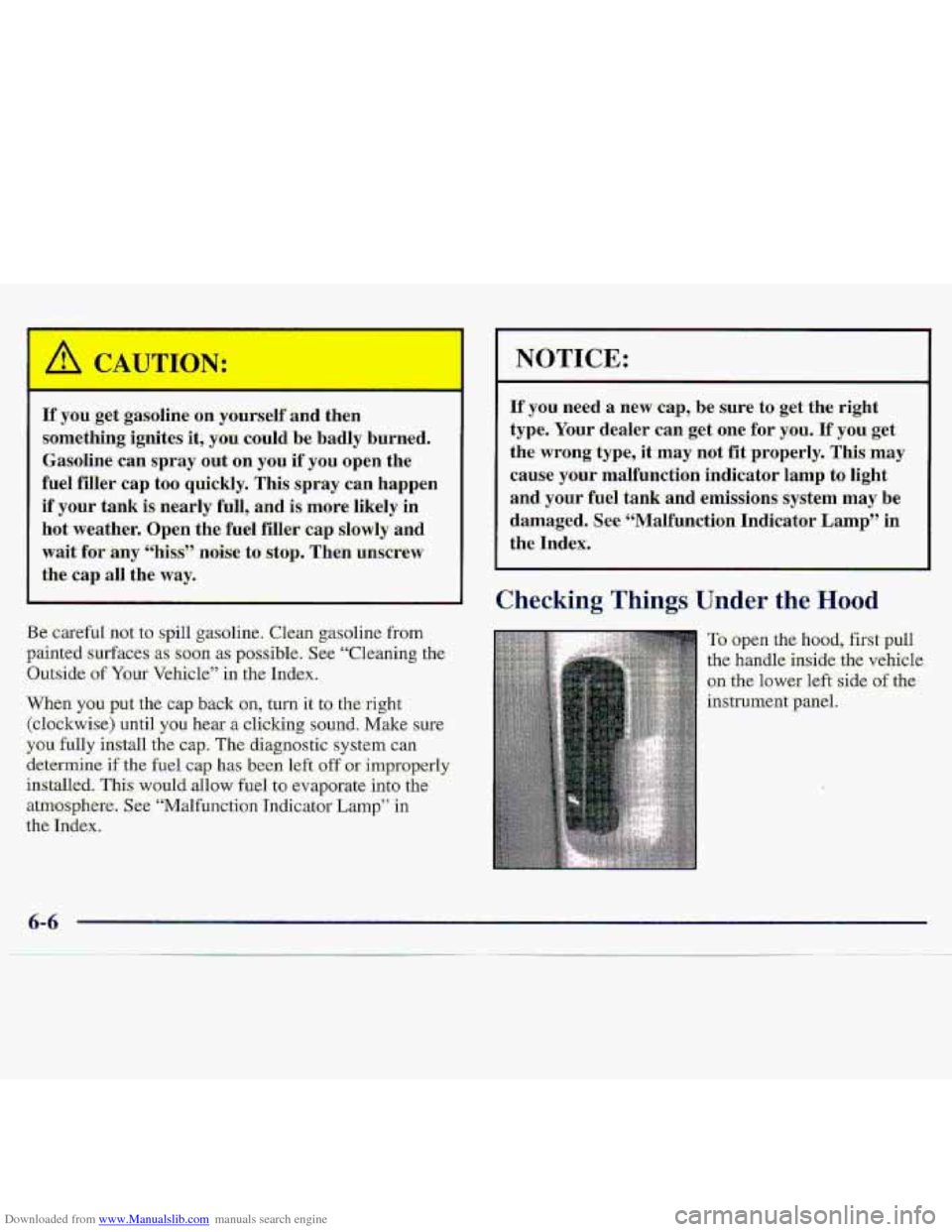
Checking Things Under the Ho
To open the hood, first pull
the handle- inside the vehicle
on the lower left side of the
instrument panel.
Page 248 of 402
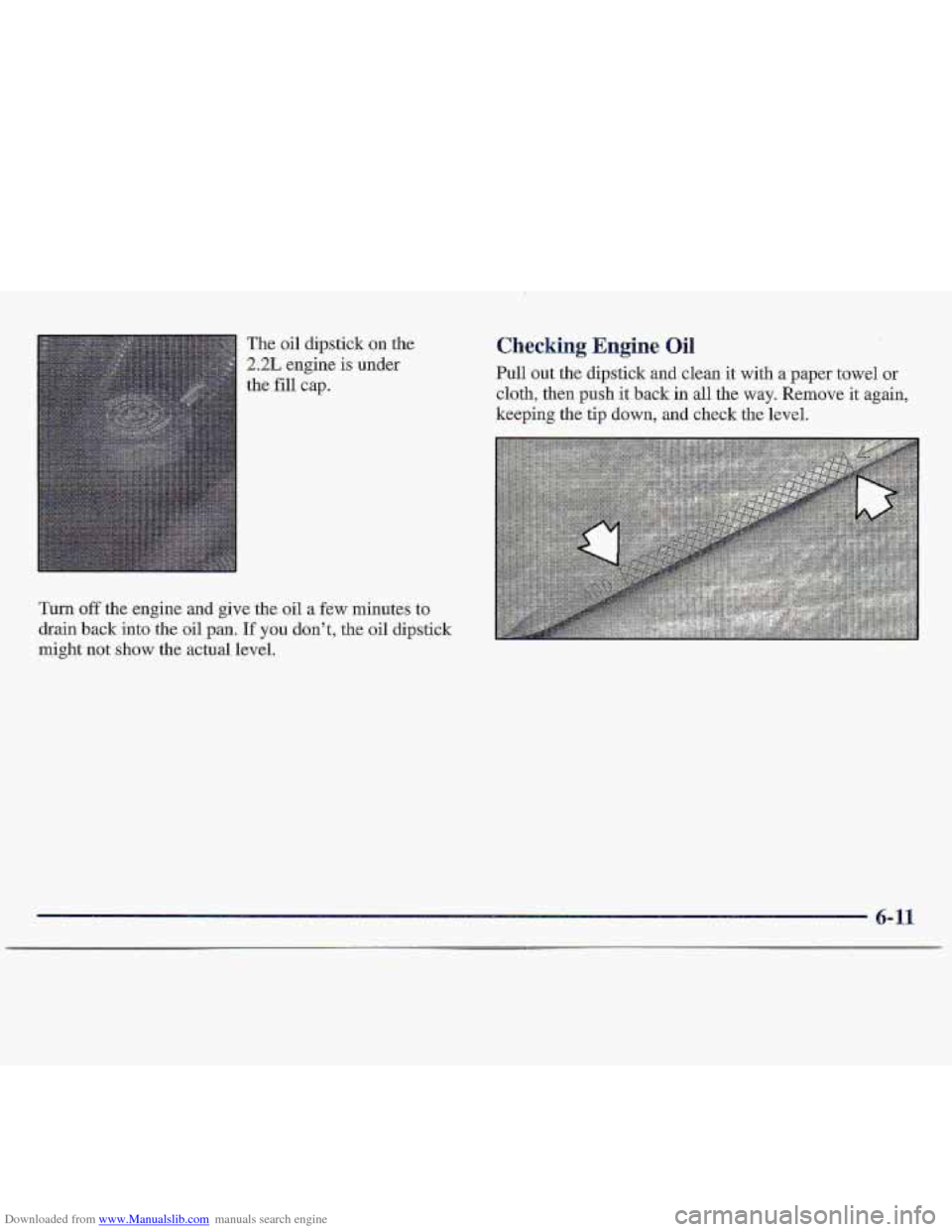
Downloaded from www.Manualslib.com manuals search engine The oil dipstick on the
2.2L engine is under
the
fill cap.
Turn off the engine and give the oil a few minutes to
drain back into the oil pan.
If you don’t, the oil dipstick
might not show the actual level.
Checking Engine Oil
Pull out the dipstick and clean it with a paper towel 01-
cloth, then push it back in all the way. Remove it again,
keeping the tip down, and check the level.
Page 254 of 402
Downloaded from www.Manualslib.com manuals search engine When to Check and Change
.A goad time to check-your a0tomati.c transmission fluid
level is when the en.gine .oil is chanzed,
C.hange
both the fluid an.d filter every 50,000-miles
(8'3 000 km) if the vehicle is mainly driven under one or
more of these conditions:
In heavy city traf€ic where the-outsi.de. temperature
regularly reaches.
906F (.32'C) or higher.
In hilly or mountainom terrain.
0 When doing frequent trailer towing.
0 Uses. such as found in taxi, police or delivery service.
If
you do not use your vehicle under any of the-se
cqnditions, the fluid and filter do not require changing.
See "Scheduled Maintenance Services"
in the Index,
How to Check
B.eCanse this operation can be a little difficult, you
may cho.Oge to have this dme at your GM de-alership
Service
Department
If you do it ywrsiAf, be sure to follow all the instruaims
here, uryclu coukd get a false re.adirig on the dipstick.
NOTICE:
Too much or too little fluid can damage- your
transmission,
TQO much can mean that s.ome of
the fluid could come out and fall on hot engine
parts or exhaust system parts, starting a fire. Be
sure to getan accurate reading if .you .check .your
transmission fluid.
Wait &t least.30 minutes before checking the
transmissioil fluid
level if.you have been driving:
* When ou&ide te:mperatures ar~ above 9C>-'F (32 O C).
0 At high spe>ed fbr.quite-.a while.
0 Tn'heavy traffic -- especidly in hot weather.
While pulling
a. trailer:
To -get the right reading, the flui,d'should be at dermal
operating temperature, which- is 1:80."F to 208°F
(82QG to 33°C).