1997 CHEVROLET S10 check engine
[x] Cancel search: check enginePage 150 of 402
Downloaded from www.Manualslib.com manuals search engine * Check your mirrors, glance over your shoulder and.
start your left lane change
signal before-moving out
of the right.lane to pass. When you are far enough
ahead
of the passe.d vehicle to see its front in your
inside -01, activate your right lane change sigmd
and-move back into the.
ri,ght lane. (Remember that
your-right outside ,mirror is convex. The vehicle you
juslpassed may
seem to be farther away from y6u
than it really is.)
Tfy not co p.ass mufe ,than one vehicle ,at a time
on two-lane’roads. Reconsider before passing the
next vehicle.
D.on’:t overtake-.a slowly moving vehi-de too rapidly.
Even though
the brake -1amp.s are not flashing, it m.a.y
be slowing down or starting to, turn.
Qi If+ you’re being .passed, make it easy- for the
fallowing driver to
get..ahead .of you. Perh,aps you
can ease.&
little to the right.
Let’s review what driving expmts s-ay about what
happens when the thre.e
con.trol systems- (brakes., steering,
and,acceleration) don’t
have enough friction where the
tifes ”meet the road to do what the drivt?r has asked..
In any emergency, don’t give up Keep trying to
steer and constantly seek
an escape route-or aea of
less danger.
In a. skid, a driver cn lose control of .the vehicle, Defensive
drivers .avoid
most skids by taking reasonable care suited t9
existing conditiolrs, and by not “overdriving” those
conditions.. But- ,&ids
are always -pa.ssible.
The three typcis of skids correspond to your vehicle’s
three
c’0ntro1 syst,erns. In. the. brakifig skid, y0.m whe.eIs
aren’t rpl.ling. Ln the steering or- cornering skid, too
much speed or steering in a curve causes tires: to slip and
lase cornehg, foxce,. And. in the acceleration skid, too
much throttle causes the driving wheels- to spin.
4-13
Page 166 of 402
Downloaded from www.Manualslib.com manuals search engine After Off-Road Driving
Remove .any brush. or debris th.at has collected an. the-
underbQdy, chassis
or under the hood. These
accu.mulation-s
can be a fire hazard.
After
operation in mud or. sand, have the br&e linings-
cleaned -and checked. These substances can cause
glazing- and uneven braking,. C,heck tihe, body struc.ture,
steerbig, su$pensioonj
wheels, tires .-and exhaust system
for damage, Also, check the file1 lines and cooling
system for any leakage.
Your vehicle will req.uire more frequent service due to
aff-rrrad
use.. Refer to the Maintenance Schedule fo,r
additional infofmation.
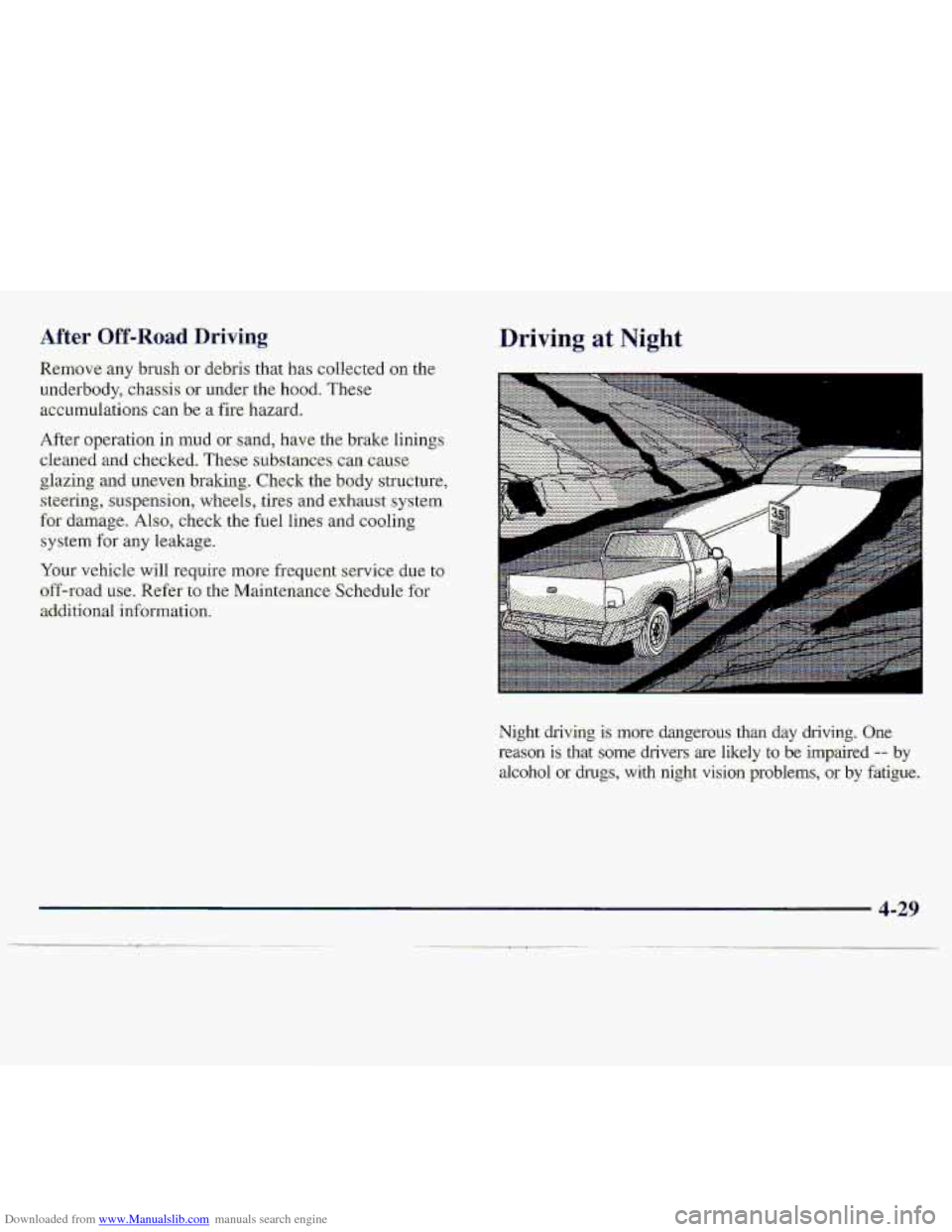
.Driving at Night
Night driving is more dangerous th-an day driving. One
reason is that some drivers are likely to be impaire-d -.- by
alcohol or drugs, with nieht vision broblems, or by fatigue.
4-29
Page 171 of 402
Downloaded from www.Manualslib.com manuals search engine C.ity Driving.
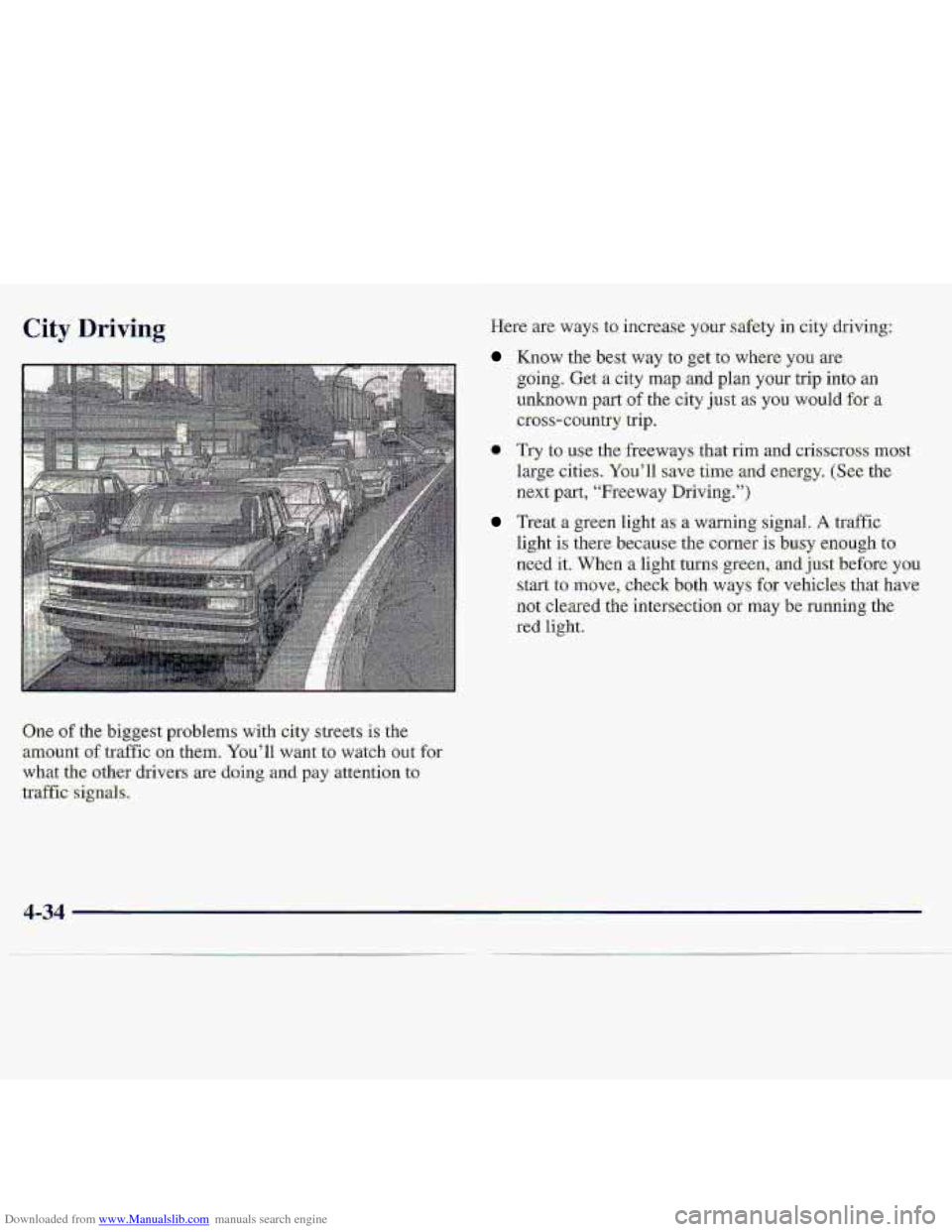
Orkof the bigg.est problems with city streets is the
:amount of traffic on them. You’ll want to watch o.ut for
what the other drivers are doing and pay attention to
traffic -.signals.
Here -are ways to increase y.ou safety in city driving.:
.Know the best way to get to where you are.
going, Get a city map and plan your trip into an
unknown part .of the city just as you wo.uld for a
cross-country trip.
m Try to use the freeways that-rim and.erisscr.oss mmst
large &tie-s. You’ll save time -and energy (See. the
next part, “Freeway Driving.”)
Treat a green light as a warning signal. A traffic
ligh.t-is there because the corner is busy emugh to,
need it. When a light turns gre,en, and just before you
start to Iimve, check both ways for vehicle-s that have
not cleared the intersection Or may be running the’
red li-ght.
4-34
Page 172 of 402
Downloaded from www.Manualslib.com manuals search engine Freeway Driving At the &irrance, there is usually a ramp that leads to the
freeway.
If you have a clear view of the freeway as you
drive along the entrance ramp, you should. be.gin to
check traffic. Try to determine where
you exp.e.ct to
blend with the flow. Try to merge iritd the gap at close to
the prevailing sp%eed. Switch on your turn signal, check
your mirrors and glance over your shoulder as often as
necessary. Try to blend smoothly with the, traffic flow.
Once
you are on the freeway, adjust youspeed to the
posted
limit or to the prevailing rate if it’%$Qwqq Stav
in the right lane uniess you want’to pass.
Before changing lanes, check y0u.r mirrors. Then use
your turn signal.
Just before you leave the-lane; glance. quickly over your
shoulder,
to make-sure there-isn’t another vehickin your
“blind” spQt.
Once you are moving
on the freeway, make certain you
allow a reasonable fdhwing distance. Expec-t to move
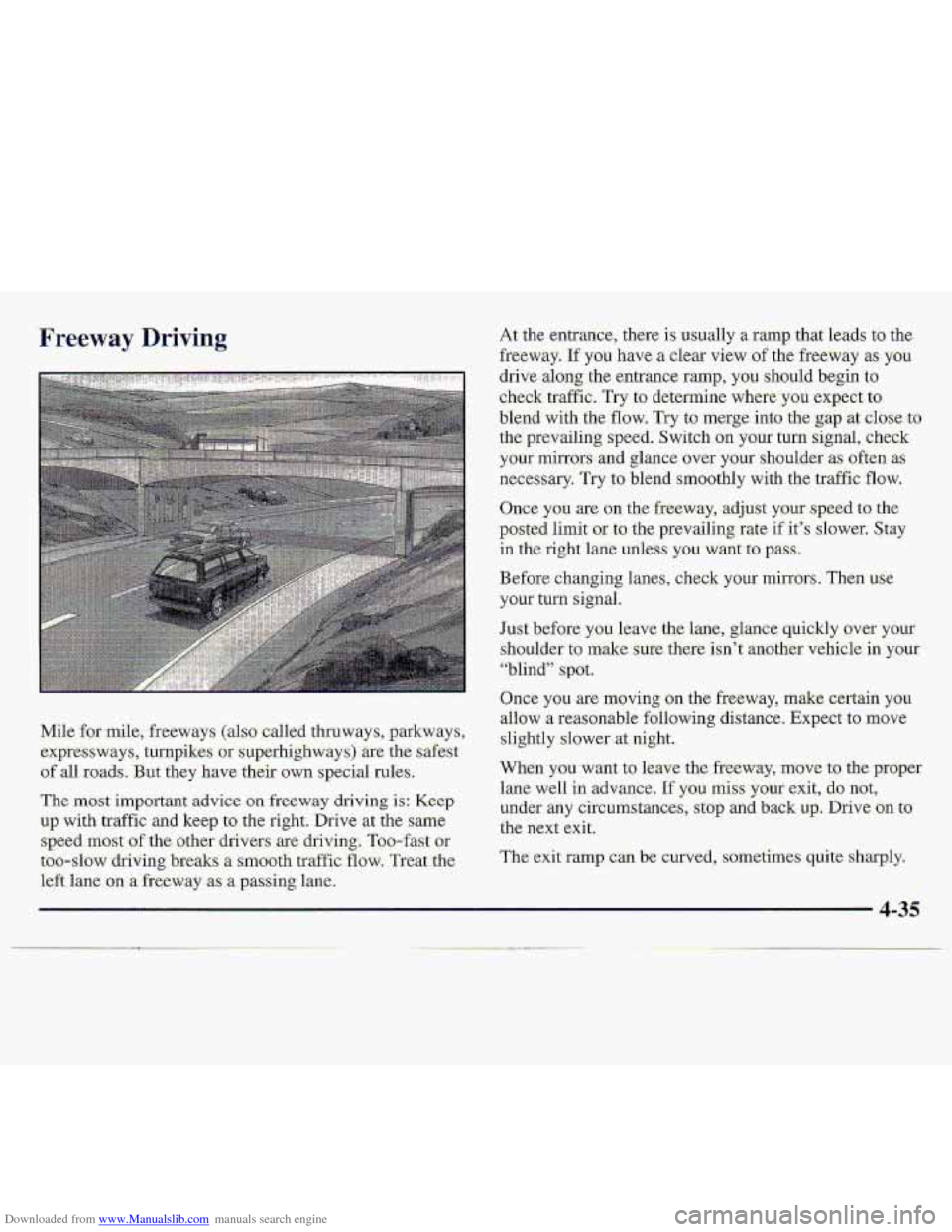
Mile fox mile, freeways (also called thruways, parkways, at night.
expressways, turnpikes or superhighways) are the safest
of-all roads. But they have- their own special rules,. When you want to leave the:freeway, move to the-proper
The most important advice on freeway-driving is: Keep under any circumstances, stop and back up, D~.~~ on to
up with traffic and keep to the right. Drive at the sam-e
s-peed .most of the other -drivers are dri.ving; Too-fast gr
too-dow driving. brek a smooth traffic flow. Treat .the The exit ramp can be curved, sometimes quite sharply.
left
lane on a fr-eeway as a passing lane. lane well
in advance. If you
miss your exit, do not,
the
next exit.
Page 175 of 402
Downloaded from www.Manualslib.com manuals search engine If you drive regularly in steep country, or if you're
planning to visit there, here are some tips that can make
your trips safer-and more enjoyable. (See "Off-Road
Driving" in the Index
for information ab.out driving
off-road.)
Keep your vehicle in good shape; Check all fluid
levels and
also the brakes, tires, cooling system and
transmission. These pqrts
@a work hard on
mountain roads.
Know how to go down hills. The most important
thing
to 'know is this: let: your engine do. some of the
slowing. down. Shift
-to a lower gear when you go
down
a steep or long hill.
If you .don't shift down, your brakes could get
so hot that,they wouldn't work well. You would
then have
po.or braking or even none going
down
a hill. You could crash. Shift down to let
your engine assist your brakes .on a steep
downhill
slope.
I
Coasting downhill in NEUTRAL (N) or WILII the
ignition
off is dangerous. Your brakes will have to
do all the work of slowing down. They could get so
hot that they wouldn't work wen. You would then
have poor braking
or even none going down a hill.
You could crash. Always have your enbe running
and your vehicle in gear when you go downhill.
Know how to go uphill. You may want to-shift down
to a lower gear. The lower gears help cool your engine
and transmission, and you can climb the hill better.
Stay in your own lane when driving on two-lane
roads
in hills- or mountains. Don't swing wide or cut I
across the center-of the road, Drive at speeds that let
-you stay in your own lane.
As YOU go over the top of--a hill, be alert. There could be
something in your lane, like a stalled car or an accident.
YQU may see highway signs an mountains that warn of
special problems. Examples are long grades, passing or
no-passing zones, a falling rocks area or winding
roads. Be alert to these and take appropriate action.
4-38
Page 179 of 402
Downloaded from www.Manualslib.com manuals search engine Snow can trap exhaust gases under yo.ur vehicle.
This.can cause
deadly CO (carbon rncmoxide) gas
to get: inside. CO could overcome you and kill
you.
'You can't .see it or smell it, so you might not
know it is in your vehicle. Clear away snow from
aruund the. base of your vehicle, especially any
that
is blocking your exhaust pipe. And check
around again
from time to time- to be.sure snow
doesn't col1ect:there.
Open a window just a, little on the side of the
vehicle that% away
froin the wind. This will help
keep
CO out.
Run your engine o111y as long as you h~ust. This s&veS-
fu.eL When you run the engine, make it g.-a little faster
than just idle. That is, push. the, accelerator..slightIy. This
uses less fuel far the heat that .you get and it keeps- the.
battery
charg.ed. You willl neecia well-charged battery 'to
restart the vehicle, and possibly for signaling later an
with. your headamps.. Let the heatex run for a while.
Then,. shut the-engine off and dose the window almost
all the way to' p&erve the heat. Start the e.ngine again
and repe.at
.this only when you feel ceally qxkbmfortable
from the cold. But. do it as little as possible, Preserve the
fuel as- long- as you can. To help keep warm, you can get
out of the vehicle. and do some .faidy vlgorous -exercises
every half how os so until help comes.
Page 193 of 402
Downloaded from www.Manualslib.com manuals search engine When. you tow a tixiilkr, y-our vehicle ha.s to’have extra
wiring :and a- heavy-duty turn signal flasher. (included in
the- optional trailering package).
The arrows-on your instrument panel will flash
whenever.
you signal a turn 01- 1-me. change, Properly
hooked .up, the &&la lamps will also flash, telling other
drivers you’re
about to :turn, change lanes or stop.
When towing a:txailer,
the. arrows. on your hstrument
panel will flash for turm even if the bulbs on the trailer
are burned out. Thus, you may think drivers behind you
axe seeing your signal when they arenot. ICs important
to check. occasionally to.be sure- the trider bulbs are.
still working.
Driving On .Grades
Reduce speed and shiftlo dower. ge.ar. ,befure you start
dawn B long -or steep downgrade. If-you do-n’t shift
down,
you might have to use your brakes wmuch that
they would
get hot and no longer work weIl.
If you have an.aut~~atic-transm~ssion, you should use
DRIVE (D) when towing a trailer. Operating your
vehicle in DRIVE @) when towing a. trail& will
Mze: heat:buiidup and merid the life af y.our
transmissioil. Qr, if you have, a-manu-ai transmission,
it’s
better not to use FIFTH (S), just drive in FOURTH (4)
(or, as you need to, a lower gew).
4-56
Page 195 of 402
Downloaded from www.Manualslib.com manuals search engine When You Are Re.ady .to Leave After
Parking on a Hill
1. Apply your regular brakes and hold the pedal down
while you:
Start your engine;
s.hift; int,o a.gear; and
.i Release tfie parking brake.
2. Let up dn the brake pedal.
3. .Drive slowly until the trailer- is ele-ar of-the chocks.
4. .Stop. and have someone pick up and store the chocks,
Maintenance W-hen Trailer Towing
Your vehicle will need service more. often when you're
-pullilig'.a trailer. Swthe Maintenance Schedule 'for more
on this. Things. that ar.e e.specizrlly import,at in trailer
operation
-axe automatic trmsrnission.fluid (don't
overfill),
engjne oil, axle lubricant, belt, cooling system
and brake adjustment.
Each of these is covered in this
manual, and the
Tndex- will help you find them. quickly.
If you're traileriqg, i-t's a go0.d i,dea to review these
sections before you start ,your trip ...
Check periodicailp t6 see-.th-at all hitch nuts and bolts
are -tight.
Trailer Wiring Harness,
'The -eight-wire harness is: stored under ysur vehicle
along the
rear frame crossmember. This hamess has a
30-amp feed wire with an inline fuse located by the
.junction block. It has no.cmnecttor .and should he. wired
by a qualified electrical technician. T.he .technician can
use the fullowing c~lor:c.ode chart when connecting the
-wiring harness IO yow trailer:
0
a
a
0
0
0
a
a