Page 243 of 402
Downloaded from www.Manualslib.com manuals search engine som-ething ignites it; y0.u could. be badly burned.
Gasoline
can spray out on you if you open the
fuel fiIler cap too quickly. This spray can happen
if your tank is nearly full, and is more likely in
hot weather. Open the fuel fiier cap slowly and
wait for;ang ‘ShW’ noise to stop. Then unscte-w
the cap all the way.
Be- careful .not to spill gasolina. C1e.m gasoline from
painted
surfaces-as- SOO~ as possible. Se-e “Clean-ing the
Out; e
o lam Vehicle” in- the Index.
When y0.u put the cap back on, twn it to the right
(clockwise) until you hear a cli.cking sound. Make sure
you -fully install the cap. The-dia.gn
determine if the E~1.d cap has b-e-e,n left off DX .impr.~pesly
installed,
This would-allow fud to evaporate into the
atmos.phere.
See “Malfunction Indicator Lamp” in
the Index,
NOTICE:
If y0.u need .a new cap, be sure to get the right
type. Your dealer ean get. one for you. If you $-et
the wrong type, itmay not fit properly. This-may
cause your rnalfunctiori indicator lamp to
li.ght
and your fuel tank and emissions. system may be
damaged. S;ee “Malfunction Indicator Lamp” in
the
Index.
Checking Things Under the Ho
To open the hood, first pull
the handle- inside the vehicle
on the lower left side of the
instrument panel.
Page 247 of 402
Downloaded from www.Manualslib.com manuals search engine Before cJosing the hood, he .sure- all the filler caps are on
properly. Thin lift the hood to. relieve pressure !on the
hood prop.
Remove: the hood prop: from the slot in the hood and
return the
prop to Zts reta.iner.
Then pull the hood down firmly to close. It wdl Iatch
when dropped from 10 to 1.<2 inches (25 to- SO cm)
without.pressing on th.e bod-
It’s a good idea to Cheek your- engine ‘oil-every time :you
get fuel. In order to get an accurate reading, the. o.iI must
.be warm and th.e vehicle ‘mu.st be an level ground.
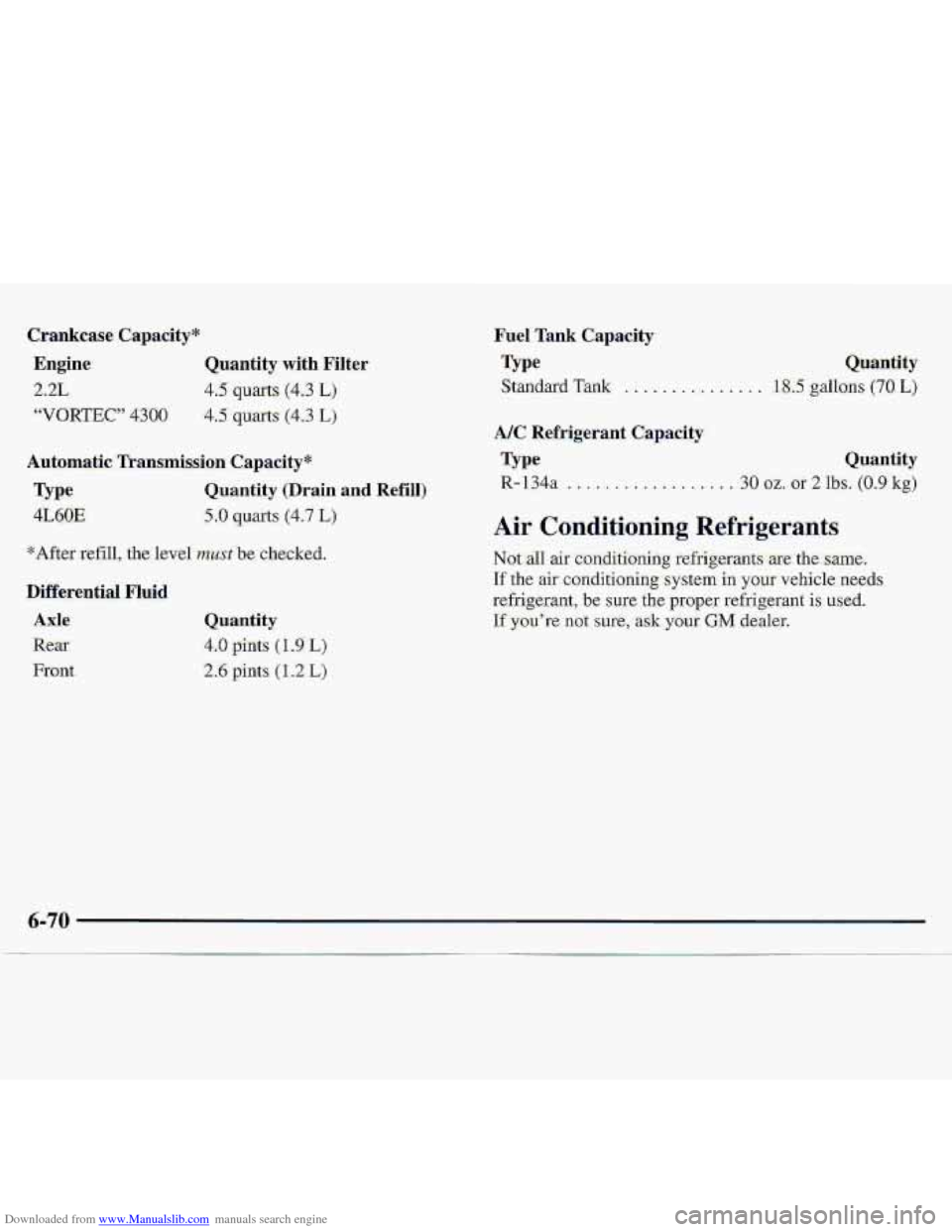
The oil dipstick ,on the
“VORTEC”4300eng~,eis
a yellow ring.
6-10
Page 250 of 402
Downloaded from www.Manualslib.com manuals search engine RECOMMENDED SA€ VISCOSITY GRADE ENGINE OILS
FOR BEST FUEL ECONOMY AND COLD STARTING, SELECT THE LOWEST
SAE
VISCOSITY GRADE OIL FOR THE EXPECTEO TEMPERATURE RANGE.
HOT
WEATHER
“F
+ 60
+ 40
+ 20
0
i
“(
- +3
- +2
~ +1
- $4
--7
--1
1 I
8
‘7
6
8-
LOOK
FOR THIS
SYMBOL
I- I I- SI
SAE 5W-30 PREFERRED
COLD
WEATHER
DO NOT USE SAE 2OW-50 OR ANY OTHER GRADE OIL NOT RECOMMENDED
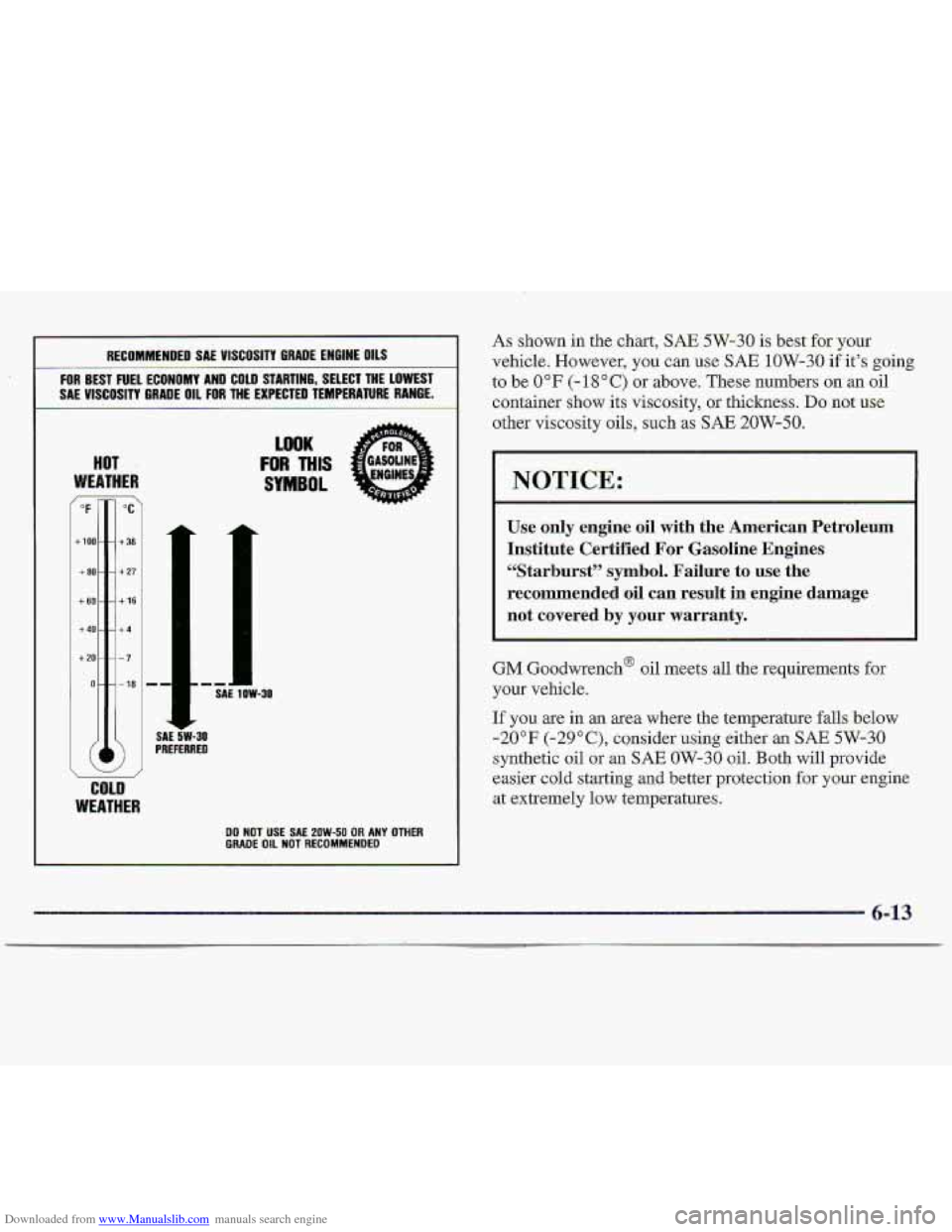
As shown in the chat, SAE 5W-30 is b.est for your
vehicle. However, you can use
SAE low-30 if it’s going
to be
0°F (- 18 “C) or above. These- numbers on an oil
container show
its viscosity, or thickness. Do not’use
other viscosity oils,
such as SAE 20W-50.
I NOTICE:
Use only engine oil with the American Petroleum
Institute Certified
For Gasoline Engines
“Starburst”
symbol. Failure to use the
recommended oil can result
in engine damage
not covered
by your warranty.
GM Goodwrench’ oil meets all the requirements for
your vehicle.
If you are in an area where,the temperature falls below
-20°F (-29°C)’ considerusing either an SAE 5W-30
synthetic oil or an SAE OW-30 oil. Both will provide
easier cold starting and better protection
for your engine
at extremely low temperatures.
6-13
Page 282 of 402
Downloaded from www.Manualslib.com manuals search engine Inflation -- Tire Pressure
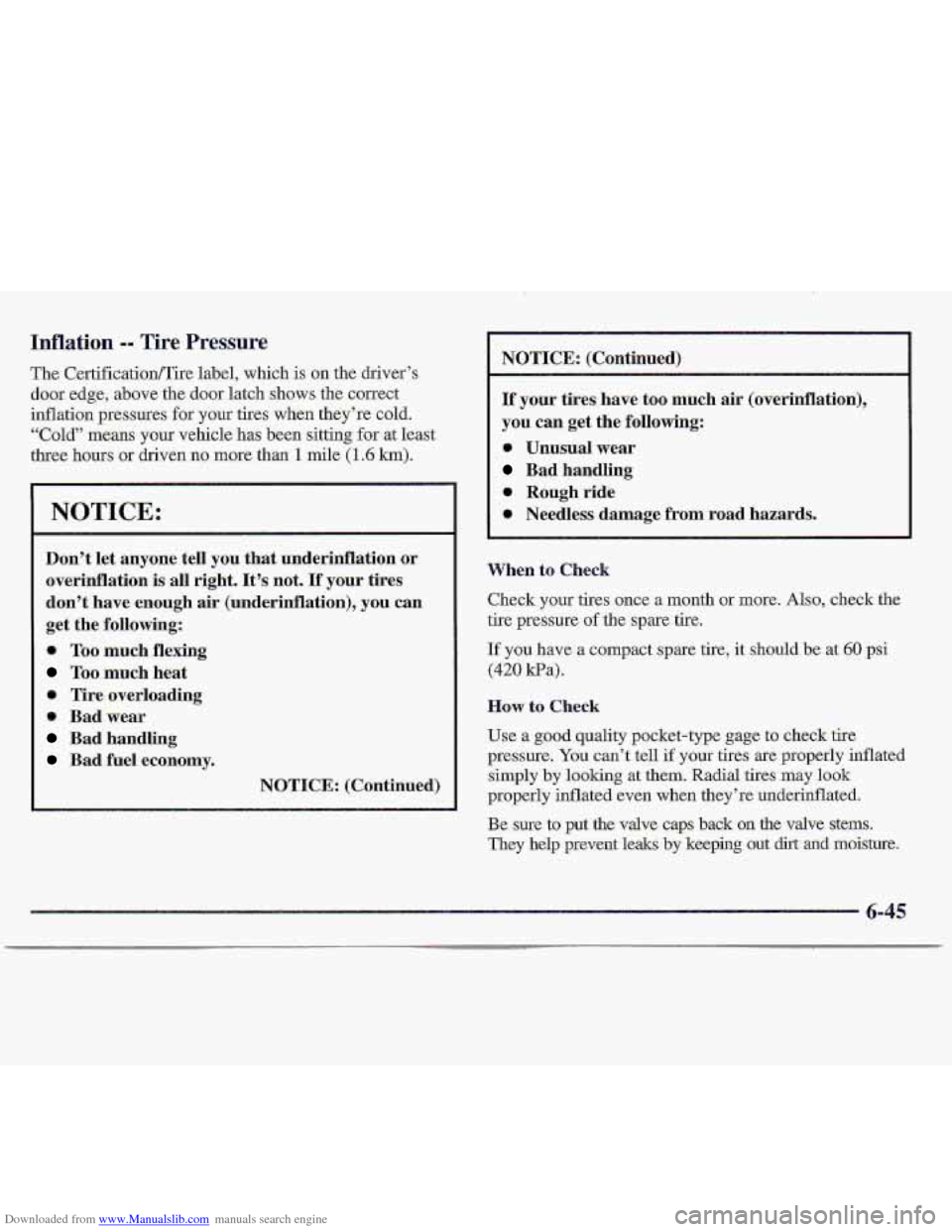
The CertificationlTire label, which is on the driver’s
door edge, .above .the door latch shows the correct
inflation pressures for your
tires when they’re cold.
“Cold” means your vehicle has been sitting
for at least
three hours
or driven no more than 1 mile (1.6 km).
NOTICE:
Don’t let anyone tell you that underinflation or
overinflation is all right. It’s not. If your tires
don’t
have enough air (underinflation), you can
get
the following:
Too much flexing
Toa much heat
@ Tire overloading
0 Bad wear
Bad handling
Bad fuel economy.
NOTICE: (Continued)
NOTICE: (Continued)
If your tires have too much air (overinflation),
you can get the following:
9 Unusual wear
Bad handhg
0 Rough ride
1) Needless damage from road hazards.
When to Check
Check your tires once a month or more. Also, check the
tire pressure
of the spare tire.
If you have a compact
spare tire, it should be at 60 psi
(420 kPa).
How to Check
Use a good quality pocket-type gage to check tire
pressure.
You can’t tell if your tires are properly inflated
simply by looking at them. Radial tires may
look
properly inflated even when they’re underinflated,
Be sure to put the valve caps back on the valve stems.
They help prevent leaks by keeping out dirt and moisture.
6-45
Page 307 of 402
Downloaded from www.Manualslib.com manuals search engine Crankcase Capacity* Engine-
2.2L
“VORT’EC” 43QO
Quantity with F-ilter
45 quarts (4.3 L)
4.5 quarts (4.3 L)
Automatic. Transmis$ion Capacity*
Type Quantity (Drain and Refill)
4L60E 5.0 quarts (4.7 L)
*After refill, the level nzmt be checked,
Dit’ferential Fluid
Axle
Rex
Front
Fuel Tank Capacity-
Type Quantity
Standard Tank . . . . I . . . + . . . . .1.8.5 gallons (79- L)
A/C ReSrigerant Capacity
Type Quantity
R-134.a . . . . . . . . . . . . . . . . . . 30 oz. or 2 lbs. (0.9kg)
Air Conditioning Refrigerants
Not :all air c.onditianidg refrigerants -me the. same..
If th,e air condi-tioning system in your vehicle needs
refrigerant,
be sure the proper reffigerant is- used.
If .. you’re. no.t mfkj ask your GM dealer.
6-70
Page 313 of 402
Downloaded from www.Manualslib.com manuals search engine Using Your Maintenance Schedule
The-proper fluids and lubicants to use are listed in.Part D.
Make sure whoever sezvic.es your vehicle uses these. All
parts should be replacedhnd all necessary repbs done
before
you Or af~ybne else drives the vehicle. ’
These schedules are for .vehicles that:
a
0
a
0
carry passengers and cargo with.in recommended
limits. You?will
find these limits on your velzich’s
Certifiication/Tire label. See “Loading. Your Vehicle”
in the Index.
are driven on reasonable-road surfaces within legal
driving limits..
.are drivec off-road
in- the -mmi%nended mer. See,
“Off-Road .Driving With-Your Four-Wheel-Drive
Vehicle” in the Index.
use the recommended fuel. See “Fuel“ in the Index.
Sekcting- the Right Schedul-e
First you’ll need to decide which ofthe two schedules is
right for YOU^. ire-hicle. Here’s how to decide which
schedule to follow:
7-4
Page 314 of 402
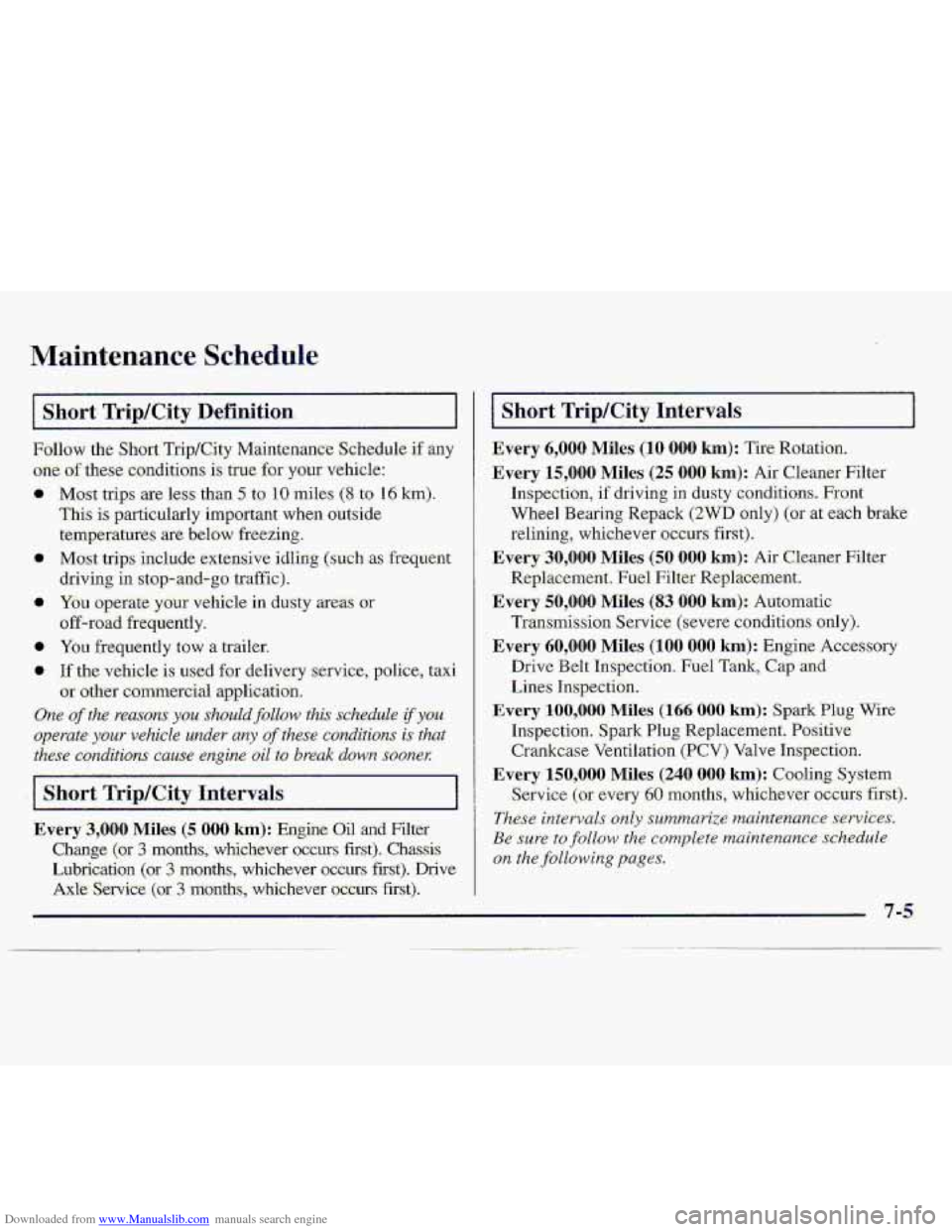
Downloaded from www.Manualslib.com manuals search engine Short Trip/City Intervals.
Every 6,000. Miles (10 QOO h): Tire Rotation.
Every 15,000 Miles (25 000 km): Air Cle-anel Filter
Inspection, if driving in dusty conditions. Front
Wheel Bearing Repack (2WD only) (orat each brake
relining, whichever occurs first).
Every 30,000 Milles (50 000 Bm): Air Cl,eaner Filter
Replacement.
Fuel Fi,lter Replacenient.
Every 50,008 Miles (83 0.84) km): Automatic
Transmission Service (sevexe conditions
only).
Every 60,000 Miles (I00 000 km): Engine Accessory
Drive Belt Inspection. Fuel
Tank, Cap and
Lines Inspection.
Inspection. Spark Plug Replacement. Positive
Crankcase Ventilation
(PCV) Valve Inspection.
Every ISO.,OOO Miles (240 000 km): Coo1in.g System
Service
(or every 60 months, whichever occurs first).
Th&se' intervals only surnfimrize maintenance x&rvkes.
Be sure to fcrllow the complete maintenance schedule
on the fulluwing-pages.
Every 100,000 Miles (166 000 km): Spark Plug-Wire
Page 315 of 402
Downloaded from www.Manualslib.com manuals search engine Maintenance Schedule
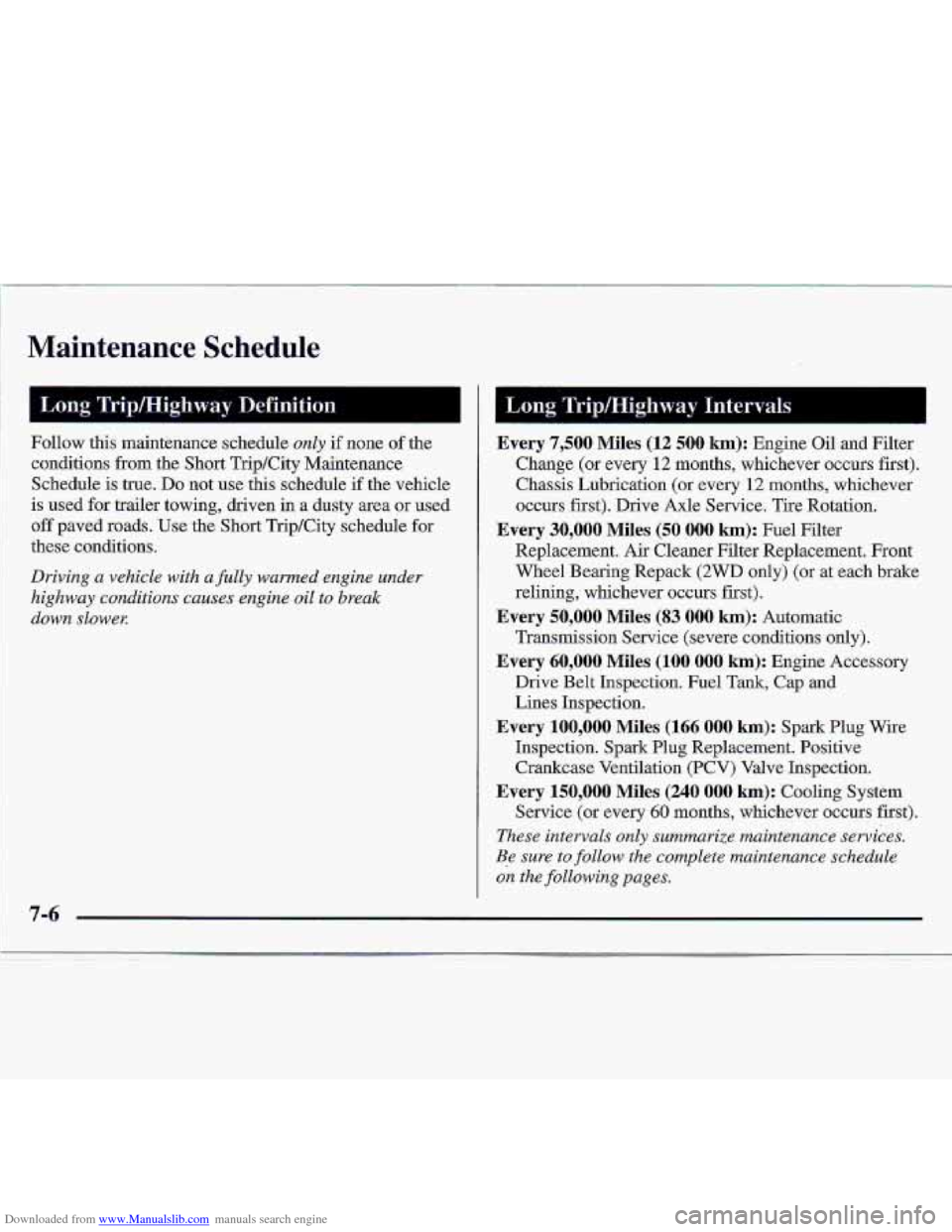
Follow this maintenance schedule only if none of the
conditions from the Short Trip/City Maintenance
Schedule is true.
Do not use this schedule if the vehicle
is used for trailer towing, driven in a dusty area or used
off paved roads. Use the Short Trip/City schedule for
these conditions.
Driving a vehicle with af.lly warmed engine under
highway conditions causes engine oil
to break
down slower,
~ - Long'T.l.ip/Hi-ghway Intervals
Every 7,500 Miles (12 500 km): Engine Oil and Filter
Change
(or every 12 months, whichever occurs first).
Chassis Lubrication (or every
12 months, whichever
occurs first). Drive Axle Service. Tire Rotation.
Replacement. Air Cleaner Filter Replacement. Front
Wheel Bearing Repack
(2WD only) (or at each brake
relining, whichever occurs first).
Transmission Service (severe conditions only).
Drive Belt Inspection. Fuel Tank, Cap and
Lines Inspection.
Inspection. Spark Plug Replacement. Positive Crankcase Ventilation (PCV) Valve Inspection.
Every 150,000 Miles (240 000 km): Cooling System
Service (or every
-60 months, whichever occurs first).
These intervals only summarize. maintenance services.
Be sure
to follow the complete maintenance schedule
on the following pages.
Every 30,000 Miles (50 000 km): Fuel Filter
Every 50,000 Miles (83 000 km): Automatic
Every 60,000 Miles (100 000 km): Engine Accessory
Every 100,000 Miles (166 000 km): Spark Plug Wire
7-6