Page 268 of 402
Downloaded from www.Manualslib.com manuals search engine Brakes
Brake Fluid
I
i
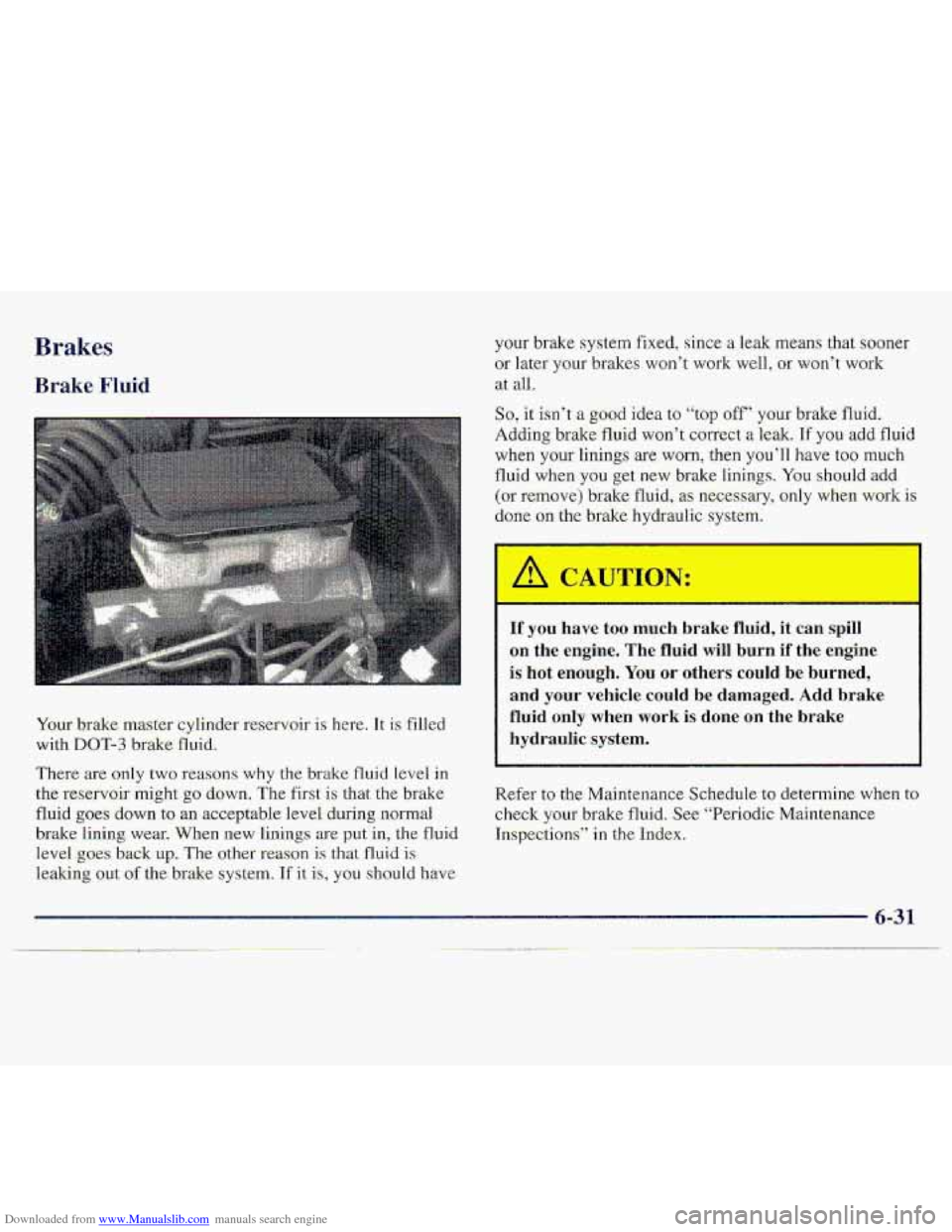
Your brake master cylinder reservoir is ha-e. It is filled
with DOT-3 brake fluid.
There .are only tw.0 reasons why the brake fluid level in
the reservoir might go down. The first is that, the brak.e
fluid goes. down to an acceptable level. :during normal
brake lining wear. When new lin-ings are put-in, the fluid
level goes back up. The other leason is that fluid is
leaking o.ut of the’brake system. If it is, you should lwve
your brake system fixed, since a leak means that so.oner
or later your brakes won’t work. well, or won’t work
at all.
So, it isn’t a good idea to “top off’ your brczke fl.uid.
Adding brake fluid won’t correct :a leak. If-you add fluid
when your linings are. worn: then you’ll have too snucl.1
fluid when you. get new brake linings. You should add
(or remove) b1-ake fluid, as necessary, only when work is
done on the brake hydraulic system.
I
If you have too much brake fluid, it can spin
on the engine. The .fluid will burn if the- engine.
is hot enough. You or others could be burned,
and your vehicle could be damaged. Add brake
fluid only when work is done on the brake
hydraulic @em.
Refel‘ to the Maintenance Schedule to determine when t.o
check your brake fluid. See “Periodic M.aintenance
Tnspection-s’”
in the Index.
Page 283 of 402
Downloaded from www.Manualslib.com manuals search engine Tire Inspection and Rotation
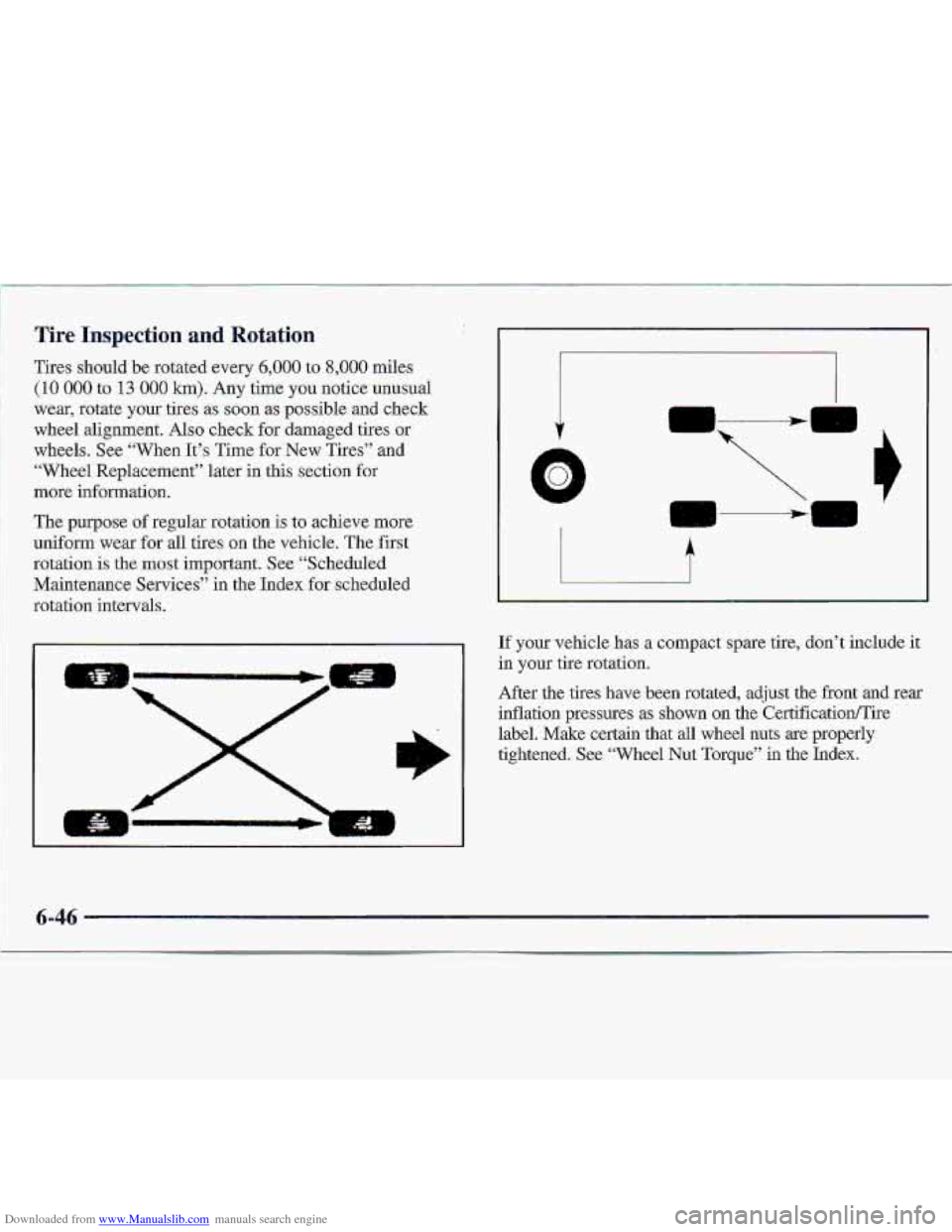
Tires should be rotated every 6,000 to 8,000 miles
(10 QOO. to 13 0.00 km). Any time you notice unusual
wear, rotate your tires
as soon as possible and check
wheel alignment. Also check for damaged tires or
wheels. See “When
It’s Time for New Tires” and
“Wheel Replacement” later in this section for
more information.
The purpose
of regular rotation. is to achieve more
uniform wear for
all tires on the vehicle. The first
rotation is the mast important. See “Scheduled
Maintenance Services”
in the Index for scheduled
rotation intervals.
If your vehicle has a compact spare tire, don’t include it
in your tire rotation.
After the tires have bea rotated, adjust the front
and rear
inflation. pressures
as shown on the Certificatioflire
label. Make certain that all wheel nuts
are. properly
tightened. See “Wheel Nut Torque” in the Index.
6-46 ,,,. .. -~I
Page 310 of 402
Downloaded from www.Manualslib.com manuals search engine Section 7 Maintenance Schedule
This section COV~TS the mainten-awe required. for your vehicle. Your vehicle ;ntxxts-tBese services to retain its safety,
dep.enclability and emission .control performance.
7-2
7-4
7-5
7 -5
7.-6
7 -6
Ilztroducitisn
Part A.: Scheduled Maintenmee Services
Short Trip/City
Defiiiition
Shmt TTip/City Intervals
Long, T~ip/Highway Definition
.Long Trip/Highway Intervals
7 -7
7-37
7-58
7-60
7-63
Short Trip/City Maintenance Schedule
Long. Trip/Highway Maintenance Schedule
Part C: Pefiodh5Maintenmc.e Inspectibas
Part D: Ret-ommended Fluids
and Lubricants
Part E: Maintenance Recard
74
Page 312 of 402
Downloaded from www.Manualslib.com manuals search engine H0.w This Section is Organized
The remainder of this section is divided into five parts:
“Part A: Scheduled Maintenance Services’’ shows
what to have done and .how often. Same of thse
services can be complex, Scj unless you are.technic.ally
qualrfied
and have the necessary equipment, you should
let your dealer’s. servic,e department or another qualified
service cent6r
do these jobs.
Pef.farming maihtexiance work on a vehicle c.an
be dange:rous.. In trying t.0 do s.ome jobs,.you .c.an
be :seriously injured.. Do ,your own maintenance
work. only if you have the required. know-how
and the proper-tools and equipment for the job.
If you have aay doubt, have a qualX1ed
technician
do the work.
If y.0~ are skilled efiough to do so-me work an your
vehicle, you will probab1.y want to gel: the service-
information
GM publishes. See ‘“S-ervice .and. Owner
Publications” in the Index.
Page 313 of 402
Downloaded from www.Manualslib.com manuals search engine Using Your Maintenance Schedule
The-proper fluids and lubicants to use are listed in.Part D.
Make sure whoever sezvic.es your vehicle uses these. All
parts should be replacedhnd all necessary repbs done
before
you Or af~ybne else drives the vehicle. ’
These schedules are for .vehicles that:
a
0
a
0
carry passengers and cargo with.in recommended
limits. You?will
find these limits on your velzich’s
Certifiication/Tire label. See “Loading. Your Vehicle”
in the Index.
are driven on reasonable-road surfaces within legal
driving limits..
.are drivec off-road
in- the -mmi%nended mer. See,
“Off-Road .Driving With-Your Four-Wheel-Drive
Vehicle” in the Index.
use the recommended fuel. See “Fuel“ in the Index.
Sekcting- the Right Schedul-e
First you’ll need to decide which ofthe two schedules is
right for YOU^. ire-hicle. Here’s how to decide which
schedule to follow:
7-4
Page 314 of 402
Downloaded from www.Manualslib.com manuals search engine Short Trip/City Intervals.
Every 6,000. Miles (10 QOO h): Tire Rotation.
Every 15,000 Miles (25 000 km): Air Cle-anel Filter
Inspection, if driving in dusty conditions. Front
Wheel Bearing Repack (2WD only) (orat each brake
relining, whichever occurs first).
Every 30,000 Milles (50 000 Bm): Air Cl,eaner Filter
Replacement.
Fuel Fi,lter Replacenient.
Every 50,008 Miles (83 0.84) km): Automatic
Transmission Service (sevexe conditions
only).
Every 60,000 Miles (I00 000 km): Engine Accessory
Drive Belt Inspection. Fuel
Tank, Cap and
Lines Inspection.
Inspection. Spark Plug Replacement. Positive
Crankcase Ventilation
(PCV) Valve Inspection.
Every ISO.,OOO Miles (240 000 km): Coo1in.g System
Service
(or every 60 months, whichever occurs first).
Th&se' intervals only surnfimrize maintenance x&rvkes.
Be sure to fcrllow the complete maintenance schedule
on the fulluwing-pages.
Every 100,000 Miles (166 000 km): Spark Plug-Wire
Page 315 of 402
Downloaded from www.Manualslib.com manuals search engine Maintenance Schedule
Follow this maintenance schedule only if none of the
conditions from the Short Trip/City Maintenance
Schedule is true.
Do not use this schedule if the vehicle
is used for trailer towing, driven in a dusty area or used
off paved roads. Use the Short Trip/City schedule for
these conditions.
Driving a vehicle with af.lly warmed engine under
highway conditions causes engine oil
to break
down slower,
~ - Long'T.l.ip/Hi-ghway Intervals
Every 7,500 Miles (12 500 km): Engine Oil and Filter
Change
(or every 12 months, whichever occurs first).
Chassis Lubrication (or every
12 months, whichever
occurs first). Drive Axle Service. Tire Rotation.
Replacement. Air Cleaner Filter Replacement. Front
Wheel Bearing Repack
(2WD only) (or at each brake
relining, whichever occurs first).
Transmission Service (severe conditions only).
Drive Belt Inspection. Fuel Tank, Cap and
Lines Inspection.
Inspection. Spark Plug Replacement. Positive Crankcase Ventilation (PCV) Valve Inspection.
Every 150,000 Miles (240 000 km): Cooling System
Service (or every
-60 months, whichever occurs first).
These intervals only summarize. maintenance services.
Be sure
to follow the complete maintenance schedule
on the following pages.
Every 30,000 Miles (50 000 km): Fuel Filter
Every 50,000 Miles (83 000 km): Automatic
Every 60,000 Miles (100 000 km): Engine Accessory
Every 100,000 Miles (166 000 km): Spark Plug Wire
7-6
Page 316 of 402
Downloaded from www.Manualslib.com manuals search engine Short Trip/City Maintenance Schedule
+ A good .time. to check your’ brakes is during tire
rotation.
See: “Brake System Inspection” under “Periodic
Maintenance Inspection” in Part C of this schedule,
** Drive axle setvice (see “Recommended Fluids ,and
Lubricants” in the Index for proper lubricant
to use):
0
0
‘Locking Differenti,al -- .Drain fluid. and refill at first
engine oi€ change.
At- subsequent oil Changes, check
fluid level and add fluid as neede.d.. If driving in
dusty areas or towing a trailer, drain fluid and refill
every
15,000 miles (25 000 km).
Standard .Differential -- Check fluid level. and. add
fluid as needed at every oil change If driving in
,dusty areas or towing a trailer, drain fluid and refill
every
15,000. miles (25 ‘000 km).
.More frequent lubrication may
be required for
heavy-duty or off-road use.